Unit 2 (Hiemler)
 Call Kai
 Learn
Learn Practice Test
 Spaced Repetition
 Match
Match Flashcards
 Knowt Play
1/50

There's no tags or description
Looks like no tags are added yet.
Name | Mastery | Learn | Test | Matching | Spaced | Call with Kai |
|---|
No analytics yet
Send a link to your students to track their progress
51 Terms
What areas were connected by the Silk Roads?
Connected China to Europe whole passing through Central Asia and Southwest Asia
What areas were connected by the Indian Ocean Trade Routes?
Connected East Asia with East Africa and had Southeast Asia, South Asia, and Southwest Asia all in between
What areas were connected by the Trans-Saharan Trade Routes?
North Africa and the Mediterranean Basin with Sub-Saharan Africa
How were the trade routes similar?
●All depended on the establishment of large states for their existence and flourishing. Best example: Mongol Control of the Silk Road which increased safety.
-when these trade
routes were well protected by large states in cooperation with one another, merchants felt safe to travel there
●All led to new innovations in navigational technology & helped spread it. Examples: the magnetic compass, lateen sail, the sternpost rudder, & saddles for camels and horses made trade along these routes far more manageable and profitable
●All led to shared culture. Examples: religions like Christianity, Islam & Buddhism spread by missionaries, monks, and marchants who all traveled the routes.
●All led to the spread of agricultural products. Example: Champa rice from Vietnam to China. Indonesian merchants introduced bananas from Southeast Asia to Africa, which lead to a large-scale migration of these bantu-speaking people
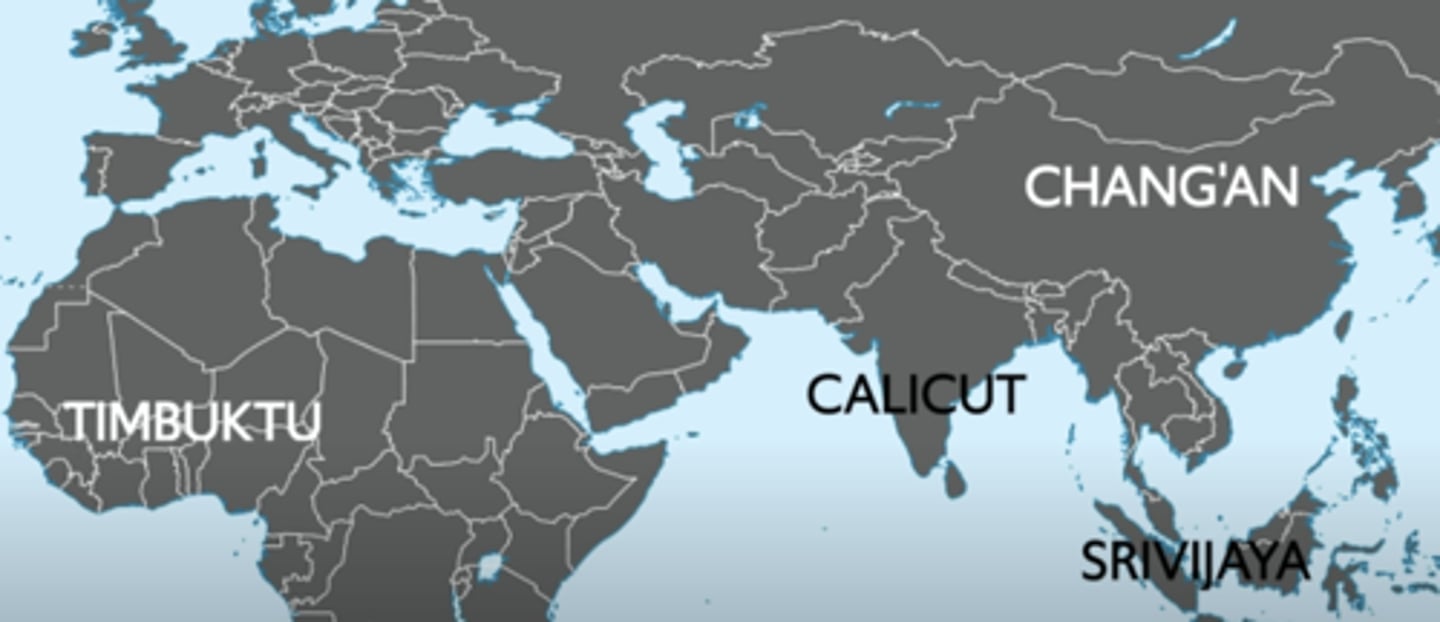
●All led to the growth of trade cities which formed because they were at the convergence of all those trading routes.
Examples:
-Chang’an in China (Silk Roads)
-Calicut in India &
-Srivijaya in Southeast Asia (Indian Ocean
-Timbuktu and Mali (trans-Saharan)
The effects of the growth of networks of exchange
-included the establishment of diasporic communities where merchants introduced their own cultural traditions into the indigenous cultures, and were affected by indigenous cultures.
-For example Arab and Persian communities in East Africa led to the growth of Swahili and the spread of Islam
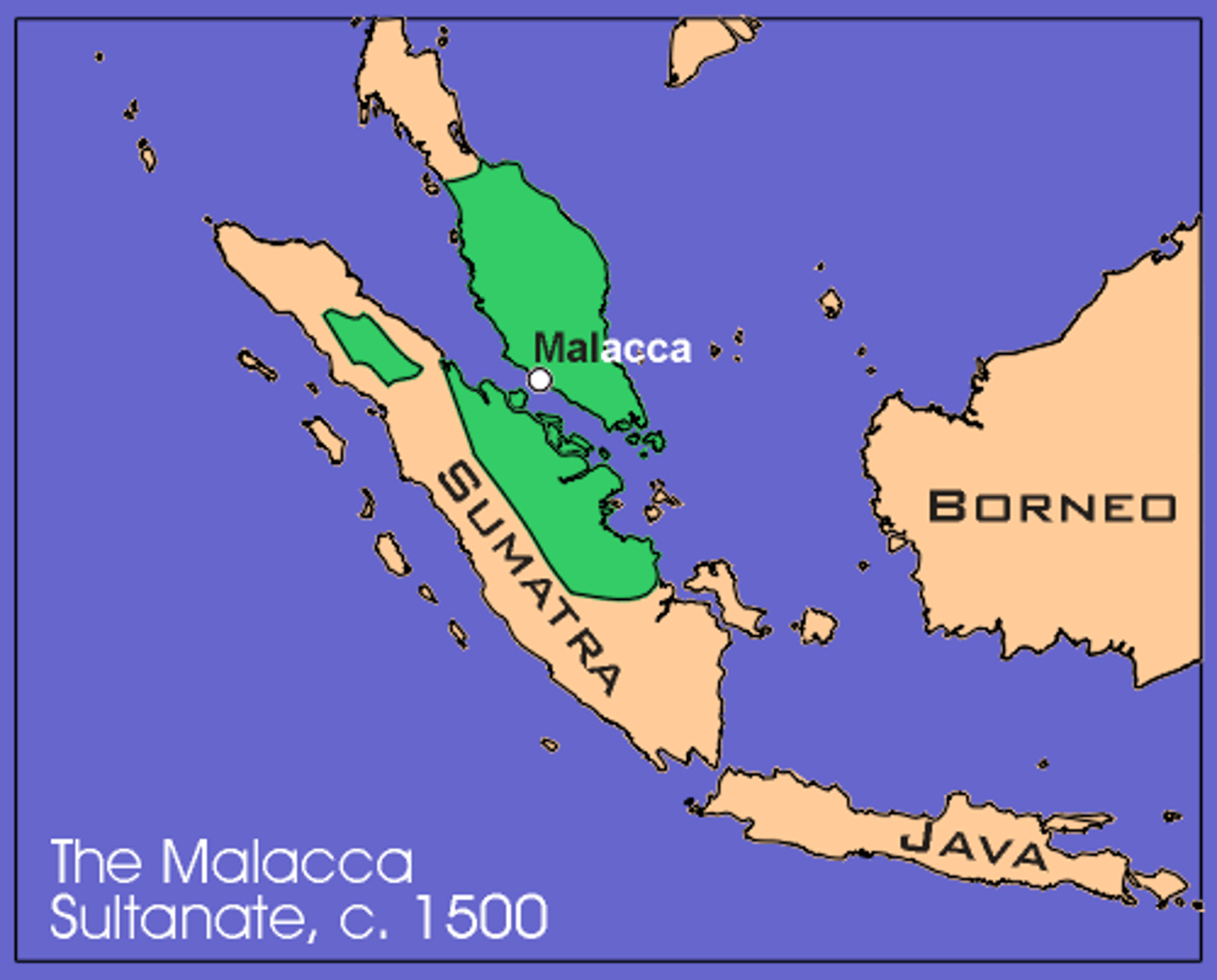
-Increased trade led to the growth of powerful new trade states (like the city-states of the Swahili Coast and the Sultanate of Malacca and cities
How were the trade routes different?
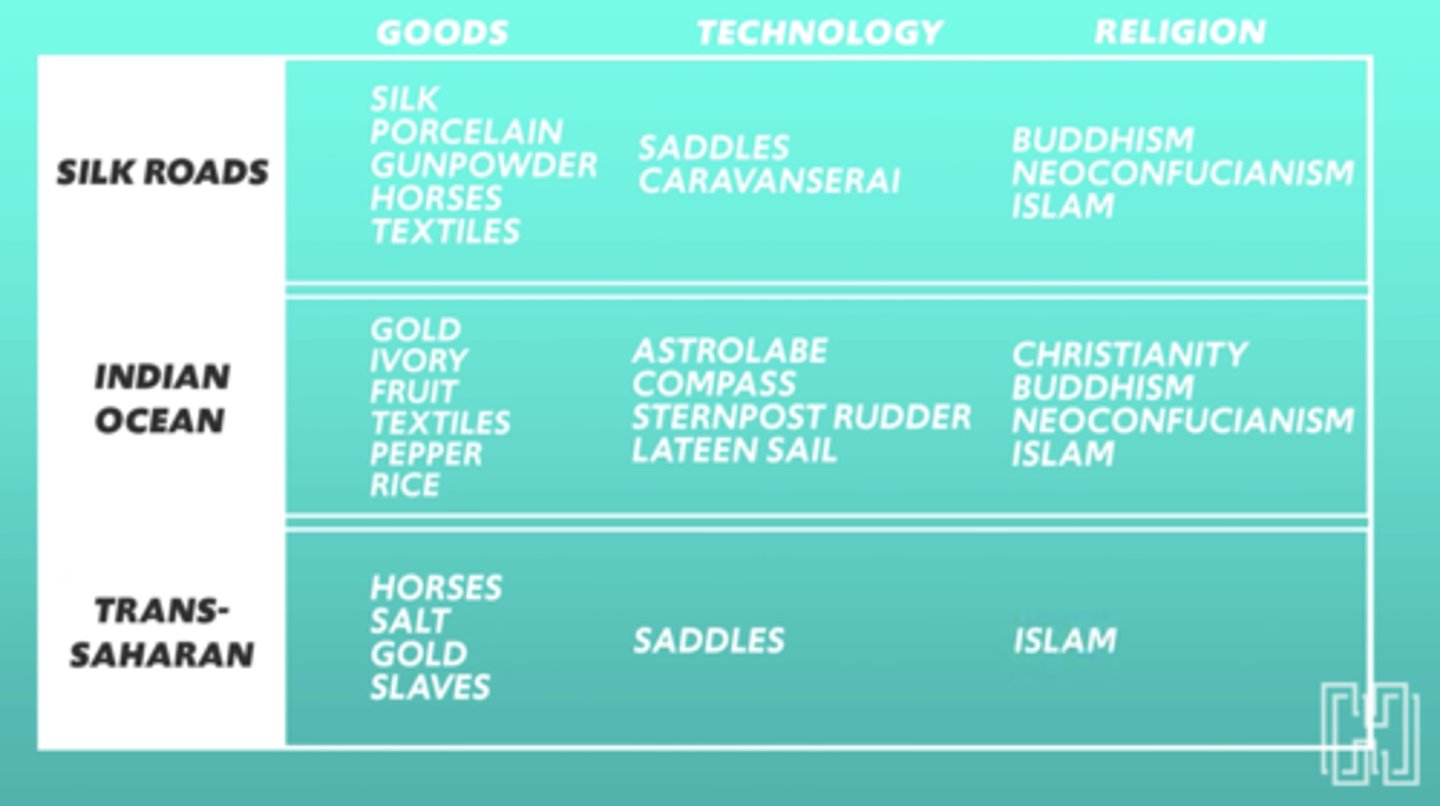
●Goods:
(different because each trading route had different conditions that require new technologies in order to facilitate trade; also not the same religions travelled across each route)
-Silk Road: Luxury goods like silk & porcelain, gunpowder, horses, textiles.
-Indian Ocean: Common goods & luxury goods like gold, ivory, fruit, textiles, pepper, rice.
-Trans-Saharan: horses, salt, gold, enslaved people.
●Technology:
-Silk Road: Saddles, Caravanserai (rest stops, spread out about a day's travel)
-Indian Ocean: Maritime technology like the astrolabe, magnetic compass, sternpost rudder, lateen sail
-Trans-Saharan: saddles
●Religion:
-Silk Road: Buddhism from South Asia to East & Southeast Asia. Neo-Confucianism from China to Japan, Korea & Vietnam. Islam from Southwest Asia to South Asia.
-Indian Ocean: Buddhism, Neo-Confucianism, and Islam here too, but also Christianity from Mediterranean Basin. -Trans-Saharan: Islam from Southwest Asia to North Africa and sub-Saharan Africa.
Effects of the Demand of Luxury Goods
-The demand for luxury goods led to Chinese, Persian and Indian artisans and merchants expanding their production of textiles and porcelains for export.
-In China the manufacture of iron and steel expanded as well.
Some other effects of technological innovations
-The technological innovations in previously existing transportation and commercial technologies help to explain the growth of interregional trade in luxury goods.
-They also led to increased volume of trade and expanded the geographical range of existing trade routes.
-On the Silk Road new forms of credit and money economies (a system in which money replaces barter in the exchange of goods) also increased trade, such as Bills of Exchange.
-Additionally with the development of money economies, like in China where paper money was being printed, trade became easier.
How did culture change due to connections on trade routes?
-Zen Buddhism (a new form of Buddhism, formed from Buddhism and Daoism) started in China and spread to Korea, Japan, and Vietnam.
-The creation of Swahili from Arabic and Bantu languages mixing in East Africa as Islam took root.
-The cultural effects of various networks of exchange in Afro-Eurasia led to the adoption of new religions as well as the blending of cultures due to diasporic communities
How were the writings of travelers on these trade routes influential?
-As exchange networks intensified, an increasing number of travelers throughout Afro-Eurasia wrote about their travels affecting the people who read them
-Ibn Battuta traveled Dar-al Islam and kept notes about the people he met.
-Marco Polo was a European who lived in China during the Yuan Dynasty.
-His book inspired many people to want to go to China to trade and advancements in mapmaking and cartography in order to get there
What were the environmental consequences of trade?
Environmental effects of trade: the spread of epidemics.
-Other than agricultural exchange, disease also spread.
-The Black Death (Bubonic Plague) started in China and spread along trade routes to the rest of Afro-Eurasia.
-It was especially deadly, sometimes killing up to 75% of populations.
-In Europe, due to worker shortages survivors gained more power and the ability to demand wages.
-Environmental causes of trade: The environment was also responsible for the development of trade networks.
-For example, in the Indian Ocean merchants continued to use their knowledge of monsoon winds to trade
Why is the Mongol Empire significant in World History?
Pastoralists created the largest land-based empire in world history!
-The Mongols help to explain the process of state building and decline in Eurasia.
-Their conquests took down Kievan Russia (1240), the Abbasid Dynasty (1258), and the Song Dynasty (1279).
-These were replaced by new imperial states including the Mongol Khanates.
Who united the Mongolian tribes and started their conquests?
Genghis (Chinggis) Khan
How did the Mongols revitalize trade on the Silk Road?
-Their conquests united the lands around the Silk Road and started the Pax Mongolica (Mongol Peace)
-The expansion of empires often influenced trade and communication over time.
-The Mongol conquests drew new people into their conquerors' economy and trade network.
What epidemic was spread most likely spread by the Mongols on the Silk Road?
The Black Plague
How did the Mongols impact new states after the demise of the Mongol Empire?
-New states had learned from their centralizing policies, and used many of the same techniques that the Mongols used to consolidate their own power.
-The Mongol Empire was significant to larger patterns of continuity and change.
-Interregional contacts and conflicts encouraged significant cultural transfers.
-An example of this would be the rise of Moscow in Russia which centralized power after the decline of the Mongols.
-They used Mongol administrative techniques, court rituals and military weapons.
What had the largest impact in the shaping of old cultures and the beginning of new cultures during this time period?
The major trade routes: the Indian Ocean Trade, the Trans-Saharan trade, and the Silk Roads
When did the Silk Roads flourish?
-Stretched all the way from China to Europe and into North Africa
-They have been in existence since 130 B.C. but worked best as a conduit of trade when empires controlled all the land across which they stretched
Ex:
-Roman Empire and Han China engaged in a robust trading relationship because they [basically] had all the land covered within their empires that the Silk Road was on
-When Mongols took over a vast swath of land, the trade routes flourished
What traveled along the Silk Roads
During prosperous times vast array of goods went across the continent along these routes [usually] packed into the saddle bags of a camel caravan
-however, most of these items were luxury goods as the cost of transporting them was too much over the long-distance
-King of these luxury goods was CHINESE SILK which originated in China ~3000 BCE
-Once people figured out how to make clothes from it the demand for silk spiked across upper class because it was considered a status symbol
Cultural transfers along the Silk Roads
These trade routes were also conduits of Culture (More significantly than trade)
-Buddhism spread throughout Central and East Asia [largely] because of the Buddhist merchants who had carried it there
-As the faith spread it changed both Inwardly & Outwardly
Outwardly:
-Original teachings of the Buddha rejected the material world as an illusion;
-however, the Buddhist monasteries (Buildings occupied by a community of monks living under religious vows) along the Silk Roads were recipients of lavish gifts from traveling merchants
Inwardly: Changes were [largely] doctrinal (a belief or set of beliefs held and taught by a Church, political party, or another group)
-the oldest (original) form of Buddhism was Atheist but a new form of Buddhism called Mahayana Buddhism developed and spread along the trade routes
-in which, the Buddha became a deity and there was an increased emphasis on compassionate works and the earning of merits (the quality of being particularly good or worthy, especially so as to deserve praise or reward)
-Across the continent in the Sogdian city of Samarkand (Middleman of Silk Roads and ancient Iranian city), the Buddhists incorporated Zoroastrian (Ancient Persian monotheistic religion where fire is an agent of ritual purity, and the associated purification ceremonies are considered the basis of ritual life) fire rituals into their devotional patterns
-Syncretism (fusion of diverse religious beliefs and practices) and change is happening to Buddhist faith as is spread
Spread of Disease along the Silk Roads
-One of the downsides of having different civilizations from different parts of the world connected is that they have a different disease, thus immunities developed and they figure ways to fight the diseases specific to their religion
-however, when those diseases find their way into a culture that can't cope (hasn't built up the immunity and developed ways to fight them), the results are disastrous
Ex:
-Black or Bubonic Plague: ~ ½ of Europe's population died between 1346 and 1348, which yielded similar results in China and Islamic world
-Death of this scale changed the entire course of history for these civilizations
Indian Ocean Trade Route
-Was the largest sea-based system of communication and exchange that ever existed until the 1500s (Age of Exploration, when people sailed the Atlantic Ocean)
-Stretched from China all the way into East Africa
-Was successful because of predictable yearly storms (Monsoons)
-In the summer, the winds blew predictably NE and in the winter it blew predictably SW
Led to significant maritime innovations:
-Magnetic compass: Allowed sailors to hold their bearing without sight of sun
-Astrolabe: Allowed sailors to calculate latitude
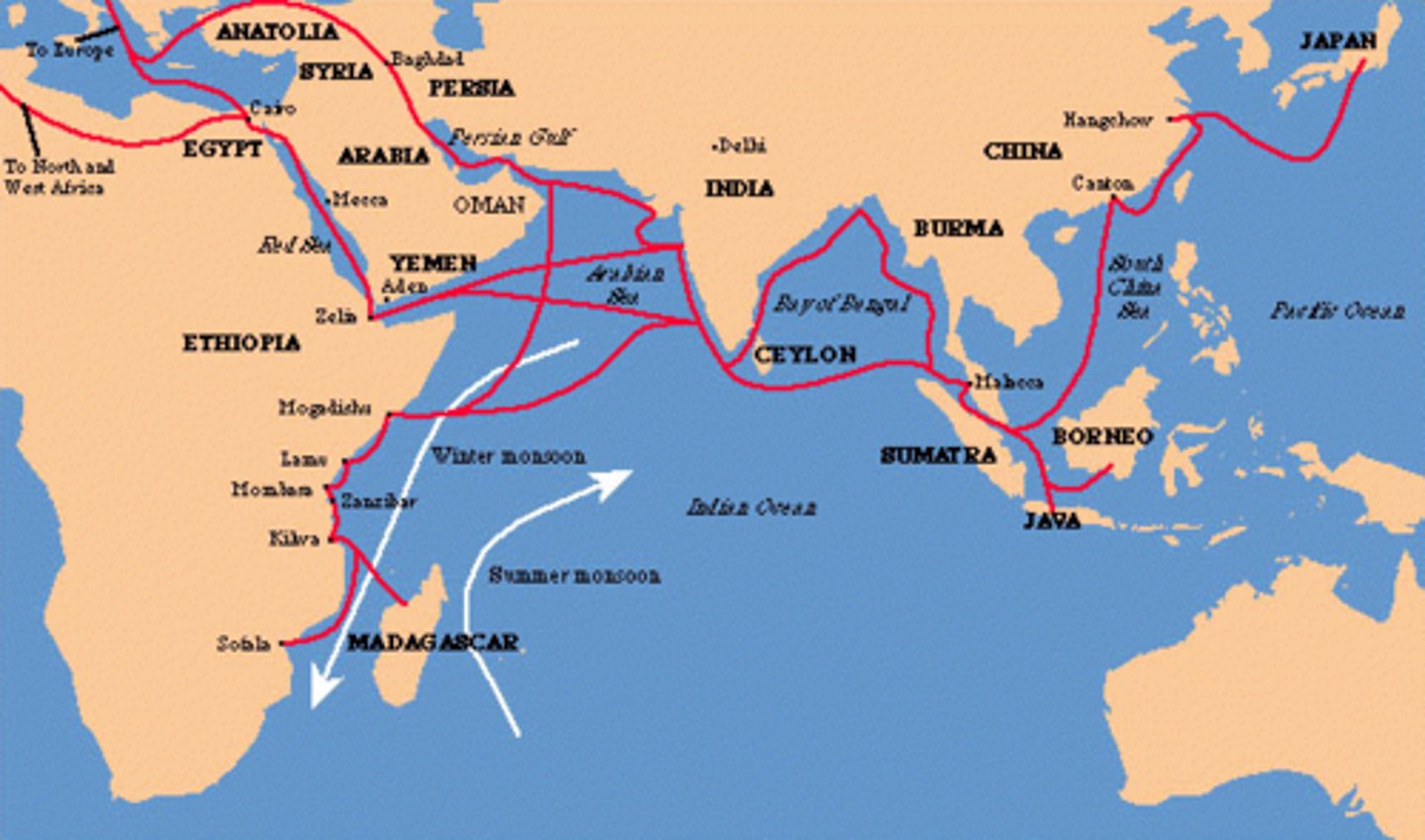
What was traded along the Indian Ocean
-Unlike Silk Roads (Luxury Goods) the Indian Ocean trade had a much greater variety of common and luxury goods
-ships can carry more for cheaper than a camel can
Luxury Goods:
-Porcelain from China
-Spices from Southeast Asia
-Cotton & Pepper from East Africa
-Ivory and Gold from East Africa
Common Bulk Goods: -Wheat, Sugar, Rice
Chinese Junks
-Huge, flat-bottomed boats with 6 masts jutting out of their bellies and room to carry 500 men
-Trunks for storage of enormous payload of goods
Why did the Indian Ocean Trade Grow during this time?
-Like with the Silk Roads it existed long before the 1200s but experienced massive growth during this period of 1200-1450 because of:
-economic revival in China during Tang and Song Dynasties which allowed the Chinese to export metric buttloads of goods
-Rise of Islam: Is positive toward merchant activity
-Creation of Islamic empires at this time led to a vast amount of land being connected by Islam which made it easier to trade
Southeast Asia (Srivijaya Kingdom)
SE Asia (Network of Islands and peninsulas, extends from mainland and is covered by a lot of water):
-Southeast Asia is in the middle of major trade routes which made them strategically important which created the necessary conditions for the rise of the
-Srivijaya Kingdom which dominated trade from 670 - 1025
-Malay sailors had long navigated the waters around Southeast Asia but when they opened a passage through the straits of Malacca, many surrounding sea ports in the Malay peninsula began competing for their attention traders and travelers
-Out of this competition rose the Kingdom of Srivijaya
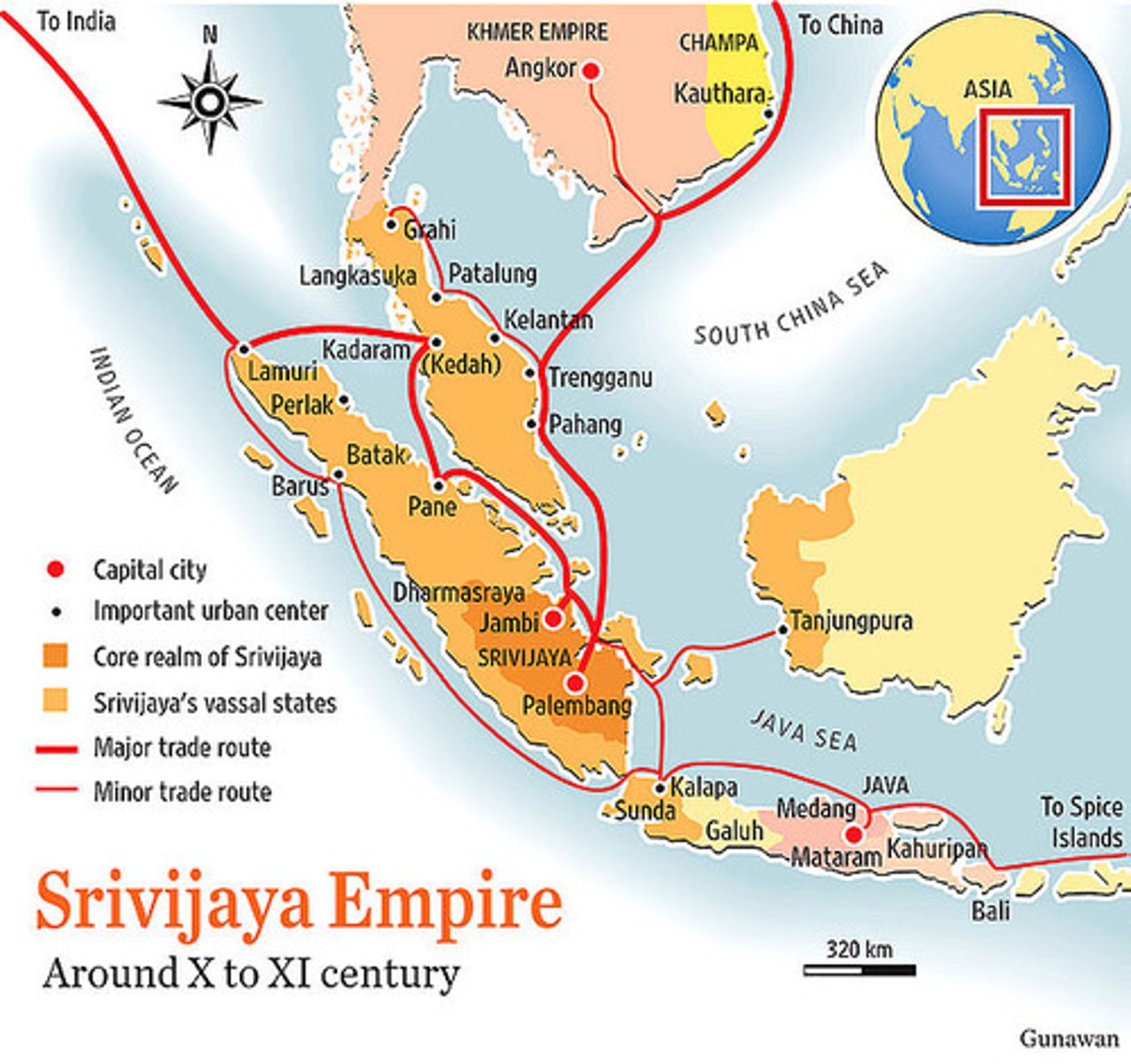
Swahili Civilization in Africa
-Emerged in the 8th century as a set of commercial city states
-their rulers found abundant opportunities to trade gods native to their area: gold, ivory, and slaves
-this resulted in an African merchant class
-and villages began turning into cities
-between 1000 - 1500 the urban commercial centers flourished
-Each of the city states was independent with a king (it was not like a unified empire, similar to the ancient Greek city states)
-Because Muslims showed up on their shores and trading, Islam eventually became the dominated religion of the area
Trans-Saharan Trade Route
-Linked North Africa and the Mediterranean world with the interior of Africa, specifically, West Africa
-Because their environments varied, they produced different goods, and thus created the incentive to trade
-In North Africa, people mainly produced manufactured goods: cloth, glasswork, and books
-Southwest Africa was agricultural, and thus produced grain crops, yams, and kola nut
-Major Turning point of the trans-Saharan trade routes was the introduction of Arabian Camels:
-This had already happened centuries ago
-but their effects were still in force in the 1200-1450 period
-They could walk up to 10 days without water which allowed people to traverse the vast desert between North Africa and West Africa
Political Culture Change Between 500 - 1600
-the trans-saharan trade routes also did its far share of culture changing, specifically politcal culture changes
-West Africa:
-civilization began to take shape:
-Rise of the Kingdom of Mali:
-At the high point in the 14th century, Mali held a monopoly on the trade of horses and metals
-They generated revenue by levying taxes on salt and copper
Social Hierarchy in the Mali Empire
-In Mali the social hierarchy was stacked up pretty similarly in comparison with other civilizations
-At the top sat the royalty,
-under them were the elite classes,
-under them were the merchants,
-under them were the military and religious folk,
-and under them were the peasants, and
-under all were the slaves.
Cultural consequences of the growing interconnectedness of the world from 1200-1450
-there is more carried along trade routes than just goods and services
-As merchants carried their various religions along these routes and introduced them to diverse areas one of two things happened:
-Either the new religion served to unify the people and provide a justification for the leadership
-Or the religions syncretized with others
Ex: Zen Buddhism, Neo Confucianism, and the Swahili Language (this was language not religion)
Zen Buddhism (an example of a syncretic cultural consequence of trade and growing interconnectedness)
-as Buddhism spread into China, it met with Daoist beliefs about the way of nature and produced a new baby religion: Zen Buddhism (aka Chan Buddhism)
-Some of the Confucian scholar gentry in the Song Dynasty opposed such religious syncretism
-nevertheless, Zen Buddhism became popular among the common folk.
Neo Confucianism (an example of a syncretic cultural consequence of trade and growing interconnectedness)
-This was basically a fusion of rational thought with Doaist beliefs and Buddhist beliefs that originated in China but soon spread to Korea and Japan
Swahili Language (an example of a syncretic cultural consequence of trade and growing interconnectedness)
-They showed up in droves on the shores of East Africa out of the Indian Ocean trade routes, and when they did, they couldn't help but share about Allah and his prophet, Mohammed.
-A major cultural consequence of that sharing was the birth of the Swahili language
-When the Muslims encountered the Bantu-speaking Africans, they gladly became believers in Islam
-And because many of the merchants spoke Arabic, the Bantu language and the Arabic language came together to form a syncretic language called Swahili
-
Scientific and technological consequences of trade
-in Cairo, Egypt, we can see medical advances
which led to improved care in hospitals.
-Also Physicians and pharmacists began to standardize their profession by studying for medical examinations
and licensing
-It was during this time that the lateen sail was invented
-This was a large triangular sail that allowed sailors to tack into the wind and therefore they had much more flexibility to travel
-Also during this time the stern post rudder was invented which gave a ship much more precision in turning
-Also the advent of the magnetic compass and the astrolabe which essentially gave sailors the ability to navigate without relying on stars and other visual aids
The Growth of Cities, Hangzhou, (an example of a cultural consequence of trade and merchant activity)
-In Hangzhou the increase in trade led to increasing urbanization
-During this period it became one of the largest and most metropolitan cities in China boasting a population over over a million people.
-In Hangzhou poetry and literature flourished, some of the most significant literary work came from the poets Lu Yu and Xin Qiji
-And finally, Hangzhou was a diverse city as we can see, for example, with its thriving Arab minority
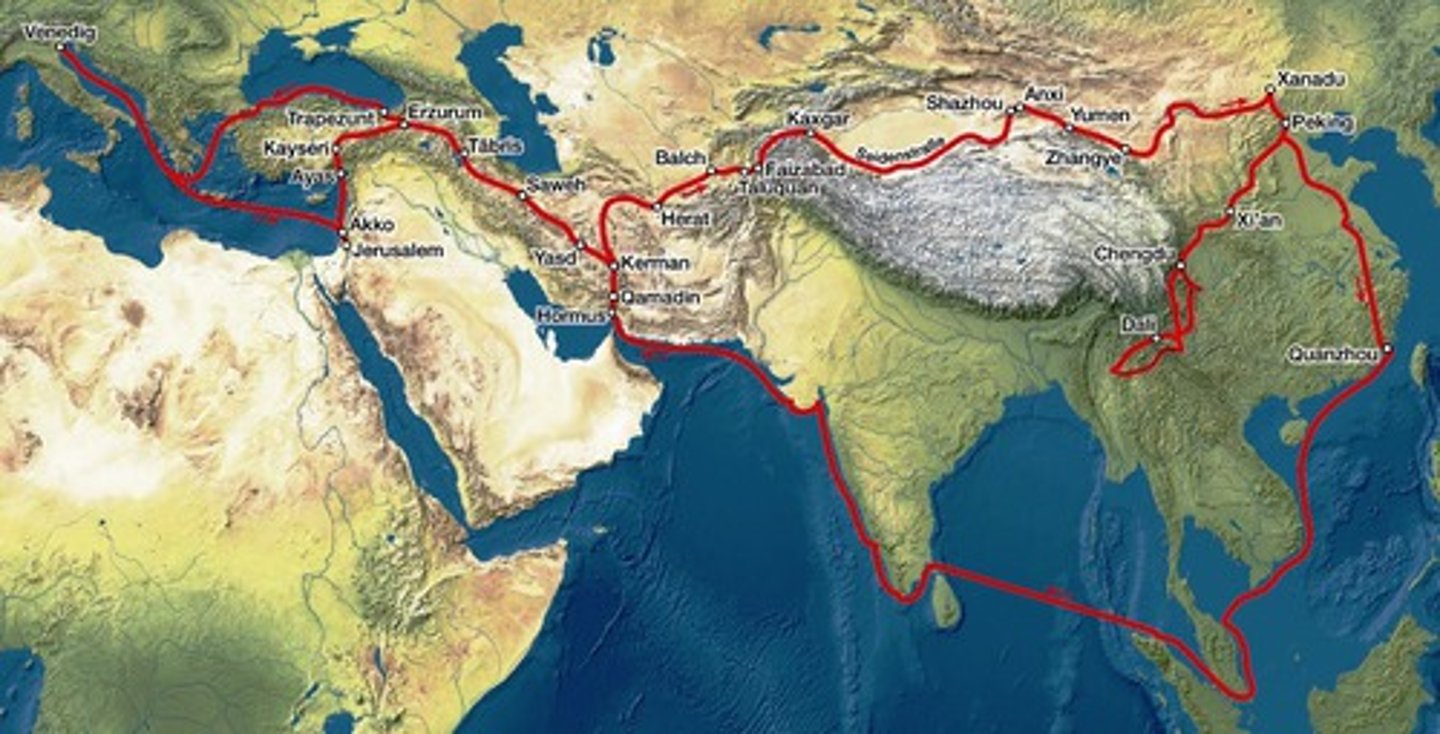
Marco Polo
-Now these folks (travelers) weren't really merchants, but because of the security of long distance trade routes, thanks to the rule of the Mongols, they were able to travel far and wide
-So in the late 13th century Marco Polo left his home in Venice and travelled for many years among the Chinese
-He arrived in the court of Kublai Khan (who was Ghengis Khan's grandson) and the Khan was very interested to hear this traveller's stories.
-In fact, so taken was Kublai Khan with Marco Polo's stories, that he convinced Polo to stay and become his ambassador to various parts of China.
-And Polo served in this capacity for seventeen years.
-After that, Marco Polo travelled home and was captured by the enemies of the Venetians.
-As he sat in prison, he entertained his fellow prisoners with stories of his travels to China.
-Eventually these stories were written down and published and they became very popular with European audiences
-They were astonished that such places could exist and Polo's stories awakened their desires to visit such places, or at least find ways to purchase goods from those places.
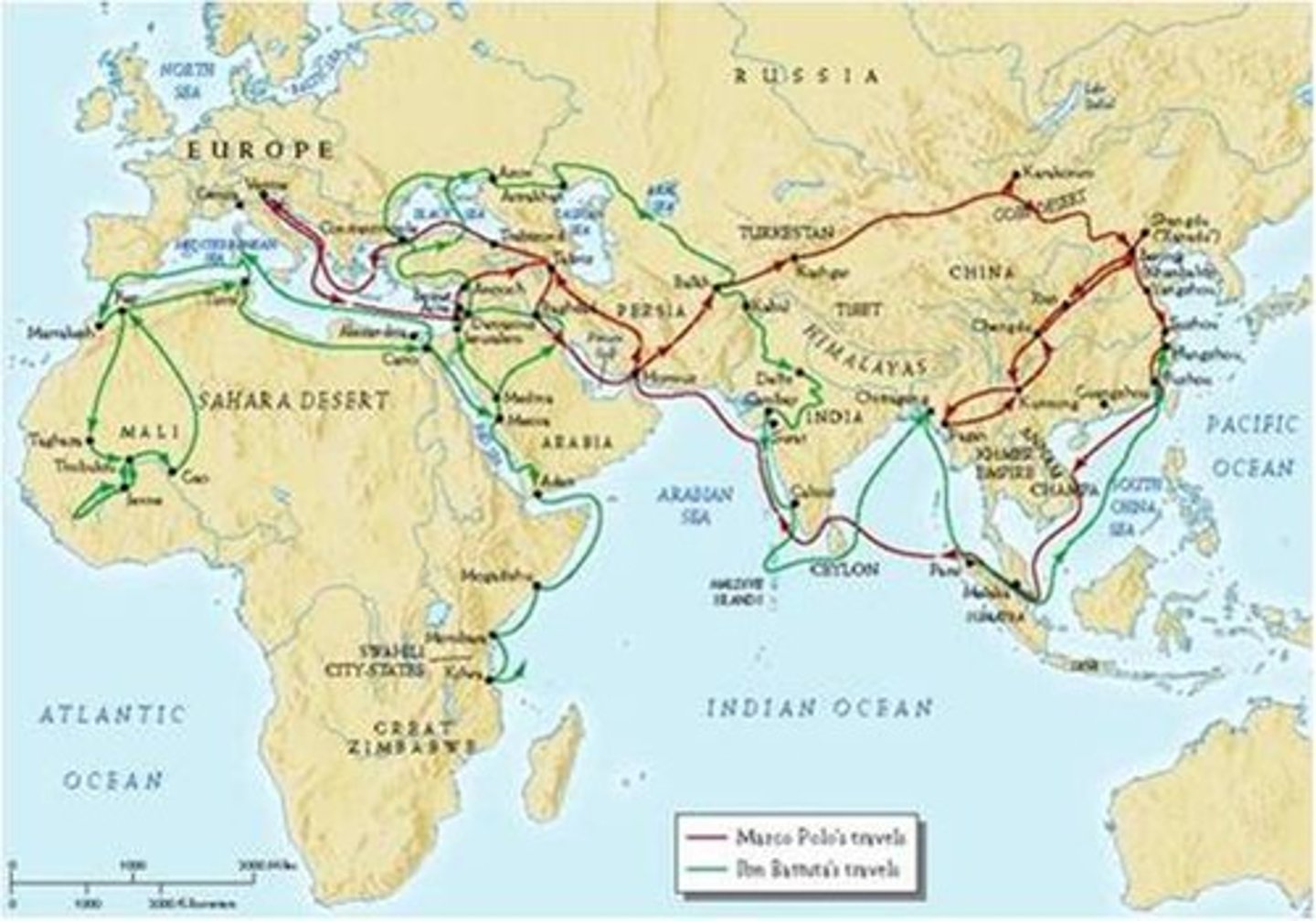
Ibn Batutta
-Ibn Batutta was a Muslim traveller who made it his ambition to travel all throughout Dar al-Islam (which is to say, everywhere Islam is)
-Ibn Batutta made his pilgrimage to Mecca and eventually travelled throughout Persia, the East African coast, India, Mali, Spain, and elsewhere.
-He kept a detailed journal and made much commentary on the people whose lands he visited
-And the subsequent publication of those journals had a similar effect on the Muslim population as the writings of Marco Polo had on the Europeans.
Environmental impacts of the growth of trade (Champa Rice and Terrace Farming)
-One two major categories of things that spread through networks of
exchange that directly effected the environment
-As merchants travelled from place to place they introduced crops into lands which had never seen them before and that had big consequences
Ex:
CHAMPA RICE
-It was introduced to China by merchants who travelled from the Champa Kingdom in Vietnam.
-This strain of rice was drought resistant and could be harvested several times a year.
-This, of course, led to massive population growth in China, but the environmental impact of champa rice was significant too
-The introduction of this crop led to the transformation of the land, namely, terrace farming.
-This was a method of farming that made previously unfarmable land farmable by cutting steps into hillsides so that you could plant rice.
Environmental impacts of the growth of trade (Bannanas)
-One two major categories of things that spread through networks of
exchange that directly effected the environment
-As merchants travelled from place to place they introduced crops into lands which had never seen them before and that had big consequences
Ex: Bananas
-Indonesian merchants bringing this foreign crop, bananas into subSaharan Africa
-And this was huge because when the Bantu-speaking natives of Africa learned to plant this crop it changed the course of their entire lives
-Their main food staple was yams, and that means they only lived in the places they could grow yams.
-But with the introduction of the banana, they could move to regions where yams couldn’t
-So because this Indonesian fruit was introduced into Africa, whole populations migrated.
-like in general, when new crops were introduced, the population increased
Environmental impacts of the growth of trade (increased population exerting more pressure on the land)
-In general, when new crops were introduced, the population increases
-But when population increases, that puts more pressure on the land, consequences will follow
Ex:
-overgrazing in Great Zimbabwe led to such severe environmental degradation that the whole city was abandoned in the late 1400s
-In Europe the land was changed through deforestation which eventually led to a profound erosion of the soil
-Combine that with the Little Ice Age that began in the 1300s, a severely contracted agricultural production ensued.
Environmental impacts of the growth of trade (Spread of Disease, Bubonic Plague)
-The Black Death was a major consequence of connectivity during this period
-This dreadful disease found its way into many societies of Afro-Eurasia, primarily by means of trade
-In Europe most estimates are somewhere in the neighborhood of half of the population dead.
-Lots of diseases spread through merchants arriving on new shores, but surely the most significant of them was the Black Death or the bubonic plague
-As the Mongols pushed further and further into new territories, they unknowingly brought these fleas with them
-the spread of this disease also came along trade routes, especially ships that provided homes to infected rats
-But not only that, as merchants travelled over land they stopped to rest in what were called caravanserai
-In these rest stops, the merchants sleep near the animals which had fleas
How did Bubonic Plague infect?
-Now we understand today how this disease was spread: namely through fleas.
-So fleas would bite a carrier infected with bubonic bacteria.
-Then the bacteria multiplies in the flea's guts and eventually there would be so much bacteria that it clogged the flea's guts.
-So then they would bite a human and regurgitate the bacteria into the bite.
Caravanserai
-These were little places that dotted the length of the Silk Roads where merchants could rest and sleep
-However, they did so in close proximity to animals and animals have fleas, leading to the spread of the Bubonic Death
Giovani Boccaccio and his book called The Decameron
-Probably the most famous account of the effects of the Black Death
-"The symptoms were not the same as in the East, where a gush of blood from the nose was the plain sign of inevitable death; but it began both in men and women with certain swellings in the groin or under the armpit. They grew to the size of a small apple or an egg, more or less, and were vulgarly called tumours. In a short space of time these tumours spread from the two parts named all over the body. Soon after this the symptoms changed and black or purple spots appeared on the arms or thighs or any other part of the body, sometimes a few large ones, sometimes many little ones. These spots were a certain sign of death, just as the original tumour had been and still remained.
Economic effects of the Bubonic Plague
-The Black Death changed the relationship between workers and lords in Europe
-Because now that half the population was wiped out, workers were all of the sudden pretty scarce
-And with this higher demand for labor, power for negotiation of wages shifted into the hands of the surviving workers
Mongol Empire
-Now over the course of World History many pastoral peoples took the stage, but by far the most significant of them are the Mongols.
-They emerged in the 13th century, and with only a few years controlled the largest land-based empire in all of human history,
-Yet, they left a very small cultural footprint
-no new language, religion, or lasting civilizations
-They grew without a blueprint
-They had no actual plan and they conquered very spontaneously
-More people they conquered the more resources they had to keep conquering
-In many cases the odds were not in their favor
Religious Tolerance:
-Allowed conquered people to keep their religion as long as their devotion to the religion didn’t become the center of political opposition
GENGHIS KHAN
-So Temujin was born in the 12th century into a network of Mongolian tribes that were fractured and at war with one another.
-Through a series of unfortunate events, Temujin and his family became social outcasts without much of a way to scratch a living.
-Temujin’s personality was magnetic and he soon forged critical personal alliances among the tribes.
-He was then recognized as a chief among his growing band of followers
-He gained a reputation of violence and brutality, ruthlessness towards his enemies
-Began amassing military victories
Unique:
-Instead of destroying or enslaving his enemies, he incorporated his enemies into tribes
-And on the wave of his growing power, a tribal council in 1206 recognized him as Genghis Khan, the supreme leader of a newly unified Mongol nation.
GOAL: To expand his empire as much as he could
-1st leg of expansion was into China
-In 1209, he perpetrated his first attack against the Chinese which set in motion the expansion of the Mongol Empire
-Attacks were vicious
-In a flash, they would destroy every army, capture every fort, and bring down the walls of every city they encountered
-they conquered everyone
Chinese and the Mongols
-Most difficult and lasted 70 yrs (1209-1279)
-the Chinese outnumbered them 100 to 1, and they possessed far more advanced technology
-Began in Northern China, the Mongols focused on destruction and plunder at first but then changed its focus to accommodate the local population
Ex: They allowed landowners to keep their land as long as they pledged loyalty
-This conquest resulted in the Unification of China
-Confucian Scholars were even convinced the Mongols were granted the Mandate of Heaven
-Mongols used existing systems of administration in China and taxation
-established a new Dynasty call the Yuan Dynasty
-Under this authority, roads were improved, canals were built, scholars and artists were patronized
-the Mongol leaders very much ruled like beneficent Confucian leaders.
-rule in China was brief (100 yrs)
-by Mid 14th century they were forced out by factionalism, the plague, and numerous peasants rebellions
Persian and the Mongols
-This conquest was far more abrupt than the one in China,
-The Muslim Persians fell to Mongol attack quickly
-Persians were disturbed that non-believers could conquer them so easily, they believed the Mongols were infidels
-They slaughtered the Persians with a ferocity they had never known before: "Every town and every village had been several times subjected to pillage and massacre... the population will not attain to a tenth part of what it was before"
-In 1258, the sacking of Bhagdad alone, the Mongols put over 200,000 people to death
-Mongols were actually more transformed themselves/influenced by the Persians
-They made use of the Persian administrative system
-They left Many Persian rulers in place
-Most Significantly, the Mongols who conquered Persia became Muslim
-This kind of large scale conversion certainly didn't occur in China
-And as for the end of Mongol rule in Persia, it was much different than in China where they were driven out
-In Persia, the Mongols just sort of disappeared gradually
-Mainly they assimilated into Persian society and soon found that they were no longer a people distinct from the Persians.
How did the Mongols conquer so well?
-Genghis Khan organized his army to make them easy to control
-he divided the entire Mongol society into military units of 10,000, 1,000, 100, and 10
-And with such organization he was able to quickly and effectively control and command his troops
-And when he conquered a people, they got swept into that organizational system as well, only he scattered them among different units so they wouldn’t get ideas about rebelling.
-In this way, he created
a growing army who were fiercely loyal (loyal out of fear, not love), if one soldier
rebelled/deserted the whole unit would be murdered
-And this reputation for brutality spread to the surrounding nations
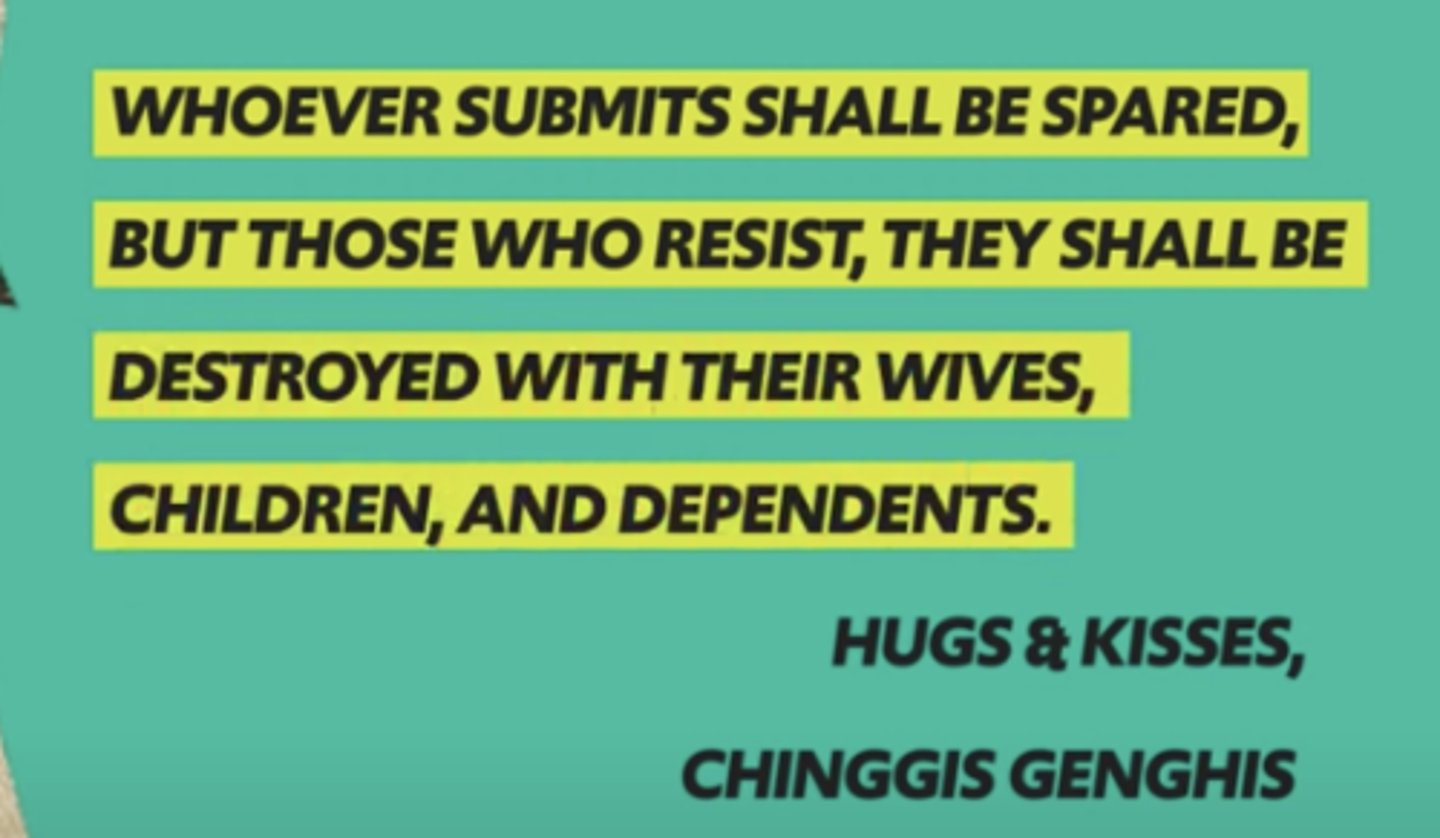
-His policy to those surrounding nations is in the photo