Social Welfare Policy Chapter 1
 Studied by 0 people
 Call with Kai
 Learn
Learn Practice Test
 Spaced Repetition
 Match
Match Flashcards
 Knowt Play
1/6

There's no tags or description
Looks like no tags are added yet.
Name | Mastery | Learn | Test | Matching | Spaced | Call with Kai |
|---|
No study sessions yet.
7 Terms
definition of policy (three types)
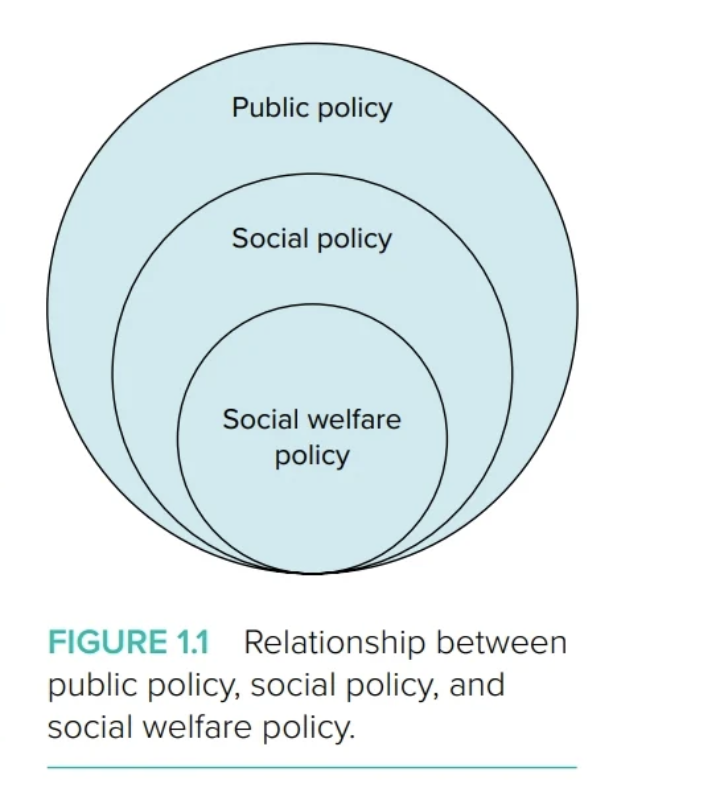
Public Policy
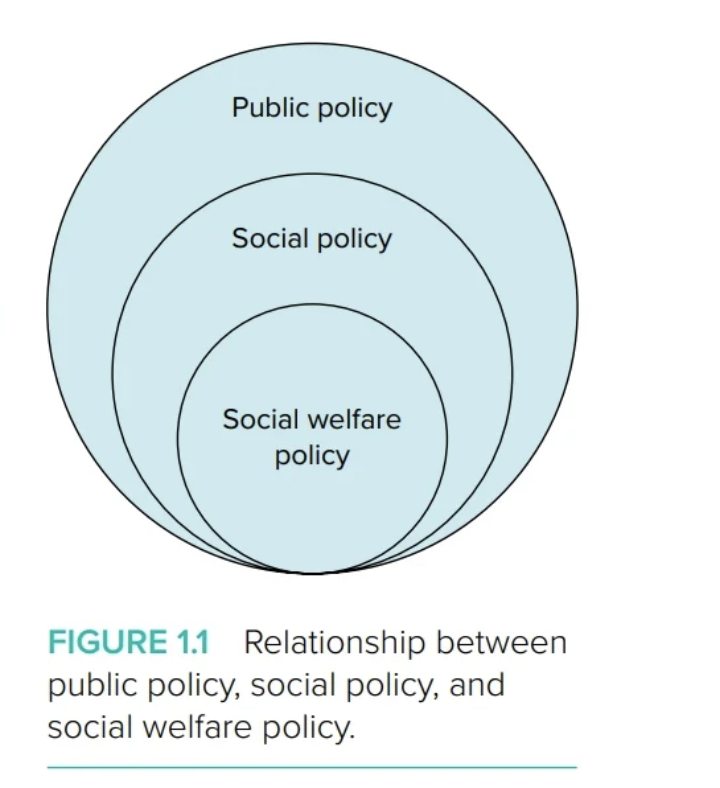
Public policy is usually considered to be all the decisions that the government makes and the laws, regulations, and other artifacts that result from these decisions. Where highways go, what types of ingredients are allowed in food, and how student financial aid is allocated are all examples of public policy. Policies include laws, regulations, budgets, plans, court decisions and orders, and other things that guide and structure governmental action.
economic policies (which are public policies) frequently have an impact on antipoverty and social insurance pol-icies
transition from the industrial economy
The nature of that interaction is becoming more complicated as time goes on and society changes from an industrial economy to one based on information.
The rise of the information economy: People today are in the midst of a major trans-formation from an industrial economy to an information economy. This will change all the social institutions and change the nature of people’s lives. Although many of the impacts of the information society will occur in the future, quite a few have already happened, and many are occurring now. The pace of change is often quicker than people realize, and change is difficult for most people.
definition of policy (three types)
Social Policy
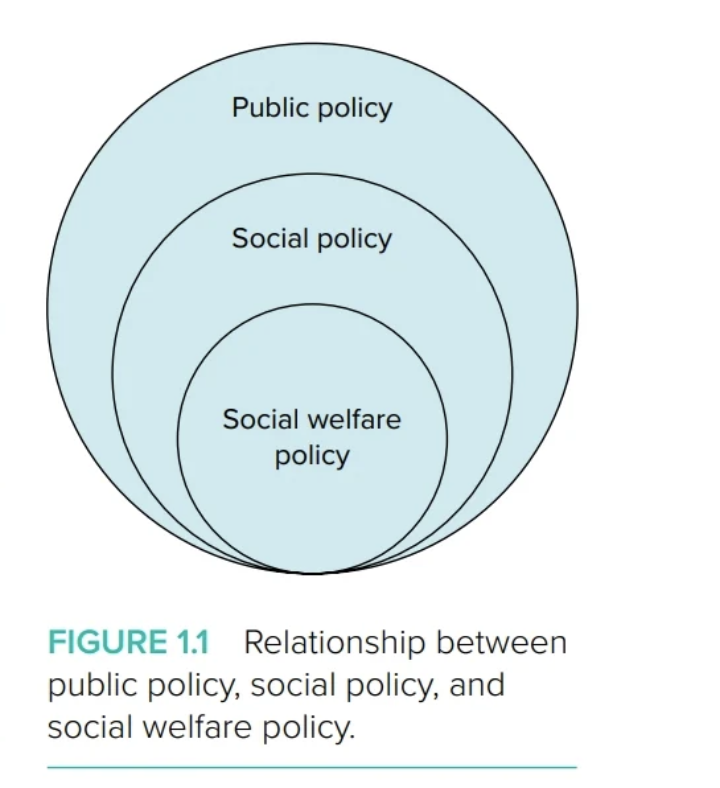
Social policy is composed of those decisions that affect social well-being. Health care, education, telecommunications, and environmental protection are examples of social policy. There is a vast array of social policy decision-making, and all social policies are part of public policy.
definition of policy (three types) Social Welfare Policy
Social welfare policy is composed of those aspects of social policy that involve mutual aid or people helping people (Warren, 1963). Mental health policy, child welfare, and social security policies are examples of social welfare policy. Environmental regulations help people by preventing the impacts of environmental destruction but are not social welfare policies because they do not involve mutual aid.
Most of the things that social workers are concerned about are part of social welfare Social welfare policy. Most of their programs (e.g., child welfare, mental health, health care, and aging) are covered by social welfare policy.
risks of globalization
The continued pace of globalization: Although there has always been international trade, the pace of globalization has increased radically. Americans now compete with people throughout the world. The development of technology has made trade easier and more immediate. Globalization has both benefits and costs. The loss of many jobs and devastation of communities are clearly among the costs of international trade. On balance, people’s ability to benefit from trade is considerable. The fact that you can interact with people all over the world is a huge benefit and one that can enrich both your working life and personal life. In addition, having products made in low-cost areas of the globe makes them less expensive for American consumers when they are sold in the United States. The influence of globalization challenges what is meant by citizen-ship and statehood by giving people a view of themselves as part of a larger system.
responsibilities of social workers
Social workers have another set of responsibilities that go beyond the professional realm. There are the responsibilities of citizenship. Certainly, they include voting, staying informed about issues, participating in public meetings, completing jury duty, and paying taxes. These are important, but there are more. You are a citizen of your community. Making your community better is your responsibility. You are a citizen of your nation. National issues are something that you should care about and try to address. You are also a citizen of the world. Although there are many good things in the world, there is no shortage of evil. War, slavery, desperate poverty, disease, and a host of other terrible things afflict our world. A question that every social worker must ask is “Do we do something, or do we look away?”
Most social workers look at the problems that negatively affect our communities, nation,
and world and want to make a difference. It would be difficult to profess the values of the social work profession and not want an end to poverty, crime, and disease. The truth is that people can make a difference. It might be difficult and costly and take a great deal of time, but it can be done. Making a difference combines your roles as citizen and social worker. How you choose to make a difference depends on the opportunities and resources that you have. The skills that you learn in social work education can be applied to discharging your responsibilities as a citizen. You learn how to assess people and situations, interview, work with groups, and organize. These are all incredibly useful skills. This book will take you further and introduce you to what may be a new role for you: applying your knowledge and practicing your skills, which will allow you to make a difference with your clients, the organizations in which you work, and the community in which you live. Some change agents have an impact at state, national, and international levels.
advocacy work
Chapter 8 provides information on how to advocate for the solutions deemed best. Because advocacy is a component of ethical social work practice, all social workers must have grounding in advocacy
This book gives you a good overview of the major issues and how they work, although you will have to continue to learn about the issues as time passes. This book will introduce you to policy analysis and advocacy skills. These are skills that will help you understand the issues and make constructive change when the opportunity presents itself. The book also gives you questions to think about, further resources to consult, and exercises to do. We hope that these will add to your understanding and deepen your learning.
 Note
Note  Flashcards (23)