Water, Minerals, and Vitamins: Essential Nutrients for Health
 Call Kai
 Learn
Learn Practice Test
 Spaced Repetition
 Match
Match Flashcards
 Knowt Play
1/73

There's no tags or description
Looks like no tags are added yet.
Name | Mastery | Learn | Test | Matching | Spaced | Call with Kai |
|---|
No analytics yet
Send a link to your students to track their progress
74 Terms
What is the niacin deficiency disease called?
Pellagra
What is the best source of vitamin C among common foods?
Strawberries
Which vitamins are fat-soluble?
Vitamin A and Vitamin D
Which of the following is NOT a symptom of pellagra?
Dysplasia
What percentage of an adult's body weight is water?
Approximately 60%
What are the primary organs involved in maintaining water balance?
The hypothalamus and the kidneys
What is metabolic water?
Water generated in the tissues during the chemical breakdown of energy-yielding nutrients
What are the DRI recommendations for daily water intake for males and females?
13 cups for males and 9 cups for females
What is the difference between hard water and soft water?
Hard water contains calcium and magnesium, while soft water contains sodium
Why might soft water be a health concern for some individuals?
The high sodium content may aggravate hypertension
What are the four 'shortfall nutrients' under-consumed by the public?
Calcium, potassium, magnesium, and iron
What is the most abundant mineral in the human body?
Calcium
What are the seven major minerals (macrominerals)?
Calcium, chloride, magnesium, phosphorus, potassium, sodium, and sulfate
What is the primary function of electrolytes in the body?
To govern water flow and maintain fluid balance
How does water move in relation to electrolyte concentration?
Water flows toward the area of greater concentration
What is the role of buffers in the body?
To maintain acid-base balance
Where is the majority of the body's calcium stored?
In the bones
What happens to bone tissue if minerals are withdrawn to cover deficits elsewhere?
The bone grows weak and may bend or crumble
What are the two primary sources of all drinking water?
Surface water and groundwater
What are the primary functions of water in the body?
Transport vehicle, solvent, cleansing agent, lubricant, cushion, and coolant
What is the primary component of amniotic fluid?
Water
Which beverages are excluded from meeting the body's fluid needs?
Alcohol and caffeine-containing beverages
What defines a 'major mineral' or macromineral?
A mineral required by the body in amounts greater than 100 milligrams per day
What is the most indispensable nutrient for the human body?
Water
What is hydroxyapatite?
The chief crystal of bone and teeth, formed from calcium and phosphorus.
Where is 99% of the body's calcium stored?
In the bones and teeth.
What are three physiological roles of calcium beyond bone structure?
Regulating ion transport, maintaining blood pressure, and assisting in blood clotting.
How does the body maintain calcium balance when intake is low?
The intestinal lining increases absorption, and the skeleton acts as a calcium bank.
What is the difference between osteopenia and osteoporosis?
Osteopenia is low bone mass that often progresses to osteoporosis, a condition where bones become porous and fragile.
At what age is peak bone mass typically reached?
Around age 30.
What is the second most abundant mineral in the body?
Phosphorus.
What is the primary role of phospholipids in the body?
They are the principal components of cell membranes.
What may excess phosphorus in the blood indicate?
Heart and/or kidney diseases.
What are the best food sources of phosphorus?
Animal products.
Besides bone health, what is a key function of magnesium?
It acts as a cofactor for hundreds of enzymes and is critical to nerve transmission and muscle contraction.
What is the chief ion used to maintain fluid volume outside of cells?
Sodium.
What is hyponatremia?
A condition of having too little sodium in the blood, which can occur from drinking too much water.
What is the recommended daily sodium intake for adults aged 14 and older according to the Dietary Guidelines?
Less than 2,300 mg per day.
What is the DASH diet designed to do?
Control blood pressure (Dietary Approaches to Stop Hypertension).
How does high sodium intake affect health?
It correlates with hypertension, heart disease, stroke, and aggravated kidney problems.
What is the approximate sodium content of one teaspoon of salt?
About 2,000 milligrams.
Why are processed foods and fast foods significant in the context of sodium intake?
They are major sources of sodium, often containing 700 to 1,500 mg per serving.
What role does calcium play in muscle function?
It is essential for muscle contraction.
What is the primary function of phosphorus salts in the body?
They act as critical buffers.
Where is the majority of magnesium stored in the body?
Over half is in the bones, with the remainder in muscles, heart, liver, and other soft tissues.
What is the function of sodium regarding body fluids?
It is a major part of fluid and electrolyte balance and helps maintain acid-base balance.
What is the Tolerable Upper Intake Level (UL) for calcium supplements?
The amount must not exceed the established UL to avoid health risks.
What is the primary role of potassium in the body?
It acts as the principal positively charged ion inside cells, maintaining fluid and electrolyte balance, cell integrity, and heartbeat.
What are the consequences of potassium deficiency and toxicity?
Deficiency can lead to dehydration; toxicity from supplements can stop the heart when injected intravenously.
What is the primary role of chloride in the body?
It helps maintain fluid balance and maintains stomach acidity, which is necessary for protein digestion.
What is the function of sulfate in the body?
It helps protein strands assume their functional shapes.
What is the main role of iodine?
It is a component of thyroxine, which regulates metabolic rate, temperature, reproduction, growth, and heart function.
What are the two primary conditions caused by iodine deficiency?
Goiter (enlargement of the thyroid gland) and cretinism (severe mental and physical retardation in infants).
What are the two iron-containing proteins in the body?
Hemoglobin (in red blood cells) and myoglobin (in muscles).
What factors promote iron absorption?
Heme iron, Vitamin C, and the MFP (meat, fish, poultry) factor.
What factors inhibit iron absorption?
Nonheme iron, tea, coffee, calcium, phosphorus, phytates, tannins, and fiber.
What is pica?
A craving and intentional consumption of nonfood substances, often associated with iron deficiency.
What are the primary roles of zinc?
It protects cell structures against oxidative damage, makes genetic material, assists the pancreas, and activates enzymes.
How does excess zinc affect the body?
It causes loss of appetite, impaired immunity, vomiting, diarrhea, and inhibits iron absorption.
What is the main role of selenium?
It acts as a cofactor that limits the formation of free radicals and prevents oxidative harm to cells.
What is the primary benefit of fluoride?
It forms fluorapatite, which improves the resistance of bones and teeth to demineralization and decay.
What is the role of chromium?
It participates in carbohydrate and lipid metabolism and helps regulate blood glucose levels.
What are the primary roles of copper?
It helps form hemoglobin and collagen.
What are the consequences of low calcium intake?
Increased risk of high blood pressure, colon cancer, and lead poisoning.
What is osteoporosis?
A condition characterized by bone loss that develops silently over years, leading to increased fracture risk.
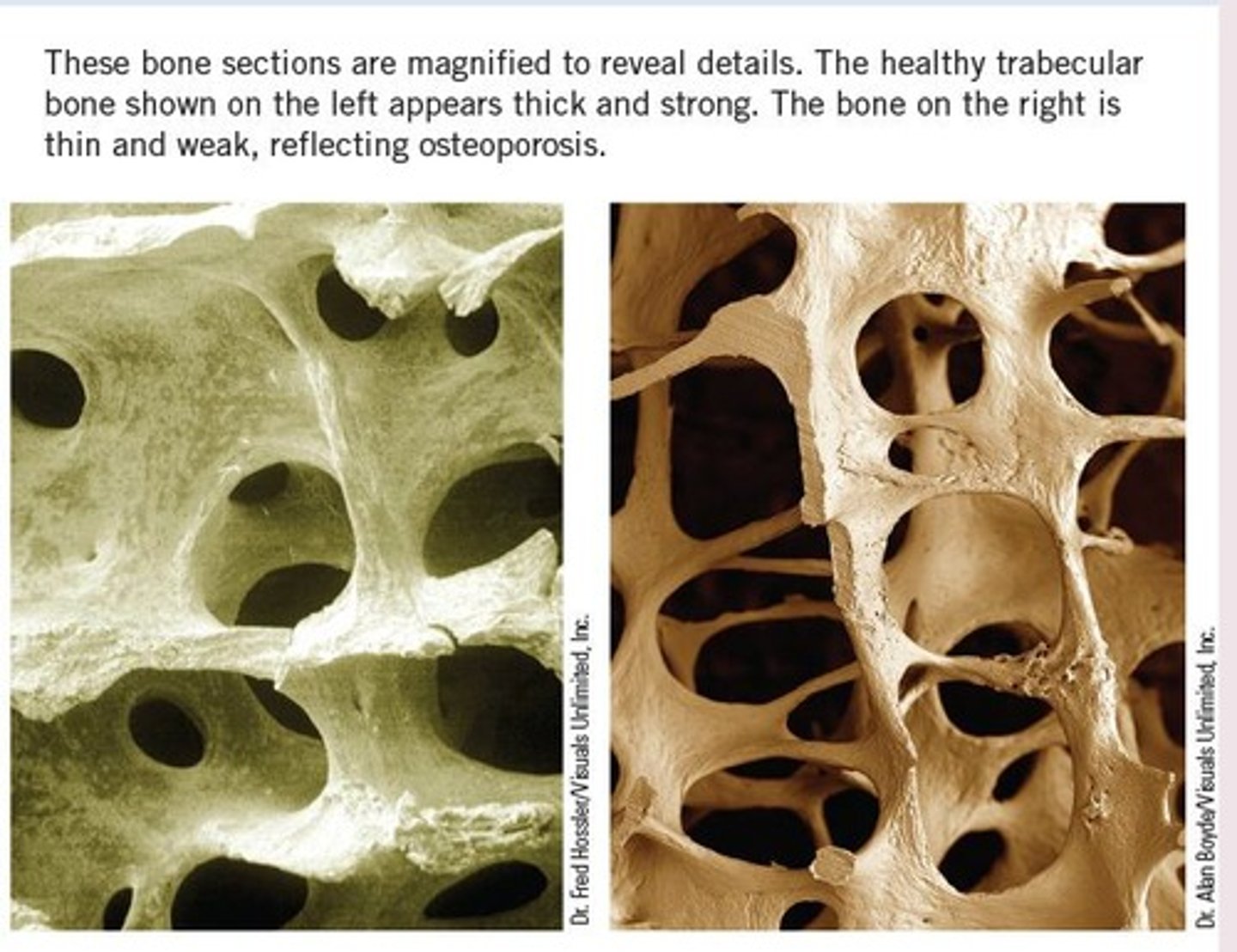
What is the difference between trabecular and cortical bone?
Trabecular bone is the inner, spongy bone that is tapped to raise blood calcium; cortical bone is the dense outer shell.
What is a DEXA scan used for?
It measures bone density to diagnose osteoporosis.
Which nutrients are essential for bone health?
Calcium, vitamin D, protein, vitamins K, A, and C, magnesium, and omega-3 fatty acids.
What is 'sedentary inertia'?
A condition where lack of exercise leads to exhaustion, creating a cycle where the less one does, the more fatigued one feels.
What is the function of hepcidin?
It regulates blood iron levels.
What are the symptoms of iron toxicity?
Fatigue, mental depression, abdominal pain, liver/joint/heart damage, and increased susceptibility to infections.
What are the symptoms of selenium toxicity?
Hair loss, brittle nails, diarrhea, fatigue, and bone, joint, or nerve abnormalities.
What is fluorosis?
A condition caused by fluoride toxicity, typically affecting teeth.
What is the general rule regarding trace mineral toxicity?
All trace minerals are toxic when consumed in excess.

