Midterm #3
 Call Kai
 Learn
Learn Practice Test
 Spaced Repetition
 Match
Match Flashcards
 Knowt Play
1/170

There's no tags or description
Looks like no tags are added yet.
Name | Mastery | Learn | Test | Matching | Spaced | Call with Kai |
|---|
No analytics yet
Send a link to your students to track their progress
171 Terms
Emotions
an immediate, specific negative or positive response to environmental events or internal thoughts
Moods
diffuse, long-lasting emotional states that do not have an identifiable object or trigger
Feelings
the subjective experience of the emotion
ex. “I feel scared” “I feel disgusted”
Affect
the outward expression (observable) of emotion
negative affect = covering ur mouth, disgusted face, etc
components of emotions
Emotion involves:
Bodily arousal (physiological component) - BP going up after watching spider video
A subjective conscious experience (cognitive component) - what i’m thinking (smtg is happening in ur mind: “this is disgusting”)
Characteristic overt expressions (behavioural component) - covering your mouth while watching spider video
Physiological Component of Emotion (pathways)
Bodily arousal - fight or flight response
fast pathway = stimulus → thalamus → amygdala → external response
“omg a spider fell on me”
slow pathway = stimulus → thalamus → cortex → amygdala → external response
“oh its a toy spider”
Cognitive component of emotions
Subjective Feelings
emotion is a highly personal, subjective experience
depends on cognitive appraisals/interpretations
what one person is scared of, the other might find funny
ex. public speaking - with all ur friends in the room versus all ur profs
Behavioural Component of emotions
nonverbal expressiveness (rolling ur eyes, etc)
expressions for emotions, body language 😊😔👋
Cognitive theories of emotion
What’s the order? - do u see it and then feel emotion and then body shows reaction or other way around??
common sense approach (not actually a theory)
james-lange theory
Cannon-Bard theory
Schachter-singer theory
Common sense approach
one of the cognitive theories for emotion
stimulus → conscious subjective feeling → autonomic arousal
ex. ghost → scared → HR increases
James-Lange theory
one of the cognitive theories for emotion
The perception of autonomic arousal results in conscious perception of emotion
stimulus → distinct arousal & behaviour → subjective feeling
whats happening with our bodies physiological and what were doing tells our brains what we’re feeling
Different distinct patterns of autonomic activation lead to the experience of different emotions
Criticisms of James-lange theory (walter canon)
Physiological arousal can occur without subsequent emotion
run up the stairs → heart rate goes up → but no emotion
Some physiological changes are too slow to precede conscious experience of emotion
pants fall down → embarrassment occurs before blushing happens
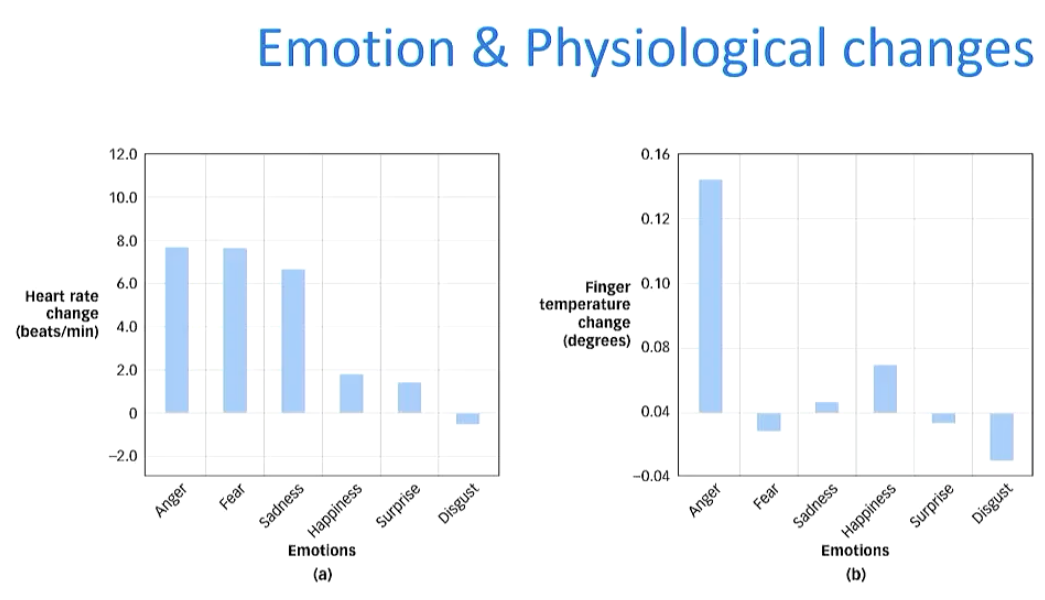
experience of fear, joy, surprise, anger exhibit similar patterns of autonomic arousal
they are not the same
Canon-bard theory
one of the cognitive theories for emotion
subcortical brain activity SIMULTANEOUSLY sends signals to the cortex (results in ‘feelings’) and the ANS (arousal)
stimulus → thalamus → common arousal/fear
happens at same time, not specific to an emotion
Schachter-Singer two-factor theory
one of the cognitive theories for emotion
Emotion depends on:
Common pattern of autonomic arousal AND
Cognitive interpretation of that arousal based on the environment
stimulus → common arousal → cognitive interpretation → subjective feeling OR fear
ex. support → Capilano Bridge Study
Capilano Bridge Study
Independent variable: physiological arousal
condition 1: unstable suspension bridge → more arousal
condition 2: stable low bridge → less
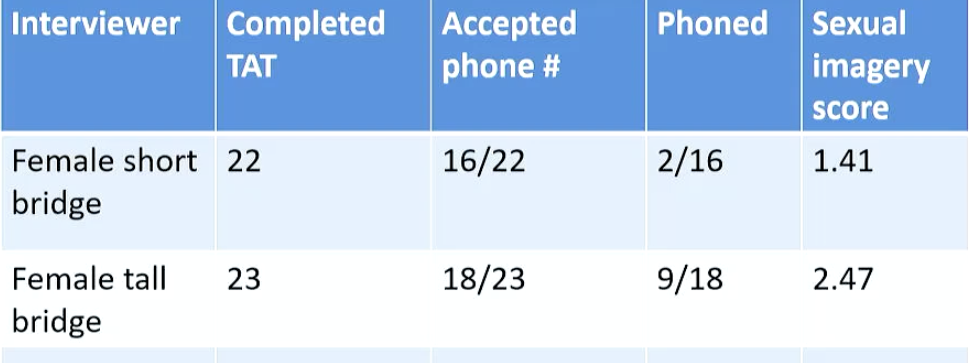
Attractive female research assistant will approach men who look between ages 18-35 on condition 1 or 2
research assistant would show an image and ask what’s the story in the image → and then ask the dude if they want her phone number to her lab in case they have any questions about the study afterwards that come to mind
found that guys on tall bridge were more likely to call - could be due to men walking on tall bridge are more likely to take the risk and call
study was done again with approached on tall bridge VS approached 10 minutes after crossing tall bridge
Criticism to Schachter-Singer two-factor theory
there’re clearly different physiological states associated with different emotions
Which cognitive theory is correct?
James-Langer? NOPE
although some emotions can be physiologically distinguished, not all are distinct
fear and sadness has similar physiological reactions
Canon-bard? NOPE
although the thalamus plays a part in emotion, they left out the contributions of the hypothalamus and amygdala
although some emotions display similar physiological responses, there is not one common response
Schachter-Singer? NOPE
although some emotions display similar physiological responses, there is not one common response
some emotions are experienced without arousal
The interplay between bodily activity and mental activity are both the causes and consequences of emotional experience
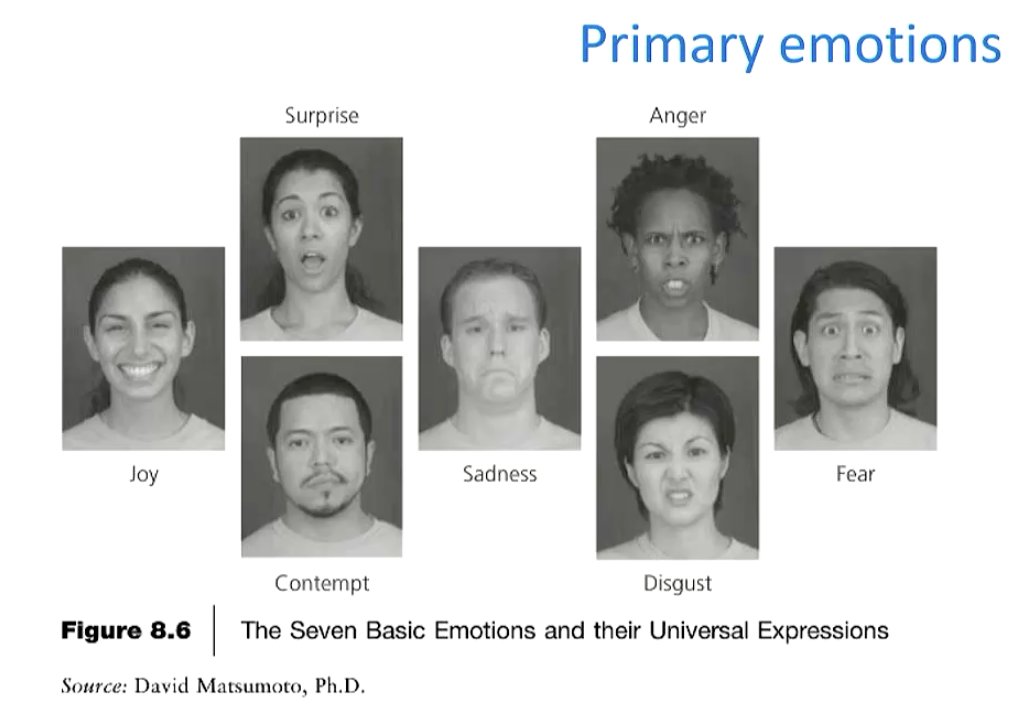
Primary emotions
Another one could be: PRIDE (body language & face)
study found that ppl who are born blind and are generally blind show this emotion
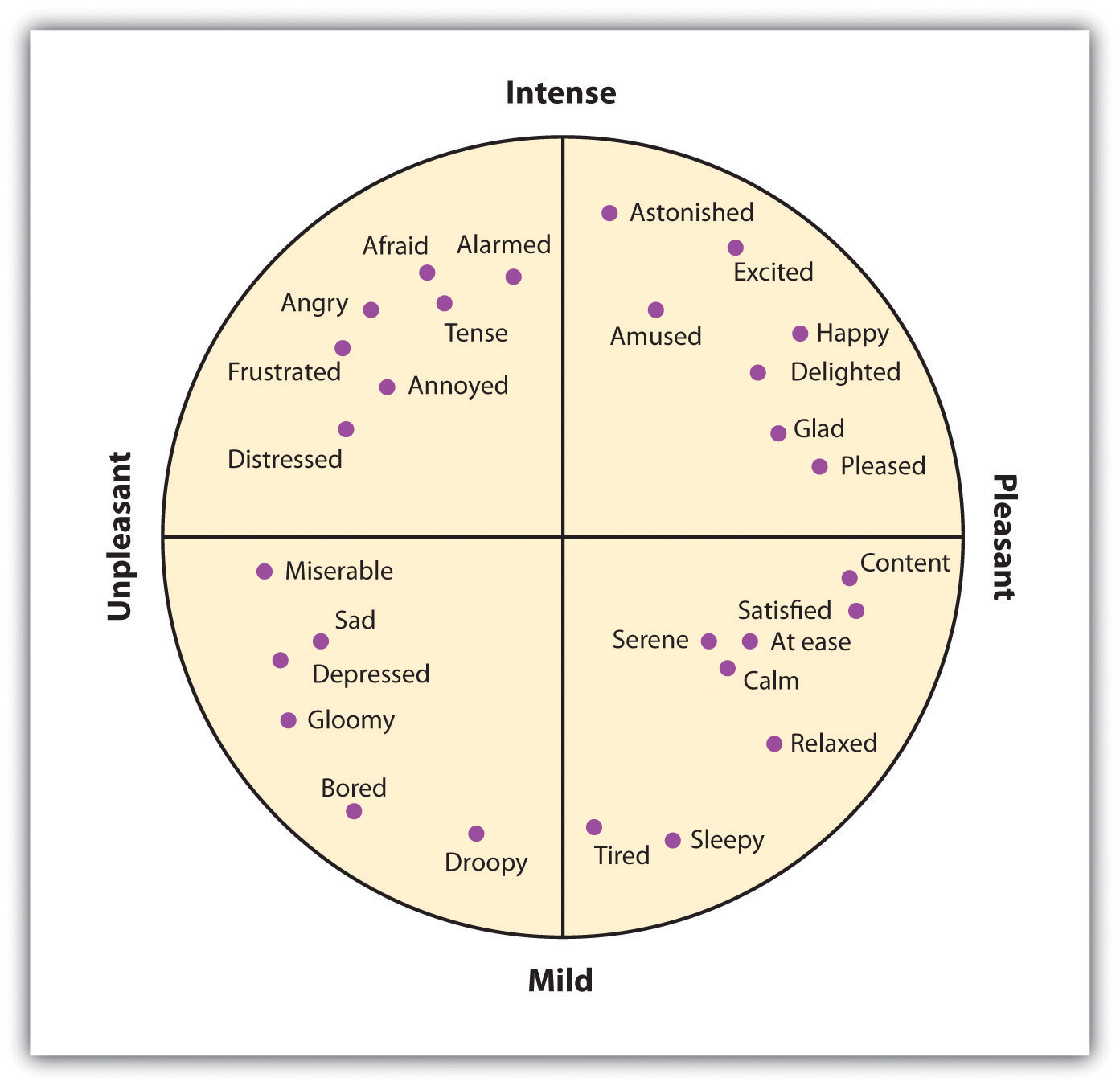
Secondary emotions
Emotions & Evolution
Darwin noticed that a lot of expressions seem to be similar between animals and humans at one point
ppl originally believed we had these expressions cuz of god but darwin said we share a lot of these expressions and facial features (musculature) with many other animals
Almost all researchers now agree that emotions are adaptive responses that arise from mechanisms shaped by natural selection → we evolved over time to have these facial expressions and features
these help us survive in some way
The universality hypothesis
emotional expressions have the same meaning for everyone
support:
blind people, they’ve never seen another person’s emotional expressions and yet when they feel happy or sad, they generate the same expression
babies generate these expressions - how do they know? is this a process of learning?
problem of doing studies on this in other countries: ppl travel to other countries, watch TV, etc they could’ve learned it → so they studied an indigenous tribe in new guinea that have never had any contact with anybody before
answer is yes they generate same emotional expressions
How do facial expressions help us survive? (evolution)
ex. when we make a disgust face we take in less oxygen (nose scrunch, lips tighten) - protects u from inhaling smtg that might make u sick
when smtg scares u, our eyes widen (able to scan environment and look for escape route), breath in (about to start running/fighting)
emotions & communication
a way for one animal to communicate to another how it is feeling and how it is prepared to act - without verbal language
helps determine a hierarchy
ex. aggression/dominance
dogs will do staredown and growl when they first meet → typically wont fight but one will back down
ex. smiling (happiness)
smiling has been found to increase the likelihood of affiliation and to reduce the likelihood of aggression between interaction partners and is thought to be a signal of “benign intent” → when smn is smiling you know they aren’t going to hurt u etc
ex. sad
study shows that ppl are more likely to go up to smn when they sad vs when they are neutral, angry, or fearful
Guilt/Embarrassment & Social bonds
a nonverbal apology that elicits forgiveness in others, thereby repairing and maintaining relationships
embarrassment represents submission to an affiliation with the social group
lips press tgt and corners turn up slightly, head moves down and to the side
expression tells u “im sorry, I did smtg wrong” and makes u more willing to forgive
Display rules
rules that govern how and when people exhibit their emotions
dictate when emotional expression is suitable in specific situations
learned through socialization
cultural variations in expression and recognition of emotions
individual differences too (depending on personality, more or less likely to display emotions)
example of stereotypes: germans have fairly cold and expressionless faces
ex of rules:
no laughing at funerals
no happy faces at a funeral
→ can differ by culture
ex. when ppl laugh they cover their mouths, others don’t
Cultural differences in Display of emotions
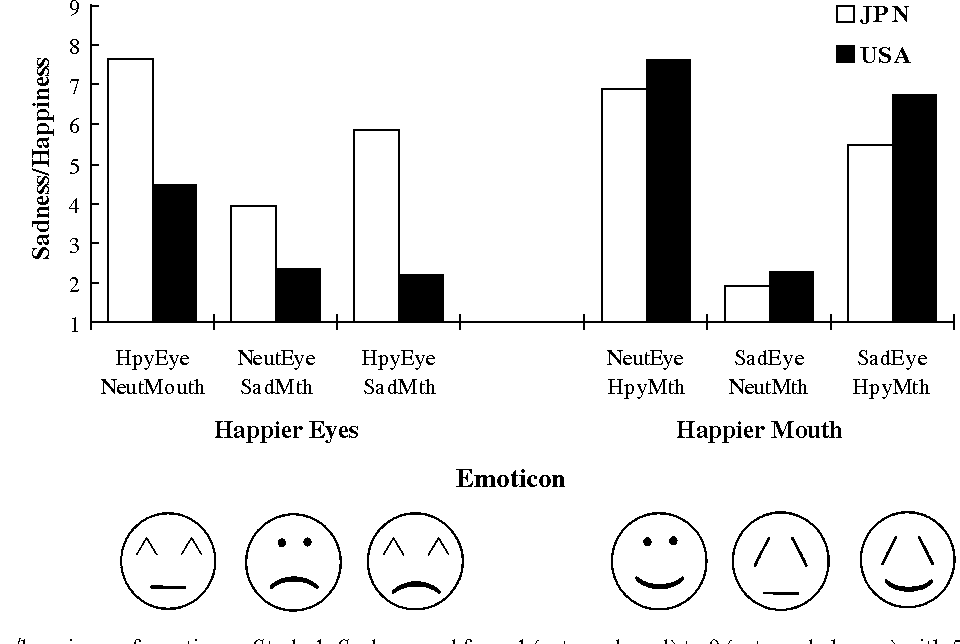
study with white & japanese man, both are shown disgusting video, both make disgusting face
but when authority is infront of them, japanese man doesn’t make face
research showed that japanese ppl looked at eyes to determine emotion while white americans looked at mouths
a picture where guy is smiling while others behind him are smiling VS one where the ppl behind him are sad
japanese ppl will focus on ppl in background → say man did smtg to ppl in backgrounf
americans will focus on central figure → say man’s happy
individualistic cultures vs collectivist
Gender differences in display rules
from culture to culture, display rules tend to be different for men and women
compared to men, women tend to:
display emotions more readily, frequently, intensely, and easily
especially when it comes to crying or laughing
men display more anger
report more intense emotions
be better at articulating their emotions
Why are there gender differences in display rules?
Is this due to biology (evolution) or socialization?
some say biology - women are responsible for caring for the children, much more likely to band tgt when under times of stress and so displaying laughter and crying
some say socialization - there’s empirical evidence that parents socialize their children to display gender appropriate expressions of emotions
ex. “block-head” game - jenga but loser is called blockhead
fathers were more responsive to boy’s anger and laughter at another’s expense and girls’ sadness or anxiety
mother’s responses did not differ by gender
Emotion Regulation (+ forms)
How individuals control which emotions they have, when they have them, and how such emotions are experienced and expressed.
the forms:
Situation Selection
Situation Modification
Attentional Deployment
Cognitive Change
Response Modulation
Situation Selection
one of the forms of emotion regulation
before an emotion has been elicited
refers to approaching or avoiding certain people, places, or objects in order to regulate emotions
ex. “after friday’s midterm I’m going to go karaoke” ← regulating positive emotions
Situation Modification
one of the forms of emotion regulation
in the moment an emotion is being elicited
modifying external, physical environments in order to change a potentially emotion-eliciting situation
ex. getting flowers for wife before asking to skip family event to go golfing with buddies
Attentional Deployment (+ types)
one of the forms of emotion regulation
in the moment an emotion is being elicited
directing attention within a given situation in order to influence one’s emotions
distraction
diverting one’s attention away from one’s emotions (TV at dentist)
concentration
focusing on activities that absorb cognitive resources (going to workout when feeling down)
focusing on emotions to amplify them (focus on feeling sad to be more sad - actors)
Rumination (typically for negative feelings) + (not intentional)
attention is directed towards feelings & their consequences (not being able to stop thinking about a breakup)
Cognitive Change (+types)
one of the forms of emotion regulation
in the moment an emotion is being elicited
Cognitively transforming the situation so as to alter its emotional impact
positive reappraisal → looking for the silver lining
downward social comparison → comparing one’s situation with that of a less fortunate person, thereby altering one’s construal(thoughts) and decreasing negative emotion
Response Modulation (+ types)
one of the forms of emotion regulation
after you alr have an emotion
occurs late in emotion generative process, after response tendencies have been initiated
modulation of behavioural responses:
suppression of emotional responses (doesn’t work on sadness)
initiation/exaggeration of emotional expression (purposely laughing louder)
modulation of physiological responses:
exercise
biofeedback (learning how to modulate breathing, etc)
drugs & alcohol
mediation & yoga
Motivation + theories
a process that influences the direction, persistence, & vigour of goal-directed behaviour
Theories of motivation:
instinct theory & evolutionary psychology
drive theory
incentive theories
psychodynamic theories
humanistic theories
Instinct theory (+ problems)
one of the theories of motivation
darwin’s theory of evolution inspired early psychological views that instincts motivate much of our behaviour
instinct → an inherited predisposition to behave in a specific and predictable way when exposed to a particular stimulus
genetic
universal within species
not learning dependent
survival value → helps us survive
problems:
lots of circular reasoning (humans are greedy because its an instinct, its an instinct because all humans are greedy)
diff instinct theorists come up with diff instincts for humans
Modern evolutionary psychologists suggest that the adaptive significance of behaviour is a key to understanding motivation → ex. why do we need social bonds? helps us survive
Drive Theories (homeostasis)
one of the theories of motivation
Homeostasis → a state of internal physiological equilibrium that the body strives to maintain
Drive theory suggests that physiological disruptions to homeostasis produce drives, states of internal tension that motivate an organism to behave in ways that reduce this tension
drives provide a source of energy that pushes an organism into action
hunger, dehydration, sleep deprivation, etc
DOESN’T explain why we feel the need to eat sm at a buffet
Incentive theories
one of the theories of motivation
Modern incentive theory emphasizes the “pull” of external stimuli and how stimuli with high incentive value can motivate behaviour, even in the absence of biological need
ex. trying rlly hard in course to get A+ avg
Psychoanalytic theories
one of the theories of motivation
Much of our behaviour results from a never-ending battle between unconscious impulses (many sexual & aggressive) struggling for release and psychological defences used to keep them under control
→ sometimes the way we behave is unclear to us
discredited by research
Expectancy (x value) theory
one of the theories of motivation
Goal-directed behaviour is jointly determined by two factors:
the strength of the person’s expectation that particular behaviours will lead to a goal → if i behave this way, this is what will result
the value the individual places on that goal
motivation = expectation X incentive value
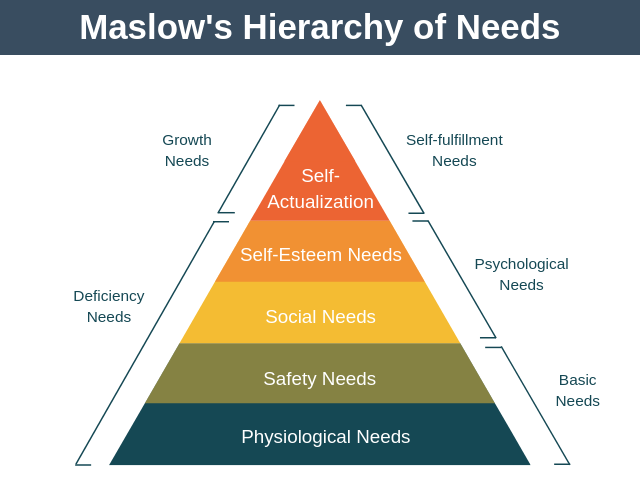
Humanistic Theories (self-determination theory)
one of the theories of motivation
Self-determination theory → focuses on three fundamental psychological needs:
Competence → need to master new challenges and skills (we feel good when we master/learn new things)
Autonomy → the freedom of choice and action without outside interference
Relatedness → the desire to form meaningful bonds with others
problems with hierarchy → why would soldiers allow themselves to be tortured, extreme dieting, etc
one was added ontop of self-actualization → self-transcendence (how can I better society?)
Motives to Achieve
Need for achievement - a relatively stable personality trait that represents the desire to accomplish tasks and attain standards of excellence
Motive for success “thrill of victory”
mastering skills &/or outperforming others (want to be able to say i’m the best)
motive to avoid failure
indicated by anxiety in achievement situations (i feel negative things will happen to me)
research suggests that having one is better than having both, because the anxiety can make u perform worse
Types of motivation goals + research study
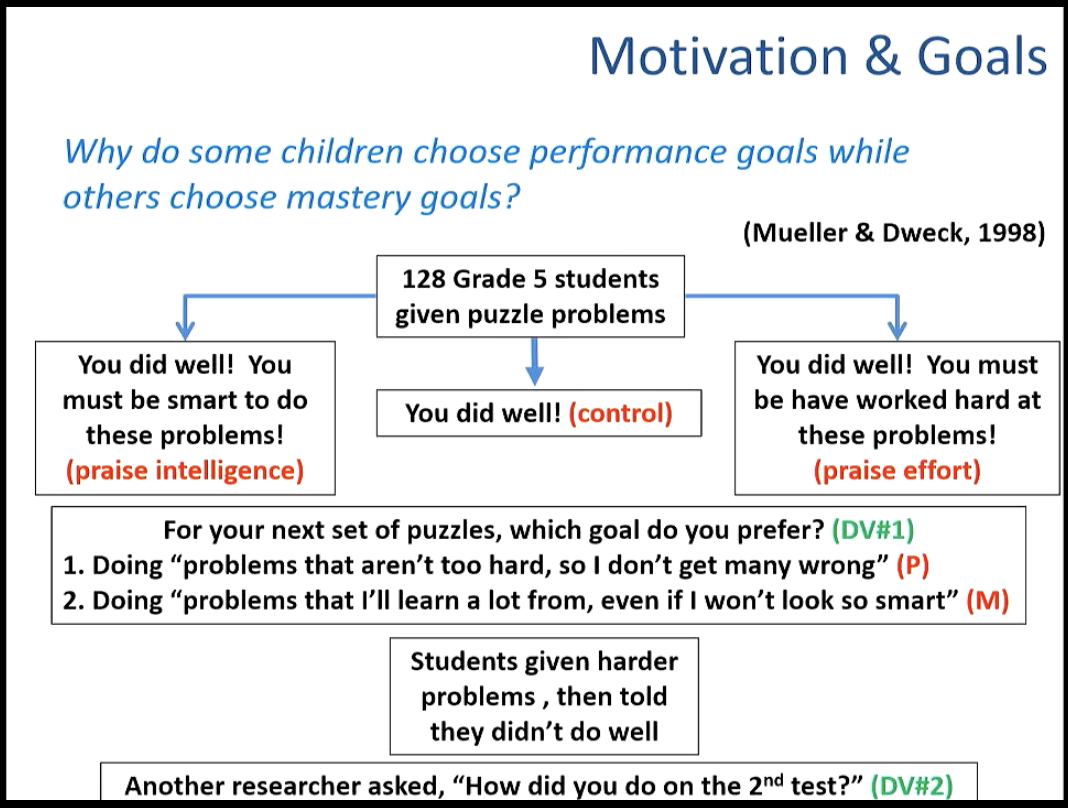
When faced with a setbakc, why do some giveup while others try harder? → It depends on the type of goals set
Performance Goals → goals that result in being judged favourably and avoiding criticism (wanting straight As)
Mastery (learning( Goals → goals that result in increased competence and skills and finding intrinsic pleasure in the task at hand (practice soccer games)
Why do some children choose one or the other? → research study
the kids who got praised for intelligence = almost 70% chose performance goals → they’d rather have easier puzzle questions so that they could do well again
almost 40% of these kids lied about their scores
kids who got praised for effort = less than 10% chose performance goals
about 12-13% lied about their scores
^ in third trail, ones that were praised for effort got higher scores while ones praised for intelligence got lower
Fixed VS Growth Mindsets (Motivations & Goals)
Fixed:
believes intelligence is fixed
responds to setbacks by giving up
avoids challenges
sees effort as pointless
Growth:
believes intelligence can grow
sees effort as crucial to success
welcomes challenges
responds to setbacks by working harder
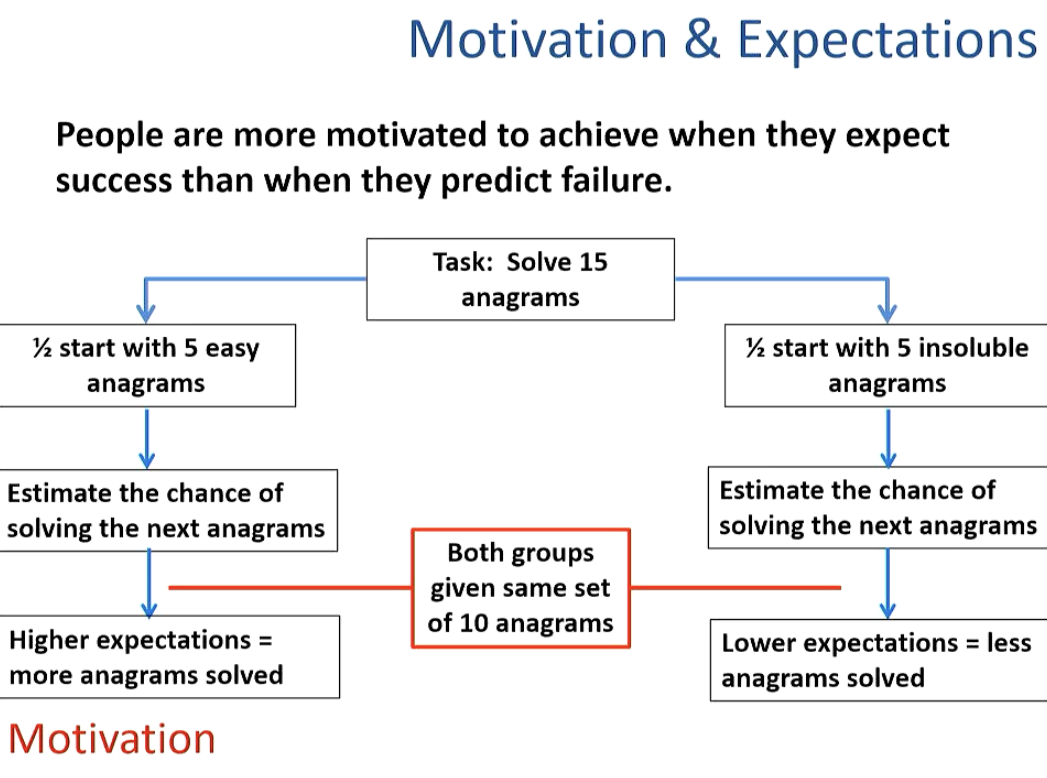
Motivation & expectations
People are more motivated to achieve when they expect success then when they predict failure
somewhat of a self-fulfilling prophecy (i’ll never understand this psych stuff → doesn’t study enough → person gives up trying → prophecy fulfilled)
Factors as to what motivated us to eat
Biological factors
Environmental Factors
Social Factors
Emotional Factors
Cultural/Cognitive Factors
Biological factors as to what motivates us to eat
The growlies? → eating because of our stomachs
Hypothalamus
Hunger Hormones
Genetics
Hypothalamus (one of the biological factors of eating motivations)
lateral hypothalamus
if you lesion area then rat will stop eating
if you stimulate it, rat won’t stop eating
Ventromedial Hypothalamus (Satieity Center - i’ve eaten enough it’s time to stop)
if you lesion → won’t stop eating
if stimulate → stop eating earlier then normally would
Stomach (one of the biological factors of eating motivations)
study:
researcher had one of their graduate students swallow a balloon (inflate it) and then measure how often there is a stomach contraction (stomach growling)
asked student to press a button every time you feel hungry
seems as though hunger pangs is linked to stomach contractions
correlations NOT causation - even when stomach nerve is cut, ppl still feel hungry
Hunger Hormones (one of the biological factors of eating motivations)
Grehlin - a hormone produce in the stomach sends “hunger” signals to the hypothalamus (appetite increaser)
Leptin - a hormone released by fat cells to inhibit hunger (appetite decreaser)
genetics (one of the biological factors of eating motivations)
appears to account for about 40-70 percent of the variation in body mass among women and men
evidence from twin studies (separated at birth)
more than 200 genes have been identified as possible contributors to human obesity
Environmental Factors as to what motivates us to eat
Portion sizes
Proximity & Visibility
Variety
Portion sizes (Environmental Factor as to what motivates us to eat) + studies
Unit bias - tendency to view a unit of food as an appropriate amount (we tend to eat a whole banana no matter size)
bottomless bowl study (tube connected to bowl) → those drinking from bottomless bowls drank 73% more than those drinking from regular bowls
container size studies → person with smaller plate thinks they ate more food than person will larger plate because of how filled up it looks
popcorn study → ppl will eat most of whatever size container they get even if it is stale popcorn
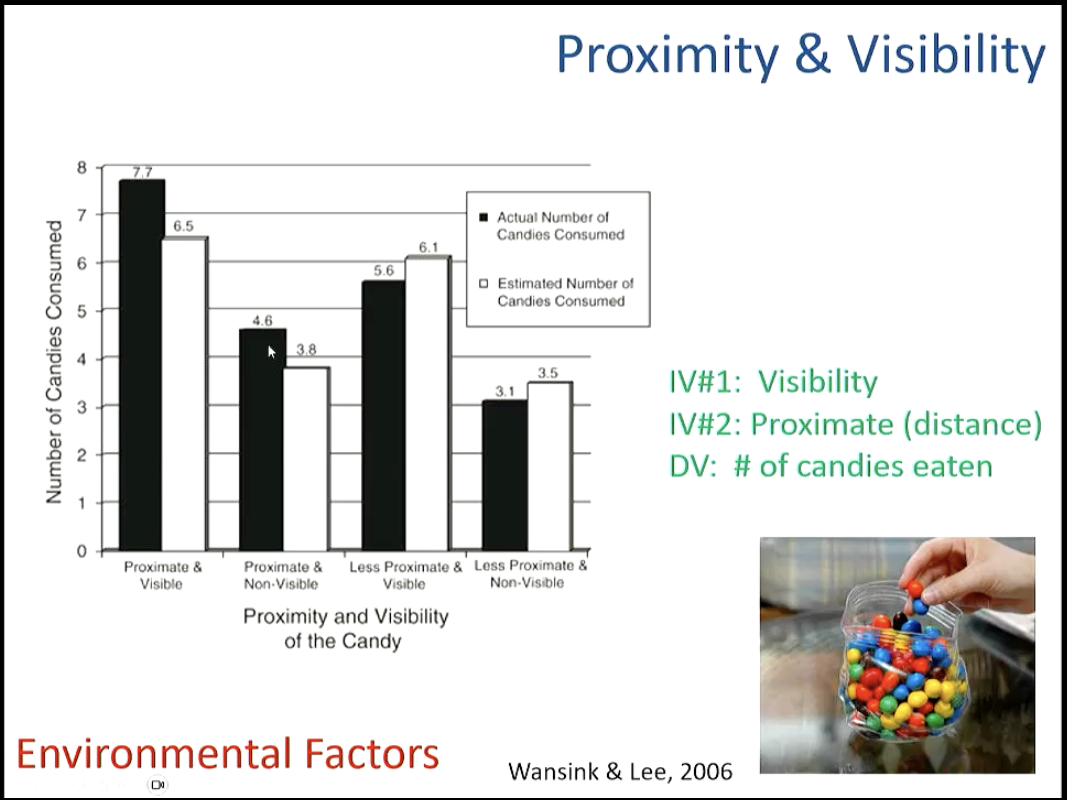
Proximity & Visibility (Environmental Factor as to what motivates us to eat)
study with a bag of candies ← different distances and bags are opaque or transparent
found most candies were eaten when bag is close & transparent
least when bag was farther and opaque
→ interview w/ ppl in office found that when its farther it gives u a couple of seconds to think about whether u rlly need the candies
Variety (Environmental Factor as to what motivates us to eat)
study found that ppl will eat more M&Ms when theres multiple colours then when there is only 2 colours (43%)
also found ppl eat more when randomly scattered then when grouped by their diff colours (69%)
Social Factor as to what motivates us to eat
eating with other ppl
study shows
when u eat with one other person instead of by urself, u eat 28% more
3 ppl → 41% more
4 ppl → 53% more
etc etc
bigger group = more eating
when eating with other ppl:
we take cues from others
we’re more relaxed, so it’s more enjoyable
we have longer meals
we’re distracted from monitoring consumption
depends on whether we’re eating w/ unfamiliar VS familiar others
Emotional Factor as to what motivates us to eat
Mood
when sad ppl eat less healthy food, more unhealthy food
when happy ppl eat less unhealthy food, and more healthy food
Obesity
It’s not a lifestyle choice of “just eat less & move more” ← causes stigma
it’s a chronic disease (medical condition)
it is driven by genes, not choice or willpower
it impacts physical & mental health
it is treatable
weight bias, stigma, & discrimination harm everyone
Why is obesity increasing? (multiple points)
The increased abundance of fast food and processed foods → we’ve evolved to hold onto our calories since there’ll be times it’s hard to find food but now all of sudden we have sm fast food
The widespread consumption of high-sugar, high-calorie drinks.→ WHO says we should have max 25 grams of sugar in a day (pop has 30-40grams - past we didn’t have this)
Sharp decline of exercise and activity levels → technological advances made us less active (remotes, roomba, etc)
Increased portion sizes of food and drink → fast food meals past vs now
Abundance of highly varied foods → predictable & routine diets result in decreases in intake (we can get whatever produce we want any time of the year)
Cultural/Cognitive Factors as to what motivates us to eat
Culture and the “Ideal” Body → whats seen as ideal or attractive has changed (muscles weren’t attractive back then - low level jobs - but is attractive now)
Perceptions of the Self/Ideal → theres a difference between what women think men find attractive and what men actually find attractive
biological influences on development (biological level of analysis)
Biological:
Genes → how do our genes impact who we are? health outcomes? codes for intelligence, personality, etc
nutrition → in womb, is mother eating right nutrients etc? after birth is child eating well?
infectious diseases → are they vaccinated? exposed to any?
environmental factors → pollution, drugs, negligence, abuse?
psychological influences on development (psychological level of analysis)
Psychological ← all impacts how they grow up and develop
temperament
personality
gender
cognitive ability
Social influences on development (social lvl of analysis)
Social
family environment
media
school environment
peers (will have greater influence as they get older)
cultural factor on development (cultural level of analysis)
Cultural
maternity leave (mom) , paternity leave (dad)
Attachment
close, emotional bonds of affection that develop between infants and their caregivers (usually with moms)
most cultures, moms are the ones that get maternity leave
Separation anxiety
emotional distress exhibited by the infant when they are separated from people they have formed an attachment to
will usually start seeing it at 6-8 months → peaks at 14-18 months and declines after
Baby Chimp studies
Why are babies attached to their mothers?
Monkey studies:
purposely separated infant chimpanzees from their mom
→ if you ask moms “is your baby attached to you because you feed the baby?” they typically say no “its because I respond & love baby”
chimpanzees were raised by two surrogate moms (one made of wire and other is made of soft cloth + heating device)
half was fed by wire and other was fed by cloth
researchers looked at who chimps ran to when scared
if attached because of reinforcement from feeding theyd go to own moms
but they all went to warm cloth mothers
Evolutionary theory as to why babies & parents are attached to eachother
John Bowlby was interested in monkey studies → suggest these babies go to softer mother (no conditioning)
believed attachment can be explained by evolutionary theory
proposed that there must be a biological basis for attachment (its in our genes for parents & babies to be attached to eachother)
survival of baby → infant smiles, coos, cries
when baby smiles/cries/etc is to get parents attention (i’m hungry, feed me, etc) → child’s bonded to caregiver because it’s essential to their survival
reproductive fitness of parents → parents care for, protect, and raise child to reproductive age so they can pass on their genes
parents care about child because they need to make sure that their genes continue on
Darwin’s Evolutionary theory
has 2 important pieces to it:
survival
genes can have mutations (diff versions) ← variability = environment will be better suited for some members of a species compared to others
ex. dark moths VS white moths
white moths survive because buildings were white (england)
but after industrial revolution (pollution & fog) dark ones survived more
natural selection → survival of the fittest
Reproductive fitness - passing on genes to successive generations
→ peacocks are bright but they still survive
need to be able to reproduce and make sure next gen survives
grandma hypothesis → as women get older they have less and less energy to take care of their young, at some point it’s better to stop having children and help take care of it (from elephants ← herds keep grandmas around to help take care of babies)
Ainsworth’s Strange Situation (what did they look at?)
Study where they looked at how babies reacted to being left alone, left w/ stranger, and being reunited with caregiver
Observed four aspects of the child’s behaviour:
Amount of exploration (ex. playing with new toys) the child engages in throughout
child’s reactions to departure of its caregiver
stranger anxiety (when the baby is alone with the stranger)
child’s reunion behaviour with its caregiver
found patterns of attachment
Secure attachment
Children with secure attachment style will demonstrate these behaviours:
separates from mom & explores (while mom is still in room)
seeks comfort and is easily consoled when threatened or scared (when stranger comes in, baby goes back to mom)
Does not avoid contact when mom approaches
When reunited with mom, easily soothed if upset
prefers mom to stranger
Insecure (anxious-ambivalent) attachment
children with this will show this: → may result from parents who are having a hard time themselves & can’t respond appropriately/consistently when necessary
little exploration & wary of stranger
very upset at separation from mom
not comforted when mom returns or attempts to soothe child
may show anger towards mother at reunion
Insecure (avoidant) attachment
child shows these:
avoids contact with mother especially after absence
doesn’t seek contact from mom
doesn’t resist contact from mom
shows no preference for mom or stranger
Insecure (disorganized/disoriented) attachment
child shows this:
dazed behaviour, confusion, apprehension
child may show contradictory behaviour patterns (i.e. moving towards mom but looking away)
Patterns of attachment (types)
secure attachment
insecure attachment (anxious-ambivalent)
insecure attachment (avoidant)
insecure attachment (disorganized/disoriented)
Criticisms of Ainsworth’s strange situation
Not a consistent indicator of attachment
may change over time (could do it again after a few months and show diff style)
may change if home environment changes (mom goes back to work, may see changes)
can be different with different caregivers (secure with one, insecure w other)
alternative measures of attachment → retrospective accounts (important to measure attachment in different ways) ← maybe ask babies when older “were they there for u?”
Long-term consequences of attachment
researchers did longitudinal study: followed a group of children over time
strange situation at 12 & 18 months
follow-up at 2, 6, 7, 8, 13, 19, 26 years
studied behaviour at home, in school, at summer camp ( invited kids who did strange situation to summer camp) ← research assistants watched and coded behaviour
what they found:
kids w/ secure
more self confident
better social skills
more positive emotions
more friendships
more complex play
kids w/ insecure
isolated from peers
passive
hyper
aggressive
Attachment & Love in Adulthood
kids w/ secure attachment as adults:
easy to feel close to others
describe relationship as trusting
rarely worry about being abandoned
fewest divorces
kids w/ insecure anxious-ambivalent as adults:
report more relationships that are volatile & marked with jealousy
preoccupied with love & worries about rejection
kids w/ avoidant as adults:
hard to get close to others
relationship lacks intimacy & trust
Why are there long-term consequences in later life relationships (attachment)?
Attachment processes provide the basis for adult expectations regarding social relationships→ were my caregivers trustworthy and dependable?
if ur parents are responsive to you when you’re young in that first year, you do tend to continue to be fairly responsive
Attachment & culture
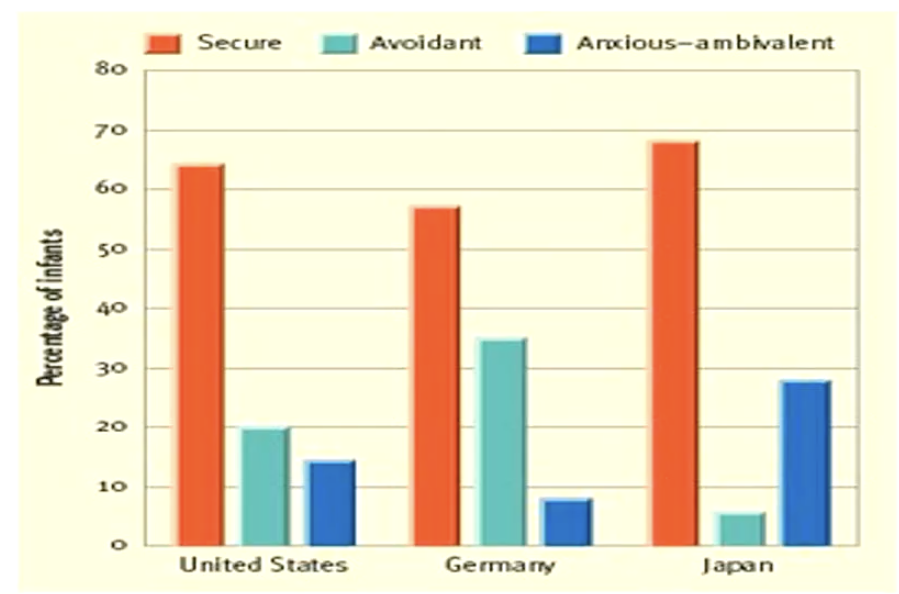
there are differences in diff cultures/countries
attachment can be impacted by culture
japan → more insecure-anxious
north america → insecure avoidant
Attachment & temperament
attachment can be impacted by temperament of baby
temperament → a babies characteristic mood, activity level, sensitivity, and emotional reactivity
how responsive/consistent a parent is also depends on how responsive/consistent a baby is
easy VS difficult
slow to warm-up to ppl
behavioural inhibition
Cognitive Development
How we acquire the ability to learn, think, communicate and remember over time
The Active Learner (Jean Piaget’s Cognitive Theory)
Piaget believed that children are not passive observers but actively explore the world around them
believed children’s development is marked by stages of change in thinking followed by periods which their understanding of world stabilizes
Cognitive development is the result of both interaction with environment and maturation → as brain is changing u need to interact with environment as well
proposed that cog change is marked by equilibration: maintaining a balance between our experience of the world and our thoughts about it
Assimilation
interpreting new experiences in terms of existing mental structures (schema) without changing those structures
putting new event into existing mental structures
ex. thinking puppies have four legs, are fuzzy, are tall → sees cat and calls it puppy
Accommodation
forming new or changing existing mental structures (schema) in order to explain new experiences
changing/making mental structures to put in new event
ex. thinking puppies have four legs, are fuzzy, are tall → sees cat and then:
adds “barks” and “can’t climb” onto puppy schema
and makes new cat schema
Schema
an organized cluster of knowledge about a particular object, concept, or event
ex. mammals → milk, warm-blooded, live birth, etc
Stages of Cognitive development (piaget)
Sensorimotor stage (0-2y)
Preoperational stage (2-7)
Concrete operational (7-11y)
Formal operational stage (12+)
Sensorimotor stage (0-2) (piaget)
one of the stages of cognitive development
motor → getting around, moving
sensory → using your senses to learn about the world
during stage you’ll see:
appearance of symbolic thought (saying teddy bear, and image of teddy bear appears in child’s mind)
object permanence slowly develops → over time, child starts to recognize when it can’t see something, that the thing is still there (moving waterbottle behind desk)
deferred imitation slowly develops (hand gestures for itsy bitsy spider) → not having it means they can’t remember it (do it) without seeing it happening infront of them
Preoperational stage (2-7) (piaget)
one of the stages of cognitive development
their mental imagery improves, but there’s also still a number of shortcomings during this stage
Difficulties with:
conservation → understanding that the physical properties of volume/mass is conserved (changing shape of playdoh doesn’t change volume of playdoh)
tend to centrate → focus on one aspect of that physical property (ex. height → taller = bigger)
reversibility → if pour liquid from short cup into tall cup, they don’t understand that it could be poured back into short cup again and still be the same
ex. break a lego set → “its broken and can’t be fixed now”
hierarchical classification
and they display:
Egocentrism → only see things from their perspective (do u have a sister? yes. Does ur sister have a sister? no.)
animism → think inanimate objects as real live things
a developing theory of mind → other ppl dont see the way they see things from your perspective
Theory of mind
the ability to reason about what other people might believe, think, or feel
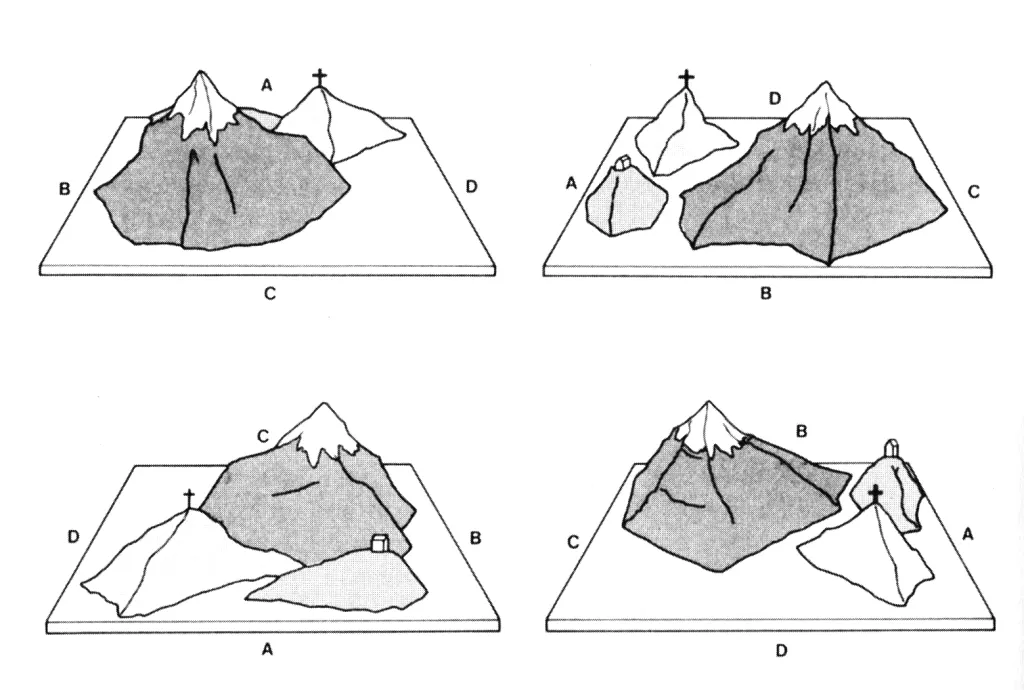
Piaget’s Three Mountain Problem
doll on one side, child on other
“what does doll see?” → child doesn’t understand that the doll would have the opposite perspective
Concrete Operational stage (7-11y) (piaget)
one of the stages of cognitive development
de-centration/conservation → understand if you pour liquids back and forth its the same volume
understand reversibility
decline in egocentrism
understand hierarchical
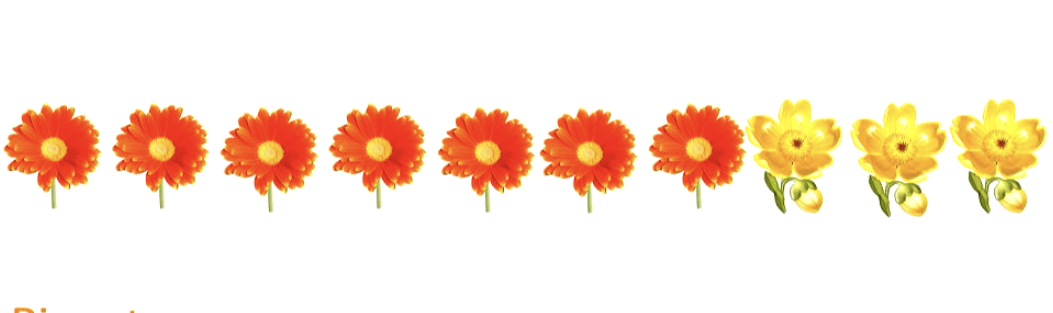
ex. before this stage if asked “are there more daisies then buttercups?” they say yes but if there are more daisies than flowers? they say yes
→ kids can now perform operations like multiplication and division
Formal operational stage (12+) (piaget)
one of the stages of cognitive development
they become more:
abstract
systematic
logical
reflective
at this stage, development continues but not in nature of the thinking, just in complexity
you can start asking them about justice & love
Criticisms of Piaget’s theory
Underestimation of cognitive development → piaget underestimated how quickly kids developed
some of the ages he mentions for each stage, it’s actually earlier (research shows)
Individual differences in development → not every kid will go through each stage at the same time, some go faster/slower
mixing → there’s often this continuous blending of stages (before finishing one, you can start other)
Environmental influences on timetable
different cultures may develop slower/faster ← depends on what’s normal for that culture
Kohlberg’s stage theory
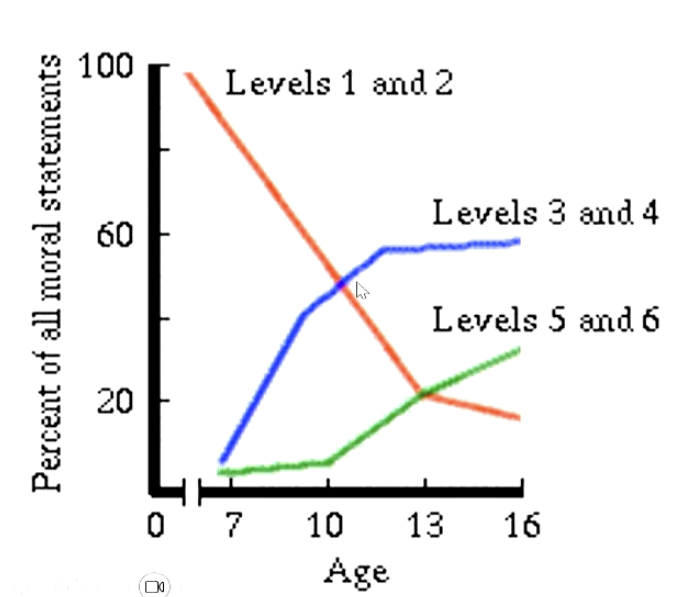
theory of moral development
depending on how children would answer questions like Heinz’ problem, Kohlberg would slot them into different stages
the different stages:
Pre-conventional stage
Conventional
Post-Conventional
in graph → lots of pre-conventional early on but goes down a lot from there
Pre-conventional stage
one of the stages of kohlberg’s stage theory
believes right & wrong based on reward/punishment
ex. looking both ways before crossing street or else parents will punish
Conventional stage
one of the stages of kohlberg’s stage theory
Social approval → being good citizen or parental approval of being a good child
Rules necessary for society
ex. looking both ways before crossing street to keep everyone safe
Post-Conventional
societal rules are fallible, not absolute
more thoughts about justice & equity
ex. looking both ways before crossing the street, but if its 2am and no one is driving, who cares?
Criticisms of Kohlberg
Stage theory issues → you don’t go thru each stage one by one, there’s more blending (can start next one before finishing one)
Moderate correlation with moral behaviour → what you should do VS what ppl do ← doesn’t account for other factors (reading about smn else and saying what he should do VS you actually being in that situation)
Cultural Bias → other cultures might not have same reasoning
Gender Bias → lot of it is based on boys, females tend to be a bit more relationship focused (they may respond differently)
Causal direction (moral reasoning → emotions?) → in certain cases we FEEL whats right or wrong before we even think about it (incest iclicker)
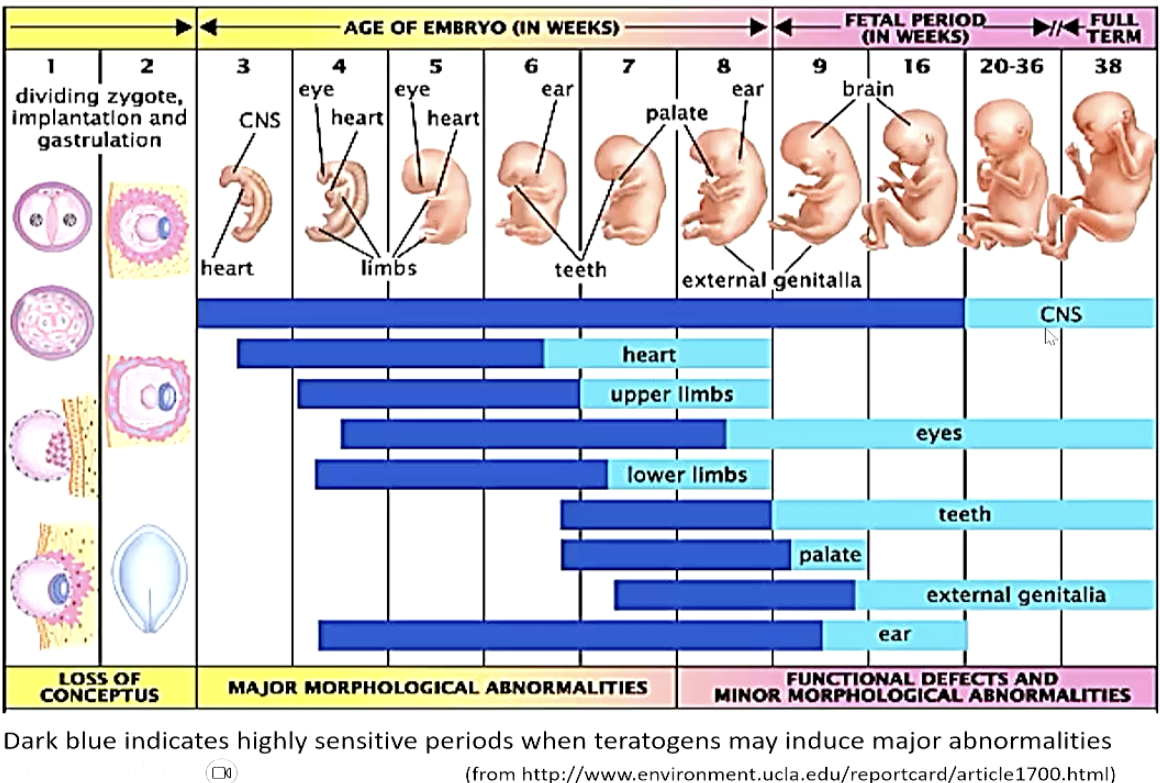
Teratogens (+ what organ is most vulnerable)
an obstacle to fetal development
environmental (external) factors that can exert a negative impact on prenatal development
viruses/illnesses (if mother has HIV/AIDS that can be passed to child)
chemicals
medicines & drugs (alcohol, etc)
→ dark blue bars is where most sensitive to teratogens
the brain is most vulnerable to teratogens due to its long period of maturation relative to most other organs
Crack Cocaine studies (teratogens)
219 pregnant mothers from same hospital
118 non-exposed & 101 cocaine exposed
all from low SES backgrounds
Cocaine use (IV) verified via:
self-report of cocaine use
urine test before and after baby delivered
babies’ meconium tested
IQ scores of all babies at age 4 were the same (82) → 82 is pretty low, researchers found it may be due to low SES (parents aren’t around much, less brain stimulation)

