Week 4 - Human Evolution
 Studied by 0 people
 Call Kai
 Learn
Learn Practice Test
 Spaced Repetition
 Match
Match Flashcards
 Knowt Play
1/26

There's no tags or description
Looks like no tags are added yet.
Name | Mastery | Learn | Test | Matching | Spaced |
|---|
No study sessions yet.
27 Terms
when did primates evolve?
Primates evolved with the extinction of dinosaurs about 65 mya
what makes humans human?
bipedal locomotion → evolved as an efficient way for apes to travel on the ground
quadrupeds are faster but humans are good LONG DISTANCE
good way to keep cool in open country with less solar radiation and more wind
leaves hand free to carry things
derived dentition and jaw musculature
larger brains in relation to body
slower development
language and culture
when did bipedal locomotion and derived dentition and jaw musculature evolve
begin to appear 7-6 mya, australopithecines (4-2 mya) showed these traits
when did larger brains in relation to our body size
begin to appear in the genus homo around 2 Mya
when did language and culture begin to form
at least by 200 thousand years ago
where and when were australopithcines
pliocene epoch (5.3-2.6 ma)
who was lucy
An australopithecus afarensis - a bipedal hominid from 3.5 mya - found in East Africa
what are the differences between australopithecines and modern human
australopithecines were also fully bipedal and sexually dimorphic but were much smaller than humans
australopithecines had brains that were about 400mL (similar to chimps), humans brains are around 1450 cubic centimeters
when did the genus homo appear - what changed
homo erectus → around 2 mya, climate got colder in the Pleistocene (1.6ma- 12ma), led to isolations of populations and adaptions to changing environments
brain size also doubled from 400cc in australopithecine to 8— in hoo ergaster/erectus
how did homo ergaster compare to modern humans?
developed slower than early hominins, but faster than modern humans
shorter childhood than modern humans with less learning
tools became more complex → achulean tools (mode 2, 1.6MA) - hand axes, cleavers and picks
fire invented
what were the first (mode 1) tools like
Oldowan stone tools, used by australopithecines or early homo - unchanged for a mil years 2.5-1.7ma
what was the step after homo erectus? what tools did they use?
Homo heidelbergensis → much larger brain 1200 cc, used mode 3 stone tools
what was the step after Homo heidelbergensis?
Homo neanderthalis (600,000 → 33,000 years ago), discovered in the Neander Valley in germany.
archaic humans
adapted to colder climate, shorter & stockier than us
larger brains 1520 cc compared to our 1450 cc
were neatherthals similar to us?
Hyoid bone as possible evidence for language
made complex tools and hunted large prey
buried their dead, perhaps without ritual
cared for their sick
few lived past 40y/o, skeletons show evidence of arthritis, gum disease, fractured skills, lesions, stab wounds
who evolved in Europe & Africa
Neanderthals evolved in Europe, Hominins in Africa were becoming Homo sapiens 190-90,000 years ago
how were Homo sapiens similar to us
Anatomically modern (100-300Ka)
modern behaviour in paleolithic era 40-50Ka e.g. art
more complex (mode 4) tools
built shelters
domesticated dogs
ritual burials
arts & crafts
no gap between emergence of modern humans and modern behaviour
when were homo sapiens the only hominin left? why?
30ka → neanderthals were likely wiped out by competition rather than direct conflict or disease
neaderthals interbred with early h. sapiens, about 1.5-2.6% of DNA in non-Africans due to interbreeding with Neanderthals - some of the genes associated with higher cholesterol, more belly far, sunburn, arthritis and schizophrenia
who are the homo floresiensis & denisovans
homo floresiensis were still living on the island of Flores, Indonesia until 14ka - shares many features with Homo erectus, uses mode 4 tools
Denisovans, discovered in Siberia 41ka
outline the Piltdown Man Hoax of 1912
tried to make it seem like humans evolved in England → exposed as a hoax in 1953
Dawson forged it using medieval skull, orangutan jaw, chimp teeth
outline the multiregional hypothesis
Humans evolved about 2ma from homo erectus - different populations evolved in Africa, europe, asia, and Australasia with gene flow between them
outline the singe origin ‘out of Africa’ hypothesis
more widely accepted → modern humans evolved around 200 ka, 1st wave of migration to europe from northern africa around 130 ka and the second wave from southern africa to the whole world
what are ongoing debates in this field?
is Homo heidelbergensis a distinct species?
are h. ergaster and h. erectus the same species
individual variation may be misclassified as different species
what does modern human DNA look like
humans have little genetic variation compared to great apes
during the course of migration, humans would have gone through population bottlenecks, decreasing genetic diversity
differences between human and chimp hunters
chimps use tools as did early homonins, stone tools first appeared 2.5Ma
human foragers collect, extract and hunt foods
humans rely more on hard-to-acquire foods than apes
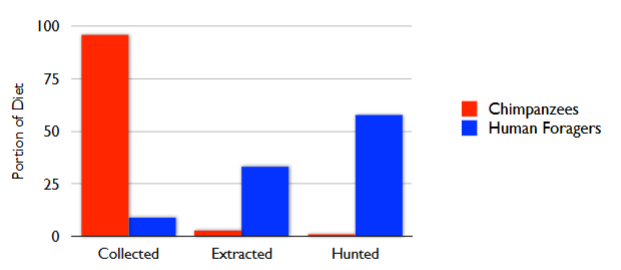
expensive tissue hypothesis
big brain is an expensive thing to have in your body, but gives you the resources to get more food
meat, especially cooked requires smaller guts allowing more energy for larger brains
outline the hunting sexual division of labour
women mainly forage, men mainly hunt → only possible if men and women share
Men usually bit bigger and stronger ( but this is for fighting other males)
BUT - women do hunt (evidence during the stone age and possibly much earlier), females in wolves etc.
Tend not to because of the burden of childhood
may have led to reduced dimorphism

how is food sharing different in chimps and humans
Chimps mostly eat what they collect, mothers share with infants, males share small amounts of meat
Food sharing is extensive in humans
 Note
Note  Flashcards (53)