PB 200 Exam 2 Study Guide
 Call Kai
 Learn
Learn Practice Test
 Spaced Repetition
 Match
Match Flashcards
 Knowt Play
1/115

Name | Mastery | Learn | Test | Matching | Spaced | Call with Kai |
|---|
No analytics yet
Send a link to your students to track their progress
116 Terms
major functions of roots
anchor plant
absorbing water, minerals, and transporting them to stem
may be modified for storage → carrot/sweet potato
prevent erosion → ecosystem service
morphology
outward structure and appearance
2 types of root morphology
Fibrous and Taproot
Fibrous Root
smaller roots individually
more branching → increase surface area
more spread out
grow closer to soil surface
many monocots
TAP ROOT:
larger
less branching
less spread out
grow deeper
(many dicots and gymnosperms)
Root anatomy
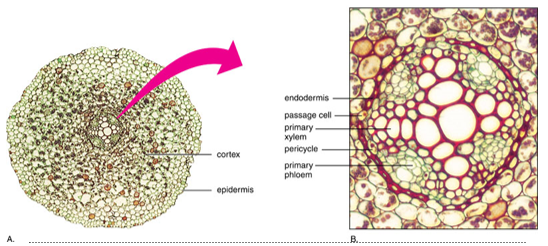
Roots are composed of several tissues, some of which are unique to them
stele of a root or stem
the vascular tissues derived from primary growth
What does the stele of a root include?
In roots, it includes the pericycle (developed from the procambium) and all tissues internal to it.
What do monocots typically have in the center of their roots that is not involved in long-distance transport?
pith (parenchyma)
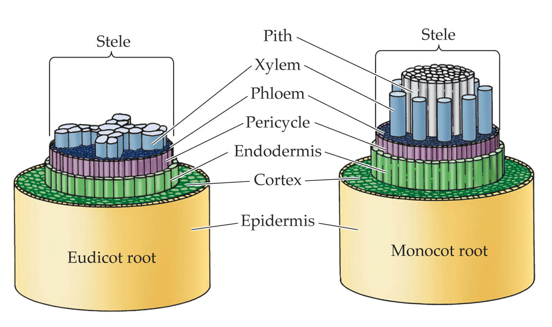
Specialized Tissues Found in or on Roots
Pericycle
Root Hairs
Endodermis
Pericycle
vascular tissue → type of primary growth and origin of lateral/branch roots
Root hairs
unicellular extensions of the epidermis
function: increase surface area and absorption
thin/fragile/temporary
Endodermis
A ground tissue that has a waxy, hydrophobic Casparian strip/layer around almost all of its cells. This strip or layer prevents water and nutrients from being transported between cells. Water and nutrients must be transported through the living components of the cell.
What is the pathway of water from the soil into and through the root to the stem?
Two major transport pathways:
Apoplastic
Symplastic
Apoplastic transport
transport between plant cells along cell walls or intercellcular spaces
Symplastic transport
(within the same cell) transport from cell via plasmodesmata. This type of transport is required at the endodermis.
Nitrogen-fixing bacteria, including Rhizobia species (associated with the legume family of alfalfa, peanuts, soybean
Bacteria that “infect” root hair cells and migrate into the cortex (but no further)
Stimulate root cell division and enlargement
Results in the formation of nonharmful nodules
The plant receives fixed nitrogen
Plants can’t access ___ so they rely on bacteria to break it down into ammonia.
nitrogen
nitrogenase
enzyme produced by bacteria that makes this conversion possible
What do bacteria get in exchange for a plant?
sugar
Mycorrhizae
occur in or on 80% of land plants
evidence suggests that mycorrhizae extending from roots can connect or network the root systems of nearby plants
two types:
Endomycorrhizae:
Ectomycorrhizae:
Endomycorrhizae
fungal cells penetrate epidermis and cortex and grow inside of plant cells
Ectomycorrhizae
fungal cells grow outside/between epidermis and cortex cells
Major Functions of Stems:
conduct H2O and minerals from roots to leaves
provide aerial support for leaves
some are photosynthetic
conduct nutrients via phloem to roots , flowers, young leaves
some modified for storage → potato/ginger
some horizontal and run just above or below ground
Some stems are diminished (less prominent) but still serve important functions!
carnivorous plants → stems are leaf-anchoring
Herbaceous stems
generally have not undergone significant secondary growth and are often green, fleshy, and flexible
woody stems
have undergone secondary growth and developed a periderm. They are typically not green, are harder or firmer, and less flexible.
True or false: some herbaceous stems can become woody over time
true
Examples of species that are herbaceous at maturity:
monocots: lily, orchid, some grasses, onion
dicots: mint, parsley, beans, Coleus, clover
Examples of species that are woody at maturity:
monocots: palm, date, coconut
dicots: apple, oak, maple, Azalea, pecan, redbud
node
a point of attachment, typically of a leaf or a flower
internode
the area of the stem between 2 nodes
axillary bud
a structure composed of a dormant apical meristem and scales (modified leaves) covering it. Occurs specifically in the axil, which is the angle between a leaf attachment and the main stem axis.
terminal bud
a dormant apical meristem covered by scales at the apex or end of the stem or the stem branch
leaf (petiole) scar
the location where a leaf was once attached. Vascular bundle scars may be visible.
terminal bud scale scars
a ring-like array of scars indicating the location of a previous terminal bud.
lenticels
small perforations in the periderm of woody stems through which limited gas exchange may occur.
Opposite arrangement
2 leaves per node (dogwood, maple, ash)
Alternate arrangement
1 leaf per node (ex. oak, hickory, tulip tree)
whorled
3 or more leaves per node (ex: catalpa, oleander)
Monocot Stem Anatomy
vascular tissue arrangement: scattered
presence of pith: no
cortex cells: yes
Dicot Stem Anatomy
vascular tissue arrangement: in a ring
presence of pith: yes
cortex cells: yes
Potato
Solanum sp.
Nightshade family
Solanaceae
Stem
Dicot
Temperate climate
Sweet Potato
Ipomoea sp.
Morning glory family
Convolvulaceae
Root
Dicot
Subtropical
Yam
Dioscorea sp.
Yam family
Dioscoreaceae
Stem
Monocot
Tropical
Nonbotanical factoids:
the “candied yams” you eat are most likely sweet potatoes
NC is the #1 sweet potato producer in the USA
-phyll
leaf
phylloplane
surface of the leaf
phyllosphere
microclimate of the leaf
What processes or activities occur in the leaf?
photosynthesis
storage
protection (spikes on cacti)
transpiration → loss of water vapor via stomata
climbing → tendrils
prey capture (carnivorous)
LEAF MORPHOLOGY:
Some leaves may have leaf-like appendages at their bases called stipules.
Not all leaves have a distinct petiole.
Leaves are perhaps the most varied plant structures. Botanists have developed ways to describe them based on certain characteristics. Among the most common, in addition to their arrangement on the stem, are the following:
BLADE SHAPE (many types)
specific appearances of the base and/or the tip of the blade may be used
BLADE MARGINS (again, many types)
Pinnate, Palmate, (Netted/reticulated forms → common in dicots)
(Pinnate. Pinna: feather. Midrib/midvein with lateral veins and minor veins)
(palmate: palm-like, several major veins radiate from base)
and Parallel/Linear (More common in monocots)
COMPLEXITY
Simple: One intact blade
Compound: Blade separated into leaflets
Leaf Anatomy
Epidermis (lower and upper): outer coverings of leaf that produces cuticle
numerous stomata regulated by guard cells
Cuticle: prevents water loss
waxy, hydrophobic
provides protection
Trichomes: hairs on leaf → reflect light, decreases air flow across leaf, may be defensive, reduce water loss
Mesophyll: bulk of blade, ground tissue, may be columnlike in shape → if so, palisade
may be air spaces between cells → sponge
Vascular Bundle: veins: xylem and phloem surrounded by bundle sheath cells
Some anatomical differences between dicot and monocot leaves:
Mesophyll Composition:
Monocots: may be spongy, typically not palisade
Dictors: often have palisade and spongy mesophyll
Stomatal Density (average number of stomata per cm²):
Monocots:
Corn → Upper: 5,500, Lower, 6,800
Oat → Upper: 2,500, Lower: 2,300
Wheat → Upper: 3,300, Lower: 1,400
Dicots: (lower is usually much higher)
Bean → Upper: 4,000, Lower: 28,000
Coleus → Upper: 0, Lower: 14,100
Geranium → Upper: 1,900, Lower, 5,900
spinose
sharp projections of leaves
spines
modified leaves (ex: cacti, Acacia) → have vascular tissue, protection against predation, emerging of some leaves may be spinelike (holly)
thorns
modified stem branches (ex. honey locust, some citrus) → vascular tissue, subtended by leaves
prickles
epidermis and cortex of stems or leaves (ex: rose, greenbrier) → no vascular tissue “shark fin” appearance
stinging (urticating hairs)
modified trichomes (ex: stinging nettle)
What do carnivorous plants mostly absorb?
macronutrients → N, P, Ca, Mo, poor soils
What do most terrestrial carnivorous plants possess?
small thickened stems anchoring highly modified leaves for trapping prey. The trapping mechanism is usually classified as being active or passive. Prey attraction may be visual or chemosensory.
Venus Flytrap
NC and SC only. Active.
Sundew
semi-active, leaves wrap around prey
Pitcher Plants
passive, pitfall traps, insect drowns
bladderworts
active
bracts
specialized leaves, usually below flowers that are different in form or color → attract pollinators (ex: poinsettas, dogwood → leaves inside are the flowers actually)
Tendrils
there are tendrilating stems AND tendrilating leaves: (passion flower, pea, Virginia creeper, morning glory, wisteria)
mechanical support
direct growth
Reproductive Leaves:
asexual propagation → plantlets
produced on leaf margin → Kalanchoe (mother of thousands)
Xerophytes/water-conserving succulents
(ex: aloe, jade, cacti, sedurn)
some may have extremely deep root systems
thickened stems/leaves
hydrophytes
water lily, lotus, rushes
sun/shade leaves
2 forms of leaves on the same plant → dimorphism (ex. maple)
strategy to maximize light capture
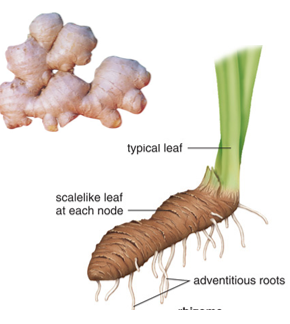
rhizome
horizontal underground stems
short internodes
thickened for storage
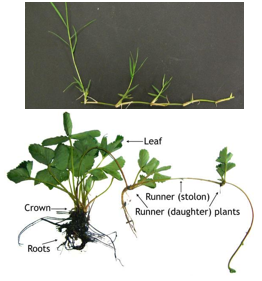
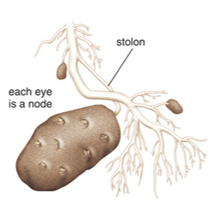
stolon
horizontal stem aboveground or underground
longer internodes
smaller in diameter
some produce asexual plantlets
tuber
part of stolen that is modified for storage e.g. potato
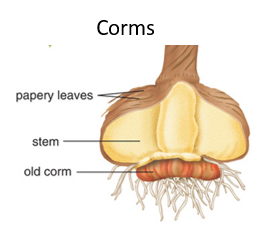
Corm
storage stem covered by thin or scaly leaves
meristem grows vertical stem
Crocus, Gladilous, Corrieflower plants
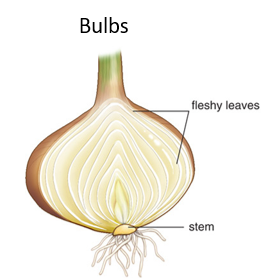
bulb
fleshy storage leaves covering a small stem
onion, amerylies, daffodil, hycanith, garlic, shallot
abscission
cutting away
environmental factors of leaf abscission
day length, water, temperature
hormonal changes → degradation of cell walls of petiole, suberinization of cell layer nearest stem → leaf scar
What is happening when leaves change color and drop during the fall?
Breakdown and transport of cellular components
cholorophyll broken down of some minerals
nutrients transported to stems and roots
reclamation of nutrients
Pigments develop or are unmasked.
Reds: anthocyanins
Tans or browns: tannins/ cell death
Yellows or golds: carotenoids → plastids
Other hues (oranges, etc.): combo of thereof
leaf drop→ abscission “to cut away”
due to reduced water, temp, daylength, or hormonal changes
Metabolic reactions
Biochemical reactions carried out to maintain homeostasis.
ATP
a denotive triphosphate → energy currency of cells
ATP →
ADP + Pi diphosphate
The role of NADPH:
NADPH → NADP^+ + H + 2e (which can be donated to another molecule)
6 H2O + CO2 → 6O2 + C6H12O6
bulk reaction equation for photosynthesis
6 H2O → 6O2 is from ___
light
CO2 → C6H12O6 is from ___
chloroplasts
C6H12O6
glucose
Is glucose the first product of photosynthesis?
No
sunlight is __
electromagnetic energy
electromagnetic energy
radiation that travels through space in waves
Artifical light
portion of spectrum → visible (mostly)
grow lamps → optimized for photosynthesis and far red light
Plant pigments
chlorophyll a, chlorophyll b, accessory pigments
Chlorophyll a
primary pigment
Absorption spectra: blue/violet and red visible
Functions: convert light energy into chemical energy via loss of electrons
Chlorophyll b
Absorption spectra: blue/green and orange
Functions: expands on spectrum of chl. a and can transfer energy to chl. a
Accessory pigments
Absorption spectra: most absorb in UV spectrum of some green
Functions: carotenoids
Transfer light energy to chlorophyll → protection
Dissipate light energy excess short wave
How did we first find out that photosynthesis is most active in the blue- and red-light spectra?
Red light is absorbed effectively by chlorophyll which ranges within this wavelength. It is utilized in the maximum amount. This red light is followed by blue light which falls next to red in the visible spectrum, thus it is also absorbed in a very effective way for photosynthesis.
Photosynthesis reactions can be divided into 2 general “sets” of reactions:
Light-dependent reactions
Light-independent reactions
light-dependent reactions
in and across thyaloid membranes of chloroplasts
H2O split
O2 byproduct
ATP and NADPH produced
light-independent reactions
or “carbon reactions” or “dark reactions”
in chloroplast stroma
CO2 is input → ATP and NADPH used
3-carbon compounds produced
Where are chloroplast pigments anchored to?
thylakoid membranes
What do chlorophyll a and b form when they cluster together?
light-harvesting complexes and a reaction center.
photosystems (PS)
protein complexes of 200-300 pigment molecules (from chl. a and b)