AP Bio chapter 10
 Call Kai
 Learn
Learn Practice Test
 Spaced Repetition
 Match
Match Flashcards
 Knowt Play
1/60

There's no tags or description
Looks like no tags are added yet.
Name | Mastery | Learn | Test | Matching | Spaced | Call with Kai |
|---|
No analytics yet
Send a link to your students to track their progress
61 Terms
Which of the following would NOT contribute to genetic variation?
Crossing over of sister chromatids
Which of the following accurately describe anaphase I and anaphase II? Select all that apply.
At the end of anaphase I, each chromosome is composed of two chromatids and at the end of anaphase II, sister chromatids have separated.
Homologous chromosomes separate during anaphase I and sister chromatids separate during anaphase II.
Which of the following is a true statement concerning meiosis in males and females?
Spermatogenesis in males results in four functional sperm while oogenesis in females results in only one egg.
The cell formed after fertilization of an egg by a sperm is called a(n)
zygote
If a sperm cell contains 8 chromosomes, it comes from an animal whose regular body cells have _____ chromosomes.
16
Dogs have 39 chromosome pairs. Based on this information, determine which of the following statements are true. Select all that apply.
all of the above
true or false:In meiosis, the reduction from 2n to n is accomplished by sister chromatids splitting apart and migrating to opposite daughter cells
false
If gametes had the same number of chromosomes as body cells, and an organism had 12 chromosomes in its body cells, how many chromosomes would it have after three generations? How does this illustrate the necessity of meiosis for gamete formation?
After 3 generations, the cells would have 96 chromosomes. This shows how essential it is for meiosis to occur because, if a gamete does not undergo meiosis and fertilization still occurs, the number of chromosomes would double each generation.
Another name for a tetrad is a
bivalent
If a cell contains 12 chromosomes at the end of meiosis I, how many chromosomes will the daughter cells contain at the end of meiosis II?
12
During which stage of meiosis does crossing-over occur?
prophase I
Which of the following is not a characteristic of homologous chromosomes?
they carry the same alleles for all traits
Why is crossing-over important?
It increases the likelihood that daughter cells contain different genetic material.
Meiosis accomplishes all of the following EXCEPT
growth and repair
Sources of genetic variation in sexually reproducing organisms include(s) which of the following?
all of the above
To what does the term chiasma refer?
a structure that holds together homologues during crossing-over
During which stage of meiosis are the bivalents arranged along the equator of the spindle?
metaphase I
At which stage of meiosis is each chromosome composed of a single chromatid?
telophase II
During which stage of meiosis do the homologous chromosomes separate?
anaphase I
Which statement is NOT true about homologous chromosomes in meiosis I?
Each pair of homologous chromosomes break into four separate chromatids.
Interkinesis is different from interphase in which way?
Interphase involves DNA replication and interkinesis does not.
Which does NOT occur in meiosis?
two daughter cells at completion
Meiosis occurs during all of the following EXCEPT
A, B, and C all involve meiosis.
The polar body is
a nonfunctional cell formed at the same time as an egg cell.
What is the function of polar bodies?
They allow a reduction in chromosomes while preserving most of the cytoplasm for one egg.
Which of the following is/are true about sexual reproduction?
all of the above
Species X reproduces asexually by fission and species Y reproduces sexually. Consider that all other relevant characteristics are similar between these species. When the environment changes, then
species Y should have a better chance of surviving than species X.
There is a species of desert lizard that is entirely female. It is nevertheless necessary for two females to court and for one to assume the posture of a male to stimulate the female to produce eggs. No fertilization can occur, and the eggs develop into female lizards. What is the probable evolutionary mechanism for this occurring?
The desert is relatively uniform and there is little advantage to maintaining variation, but the animal has not been able to completely evolve away from its heritage of sexual reproduction.
In human females, when is meiosis II completed?
immediately after the sperm penetrates the primary oocyte
Where in the human male does spermatogenesis occur?
testes
Which of the following is NOT true about daughter cells of mitosis or meiosis?
In meiosis, the daughter cells are genetically identical.
true or false: A primary spermatocyte has 64 chromosomes. After meiosis I, each secondary spermatocyte would have 32 chromosomes. After meiosis II, each spermatid would have 16 chromosomes
false
true or false: Spindle formation, centrosome migration, the fragmentation of the nuclear envelope, and the disappearance of the nucleolus are characteristic of prophase I of meiosis but not prophase of mitosis.
false
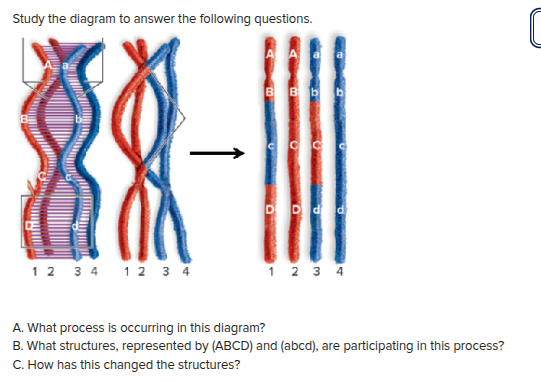
A. What process is occurring in this diagram?
B. What structures, represented by (ABCD) and (abcd), are participating in this process?
C. How has this changed the structures?
The process occurring in this diagram is called crossing over. The structures ABCD and abcd represent the alleles located on the chromatids. Crossing over results in the making of new combinations of alleles, changing the structure of the chromatids and producing more genetic variation in offspring.
All of the following are true concerning Down syndrome EXCEPT
chances of a woman having a child with Down syndrome decrease as she gets older.
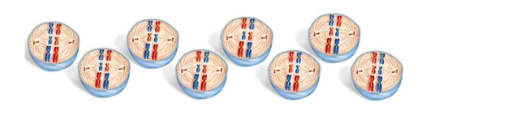
This is one cell with three homologous pairs of chromosomes pictured in eight different patterns.
A. What is this diagram illustrating?
B. How many daughter nuclei will result from these cells?
C. How many different combinations of chromosomes are there?
This diagram illustrates independent assortment. These cells will result in the making of 4 daughter cells. There are eight different combinations of chromosomes.
true or false: The correct number of chromosomes in a species is known as aneuploidy.
false
true or false: change in the chromosome number resulting from nondisjunction is called euploidy.
false
true or false: Monosomy occurs when an individual has only one of a particular type of chromosome.
true
true or false: Primary nondisjunction occurs during meiosis II when the sister chromatids fail to separate and both daughter chromosomes go in the same gamete.
true
true or false: Sex chromosome aneuploids are better tolerated and have a better chance of producing survivors
true
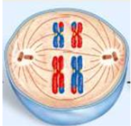
A. Is this cell going through mitosis or meiosis?
B. Explain your answer.
C. Identify the stage.
This cell is going through meiosis because the chromosomes are lined up side by side in homologous pairs, if it were mitosis, all four chromosomes would be in a straight line. The stage of meiosis occurring in the image is metaphase I.
Some plants are tetraploid (4n). How might such a plant arise?
A tetraploid plant would arise if two plants underwent autoploidy, which, due to nondisjunction, would result in the gametes becoming diploid. If two of these diploid gametes combine, a fertile tetraploid plant would form.
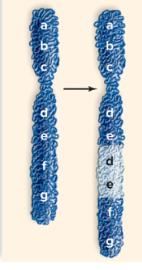
The following picture depicts which of the following changes in chromosome structure?
duplication
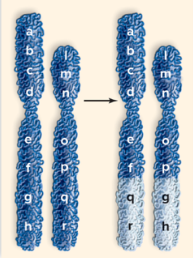
The following picture depicts which of the following changes in chromosome structure?
translocation
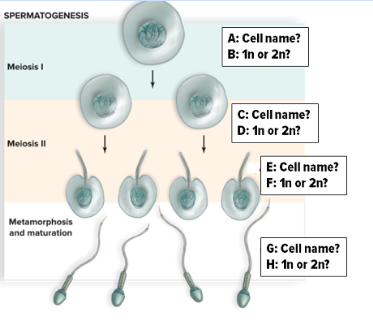
Study the figure depicting the process of spermatogenesis. Name the labeled cells and tell whether they are haploid or diploid. In what part of meiosis is the number of chromosomes reduced by half?
Cell A is a primary spermatocyte which is diploid, or 2n. Cells C are called secondary spermatocytes which are haploid (1n). Cells E are called spermatids and are haploid (1n). Cells G are sperm which are haploid (n). The number of chromosomes is reduced by two during meiosis I.
Identify the chromosomal abnormalities as well as the physical features present in a person suffering from Turner syndrome.
The chromosomal abnormality that results in Turner syndrome is a female with a single X chromosome. The physical features associated with this condition include being short with a broad chest and widely spaced nipples.
Sexual reproduction brings about genetic variation within a species. How does sexual reproduction contribute to variation? Why is genetic variation so important to the survival of a species? Support your answer with an example.
Sexual reproduction contributes to genetic variation through crossing over, independent assortment, and fertilization. Genetic variation is essential for allowing a species to survive in a changing environment, fueling the process of natural selection so the strongest of a species survive. An example of genetic variation allowing a species to better survive is with the infamous galapagos finches, with their varied beak size being better suited for a variety of food sources in the event of a drought.
true or false: Oogenesis always involves an equal division of cell contents in the formation of an egg and polar bodies.
false
true or false: A lattice holds the members of a bivalent together in such a way that the RNA of the nonsister chromatids is aligned.
false
true or false: It is estimated that an average of two or three crossovers occur per human chromosome
true
true or false: Aneuploidy is a change in the number of chromosomes resulting from nondisjunction during meiosis.
true
true or false: Only one of the four daughter cells becomes a functional gamete in spermatogenesis.
false
true or false: Jacobs syndrome, XYY, results from nondisjunction during spermatogenesis
true
Identify which event will occur during prophase I of meiosis but does not occur during prophase of mitosis.
bivalents will form
During _____, the homologous chromosome pairs independently align themselves at the equator of the cell.
independent assortment
If the diploid number of chromosomes for an organism is 52, what will the haploid number of chromosomes be?
26
Which of the following statements correctly compares the events of meiosis and mitosis?
During metaphase I of meiosis, the bivalents are present at the metaphase plate; during metaphase of mitosis, the duplicated chromosomes are at the metaphase plate.
During which phase of mitosis and meiosis will the state of the chromosome be the same?
anaphase II and anaphase
Which of the following statements is true about the life cycle of animals?
The gametes are the haploid phase of the animal's life cycle.
Which statement applies only to plants?
The haploid phase can be larger than the diploid phase.

