W6(2) - Taking Stock | Quizlet
 Call Kai
 Learn
Learn Practice Test
 Spaced Repetition
 Match
Match Flashcards
 Knowt Play
1/26

There's no tags or description
Looks like no tags are added yet.
Name | Mastery | Learn | Test | Matching | Spaced | Call with Kai |
|---|
No analytics yet
Send a link to your students to track their progress
27 Terms
W6(2)
taking stock
ex post rules (W6(2))
are applied after harm has occurred (even when that may be potential harm), thus having a punitive nature
= Resulting in an adversarial process
- costly: Company has the incentive to dispute everything “I’m not dominant"
" if I am dominant there was no abuse"
" if there was an abuse it was objectively justified"
"the fine was incorrectly calculated”"
( counter to everything that the commission has found)
ex ante rules (W6(2))
are applied in the absence of any harm or rather to prevent harm from occurring by shaping markets
e.g. regulation of the costs which a monopolist can charge
= Resulting in a less adversarial process: hopefully less costly compromise,
e.g. telecoms and energy market liberalisation - Cooperative and negotiated.
ex antefication of digital market regulation (W6(2))
• DMA – bulk of ex ante regulation
• art. 102 – still highly relevant, e.g. Teams decision’ - cooperative regulation
Cooperative rather than adversarial process needed.
digital market sprawl (W6(2))
Dominant companies trying to go into new markets, growing larger.
e.g. To break into AI market have to train their LLM based on quality data.
e.g. Meta’s Whatsapp AI policy (if you want to use whatsapp to communicate professionally with customers, have to use their AI – a classic tie?)
- Meta doing this for AI training, looking for professional, coherent, nicely conversations as opposed to random exchanges on the internet. This is valuable data for meta’s LLM
reflecting on ex post enforcement (W6(2))
works, but too slow: cases take several years
- company cannot really wait multiple years for a court judgement (e.g. the price comparison services which complained about google shopping)
Legal certainty for the dominant companies and their contestants
- Inconsistency between GC and ECJ – there are subtle changes. A lot of jurisprudence needed to create legal certainty.
= Call for ex ante rules or, rather, the ex antefication of rule
reflecting on remedies (W6(2))
Effectiveness wise remedies are politically successful but still dominant companies left unchallenged
- e.g. google shopping --> non-discrimination remedy
- e.g. google android --> no pre-installation and offer choice
- e.g. microsoft --> offer non-WMP/IE version and provide interoperability info at FRAND conditions
Remedies matter and this is where effectiveness falls short (fines don’t do anything)
google shopping remedy (W6(2))
non-discrimination remedy
- One page dedicated to the remedy - When the whole concept of discrimination is actually very tricky, its based on equality
- Implemented through auction (bidding; highest bidder gets prominently displayed)
- competing price comparators now have to pay to still not have the same traffic as before
- newcomers still have a hard time to break into the market, basically have to pay for traffic (when before, used to be listed for free)
- Vestager (EU) admits not the best way of dealing with the problem)
google/android remedy (W6(2))
no pre-installation and offer choice
- Implemented by free browser/SE choice screen, then by auction and now by free browser/SE choice based on market share
- but If you offer something for free: more people will want it. If you have a browser choice screen for free, every tiny search engine will want to be displayed on the screen. If you have a list that does not reasonably fit on your screen, the scarce resource becomes the top spots on the list.
dominant companies can pay to be listed on top and can outbid anyone else. Not contestability here.
- Listing by market share? – only solidifies the position of existing companies
- Evidence: Google search’s market share on Android has declined by less than 0.1%
microsoft remedy (W6(2))
offer non-WMP/IE version and provide interoperability info at FRAND conditions
- MS offered non-WMP softwar: 17 (maybe 18) copies of Windows 7 without WMP were sold
- consumers will buy the standard windows with media player and internet explorer pre-installed if its for the same price
took €1 Bn in fines and 4 years to get FRAND supply of interoperability info…….. competitors had to wait years to actually get access to interoperability software.
- implemented browser choice screen: Chrome did overtake IE as browser, but not sure whether that was because of the remedies or just because of better product
designing an effective remedy (W6(2))
1. Start from the Theory of Harm (what is wrong with the market)
- Exclusion, exploitation, discrimination etc.
2. Then design an optimal remedy - Optimal in the light of what competition requires:
- Right now (to actually overcome the problem identified by the theory of harm)
- In the future (what the competition can be in the future – a ‘sunset’ clause for your remedy. Lating how long?
Depending on how competition is predicted in the futrure)
- Information asymmetries (information positions between the regulator and regulatee). e.g. The commission vs Google (top lawyers, top economists, engineers who know Alphabet) - asymmetry will be exploited.
Restricted by proportionality (what is necessary to address the harm)
Helped by co-operative processes (ex-antefication helps shape these processes. Cooperative bc the commission negotiates)
DMA legal basis (W6(2))
Based on Art. 114 TFEU (so not competition law in the strict sense but internal market law)
- complements art. 102
DMA as a response to national divergencies (W6(2))
Recital 6 - 9: national rules potentially resulted in different outcomes, danger to the internal market
- EU wants one big digital market where companies set to a uniform set of rules
Art 1(5), (6)(a) and (b): Ruling out national diverging national
- Whatever is in the scope of the DMA can only be ruled by the DMA and not national competition law
DMA is without prejudice to art. 101/102 (W6(2))
recital 10-11: designed to complement art. 101 and 102, it is without prejudice (art. 1(6))
- Raised a double jeopardy problem
- Could the same phenomenon be addressed as a restriction of competition under 101/102 and as a reduction of contestability under the DMA?
e.g. a DMA issue: meta is a gatekeeper, DMA applies, engaging in self-preferencing. additionally can be an infringement of art. 102 TFEU bc Meta is dominant company.
but double jeopardy requires same facts and same rules needed: DMA is internal market law, 102 is competition law
how is the DMA Complementary (W6(2))
(i.e. why have the DMA in addition to art. 101 and art. 102?)
- Complementing by not requiring ‘actual, potential or presumed effects’ (recital 10)
- the behaviour caught by the DMA can be assumed bad for competition / bad for contestability = Less costly!
- More fundamentally: “Any justification on economic grounds seeking to enter into market definition or to demonstrate efficiencies deriving from a specific type of behaviour by the undertaking providing core platform services should be discarded, as it is not relevant to the designation as a gatekeeper” (recital 23)
= if you are a gatekeeper you are dominant. No need to go through economically and time-conusming route of establishing dominance.
why favour gatekeeper designation over dominance analysis
Justified by preventing market tipping (recital 26)
- Markets started out as competitive markets
E.g. the search engine used to actively engage in competition
- Then the market tipped in favour of Google
- Once it has tipped very difficult to untip it; Cant afford to wait years
DMA scope (W6(2))
core platform services + gatekeepers
- core platform services are the central substantive concept (Art. 2(2)) consisting of:
a) online intermediation services;
(b) online search engines;
(c) online social networking services;
(d) video-sharing platform services;
(e) number-independent interpersonal communication services
(f) operating systems;
(g) cloud computing services;
(h) advertising services, including any advertising networks, advertising exchanges and any other advertising intermediation services, provided by a provider of any of the core platform services listed in points (a) to (g);
gatekeeper (W6(2))
a relative concept dependent on lasting impact on the market (Art. 3)
- Significant impact
- Gateway – control how many can enter the market
- Durable and entrenched position
designating gatekeeper status (W6(2))
Replaces a dominant analysis with a 15 minute- 1 hour analysis from the DMA:
- Impact: Annual EEA turnover > € 7.5 billion/3 financial years, or average market capitalisation > € 65 billion in the last financial year, and core platform service in at least three Member States
- Gateway > 45 million monthly active end users established or located in the Union and more than 10 000 yearly active business users established in the Union in the last financial year;
- Durable: Above thresholds met in each of the last three financial years
All measured at the level of the ‘undertaking’ (e.g. Alphabet in the case of Google)
emerging gatekeepers (W6(2))
procedure for inclusion below threshold (Art. 3(6)(8)) for emerging gatekeepers, taking into account:
- Extreme scale economies
- very strong network effects, an ability to connect many business users with many end users through the multi-sidedness of these services...
- lock-in effects, a lack of multi-homing or vertical integration
- a very high market capitalisation
- high growth rates, or decelerating, growth rates read together with profitability growth.....
familiarity: These effects are looked at also for competition cases to establish dominance (only in the DMA, used only for companies that do not meet the gatekeeper threshold)
rebuttal of gatekeeper status (W6(2))
Self-notification before 2 July 2023, designation by Commission before 6 September 2023, applicability from 7 March 2024
- Legal certainty
acceptance of rebuttals in Gmail and Outlook turned on openness of platforms and frequent multihoming.
- although this ignores the the data eco-system effects of these services
- dealing with a multi-sided platform market, so openness/multi-homing on one side may not mean the absence of network externalities on another side
DMA substance (W6(2))
market oriented (as opposed to DSA), focused on ensuring fair and contestable markets (largely a rehash of competition law enforcement and sector-specific regulation)
• Remedy-based approach: What gateeeper should and should not do to enable fairness and contestability.
• Fairness :negative/reactive obligations (don’ts) in Art. 5
• Contestability: positive/proactive obligations (do’s) mostly in Art. 6
don't obligations (W6(2))
negative/reactive obligations under art. 5 DMA --> restores fairness
do obligtaions (W6(2))
positive/proactive obligations under art 6 DMA --> creates contestability, Competitors being able to contest market power (structure).
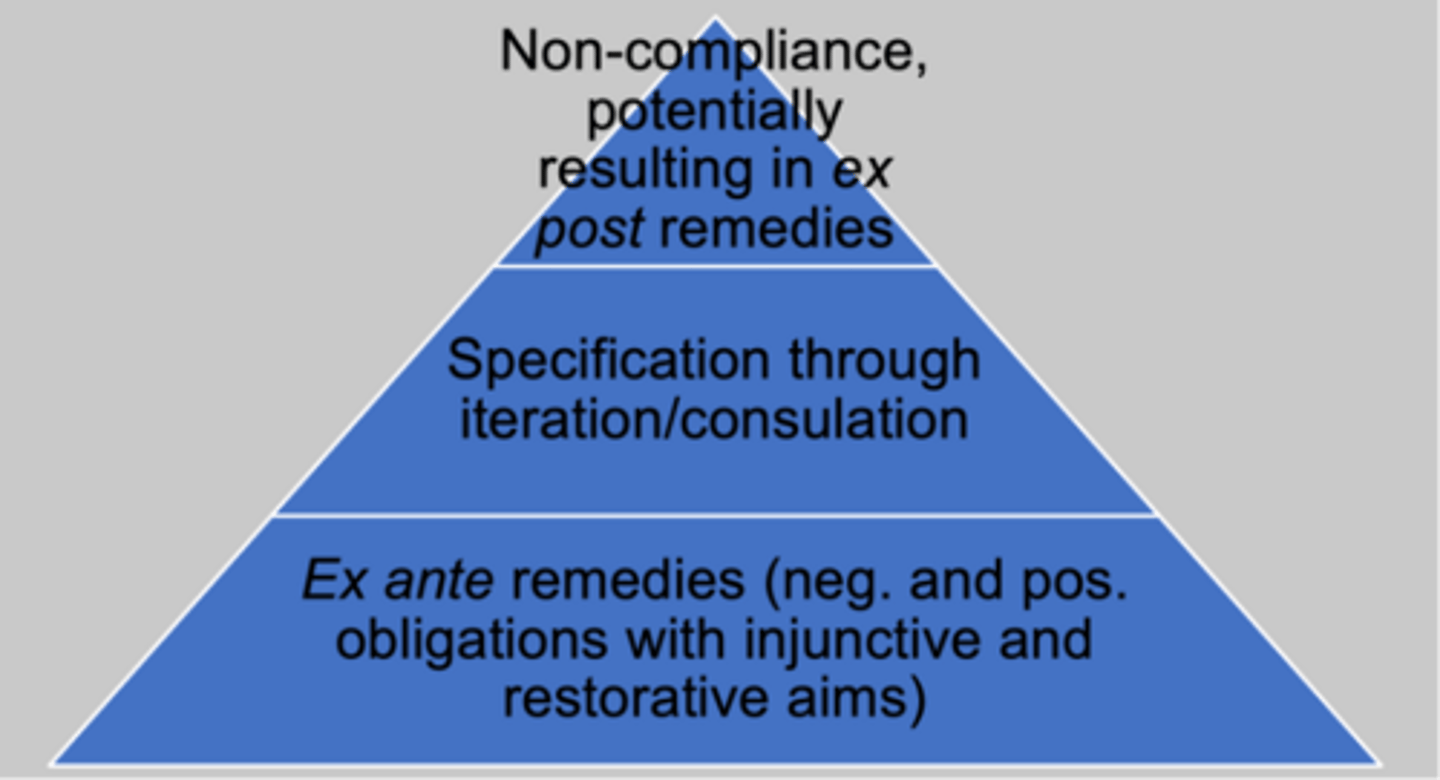
DMA Compliance pyramid (W6(2))
Ex post remdies: but very last resort.
Specification: commission helps gatekeeper further understand what is needed to comply with DMA (cooperative regulation)
Ex ante remedies: provisions in art. 5, 6, 7 DMA
ex post remedies (W6(2))
at the top of DMA compliance pyramid
e.g. divestiture (splitting up a company), but very last resort. Only then does enforcement become adversarial (resulting from systematic refusal to comply)
- Divestitute has happened 0 times (EU)
ex ante remedies (W6(2))
at the bottom of DMA Compliance pyramid
provisions in art. 5, 6, 7 are self-executing and so clear that gatekeepers know how they should comply (compliance reports)
Explore top notes

