RO14 1.2.1 Wasting processes
 Call Kai
 Learn
Learn Practice Test
 Spaced Repetition
 Match
Match Flashcards
 Knowt Play
1/48

There's no tags or description
Looks like no tags are added yet.
Name | Mastery | Learn | Test | Matching | Spaced | Call with Kai |
|---|
No analytics yet
Send a link to your students to track their progress
49 Terms
Sawing definition:
. Use of a thin, toothed blade to remove material and cut a narrow slit.
Sawing, Hand tools with Uses(3):
. Hacksaw, straight cuts in metal <30mm thick.
. Junior hacksaw, straight cuts in metals and polymers <10mm thick.
. Coping saw, complex curved shapes in wood or polymer sheets <5mm thick.
Sawing, Hand tools’ safety measures(4):
. Handle sharp tools with care.
. Do not apply excessive pressure when cutting, as blades might break.
. Store tools safely when not in use.
. Beware of burrs and sharp edges that can cause cuts.
Sawing, Power tools with Uses(2):
. Mechanical power hacksaw, straight cuts in metal >30mm thick.
. Band saw, straight or curved cuts in a wide range of materials depending on blade type and cutting speed.
Sawing, Power tools’ safety measures(4):
. Use only when trained in the safe operation of the equipment.
. Wear eye protection and substantial footwear.
. Secure long hair and loose clothing, and remove rings and jewellery.
. Ensure workpieces are clamped and/or supported appropriately
. It is recommended that band saws are not used by under-16s in schools.
Filing definition:
. Removes material from the surface of a metal component to refine its shape.
Common file sizes(length)(4):
. 6"
. 8"
. 10"
. 12"
Common file cuts(teeth sizes)(3):
. Smooth cut(fine) for a good surface finish when near the required shape/size
. Second cut(medium)
. Bastard(coarse) used to remove material quickly
Filing, Common materials(3):
. Non-ferrous materials
. Most ferrous materials
. Hard polymer materials
Filing, Shapes and Uses(3):
. Flat, flat surfaces and external curves
. Half-round, internal curves
. Round, inside holes or tight internal curves
Filing, Safety measures(3):
. Ensure file handles are secure before use(don't use a file without a handle)
. Store tools safely when not in use
. Beware of burrs and sharp edges
Shearing definition:
. Used to cut metal sheet material using tools and equipment that employ a shearing action like scissors cutting through paper
Shearing, Hand tools with Uses(3):
. Straight//Left-handed tin snips, straight/right-handed/left-handed cuts in sheet metal(typically 0.8mm maximum sheet thickness in mild steel)
. Right-handed tin snips, right-handed curved cuts in sheet metal(typically 0.8mm maximum sheet thickness)
. Left-handed tin snips, left-handed curved cuts in sheet metal(typically 0.8mm maximum sheet thickness)
Shearing, Hand tools’ safety measures(3):
. Use appropriate manual handling techniques when moving metal sheets
. Beware of sharp points, burrs and sharp edges that can cause cuts by wearing gloves
. Wear eye protection and substantial footwear
Shearing, Manually operated machinery with Uses:
. Foot-operated manual guillotine, straight, long cuts in a single action(typically 1300mm maximum length) in sheet metal(typically 1.6mm maximum sheet thickness in mild steel)
Shearing, Manually operated machinery’s safety measures(6):
. Ensure all guards are in place prior to use
. Use appropriate manual handling techniques when moving metal sheets
. Beware of sharp points, burrs and sharp edges that can cause cuts by wearing gloves
. Use only when trained in the safe operation of the equipment
. Wear eye protection and substantial footwear
. Secure long hair and loose clothing, and remove rings and jewellery
Drilling definition:
. Used to produce round holes in a wide range of materials by marking out your work and centre punching the position of a hole prior to drilling
Drilling, Tools(2):
. Twist drills(for holes up to 13mm diameter)
. Hole saws(for holes larger than 13mm in sheet material)
Drilling, Working holding devices(3):
Vice
Machine vice
Clamps
Drilling, Equipment(2):
Pillar drill
Portable cordless drill
Drilling, Pillar drill, Use(6):
Used in the workshop for drilling accurately positioned, vertical holes
Speed is set according to the workpiece material and the size of the drilled hole
Rotating parts are guarded
The table is adjustable to support work and allow secure work holding(using a machine vice or clamps)
The rotating tool is lowered vertically into the workpiece
Safer and more accurate option
Drilling, Portable cordless drill, Use(5):
Portable hand-held machine used for general drilling operations
Convenient and versatile
No guards
Single speed
Low accuracy
Drilling, Safety measures(6):
Use only when trained in the safe operation of the equipment
Use an appropriate speed according to the material and size of the drilled hole
Clamp the workpiece securely
Ensure all guards are in place prior to use
Wear eye protection and substantial footwear
Secure long hair and loose clothing, and remove rings and jewellery
Threading, Definitions:
Dies cut external threads like bolts, and taps cut internal threads like nuts, which are then commonly used to fix components together into assemblies
Threading, Internal thread tools(4):
Taper tap
Second cut tap
Plug tap
Tap wrench
Threading, Equipment(2):
Tap and tap wrench
Die and die stocks
Threading, Tap and tap wrench, Uses(4):
Used for cutting threads on the inside of a drilled hole
The initial hole must be drilled to the correct tapping drill hole size for the thread type and size
Use threading cutting fluid to lubricate the process
Sets of taps must be used in the right order: taper, second cut and the plug
Threading, Die and die stocks, Uses(3)
The die, which is held in a die stock, is used for cutting threads on the outside of a round metal bar
The bar must have the correct diameter for the thread size and have a small chamfer on the end before threading
Use thread-cutting fluid to lubricate the process
Threading, Safety measures(4):
Use correct technique, lubrication and appropriate force to prevent hardened steel taps from snapping or shattering in use
Wear eye protection
Avoid skin contact with swarf and thread cutting fluid
Ensure the work is held securely
Laser cutting, Definition:
It uses a computer-controlled laser to cut complex shapes in a range of flat sheet materials for 2D components. It is accurate and repeatable, with design changes being quick and easy but the cost ranging between £10k and £250k.
Laser cutting, tools and equipment(5):
Computer with computer-aided design(CAD) software
Laser cutting machine
Fume extraction
Filtration equipment
Cooling system
Laser cutting, Computer with computer-aided design(CAD) software, Uses(2):
Generates CAD drawing of 2D components
Exports CAD data in a format readable by the laser cutter
Laser cutting, Machine, Uses(3):
Uses CAD data to control the movement of the laser head and cut complex shapes from sheet material
A laser makes cuts by causing localised extremely high temperatures that vaporise material
Laser power limits materials that can be cut(high power lasers are required to cut metals >300W)
Laser cutting, Fume extraction and filtration, Uses(3):
The operation is controlled automatically when the laser is in use
Extracts fumes generated when cutting
Filters out harmful particulates
Laser cutting, Cooling system, Uses(3):
Assist gas - gas is blown through the cutting nozzle like oxygen(helps cutting and increases heat), nitrogen(cooling and prevents oxidation) or air(cheap alternative) to remove molten material, cool the cut area and improve cut quality
Air cooling fans to move heat away from the material and prevent overheating of machine components
Water cooling to prevent internal overheating of the laser tube and optics
Laser cutting, Safety measures(5):
Laser radiation can cause sight loss and severe burns
Use only when trained in the safe operation of the equipment
Use appropriate laser power and speed according to the material type and thickness being cut
Ensure all guards are in place before use
Ensure that fume extraction, filtration, and cooling systems are used
Milling/Routing, Definitions:
They both use a rotating cutter to remove material from a workpiece, but while milling is used primarily to machine metals, routing is used to cut and shape wood and man-made boards.
Milling/Routing, Tools(4):
End mill(face milling and slot cutting)
Slot drill(plunge and slot cutting)
Face mill(used to create large, flat surfaces)
Routing bits(wide range available for slot cutting and edge profiling)
Milling/Routing, Work holding(2):
Machine vice
Clamps
Milling/Routing, Equipment(2):
Vertical milling machine
Portable router
Milling/Routing, Vertical milling machine, Uses(4):
A workshop machine for accurately cutting flat surfaces and slots in metal components using a rotating tool
The rotating tool is in a fixed position
The clamped workpiece is fed into the tool by moving the machine table in X, Y, and Z directions
Speed, feed and depth of cut are set according to the workpiece material, tooling, and feature being machined
Milling/Routing, Portable router, Uses(3):
Portable handheld machine for cutting thin material, slots and edge profiles in wood and manmade board
High speed tool rotation
Limited guarding
Milling/Routing, Safety measures(6):
Use only when trained in the safe operation of the equipment
Use appropriate operational parameters according to the material, tooling and feature being machined
Clamp the workpiece securely
Ensure all guards are in place prior to use
Wear eye protection and substantial footwear
Secure long hair and loose clothing, and remove rings and jewellery
Turning, Definition:
It is a wasting process used to machine round bars. This can include reducing the bar diameter, flattening and squaring(perpendicular to axis) the ends of the bar or drilling/boring a hole along its central axis
Turning, Tools(5):
Facing tool(makes ends flat and square)
Parallel turning tool(reduces diameter)
Parting tool(separates finished component from bar stock)
Boring tool(for holes larger than 13mm diameter)
Twist drill(for holes up to 13mm diameter)
Turning, Work holding:
3-jaw lathe chuck
Turning, Equipment:
Centre lathe
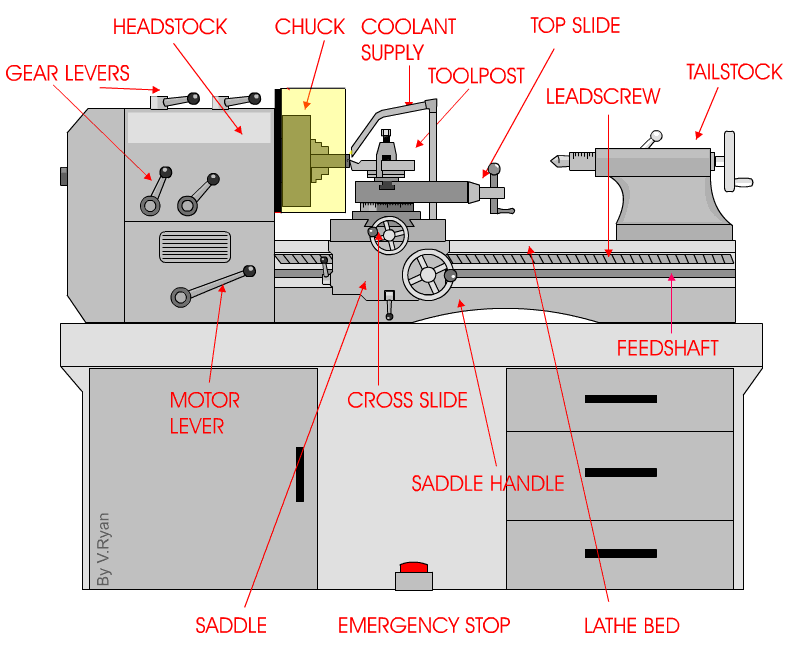
Turning, Centre lathe, Uses(4)
A workshop machine for accurately shaping a rotating metal bar using a fixed single-point tool
Turning tools are fed into the rotating workpiece by moving the tool post in the X and Y directions
A fixed twist drill mounted in the tailstock can be used to drill a central hole in the face of the workpiece
Speed, feed and depth of cut are set according to the workpiece material, tooling and feature being machined
Turning, Safety measures(6):
Use only when trained in the safe operation of the equipment
Use appropriate operational parameters, according to the material, tooling and feature being machined
Clamp the workpiece securely
Ensure all guards are in place prior to use
Wear eye protection and substantial footwear
Secure long hair and loose clothing, and remove rings and jewellery
Explore top notes

Explore top flashcards
