5.3 Energy transfers between organisms & Nutrient cycles
 Call Kai
 Learn
Learn Practice Test
 Spaced Repetition
 Match
Match Flashcards
 Knowt Play
1/94

There's no tags or description
Looks like no tags are added yet.
Name | Mastery | Learn | Test | Matching | Spaced | Call with Kai |
|---|
No analytics yet
Send a link to your students to track their progress
95 Terms
Biomass
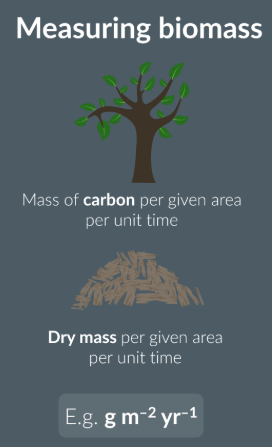
The total mass of carbon/living material per given area per unit time / gm⁻² or gm⁻³
Measured in terms of:
● Mass of carbon
● Dry mass of tissue (per unit area)
Describe how biomass is formed in plants.
● During photosynthesis, plants make organic compounds from (atmospheric/aquatic) CO₂
● Most sugars synthesised are used by the plant as respiratory substrates (to produce ATP)
● Rest used to make other groups of biological molecules (e.g. carbs, lipids & proteins) → form biomass
Respiratory substrates
Organic molecules that can be oxidised during respiration to produce ATP, release energy for growth and reproduction
E.g. carbohydrates (glucose in glycolysis), lipids (fatty acids and glycerol) proteins (amino acids, deaminated first then used in respiration)
How can biomass be measured?
Mass of carbon / dry mass of tissue per given area
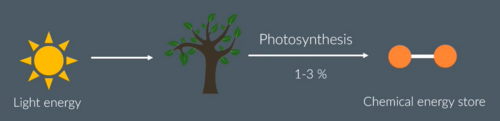
What do we call the total amount of energy stored in biomass ?
Chemical energy store
Describe how dry mass of tissue can be measured?
1. Sample dried in an oven e.g. at 100°C (avoid combustion)
2. Sample reweighed and reheated at regular intervals
3. Until mass remains constant (all water evaporated)
How could you ensure a sample of biomass was dry before measuring the energy content?
Dry sample in an oven, weigh, return to oven, reweigh until sample does not change weight.
Explain why dry mass is more representative than fresh (wet) mass
Water volume in won't vary in dry mass
Describe how the chemical energy stored in dry biomass can be estimated.
Using calorimetry:
1. Known mass of dry biomass is fully combusted (burnt)
2. Heat energy released heats a known volume of water
3. Increase in temperature of water is used to calculate chemical energy of biomass
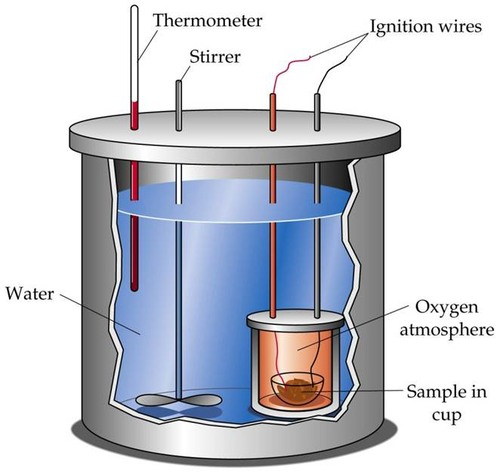
Explain how features of a calorimeter enable valid measurement of heat energy released.
● Stirrer → evenly distributes heat energy (in water)
● Air / insulation → reduces heat loss / gain to and from surroundings
● Water → has a high specific heat capacity
How to calculate heat energy released per gram

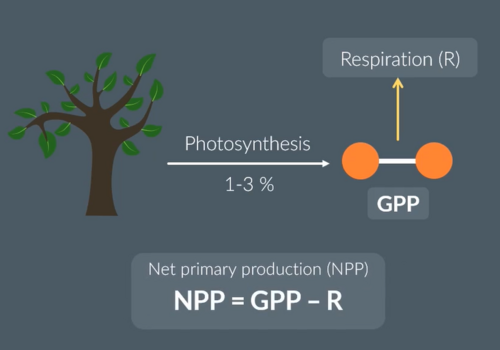
What is gross primary production (GPP) ?
● Chemical energy store in plant biomass, in a given area or volume
○ Total energy transferred into chemical energy from light energy during photosynthesis
What is net primary production (NPP) ?
Chemical energy store in plant biomass after respiratory losses (of the plant) to environment taken into account
What can NPP be used for ?
● Plant growth and reproduction
● Available to other trophic levels in the ecosystem, such as herbivores and decomposers.
State the formula for NPP.
NPP = GPP - R
R = respiratory losses to the environment
GPP and NPP only apply to...
GPP and NPP only apply to producers, such as plants.

What is primary or secondary productivity?
The rate of biomass production, in a given area in a given time
Units e.g. g m⁻² yr⁻¹
So primary productivity measures how much new plant biomass grows in 1 square metre each year, whilst secondary productivity measures how much new consumer biomass is produced in that same area and time.
State the units used for primary or secondary productivity.
kJ ha⁻¹ year⁻¹
(unit for energy, per unit area, per year)
Or g m⁻² yr⁻¹
State why it is rare that food chains seldom contain more than five
organisms.
Too much energy would be lost, leaving the tertiary consumers with very little.
Approximately how much energy is passed from producers to primary consumers?
10%.
Explain why these units for primary or secondary productivity are used.
● Per unit area → takes into account that different environments vary in size
● Per year → takes into account effect of seasonal variation (temperature etc.) on biomass
○ Standardising results, more representative, enables comparison between environments

Give three reasons for the low efficiency of photosynthesis.
Reflection
evaporation as heat
transmission
Explain why most light falling on producers is not used in photosynthesis.
● Light is reflected or wrong wavelength
● Light misses chlorophyll
● CO₂ conc / temperature is a limiting factorq
Respiratory loss
The energy lost to the environment as heat when organisms respire.
Net secondary production
Energy remaining in consumers after accounting for energy lost through respiration, excretion, faeces
It represents the net production of consumers.
N = I - (F + R)
Excretion vs egestion
Excretion is metabolic waste e.g. CO₂ from respiration, urea from amino acid break down
Egestion is faeces; undigested food that was never absorbed into body cells
State the formula for net (secondary) production of consumers (N)
N = I - (F + R)
I = the chemical energy store in ingested food (energy)
F = the chemical energy lost to the environment in faeces and urine (EGESTION)
R = respiratory losses (EXCRETION)
Formula for efficiency of energy transfer (from one trophic level to another)
Energy or biomass available after transfer / energy or biomass available before transfer
x100 if a %
How can % efficiency be increased ?
1. Simplify food webs to remove competition
2. Reduce respiratory losses e.g. staying warm
Explain why energy transfer between trophic levels is inefficient.
● Heat energy lost via respiration
● Energy lost via parts of organism that aren't eaten (e.g. bones)
● Energy lost via food not digested → faeces
● Energy lost via excretion e.g. urea in urine
Explain how crop farming practices increase energy transfer efficiency.
● Simplifying food webs to reduce energy / biomass losses to non-human food chains e.g.
○ Herbicides kill weeds → less competition (e.g. for light) so more energy to create biomass, greater NPP.
○ Pesticides kill insects (pests) → reduce loss of biomass from crops
○ Fungicides reduce fungal infections → more energy to create biomass
● Fertilisers e.g. nitrates to prevent poor growth due to lack of nutrients
Explain how livestock farming practices increase energy transfer efficiency.
● Reduce respiratory losses within a human food chain (so more energy to create biomass):
○ Restrict movement and keep warm → less energy lost as heat from respiration
○ Slaughter animal while still growing / young, when most of their energy is used for growth
○ Treated with antibiotics → prevent loss of energy due to pathogens
○ Selective breeding to produce breeds with higher growth rates

Farming cattle for humans to eat is less efficient than farming crops because of energy transfer.
Explain why.
● Energy lost between trophic levels
● Energy lost via respiration / excretion / faeces; contraction / movement / maintaining temperature.
Reject energy used in respiration.
In 2 different food chains, corn is the primary producer.
In one food chain, corn is directly consumed by humans. In the 2nd food chain, humans consume cows which are raised on corn.
Which food chain would lead to a higher energy transfer to humans?
● The food chain in which humans directly consume corn
● One less trophic level required so less energy lost through respiration / heat loss / digestive waste / metabolic excretion on each level
A farmer tries 2 methods to increase the meat yields from sheep on his farm:
1. Increasing the area of land in which the sheep can roam
2. Providing the sheep with a high-nutrient feed
He concludes: "Providing the sheep with a high-nutrient feed is a better way to increase meat yields than increasing the area of land."
Evaluate this statement.
YES:
● More movement leads to more energy lost
● Through respiration / as heat/ muscle contraction
● (And) less energy converted to biomass / (growing) muscles
● More risk of sheep being eaten by predators
● Feed can supply nutrients to promote muscle growth
NO:
● Free movement would lead to an increase in muscles / better meat quality
● Feed more expensive than grazing
● Introducing feed requires more work from the farmer
State one ethical issue arising with new styles of farming
● Lower quality of life for animals
● Animals more prone to infection
Explain why it is rare to have more than 5 trophic levels in a food chain
● The total energy available is less at each level
● So more trophic levels wouldn't have sufficient energy
Suggest 2 reasons for conserving rainforests.
1. Protect species OR For biodiversity;
2. Protect habitats/niches. Accept conserving land for indigenous communities.
3. Reduces global warming;
4. Source of medicines/drugs/wood;
5. Reduces erosion/eutrophication;
6. Tourism;
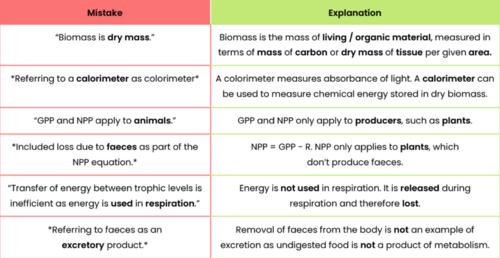
Common mistakes
Nutrient cycles
What are saprobionts and what do they do ?
● Group of organisms that decompose dead organic compounds (proteins / urea / DNA in dead matter / organic waste)
● By secreting enzymes for extracellular digestion
● Absorb soluble needed nutrients and release minerals ions e.g. phosphate ions
Explain the role of mycorrhizae (TO DO WITH PHOSPHORUS CYCLE!!!!)
Mycorrhizae = Symbiotic RELATIONSHIP between fungi and plant roots
● Fungi (hyphae) act as an extension of plant roots to increase surface area of root system
● To increase rate of uptake / absorption of water and inorganic ions like phosphate from the soil (the fungi act like a sponge and hold onto water)
● In return, fungi receive organic compounds e.g. carbohydrates (sugars), amino acids from the plant by photosynthesis
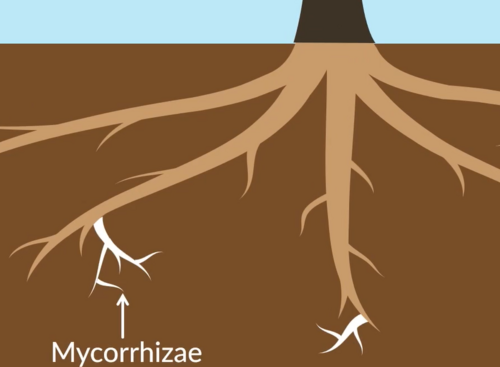
Why is it beneficial for plants to have increased root surface area?
● Increases absorption of water
● The fungi act as a sponge and hold onto water, which is especially helpful if there's a drought.
The relative speeds of the nitrogen and phosphorus cycle
● The phosphorus cycle is slower as phosphate is obtained from mountain-rock, which eventually dissolves into the soil.
● The nitrogen cycle is quicker as nitrogen is readily available. It can be obtained directly from the atmosphere and absorbed into the soil.
Give examples of biological molecules that contain nitrogen.
Amino acids
Proteins or enzymes
Urea
DNA or RNA
Chlorophyll
ATP or ADP
NAD or NADP
Draw a diagram to show the key stages of the nitrogen cycle.
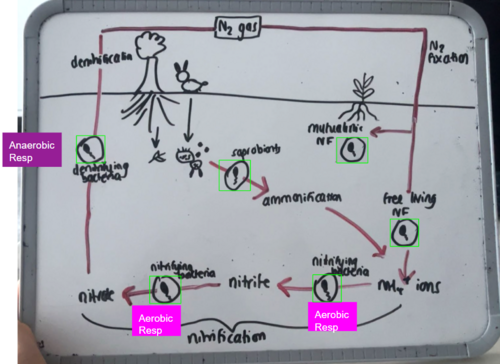
Which form of nitrogen is most commonly absorbed by plants?
Nitrate ions
Summarise how nitrogen gas is converted into nitrate ions.
Nitrogen gas → Ammonium ions → Nitrite ions → Nitrate ions
By bacteria in the soil
Nitrogen fixation
● The process of converting nitrogen gas into biologically usable forms (ammonium ions)
● Nitrogen is fixed/stored in the ammonium
Describe the role of bacteria in nitrogen fixation.
● Nitrogen gas converted into ammonia, which forms ammonium ions in soil
● By nitrogen-fixing bacteria (may be found in root nodules)
2 types of nitrogen fixing bacteria
1. Mutualistic (symbiotic) nitrogen-fixing bacteria: live in root nodules of leguminous plants (beans, peas)
Convert nitrogen gas → ammonia, obtain carbohydrates from the plant, and the plant acquires amino acids from the bacteria.
2. Free-living nitrogen-fixing bacteria: in soil
Convert nitrogen gas → ammonia → ammonium ions
Describe the role of bacteria in ammonification
● Nitrogen-containing compounds from dead organisms (e.g. proteins / urea / excretion), are decomposed
● Converted to ammonia, which forms ammonium ions in soil
● By saprobionts - secrete enzymes for extracellular digestion, forming ammonium ions: (ammonification)
Describe the role of bacteria in nitrification
● Ammonium ions in soil converted into nitrites then nitrates, via a 2-step oxidation reaction
○ For uptake by plant root hair cells by active transport
● By nitrifying bacteria in aerobic conditions (oxygen)
Describe the role of saprobionts in the nitrogen cycle (2)
1. Saprobionts use enzymes to break down nitrogen-containing compounds (DNA / proteins / urea)
2. Producing ammonium ions
Describe how the action of microorganisms in the soil produces a source of nitrates for crop plants. (5)
1. Nitrogen containing compounds (Protein / amino acids / DNA) broken down into ammonium compounds
2. By saprobionts;
3. Ammonium into nitrite;
4. Nitrite into nitrate;
5. By nitrifying bacteria / microorganisms;
6. Nitrogen gas to ammonium (ammonification);
7. By nitrogen-fixing bacteria / microorganisms in soil;
Nitrogen cycle (check book) ⭐
1. Nitrogen gas converted to NH₄⁺ by nitrogen-fixing bacteria in roots of leguminous plants
2. Saprobionts decompose nitrogen containing compounds (DNA, urea) from dead orgainsms / excretion, into NH₄⁺ in soil
3. Nitrification: NH₄⁺ in soil converted into nitrites then nitrates by nitrifying bacteria (respire aerobically) Via a 2-step oxidation reaction
4. Denitrification: nitrate to nitrogen gas by denitrifying bacteria via anaerobic respiration
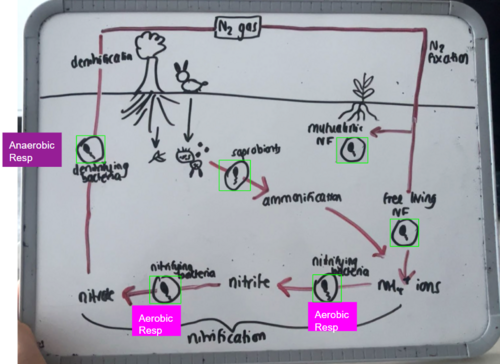
Which bacteria respire aerobically and which anaerobically ?
● Nitrifying bacteria respire aerobically
● Denitrifying bacteria respire ANAErobically
Describe the relationship between legumes and nitrogen-fixing bacteria. (check book)
Plant provides: sugars / organic compounds
Bacteria provide: NH₃ which becomes NH₄⁺ ions that plants can use
On soils with a low concentration of nitrate ions, leguminous crops often grow better than other types of crop. Explain why.
1. Leguminous crop plants have nitrogen-fixing bacteria in nodules on their roots.
2. (Nitrogen) to ammonia / ammonium;
3. Produce protein / amino acids / DNA / RNA;
How can farmers ensure productivity ?
● Keep soil structure well aerated by ploughing.
● Good drainage prevents the air spaces from being filled with water and so prevents air being forced out of the soil.

In areas where soil is less aerated, the plants had stunted growth. Suggest why.
● Denitrifying bacteria respire anaerobically, so more denitrification.
● Less nitrification (as nitrifying bacteria respire aerobically.)
● Overall, less nitrate available in soil for plants to absorb for growth.
One farming practice used to maintain high crop yields is crop rotation.
This involves growing a different crop each year in the same field.
Suggest 2 ways in which crop rotation may lead to high crop yields.
1. Grow crops / plants with nitrogen-fixing (bacteria)
2. (Different crops use) different minerals / nutrients / ions (from the soil)
3. (Different crops have) different pests / pathogens / diseases.
Give examples of biological molecules that contain phosphorus.
Phospholipids
DNA or RNA
ATP or ADP
NADP
TP or GP
RuBP
Describe the phosphorus cycle.
1. Phosphate ions in rocks released (into soils / oceans) by erosion / weathering
2. Phosphate ions taken up through roots by producers and incorporated into their biomass (make bio mols)
○ Rate of absorption increased by mycorrhizae
3. Phosphate ions transferred through food chain e.g. as herbivores eat producers
4. Some phosphate ions lost from animals in excretion
5. Saprobionts decompose organic compounds e.g. DNA in dead matter / organic waste, releasing phosphate ions into soil
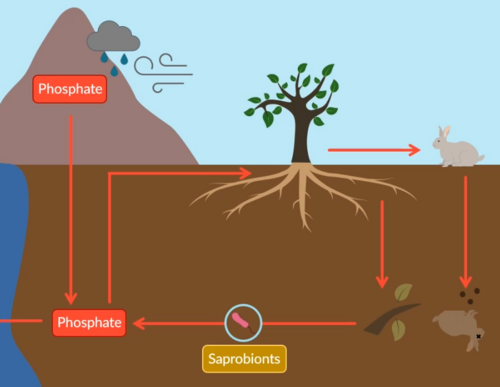
Describe how phosphorus moves from one form to another:
1. Ions in plants to animals
2. Ions in animals to dissolved in rivers, lakes and soil
3. Ions in animals to ions in waste and skeletal remains
4. Ions in remains to phosphates in rocks
5. Phosphates in remains and rocks to phosphates in water
(rivers, lakes etc)
6. Phosphates in water to phosphates in rocks
7. Phosphates in water to phosphates in plants
1. Feeding and digestion
2. Excretion
3. Excretion and decomposition
4. Deposition
5. Erosion
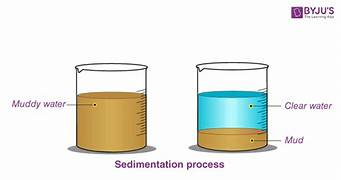
6. Sedimentation
7. Absorption
Deposition vs Sedimentation
Deposition: Phosphate ions enter bodies of water
Sedimentation: Particles (phosphates) in water naturally settle at the bottom of the fluid and form sedimentary rocks
Extracellular digestion
Saprobionts secrete enzymes onto the food, breaking down (dead organic matter) so that the nutrients can be absorbed
Saprobiotic nutrition
Obtaining nutrients from dead organic matter and animal waste using extra-cellular digestion
What process ensures the phosphorus cycle continues?
● Some phosphate ions are transported to bodies of water
● Over thousands of years, the phospshate ions are used to form new rocks
Explain why fertilisers are used
● To replace nitrates / phosphates lost when plants are harvested and livestock removed
○ Those removed from soil and incorporated into biomass can't be released back into the soil through decomposition by saprobionts
● So improve efficiency of energy transfer → increase productivity / yield
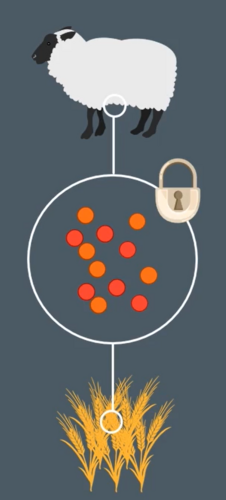
Describe the difference between natural and artificial fertilisers.
Natural
● Organic: manure, compost, sewage
● Ions released during decomposition by saprobionts
Artificial
● Contain inorganic compounds of nitrogen, phosphorus and potassium: ammonium nitrate, phosphate rock
Explain the key environmental issue arising from use of fertilisers
● Phosphates / nitrates dissolve in water, leading to leaching of nutrients into lakes / rivers / oceans
● → eutrophication
1. Rapid growth of algae in lake (algal bloom) so light blocked
2. Submerged plants die as can't photosynthesise
3. So saprobionts decompose dead plant matter, using oxygen in aerobic respiration
4. Saprobionts increase in number
5. Decreases oxygen for fish to aerobically respire, fish die
Explain the key advantage of using natural fertiliser over artificial fertiliser.
● Less water soluble so less leaching → eutrophication less likely
● Organic molecules require breaking down by saprobionts → slow release of nitrate / phosphate etc.
Are ammonia and nitrate biological molecules that contain nitrogen?
No, as they do not contain carbon.
Examples include proteins and DNA.
Fertilisers usually contain which 3 elements?
Nitrogen, phosphorus and potassium.
(NPK)
What is meant by leaching?
v
Give one example of an environmental issue arising from using fertilisers.
Eutrophication
Nitrate from fertiliser applied to crops may enter ponds and lakes. Explain how nitrate may cause the death of fish in fresh water (5)
1. Growth of algae / algal bloom blocks light;
2. Reduced photosynthesis so (submerged) plants die;
3. Saprobiotic microorganisms;
4. Aerobically respire
5. Less oxygen for fish to respire / aerobic organisms die;
Oxidation reactions
During nitrification
Oxygen is added to the compounds during conversion
Describe the role of bacteria in denitrification
● Nitrates in soil converted into nitrogen gas (reduction)
● By denitrifying bacteria in anaerobic conditions (no oxygen, e.g. waterlogged soil)
Suggest why ploughing (aerating) soil increases its fertility.
● More ammonium converted into nitrite and nitrate / more nitrification / more (active) nitrifying bacteria
● Less nitrate converted to nitrogen gas / less denitrification / fewer (active) denitrifying bacteria
Examples of nitrogen fixing and nitrifying bacteria (for essay)
Examples of nitrogen-fixing bacteria
Free-living nitrogen-fixing bacteria: Azotobacter.
Mutualistic nitrogen-fixing bacteria: Rhizobium.
Examples of nitrifying bacteria
Converts ammonium ions to nitrite: Nitrosomonas.
Converts nitrite to nitrate: Nitrobacter.
Apart from ATP generation, describe and explain why phosphorus is important for plant growth. [4]
1. Creation of nucleotides for DNA/rRNA/mRNA;
2. (Required for) protein synthesis/ cell division.
1. Make phospholipids;
2. (Required for) membrane integrity in cells.
1. Make NADP/RuBP;
2. (Required for) carbon fixation.
state 2 uses of nitrogen in all organisms:
1. Synthesis of proteins /from amino acids
2. Creation of nitrogenous bases/nucleotides for DNA / rRNA / mRNA.
There are two processes in which plants directly receive nitrogen. Name and describe these two processes. [4]
1. Absorption;
2. Absorbing nitrate ions (NO₃⁻) through the soil via active transport;
3. Nitrogen fixation;
4. Through conversion of nitrogen into nitrogen containing compounds via nitrogen-fixing bacteria.
Give examples of processes and activities which can increase the availability of nitrogen and its compounds in the soil. [4]
1. The fixing of nitrogen by nitrogen-fixing bacteria;
2. The application of artificial fertilisers by farmers;
3. Urination/defecation of animals/applying manure onto soil;
4. Lightning (causes) oxidation of atmospheric nitrogen to nitrogen oxide and carried to the soil by rain as nitrous or nitric acid;
5. Decay of organic matter via saprobionts / decomposers
Suggest two ways in which farmers can reduce leaching of nitrates. [2]
1. Crop rotation adds nitrogen / different organic matter to soils;
2. (Using) urea or ammonium form of nitrogen where possible;
3. Deep and extensive root system to capture available nutrients / no waste of applied fertiliser / nutrients;
4. Using appropriate quantity of fertiliser / matching fertiliser quantity to crop demand.
Figure 1 shows an investigation into the effects of applying increased amounts of fertiliser on the yield of wheat.
Describe and explain the results in Figure 1. [6 marks]
(graph shows with increasing amount of fertiliser on x axis, yield of wheat on y axis increases then plateaus a while then decreases)
1. (Initially) as fertiliser application increases so does yield;
2. (Because) nutrients are limiting factor in determining growth of / nutrients are not optimum for maximum growth / soil is deficient in nutrients;
3. (Then) yield plateaus / flattens / does not increase any more with increased fertiliser application;
4. (Because) nutrients are no longer liming growth / nutrients have reached optimum for growth;
5. (Eventually) yield decreases with more fertiliser application;
6. (Because) nutrients are at toxic levels.
Freshwater marshes have one of the highest rates of gross primary production (GPP) and net primary production (NPP) of all ecosystems. Carbon use efficiency (CUE) is the ratio of NPP:GPP.
Freshwater marshes have a high CUE.
(a) Use your knowledge of NPP to explain why freshwater marshes have a high CUE and the advantage of this. Do not refer to abiotic factors in your answer.
Low respiration; Accept less energy lost in respiration
2. More growth/biomass/colonisation; Allow examples of more carbon-containing molecules eg glucose