Color 1, Color 2, Depth&Size
 Call Kai
 Learn
Learn Practice Test
 Spaced Repetition
 Match
Match Flashcards
 Knowt Play
1/87

There's no tags or description
Looks like no tags are added yet.
Name | Mastery | Learn | Test | Matching | Spaced | Call with Kai |
|---|
No analytics yet
Send a link to your students to track their progress
88 Terms
Electromagnetic Spectrum for Humans
400nm-700nm
Why have color vision?
Object Discrimination
S-cone
Sensitive to short wavelengths “blue cone” (420nm)
M-cone
Sensitive to middle wavelengths “green cone” (535nm)
L-cone
Sensitive to long wavelengths “red cone” (565nm)
Spectral Sensitivity
Referring to the sensitivity of a cell or a device to different wavelengths on the electromagnetic spectrum
Photopic
Referring to light intensities that are bright enough to stimulate the cone receptors and bright enough to “saturate” the rod receptors (daytime)
Scotopic
Referring to light intensities that are bright enough to stimulate the rods but too dim to stimulate the cone receptors (nighttime)
Univariance
Sensitivity response is independent of wavelength. One photoreceptor type cannot make color discriminations based on wavelength.
Hue
Color
Saturation
Amount of white “mixed in” with the color
Brightness
Amount of light
Physics of Object ‘color’
Stimulus spectrum is product of illumination and reflectance: S(w)=E(w) x R(w)
Color Constancy
The tendency of a surface to appear the same color under a fairly large range of illuminations
Subtractive Color Mixture
Physics - A mixture of pigments. If pigments A and B mix, some of the light shining on the surface will be subtracted by A, and some by B only the remainder contribute to the perception of color.
Broadband Light
Large spectrum of light of the same wavelength
Additive Color Mixture
Perception - A mixture of lights. If light A and light B are both reflected from a surface to the eye, in the perception of color the effects of those two lights add together.
Red + Green + Blue
White
Red + Green
Yellow
Pointilism
PSF of the eye is averaging the colors so you don’t see the dots
Trichromacy
The theory that the color of any light is defined in our visual system by the relationships of the three cones
Color Matching - Additive Color MIxing
Adjusting the intensities of three lights at the same time (primary lights) (each primary light stimulates one cone type) can make it match the test light
Isomeric
Physically the same (color matching works)
Metameric
Physically not the same (color matching doesn’t work)
Color Matching Math
Response of a given photoreceptor type to a light of a given wavelength is the product of the sensitivity and the intensity of the light I(units) x S(w) = response (do for each cone type) (if match the lights would look the same for a given cone type)
Protanope
Absence of L cones, red-green color blind
Protanomaly
Weakened L cone response (curve shifts left closer to M cones)
Deuteranope
Absence of M cones, red-green color blind
Deuteranomoly
Weakened M cone response (curve shifts right to L cones)
Why are protan and deutran defects both “red green blind”?
‘red vs. green’ discrimination depends on a subtraction – if either L or M is missing, subtraction impossible
Tritanope
Absence of S cones, blue-yellow color blind
Tritanomoly
Weakened S cone response
Cone Monochromat
An individual with only one cone type. Truly color-blind.
Rod Monochromat
An individual with no cones of any type. In addition to being colorblind they are also visually impaired in bright light
Why are men more likely to be red/green colorblind?
Gene that controls colorblindness is on the x chromosome.
Why did the L and M cones diverge?
Need for red-green discrimination developed (need to be able to determine red fruit from green leaves)
Opponent Color Theory (Hering)
Perception of color is based on the output of three mechanisms, each of them resulting from an opponency between two colors: red-green, blue-yellow, and black-white (can see both but not at the same time)
Negative Afterimage
Polarity is the opposite of the original stimulus. Light stimuli produce dark negative image. Colors are complementary: red produces green, yellow produces blue
Color Contrast
A color perception effect in which the color of one region induces the opponent color in a neighboring region
Hue Cancellation Experiment
Starts with a color (bluish green) and attempts to determine how much of the opponent color (red) of one of the starting color’s components must be added to eliminate any hint of that component from the starting color (green)
Unique Hues
Any of four colors that can be described with only a single-color term: red, yellow, green, blue.
Unique Red
Need at least 2 wavelengths of light to create
Color Opponent Ganglion Cell
One region is excited by one color/cone type and inhibited by the opponent color/cones (R+/G-). Another adjacent region would be inhibited by the first input and excited by the second (R-/G+)
Chromatic Pathway
Antagonistic relationship where some retinal and LGN ganglion cells are excited by the L-cone onset in their center and inhibited by the M-cone onset in their surround (L-M) cells. There are also (M-L), and ([M+L]-S)
Luminance Pathway
Cells excited by light onset are thought of as (L+M) cells, fast intensity information
Color Constancy Exceptions
Film doesn’t account for illumination: only the visual system can adjust
Also fails in sodium light
Sodium Light
Narrow band of wavelengths
“The Dress”
Visual system interprets the illumination differently
Blue/Black: Shadow
White/Gold: Sunlight
Visual Angle
Tells you the size of an object 2 degreed of visual angle (“stand in” for retinal image size)
Monocular Cues
Information about depth that can be determined by one eye
Binocular Cues
Information about depth that relies on information from both eyes.
Occlusion
A cue to relative depth order in which one object obstructs the view of part of another object
Pictorial Cues
A cue to distance or depth used by artists to depict three-dimensional depth in two-dimensional pictures
Texture Gradient
A depth cue based on the fact that items of the same size form smaller images when they are farther away. An array of items that change in size smoothly across the image will appear to form a surface tilted in depth
Relative Height
As a depth cue, the observation that objects at different distances from the viewer on the ground plane will form images at different heights in the retinal image. Objects farther away will be seen as higher in the image.
Relative Size
A comparison of size between items without knowing the absolute size of either one.
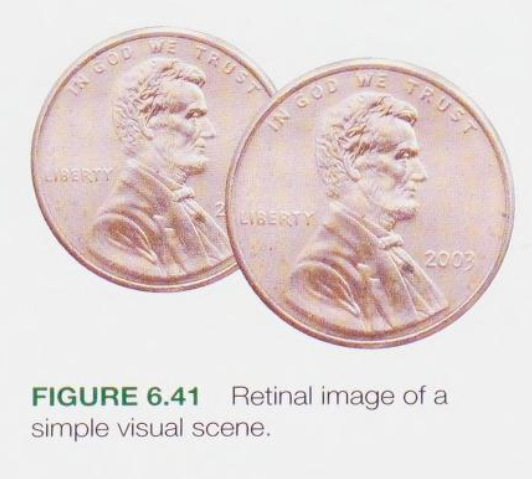
Familiar Size
A depth cue based on knowledge of the typical size of objects like humans or pennies
Aerial/Atmospheric Perspective
A depth cue based on the understanding that light is scattered by the atmosphere. Thus, more distant objects are subject to more scatter and appear fainter, bluer, and less distinct.
Linear Perspective
A depth cue based on the fact that lines that are parallel in the three-dimensional world will appear to converge in a two-dimensional image.
Vanishing Point
The apparent point at which parallel lines receding in depth converge
Motion Parallax
The retinal image of objects closer to the observer move faster
Optic Flow
The pattern of apparent motion of objects in the visual scene produced by the relative motion between the observer and the scene
Deletion
Occurs when an object is occluded by another object, making it appear as if it is moving behind the occluder
Accretion
Occurs when an object reappears after being occluded, indicating it is moving in front of the occluder
Accomodation
The process by which the eye changes its focus (in which the lens gets fatter as gaze is directed toward nearer objects)
Convergence
The ability of the two eyes to turn inward, often used in order to place the two images of a feature in the world on corresponding location in the two retinal images. (visual angle increases)
Divergence
The ability of the two eyes to turn outward, often used in order to place the two images of a feature in the world on corresponding location in the two retinal images. (visual angle decreases)
Binocular Overlap
The combination of signals from each eye that makes performance on many tasks better with both eyes than with either eye alone
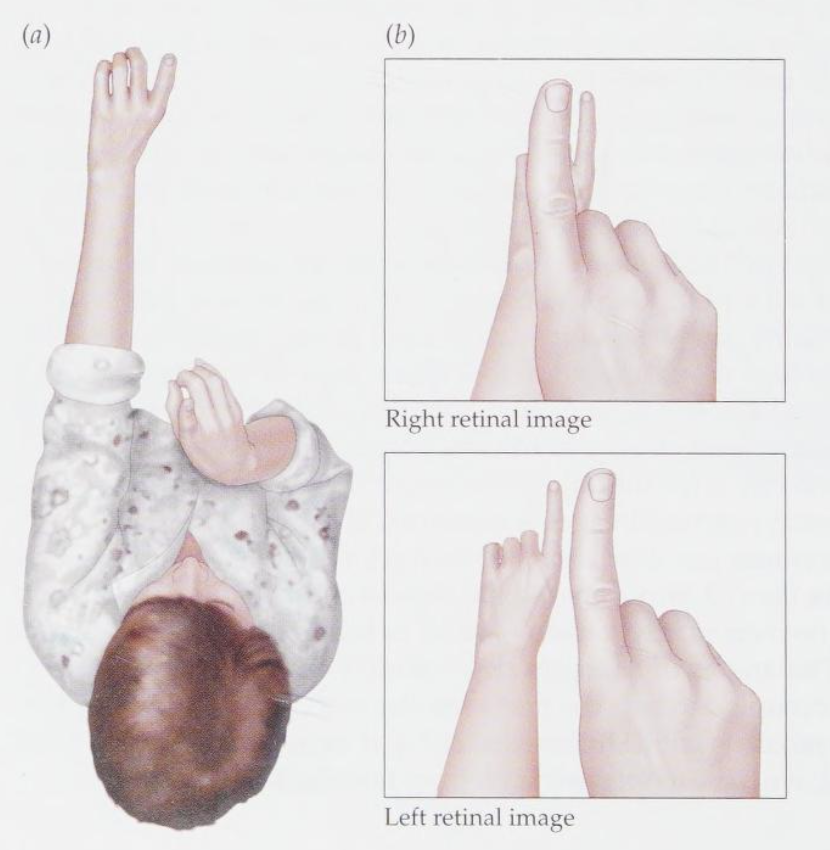
Two vantage points so the retinal images differ because the retinas are in slightly different places in your head
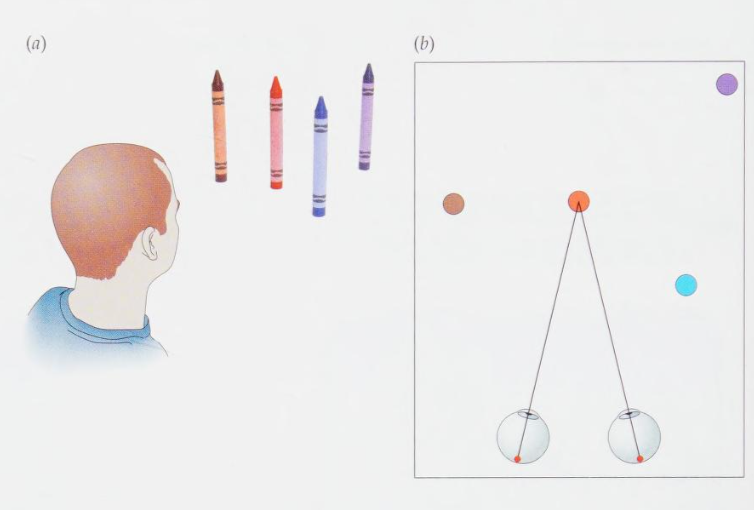
Illustrates how geometric regularities are exploited by the visual system to achieve stereopsis from binocular disparity.
Binocular Disparity
The differences between the two retinal images of the same scene. This is the basis of stereopsis, a vivid perception of the three-dimensionality of the world that is not available with monocular vision
Stereopsis
The ability to use binocular disparity as a cue to depth
Corresponding Retinal Points
Two monocular images of an object in the world are said to fall on corresponding points if those points are the same distance from the fovea in both eyes.
Horopter
Imaginary surface containing all objects that fall on corresponding positions
Retinal Disparity
Degree and direction of non-correspondence of the retinal images of an object
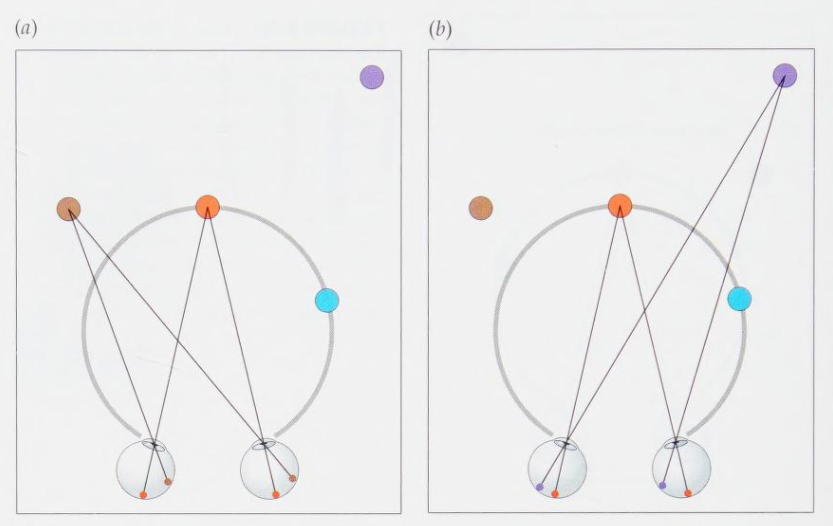
Light rays projecting from the brown (a) and purple (b) crayons onto Bob’s retinas as he continues to gaze at the red crayon
The red and blue crayons sit on the horopter and have zero disparity. They form retinal images in corresponding locations. The brown crayon forms images with a small binocular disparity. The purple crayon, farther from the horopter, has larger binocular disparity.
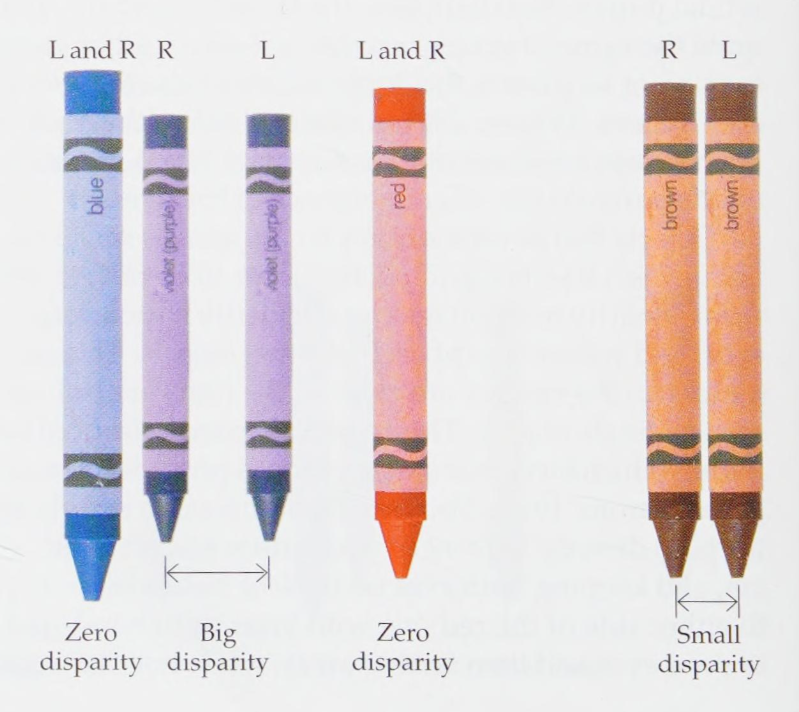
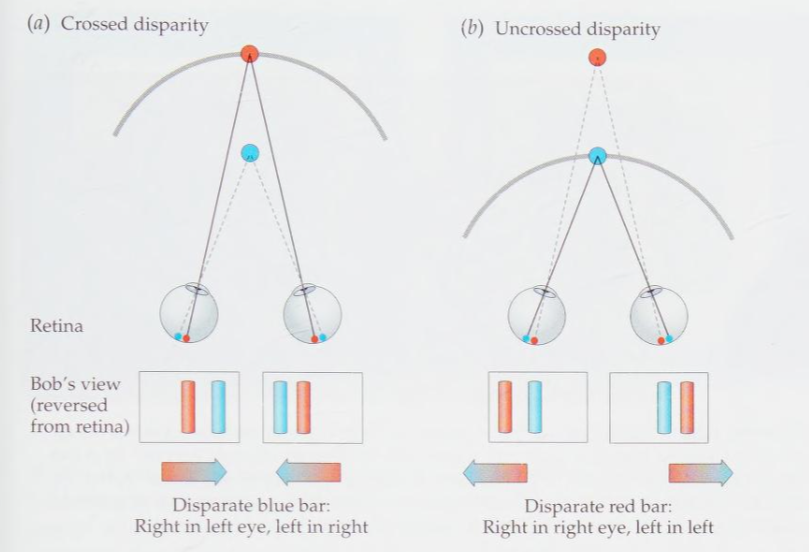
Visual system can detect whether the disparity is crossed or uncrossed, and also detect its magnitude
Crossed Disparity
The sign of disparity created by objects in front of the plane of fixation (the horopter). The images appear to be displaced to the left in the right eye and to the right in the left eye
Uncrossed Disparity
The sign of disparity created by objects behind the place of fixation (the horopter). The images appear to be displaced to the right in the right eye and to the left in the left eye
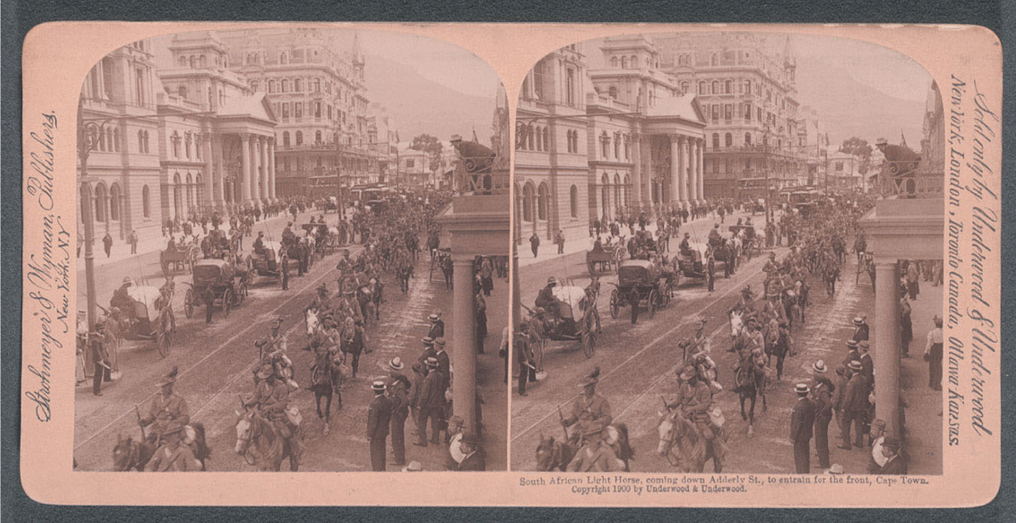
Stereoscope
A device for simultaneously presenting one image to one eye and another image to the other eye.
Free Fusion
The technique of converging or diverging the eyes in order to view a stereogram without a stereoscope
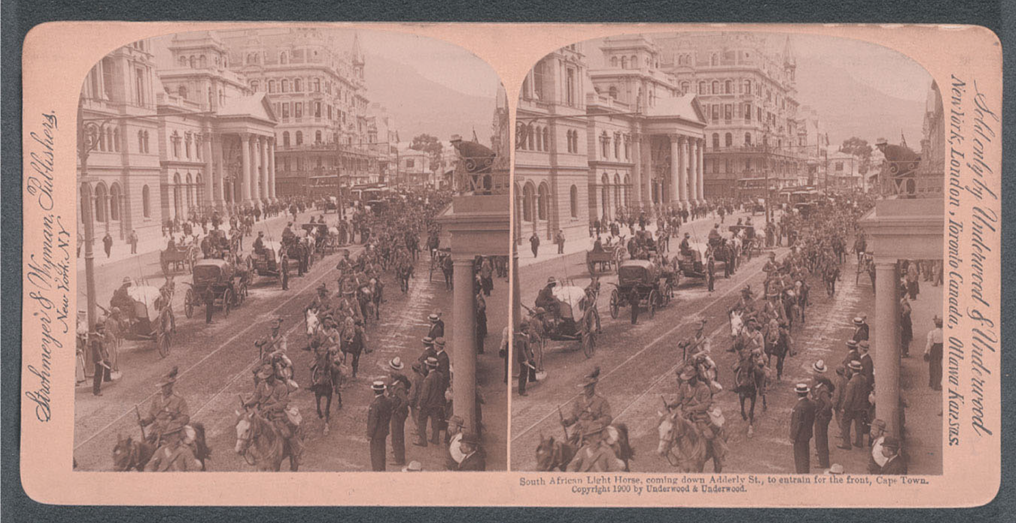
Random Dot Stereogram (RDS)
Made of large number of randomly placed dots. This contains no monocular cues to depth, but you can still see depth. (Julesz, 1950’s)
Correspondence Problem
In binocular vision the problem of figuring out which bit of the image in the left eye should be matched with which bit in the right eye. The problem occurs when the image consists of thousands of similar features like RDS and dots.
Uniqueness Constraint
The observation that a feature in the world is represented exactly once in each retinal image. (Simplifies the correspondence problem)
Continuity Constraint
The observation that, except at the edges of objects neighboring points in the world lie at similar distances from the viewer. (Simplifies the correspondence problem)
Bayes Rule
Formalizes the idea that perception is a combination of the current stimulus and our knowledge about the conditions of the world (the theorem allows us to calculate the probability that the world is in a particular state given a particular observation)
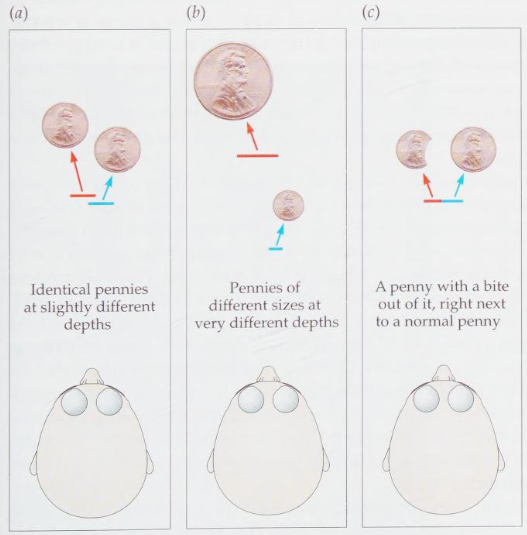
Size-Distance Relationships
For a given object, the visual angle/retinal image size is inversely proportional to the distance
visual angle (or retinal image size), distance, object size Knowing any two of these is sufficient to determine the third.
Size Constancy
In judging size, visual system “corrects for” distance or depth (size stays the same)
Increasing distance → smaller retinal image (the two effects cancel)

