4. Social learning theory
 Call Kai
 Learn
Learn Practice Test
 Spaced Repetition
 Match
Match Flashcards
 Knowt Play
1/38

There's no tags or description
Looks like no tags are added yet.
Name | Mastery | Learn | Test | Matching | Spaced | Call with Kai |
|---|
No analytics yet
Send a link to your students to track their progress
39 Terms
What are the underpinning principles of Social Learning Theory/how did it come about?
The theory was developed by Albert Bandura an American psychologist.
Behaviourism was a school of psychology that believed that all human behaviour came about though a mixture of classical and operant conditioning.
However, there were problems with this - some behaviour seemed to appear without conditioning.
This is particularly true of complex behaviour like language or antisocial behaviour like aggression.
Bandura proposed social learning theory, sometimes called ‘observational learning’, which looks at how we learn by observing other people and imitating them, without conditioning.
We learn through observation and imitation.
What are Role models? - process of social learning
The behaviour must be modelled by a person who we may class as a ‘role model’.
e.g. parents, teachers.
Role models are subjective.
What is Identification? - process of social learning
Bandura said that the likelihood of us imitating behaviour is increased when we identify with our role models,
e.g. race, gender
They are similar to the observer. This is perceived similarity - it might exist only in the observers imagination.
Similarity in gender seems particularly important but there can be a similarity in age, race, ability, social identity, interests etc.
They have satus in thte eyes of the observer.
Again, this is perceived status - a naughty child in a lesson might have status in the eyes of his classmates for clowning around, but not the teacher. - subjective
This behaviour is rewarded - this is called vicarious reinforcement.
What is observation? - process of social learning
Bandura said this also included stages
What is Imitation? - process of social learning
After the below process, behaviour is imitated.
What is Attention? - process of social learning
The behaviour must be significant enough to capture our attention.
You must be attending to the behaviour.
Paying attention to the model is a condition for learning.
This is cognitive.
What is retention? - process of social learning
You must retain it in your memory.
Remembering what the model did is a condition for imitating the models behaviour.
This is cognitive.
What is reproduction? - process of social learning
You must be capable of carrying out the behaviour.
People must have the capacity e.g. skills for imitating the behaviour.
Physical ability can limit you.
What is motivation? - process of social learning
You must have a reason to carry out the behaviour (e.g. a reward).
People must be motivated to imitate a behaviour (e.g. importance of model or reward).
Why is Vicarious reinforcement an important part of the theory?
This is a very important part of the theory and is an improvement on previous learning theories.
SLT explains WHY we learn certain behaviours; it doesn’t just describe HOW they occur - this is missing from both classical and operant conditioning.
What is Vicarious Reinforcement?
If we see someone rewarded for a certain behaviour and that reward is also appealing to us, we are more likely to imitate the behaviour in pursuit of that reward.
This is vicarious reinforcement.
What was the aim of Bandura’s 1961 bobo doll study?
To investigate if children would show more aggressive behaviour if exposed to an aggressive role model.
To investigate if the sex of the role model had an impact on aggression levels.
How many Pp were used and what was their demographic? - 1961 study
72 children - 36 boys, 36 girls
Aged 3-5.
Recruited from Stanford University Nursery school USA.
What were the conditions (IV) of the experiment? - 1961 study
Whether the role model was aggressive or non-aggressive.
Whether the role model was the same or opposite sex to the child.
There was also a control condition where the children did not see a role model at all.
Bandura also studied a naturally varying IV - whether the child was male or female.
What type of methodology and techniques were used? - 1961 study
Laboratory experiment with an independent groups design.
Matched pairs design because each child was only in one condition but they were matched on their level of starting aggression.
Bandura also used a covert observation as the children didn’t know they were being watched.
What did Bandura measure (DV)? - 1961 study
Banduras observers recorded the number of verbal, physical, mallet and gun-play aggressive actions the children carried out.
They also counted the number of acts of non-imitative aggression.
Diagram that demonstrates allocation to conditions - 1961 study
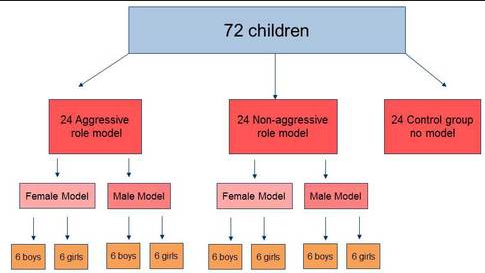
What was the procedure for the experiment? - 1961 study
24 children formed a control group - who didn’t watch any role model.
The other 48 children were split into experimental groups of 6.
Half the children saw a same sex role model, half saw an opposite sex role model.
Children were first placed in a room where they were either exposed to an aggressive role model, or a non-aggressive role model or were on their own.
This lasted for 10 minutes.
They were then moved to another room which contained toys - but were told that they were not allowed to play with them - this was designed to frustrate the children.
This also lasted for 10 minutes.
Finally the children moved to the 3rd room where they could interact with the toys.
This is where Bandura measured aggressive acts.
Lasted 20 minutes
These are standardised procedures
What did Bandura find in relation to the mean number of acts in the ‘aggressive model condition’ in comparison to the ‘non-aggressive’ and ‘control conditions’? - 1961 study
Both boys and girls showed higher levels of aggression when observing aggressive role models in comparison to non-aggressive role models or when no role model was observed at all.
What did Bandura find in relation to aggression levels when Pp were exposed to same-sex role models? - 1961 study
Girls showed more aggressive acts when they had observed a female role model.
Physical = 5.5 verbal = 13.7 except with ‘gun play’ where they showed more aggressive acts when they observed males.
Boys showed more aggression when they observed a male role model for all aggressive acts.
What did Bandura find in relation to overall gender differences? - 1961 study
Boys were more aggressive than girls in all conditions - even in the control condition.
What was the aim of this variation?
(1963 - replication using filmed role models)
To investigate if children would become more aggressive if exposed to an aggressive model in film, or in a less realistic cartoon compared to watching a live mode.
What was the IV this time?
(1963 - replication using filmed role models)
Whether the aggressive role model was real, filmed or a cartoon character.
Whether the role model was the same sex or opposite sex to the child.
Control condition where the children did not see a role model at all.
(there was no non-aggressive role model this time.)
What was the sample?
(1963 - replication using filmed role models)
96 children - 48 boys 48 girls.
Aged 3-5.
Recruited from Stanford University Nursery School USA.
Opportunity sample.
What was the change to the procedure?
(1963 - replication using filmed role models)
There was no non-aggressive model condition, but an extra condition was added where the children watched a film in which the female adult model was dressed as a cartoon cat while following the script with the bobo doll.
What were the results
(1963 - replication using filmed role models)
The control group carried out half as much aggression as the other groups.
There is no significant difference between live models and filmed or cartoon models.
What did Bandura conclude?
(1963 - replication using filmed role models)
Bandura concludes that children will imitate filmed aggression in the same way as live aggressive role models.
What was the aim of this variation?
(1965 - replication with rewards and punishment)
To investigate if children would be more likely to imitate a role model they see being rewarded (vicarious reinforcement) and less likely to imitate a role model they see being punished.
What was the IV this time?
(1965 - replication with rewards and punishments)
Whether the aggressive role model (rocky) was rewarded, punished or there were no consequences.
Whether the role model was the same or opposite sex to the child.
Whether the child received no incentive or a positive incentive.
What was the sample?
(1965 - replication with rewards and punishment)
66 children - 33 boys 33 girls.
Aged 3-5.
Recruited from Stanford University Nursery School USA.
Opportunity sample
What was the change to the procedure?
(1965 - replication using rewards and punishment)
There was no non-aggressive role model condition, but all the other conditions were filmed.
The model (rocky) went through a scripted routine of aggressive behaviour towards a bobo doll.
In the reward condition the experimenter arrived and praised Rocky for his ‘superb aggressive performance’ and gave Rocky sweets which he ate.
In the punishment condition, the experimenter called Rocky ‘‘a big bully’’ and hit him with newspaper.
In the no consequences condition nothing happened to Rocky.
The children were placed in the observation room for 10 minutes and secretly observed - this is the no incentive condition.
Then they were brought juice and told they would get more juice and sticker books if they could imitate Rocky.
They were asked to ‘‘show me what Rocky did’’ and ‘‘tell me what Rocky said.’’
If there was imitative aggression in response, they were rewarded straight away.
This is the positive incentive condition.
What were the results?
(1965 - replication with rewards and punishment)
You can see that the Model Reward condition produced about the same imitation from girls (mean 2.8) and boys (3.5) as the no consequences condition.
The Model Punished condition produced much less imitation, especially among the girls (mean 0.5)
After positive incentive, the imitation increased significantly for girls and boys and is very similar across all conditions of the model, with the girls’ scores much closer to the boys’ (all >3)
What did Bandura conclude?
(1965 - replication with rewards and punishment)
Bandura concludes that children will be less likely to imitate role models they see being punished.
However, the no consequences condition shows that behaviour doesn’t have to be punished or rewarded for it to be imitated.
When offered incentives, even children who watched the model being punished show that they had in fact learned the aggressive behaviour.
Girls are more restrained by the threat of punishment (perhaps due to cultural expectations).
But this effect lessens when they are offered positive incentive to imitate the behaviour.
Again, it shows that behaviour can be learned even when it isn’t acted out.
Bandura demonstrated that vicarious reinforcement influences the behaviour that they imitate.
Why is Bandura’s research a weakness in terms of psychological harm?
Exposure to and encouragement of aggressive behaviour breaks the guideline of protection of Pp.
Some children may have felt scared by the aggression they saw or even anxious about getting in trouble from replicating the behaviours they observed.
Pp are supposed to leave a study in the same state they entered it - which may not have happened here.
Why is Bandura’s research both a strength and weakness in terms of External validity?
The mundane realism is good because children will at some point witness someone being aggressive and will also see aggressive cartoons and the Bobo doll is a real toy.
Bandura made an attempt to make it look like a real children’s playroom to make it representative but it is still an artificial setting because in a real one there would be other children and other adults.
The ecological validity is both a strength and weakness.
Why is Bandura’s research a strength in terms of standardised procedures?
There was a good use of standardised procedures and gave it good internal and external reliability.
And internal validity.
Why is Bandura’s research a weakness in terms of demand characteristics?
The children were put in a strange situation, exposed to unusual adult behaviour and given toys to play with which encouraged them to act unnaturally.
For example, a bobo doll is designed to be hit and knocked over, some of them may have even seen them before.
Children would suppose the experimenters wanted them to play with the bobo doll in this way.
Evidently, these are demand characteristics because the Pp did what they thought the researchers wanted them to do.
Why is Bandura’s research a strength in terms of inter-rater reliability?
Bandura used 2 observers behind the one way mirror.
This creates good inter-rater reliability because the behaviour had to be noted by both observers otherwise it didn’t count.
He also filmed the 1963 study and the films can be watched and checked which adds to the inter-rater reliability.
Why is Bandura’s research a strength in terms of replicability?
Bandura’s procedure is very reliable because it can be replicated - as he did replicating the study in ‘63 and

