Lecture 14: The Money Market & the Role of Money in the Economy I
 Call Kai
 Learn
Learn Practice Test
 Spaced Repetition
 Match
Match Flashcards
 Knowt Play
1/29

There's no tags or description
Looks like no tags are added yet.
Name | Mastery | Learn | Test | Matching | Spaced | Call with Kai |
|---|
No analytics yet
Send a link to your students to track their progress
30 Terms
What is money
Money is defined by its functions and is not always a paper dollar (thin about cigarettes being used as currency in Russia when the Ruble was being devalued.
The functions of money
1) medium of exchange- an asset that is easy to use in transactions, as is/ accepted as a way to pay for goods and services.
Avoids the “double coincidence of wants”- economic situation in a barter system where two individuals must each possess a good or service that the other desires for a trade to occur.
2) Store of value- needs to store value, at least in the short run, so that it can be used in future transactions
3) unit of account- a common “yard stick” against which all other goods and services are valued.
What counts as money?
cash/ currency of the country you are in.
bank accounts (checking and savings)
coupons and gift cards.
What does money not include?
stocks
bonds
gold (hard to liquidate)
NFTS (Non-fungible tokens (NFTs) are unique digital certificates of ownership stored on a blockchain, representing distinct assets like digital art, collectibles, or in-game items.)
real estate
Are credit cards money?
NO! Credit cards are a means ro delay the use of money into the future. it is a form of indebtment.
Are bitcoin/ crypto money?
In development, but not universally accepted- so they are somewhere between money and not money bc they are still used as currency in some online spaces.
Liquidity
How easily and asset can be converted into cash.
What is money stock
money stock = money supply
total amount of money in the economy.
M
M= cash + total deposits (the aggregate sum of all funds placed into a bank account)
M1
money stock (mostly liquid)
M2
M1 + some other accounts
Pros and cons of holding money assets
Pro: easy to use in transactions
Con: The opportunity cost that comes from forgoing forgoing returns represented by the Fischer Equation: i = Πe + r
Pros and cons of holding non-monetary assets
Pros: you are making returns (previous equation).
Cons: Impossible to use in transactions.
Relationship between income and money
Based on the National Accounts Identity: income= spending= production
When your income rises your your consumption rises so you demand more money.
Thus: Y ↑, transactions ↑, more need for money.
Md, money demand
downward sloping curve in the money market
Shift factors of money demand
1) increase in income
2) Price changes- in the SR we take prices as given and do not adjust until the longterm.
i = the opporutunity costs/ the “price of money”
if interest rate is up the quantity demanded of money is down because the opportunity costs of holding money and not placing it in investments is higher.
Who determines money supply?
The U.S. Central Bank- the Federal Reserve
Meets 8 times a year and sets the federal funds rate (i in the money market diagram.)
The Central Bank is not to be confused with the the U.S. treasury which manages revenue and economic policy and is led by cabinet level secretarys appointed by the president.
Money market diagram
expected inflation is the slope of this
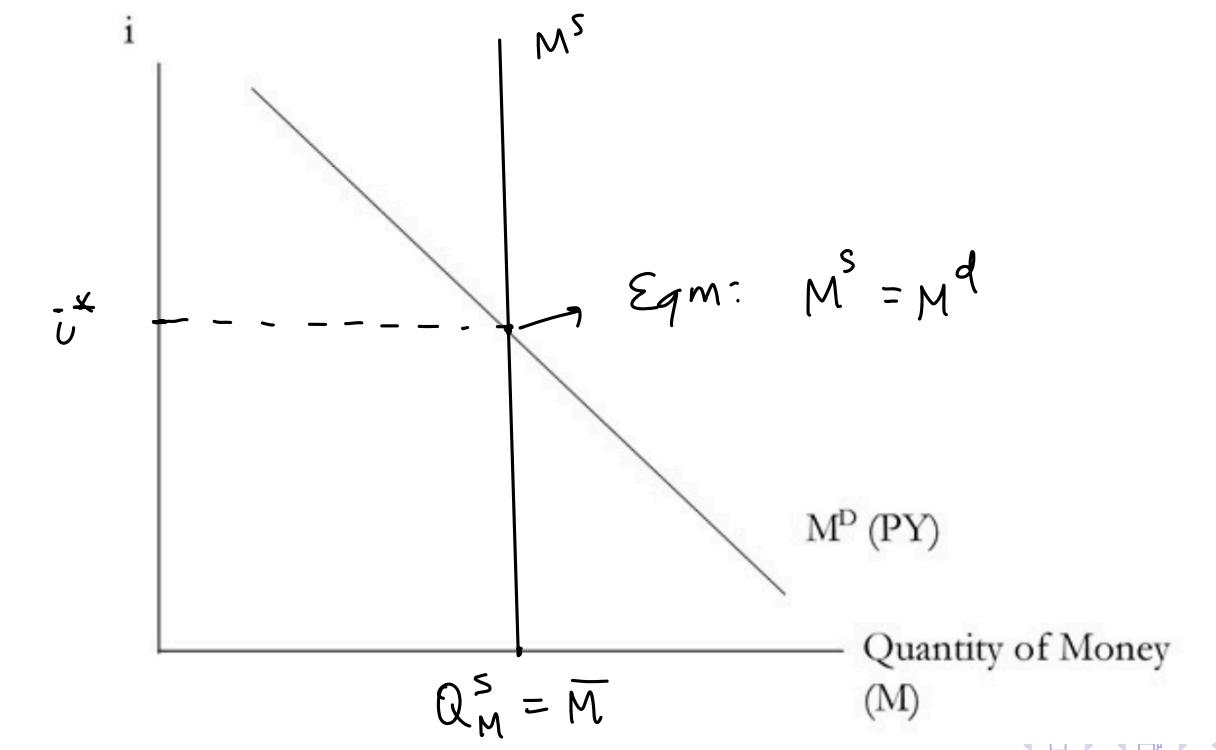
Why is there a downward sloping money demand curve?
interest rate represents the opportunity cost of holding money. When interest rate is high the opportunity cost of holding cash is high and thus there is a lower quantity demanded of cash.
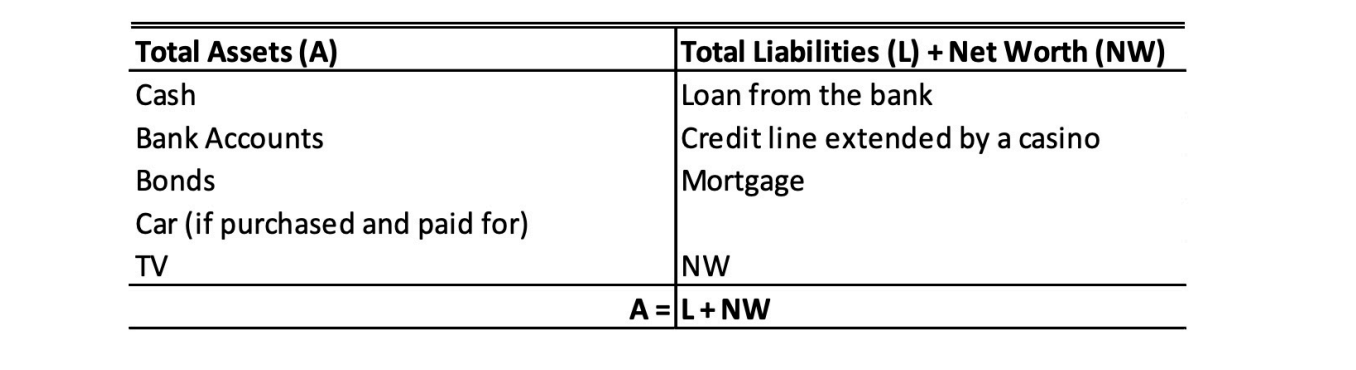
Accounting basics: balance sheet
financial summary of a person or institutions assets, liabilities, and net worth.
Accounting basics: assets (A)
items that one owns or will own in the future.
Accounting basics: liabilities (L)
Items that a person or institution owes or will owe in the future.
Accounting Basics: Net worth (NW)
NW= A - L
if A - L> 0 you are bankrupt
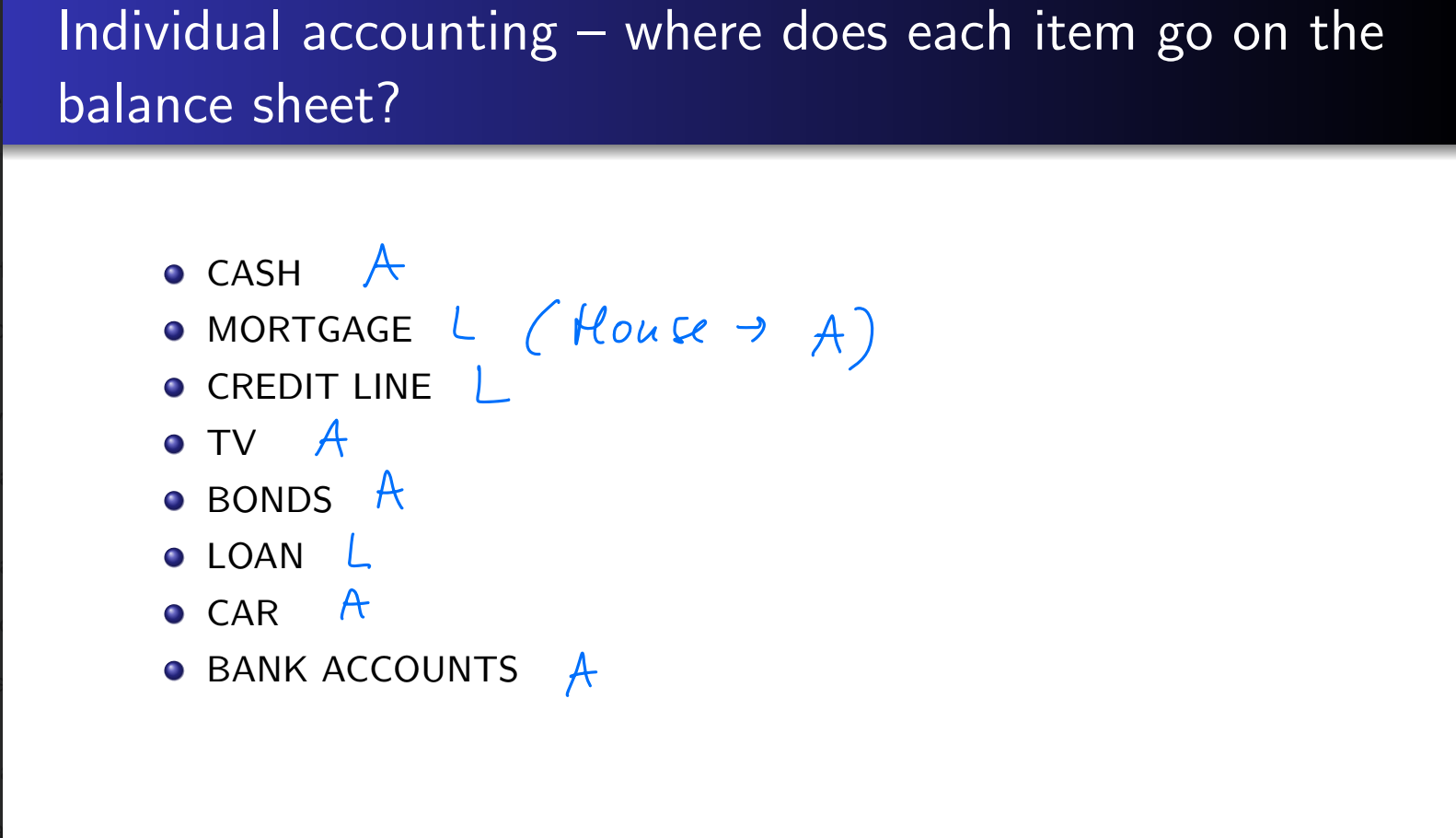
Where does each item go on the balance sheet?
T table of balance sheet
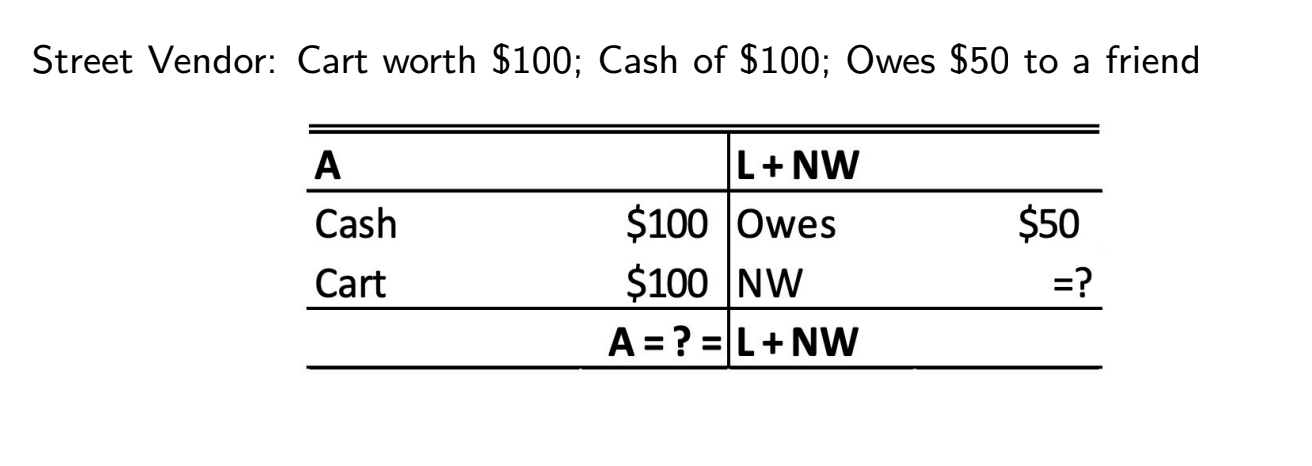
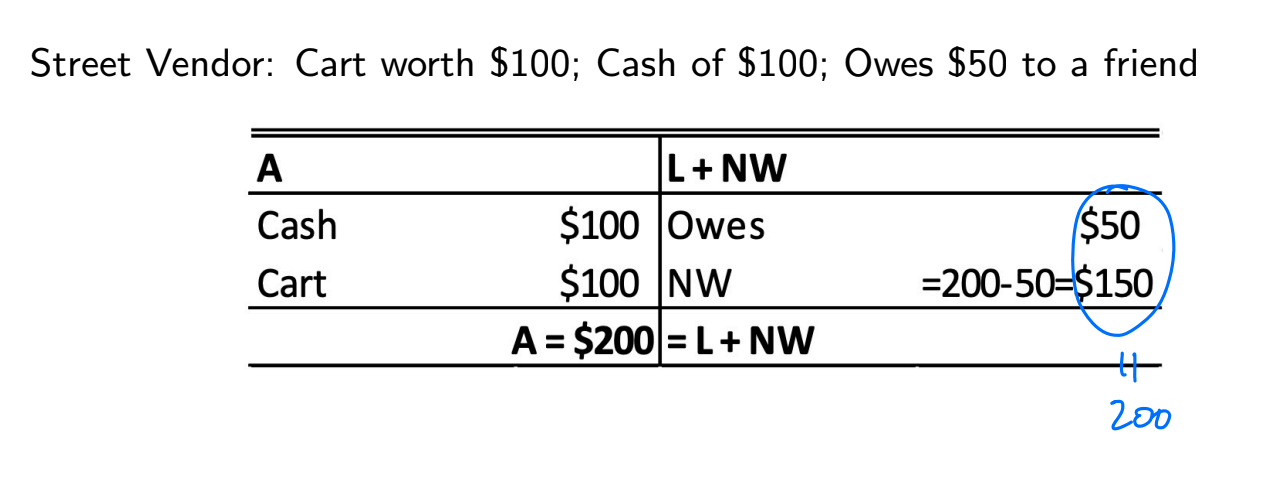
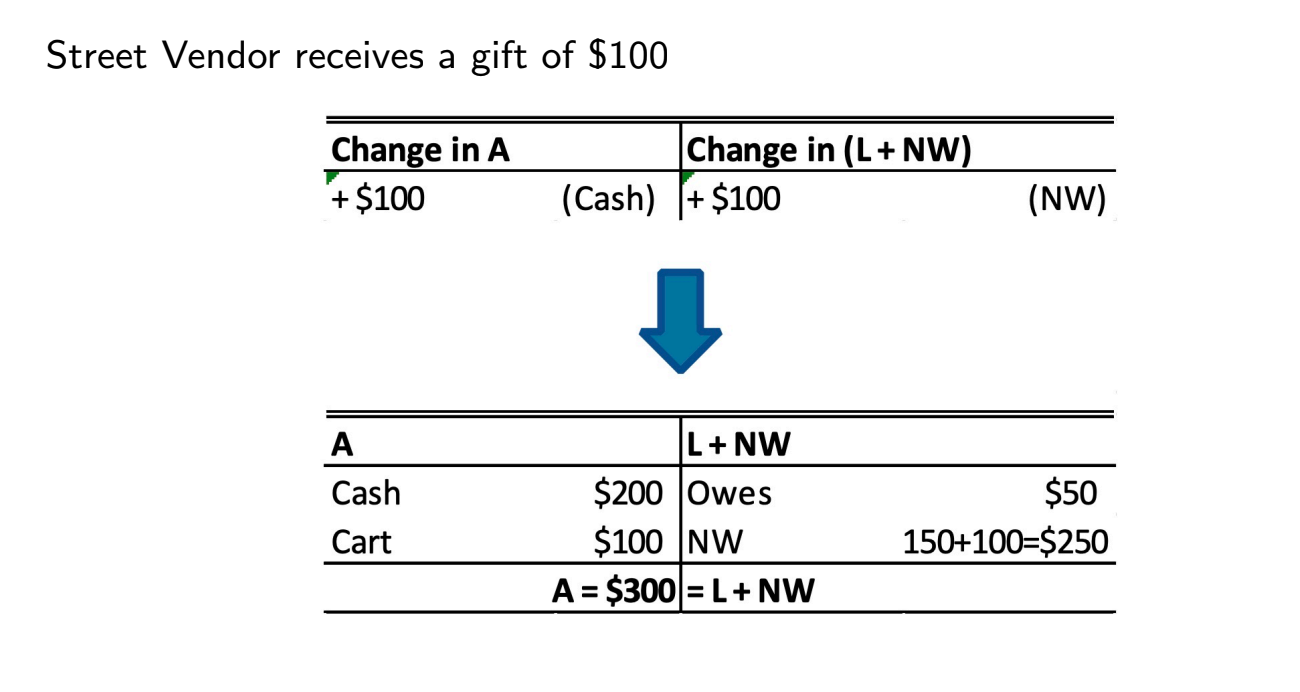
Example: Street vendor receives gift of $100
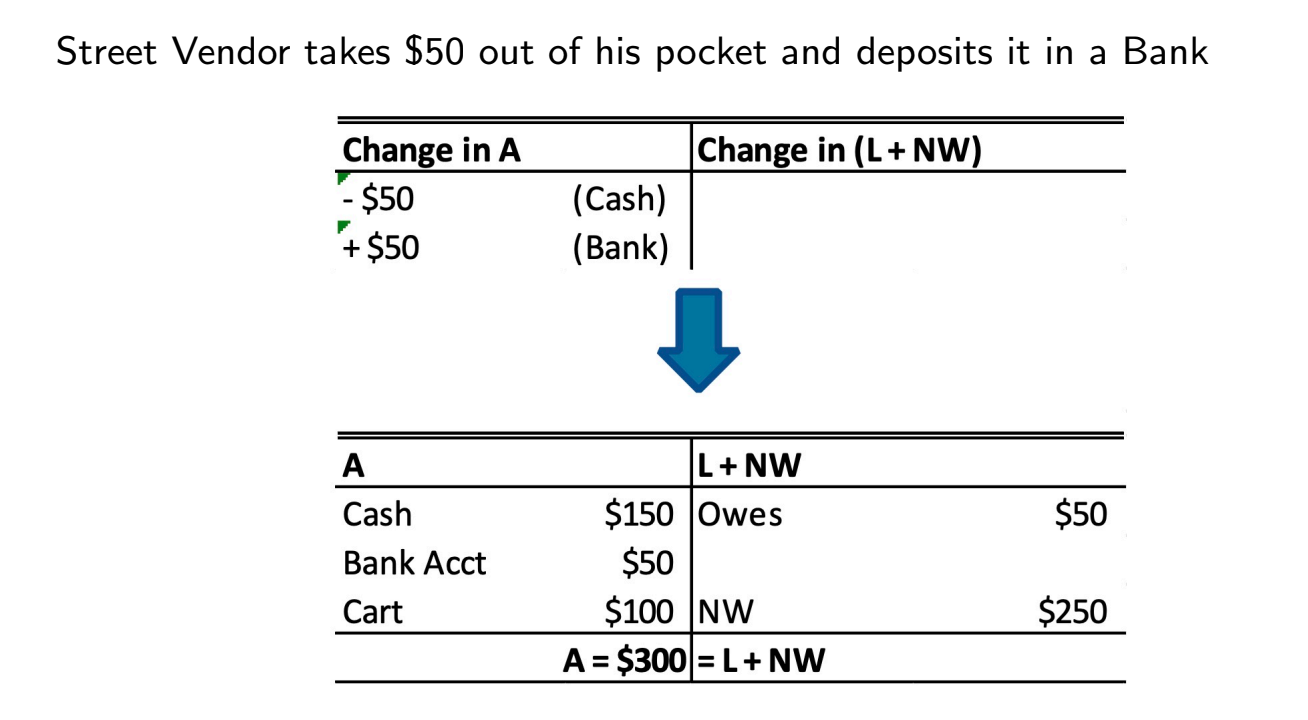
Street vendor takes 50 dollars out of his pocket and deposits it in a bank
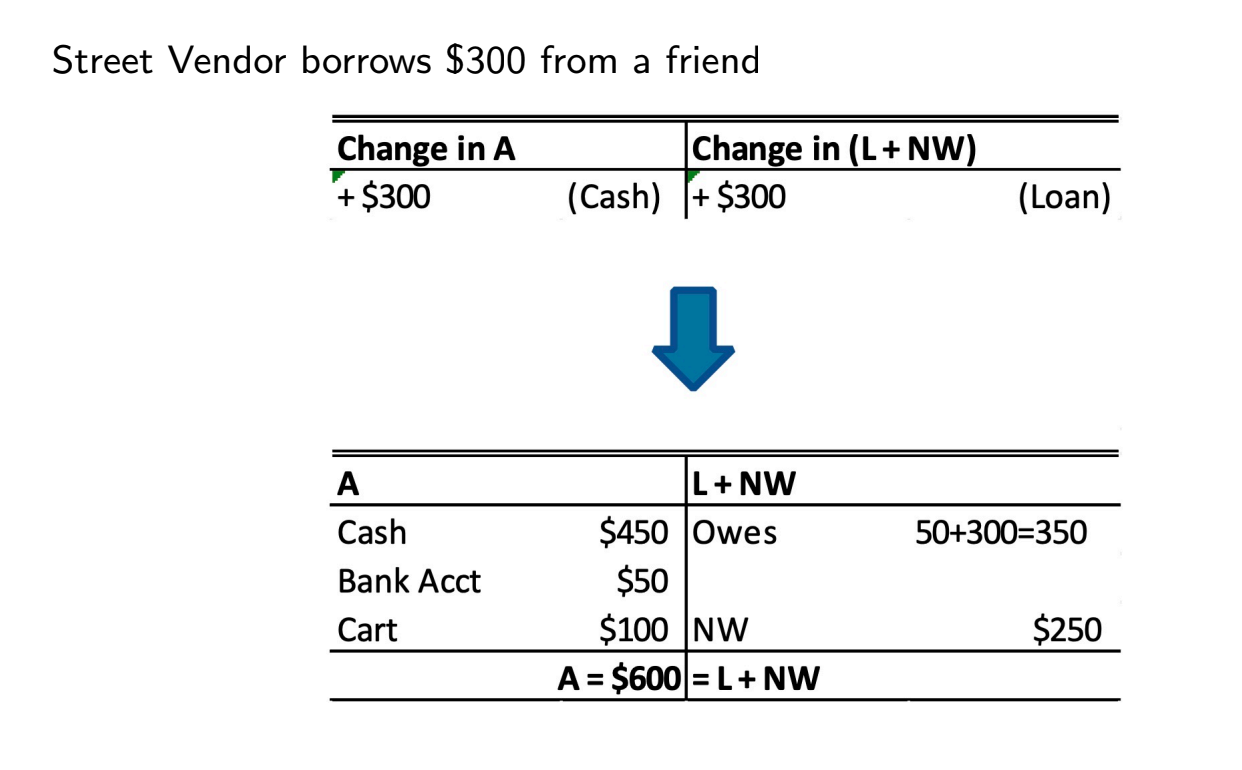
street vendor borrows $300 from a friend