Fixed Prosth Midterm Study Guide
 Call Kai
 Learn
Learn Practice Test
 Spaced Repetition
 Match
Match Flashcards
 Knowt Play
1/306

There's no tags or description
Looks like no tags are added yet.
Name | Mastery | Learn | Test | Matching | Spaced | Call with Kai |
|---|
No analytics yet
Send a link to your students to track their progress
307 Terms
replacement, restoration
Fixed Prosthodontics is the branch of Prosthodontics concerned with the _________ and/or _______ of teeth by artificial substitutes that cannot be removed by the patient
Abutment
In a fixed partial denture, the retainer is on the __________ tooth
Replacement
In a fixed partial denture, the pontic is on the __________ tooth
Need for endodontic tx (3%)
(Porcelain Veneer Fracture: 3%; Loss of Retention: 2%)
What is the most common complication for single crowns?
Caries on abutment (18%)
(Need for Endodontic Tx: 11%; Loss of Retention: 7%)
What is the most common complication for FPD?
Debonding (23%)
(Tooth Discoloration: 18%; Caries: 7%)
What is the most common complication for Resin Bonded FPD?
1. Diagnosis + tx plan(s)
2. Actual treatment:
- Preparatory phase
- Operating phase
3. Post-operative, Maintenance and Recare
What is the order of treatment for single crowns?
- Serve as a complement tool in addition to clinical examination
- Provide a legal proof of pt’s current occlusion
- Allow clinician to modify occlusal pre-tx plan prior to establish a definitive Tx Plan
- Allow clinician to evaluate pt’s occlusion in centric + eccentric positions
- Allow clinician to determine inter arch distance, relationship between the teeth and alveolar ridge and allow clinician to make as many alteration to as clinician’s desire w/ absence of the patient
What is the purpose of mounting diagnostic casts on an articulator?
Irreversible hydrocolloid
The alginate hydrocolloid we use in lab is also know as __________
An irreversible hydrocolloid impression material used to make a negative reproduction of oral tissues for diagnostic casts
- Salt of alginic acid (Na or Ca alginate)
- Alingates are cell wall constituents of brown algae
- Most widely used impression material in dentistry
What is alginate?
Inexpensive
Easy manipulation
Pleasant taste
Able to displace blood and body fluids
Hydrophilic
Easily poured
Can be used with stock trays
Accurate if handled properly (for diagnostic casts)
8 advantages of alginate hydrocolloids
Low tear resistance
Must be poured immediately
Limited detail reproduction
Dimensionally unstable (syneresis vs imbibition)
Can only be used for single casts
Incompatible w/ epoxy resin die materials
6 disadvantages of alginate hydrocolloids
1 minute
How long should you mix for regular setting alginate?
45 seconds
How long should you mix for fast-set setting alginate?
3.5 minutes
What is the set time for alginate after mixing?
Lower
(alginate) Lower or Higher W/P ratio?
- Increase in strength
Lower
(alginate) Lower or Higher W/P ratio?
- Increase in tear strength
Lower
(alginate) Lower or Higher W/P ratio?
- "Better" consistency
Lower
(alginate) Lower or Higher W/P ratio?
- Decrease in working time
Lower
(alginate) Lower or Higher W/P ratio?
- Decrease in setting time
Lower
(alginate) Lower or Higher W/P ratio?
- Decreased flexibility
Higher
(alginate) Lower or Higher W/P ratio?
- Decrease in strength
Higher
(alginate) Lower or Higher W/P ratio?
- Decrease in tear strength
Higher
(alginate) Lower or Higher W/P ratio?
- Runny consistency
Higher
(alginate) Lower or Higher W/P ratio?
- Increase in working time
Higher
(alginate) Lower or Higher W/P ratio?
- Increase in setting time
Higher
(alginate) Lower or Higher W/P ratio?
- Increased flexibility
Increase
Cold water will ________ the working and setting times
Insufficient
_________ mixing results in a grainy mix and poor recording of details
100%, 30 minutes
Storage of impressions in either air (syneresis) or water (imbibition) results in significant dimensional change. If needed, impression materials should be stored in _____% humidity for _______ minutes prior to pouring
- Sodium hypochlorite
- Iodophors
Disinfectent of alginate hydrocolloids can be accomplished by immersion in ___________ or ___________
Syneresis
Define the following:
Loss of water due to dehydration that causes shrinkage
Imbibition
Define the following:
Tendency to absorb water that results in swelling
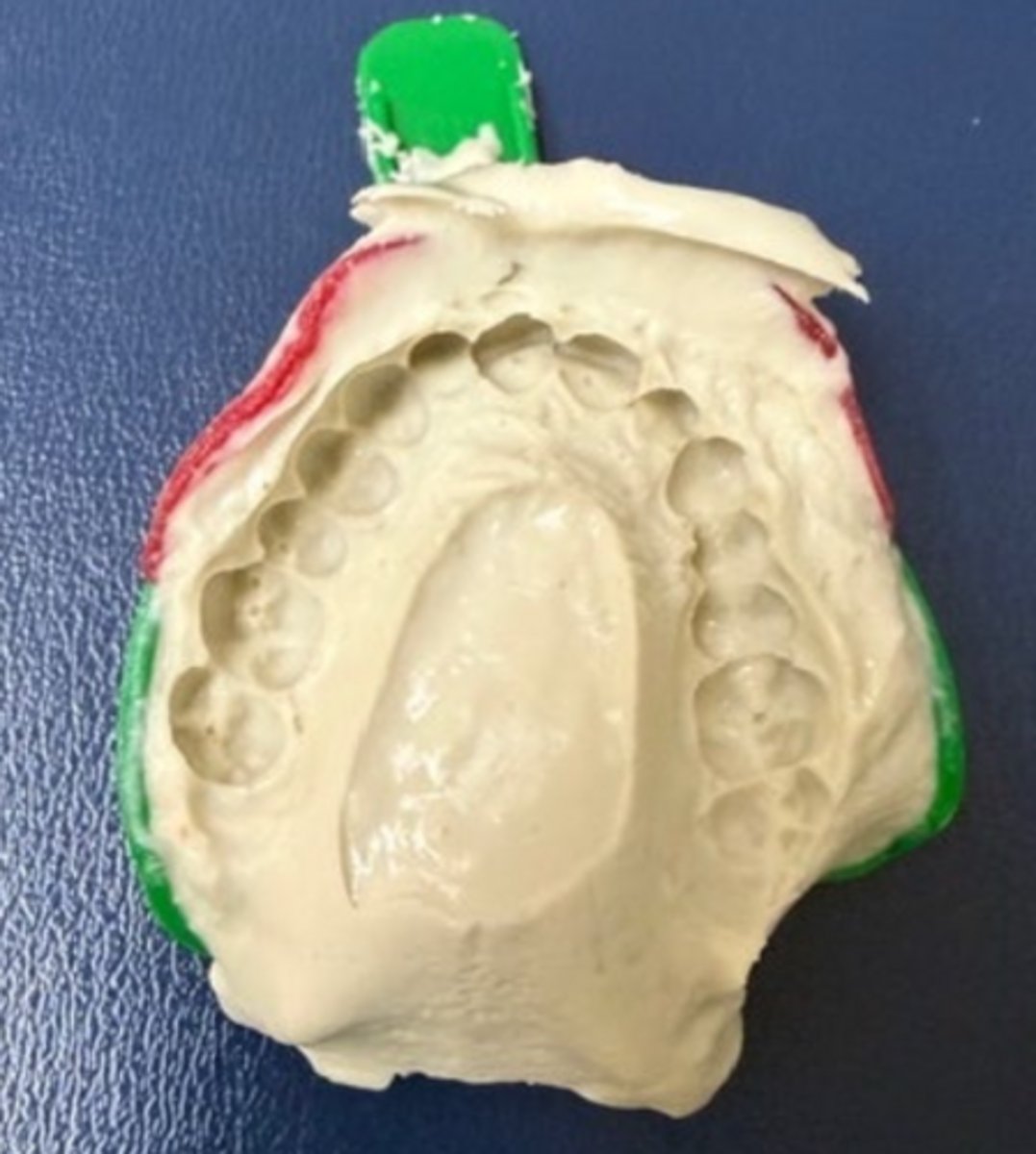
- Not centered with midline
- Voids
- Missing anatomy
What don't you like about this impression?
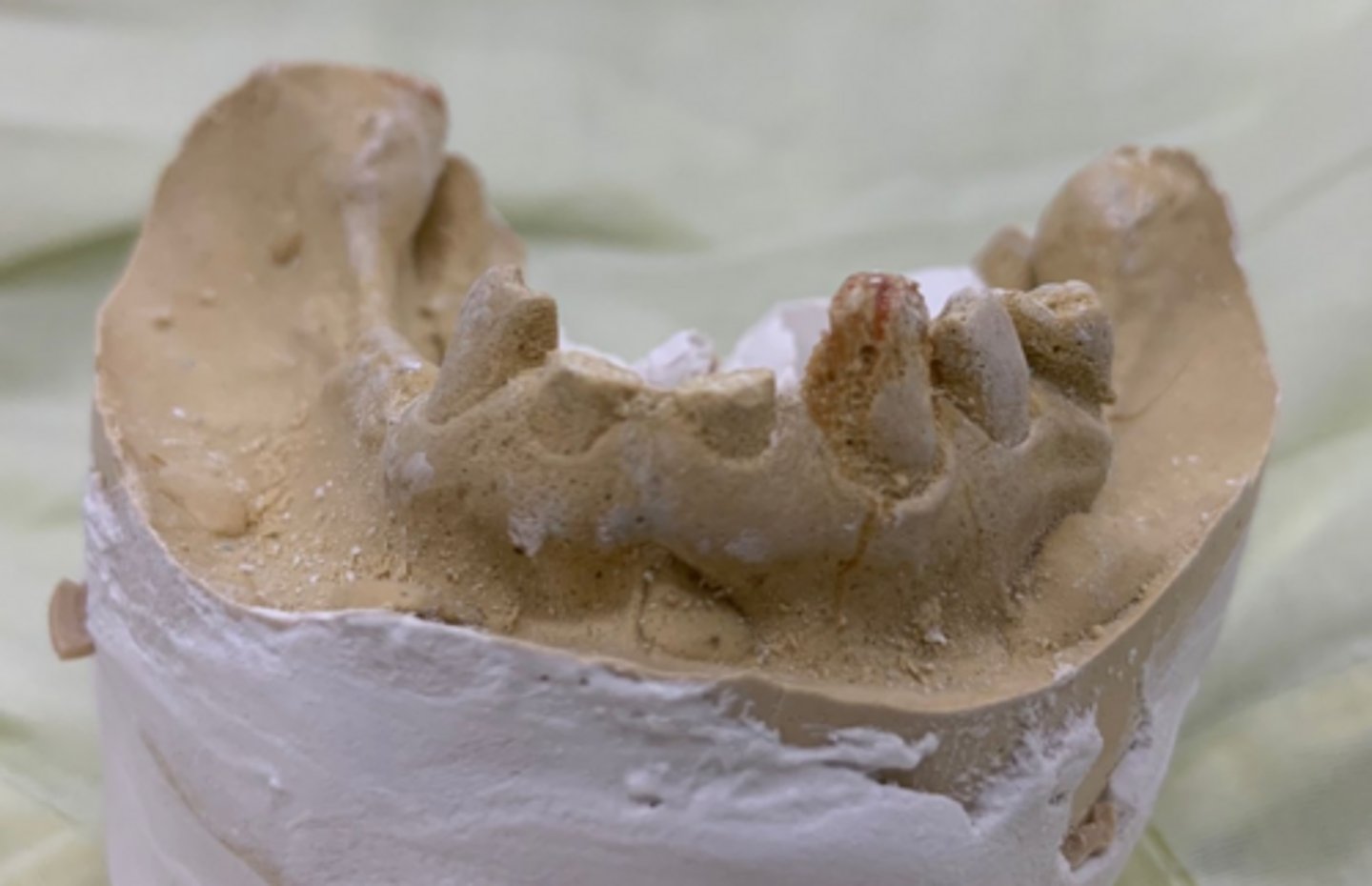
- Waited too long to pour stone
- Pour mixing spatulation
What do you think happen to this cast?
Type 1, white impression plaster
This is a dental gypsum specification of which type of stone?
- Setting expansion: 0-0.15%
- Compressive strength: 580-1160 psi
Type 2, white mounting plaster of paris
This is a dental gypsum specification of which type of stone? - Setting expansion: 0-0.30%
- Compressive strength: 1300 psi (minimum)
Type 3, yellow stone study cast
This is a dental gypsum specification of which type of stone?
- Setting expansion: 0-0.20%
- Compressive strength: 2900 psi (minimum)
Type 4, working cast for c&b
This is a dental gypsum specification of which type of stone?
- Setting expansion: 0-0.15%
- Compressive strength: 5100 psi (minimum)
Type 5, green working cast (Die Keen)
This is a dental gypsum specification of which type of stone?
- Setting expansion: 0.16-0.30%
- Compressive strength: 5100 psi (minimum)
Type 3
(allows expansion and acrylic shrinks)
What type of stone do you use when you are going to make an acrylic RPD?
Type 4
(does not expand - could be 5 but Dr. Nui said most likely 4)
What type of stone do you use when you are going to make a crown or bridge?
Type 3
What type of stone was this from?
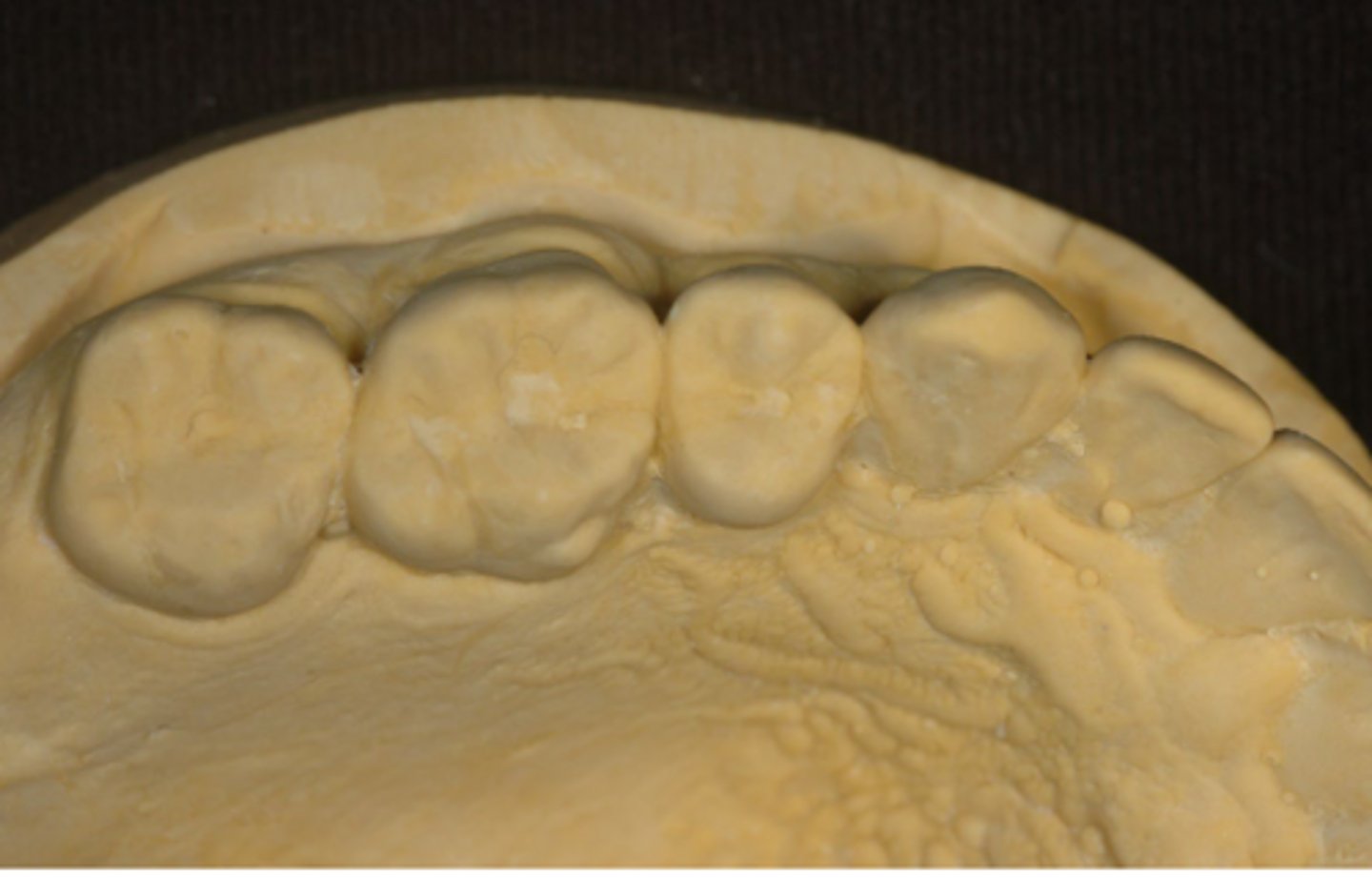
Type 5
What type of stone was this from?
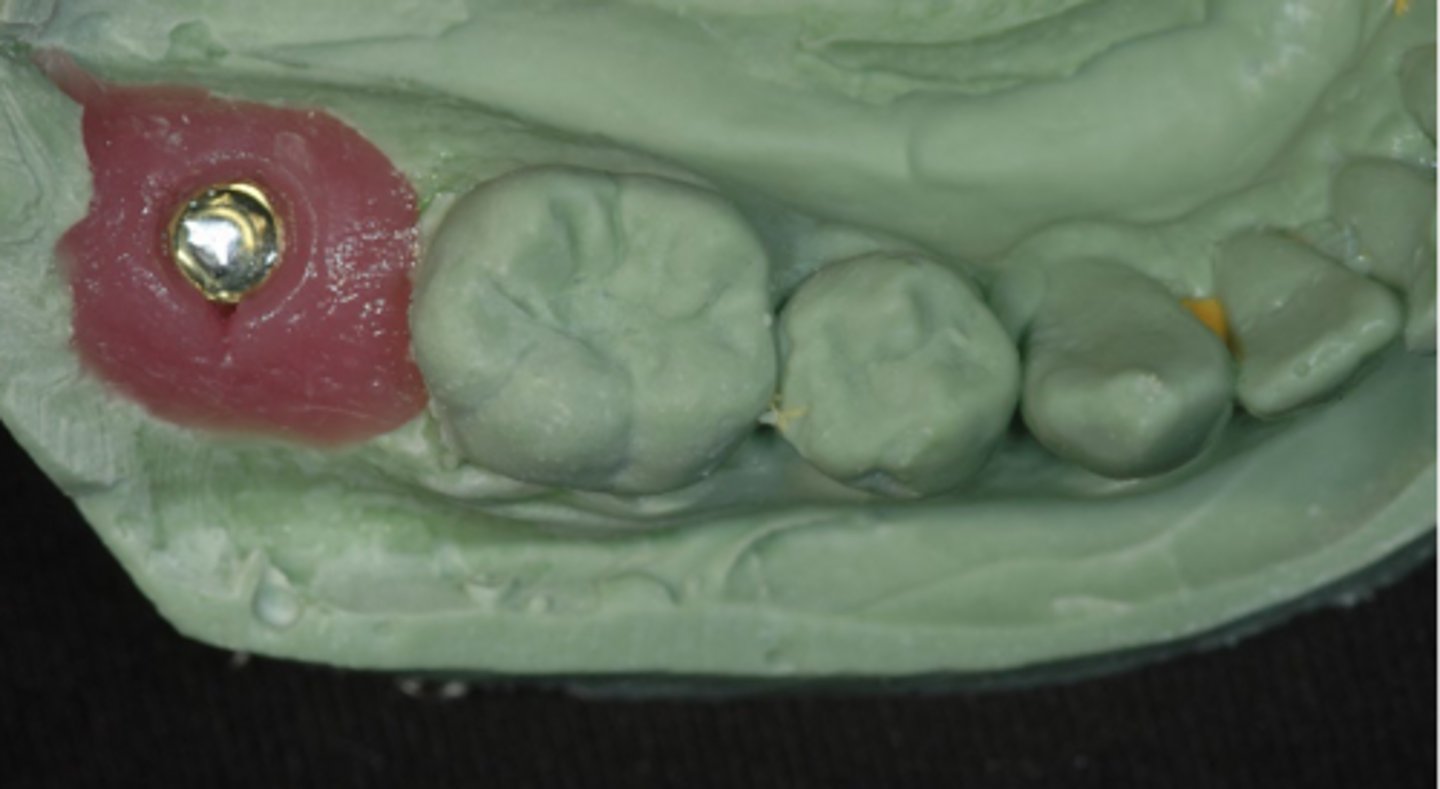
Yes
(Maxillary acrylic CD)
Did the student use proper type of dental stone to form this working cast for the dental prostheses?
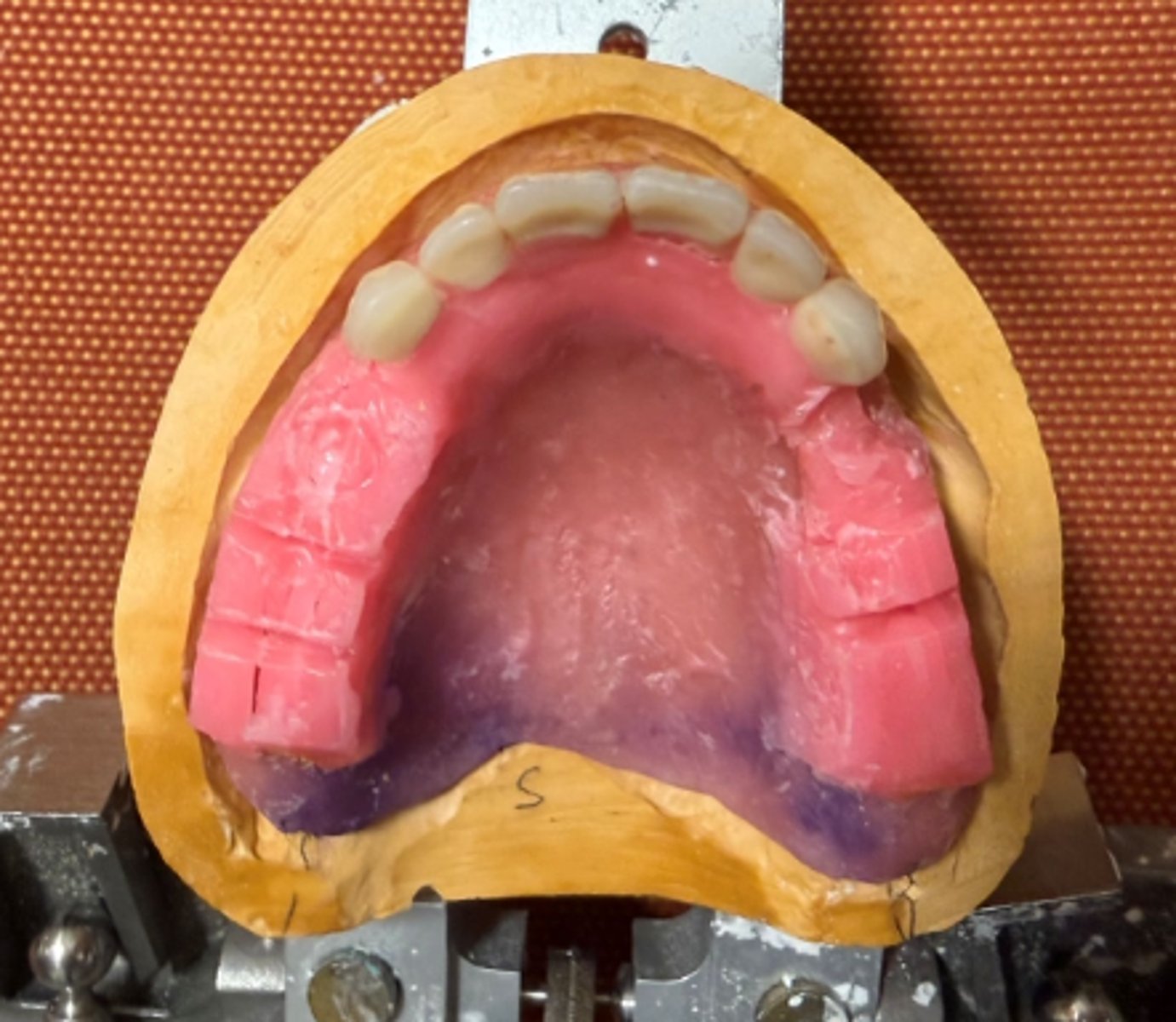
Yes
(Mandibular metal base RPD)
Did the student use proper type of dental stone to form this working cast for the dental prostheses?
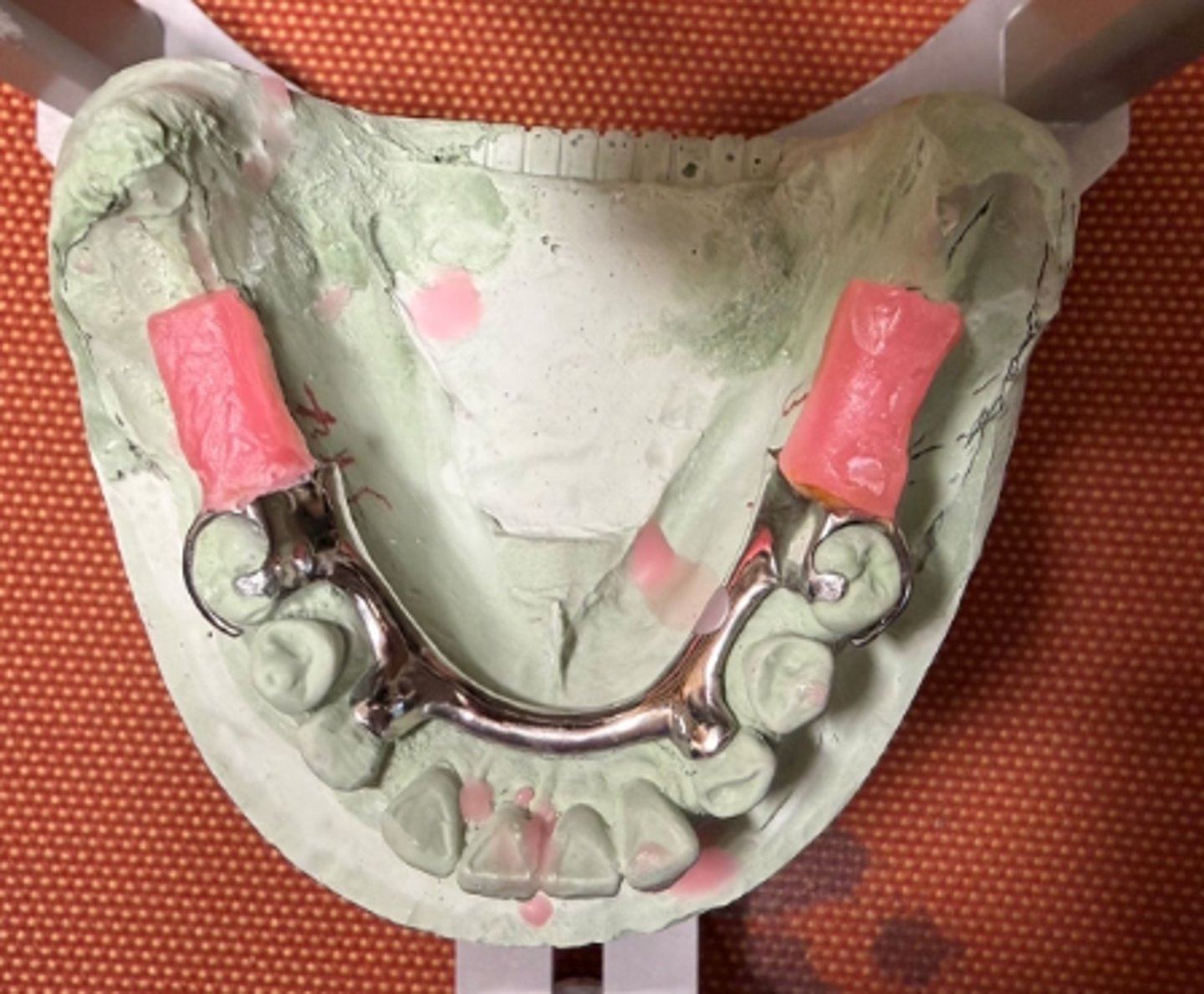
No - should use type 3
Treatment plan is for a mandibular Resin Base RPD. Did the student use proper type of dental stone to form this working cast for the dental prostheses?
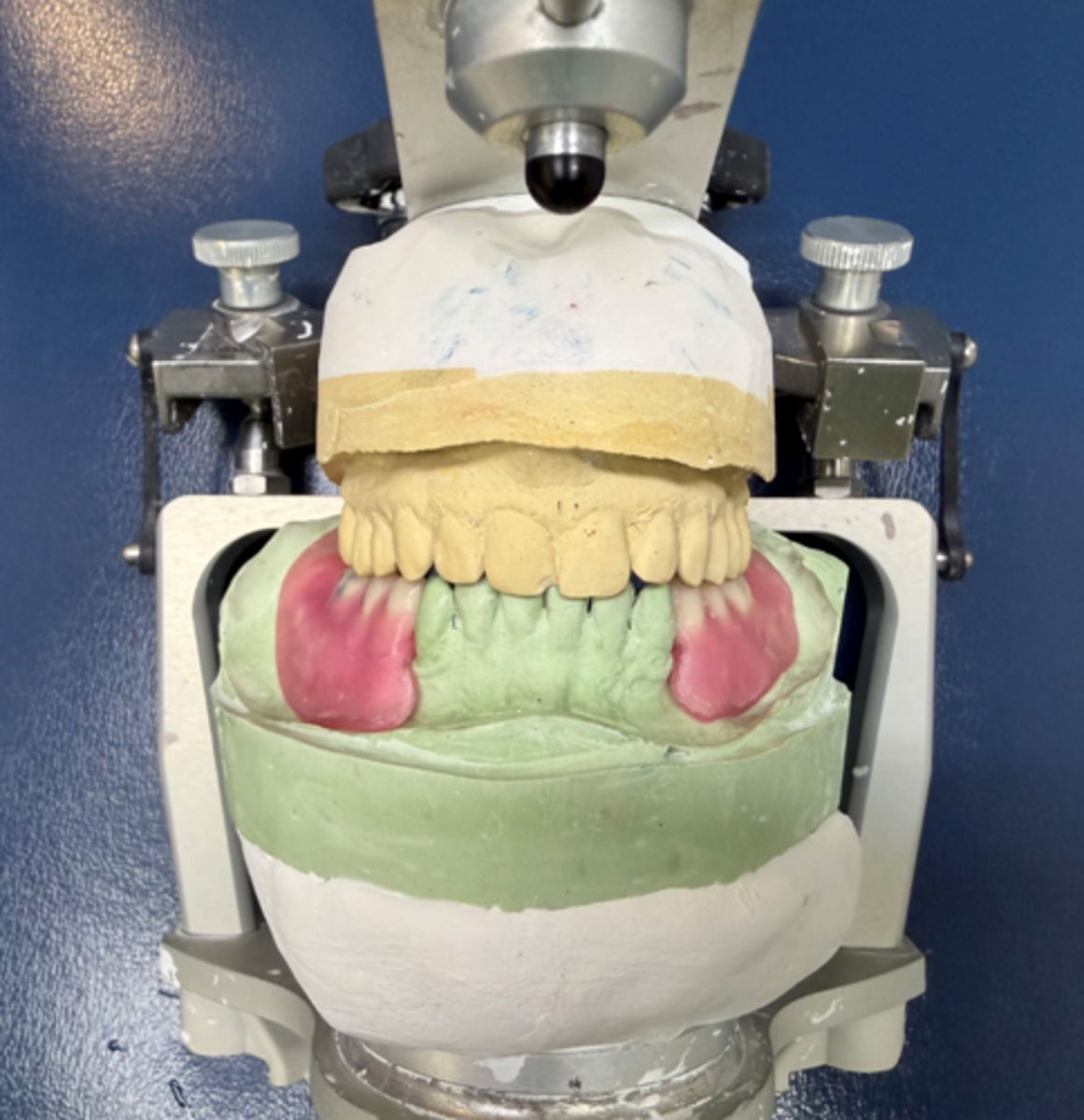
No - should use type 3
Treatment plan is for Immediate Max CD/Mand Resin Base RPD. Did the student use proper type of dental stone to form this working cast for the dental prostheses?
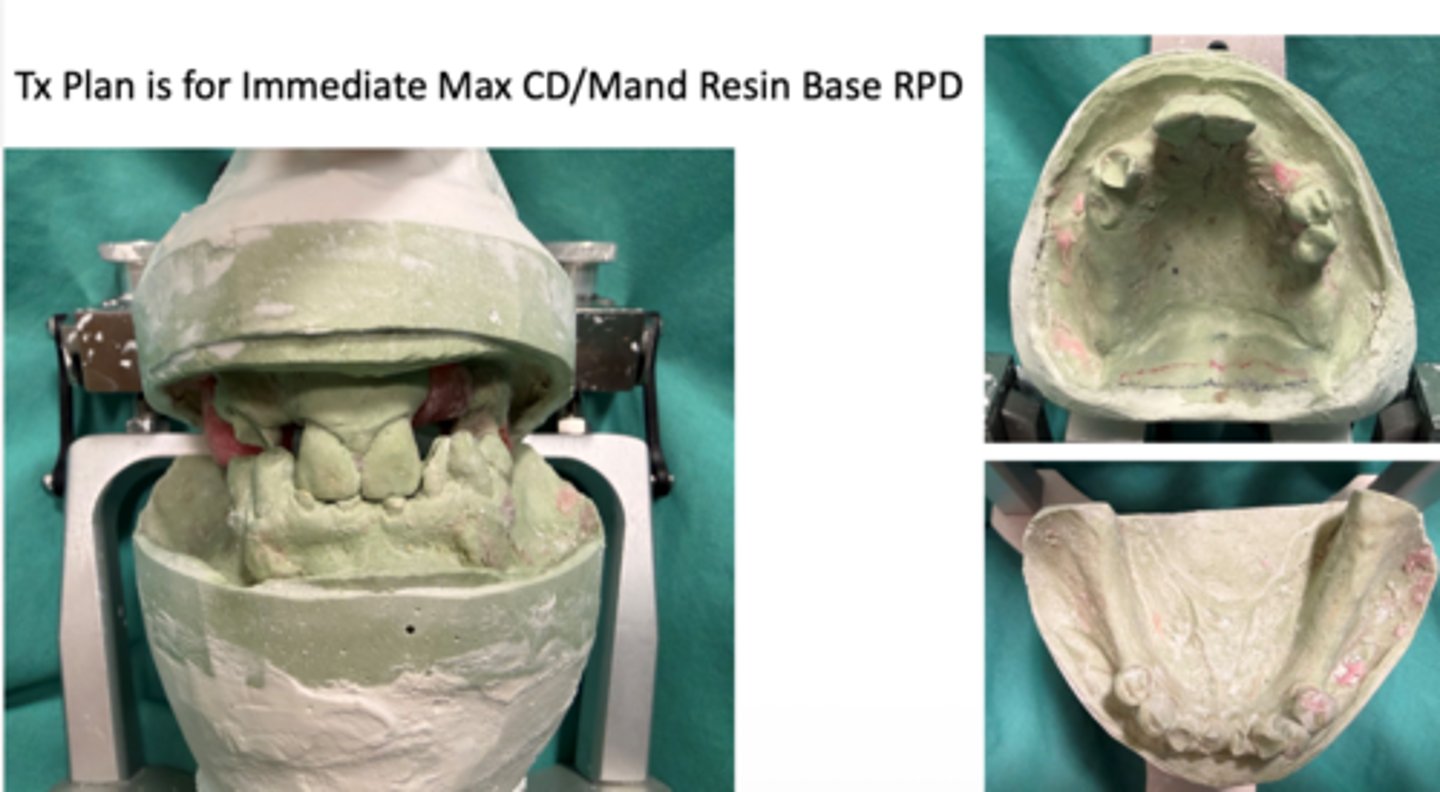
Type 3
What type of dental stone allows expansion to compensate for acrylic shrinkage?
Type 4 or 5
What type of dental stone provides limited expansion—good for prosthese that require high precision such as crown and bridge or Fixed Dental prostheses including dental implant restorations, and metal base RPD Framework?
A gypsum product made from calcined calcium sulfate hemihydrate, used to create positive casts from impressions
What is dental stone?
Exothermic
The setting reaction of the hemihydrate (gypsum) is the reverse of the first stage of dehydration and is ___________
Density of powder
Why do plaster, stone, and high-strength stone have differences in water requirement?
47 ml per 100 g powder
What is the water/powder ratio of laboratory plaster (type 2)?
30 ml per 100 g powder
What is the water/powder ratio of dental stone (type 3)?
26 ml per 100 g powder
What is the water/powder ratio of mounting stone (type 3)?
28 ml per 100 g powder
What is the water/powder ratio of microstone (type 3)?
21 ml per 100 g powder
What is the water/powder ratio of Die-Keen (type 4)?
Increase
An __________ in temperature of gypsum will decrease setting time
Low
_________ water/powder ratio of gypsum harden more quickly, and will produce less microporosities related to residual unreacted water. It will, however, increase microporosity related to crystal growth
Faster
The more you spatulate/faster you spatulate gypsum, the _________ the setting time
Hand
Setting time increases when mixed by hand or by vacuum mix for gypsum?
Vacuum
Is compressive strength higher when mixed by hand or by vacuum mix for gypsum?
Hand
Is there a greater expansion % at 2 hours when mixed by hand or vacuum mix for gypsum?
Hand
Is viscosity increased when mixed by hand or vacuum for gypsum?
Inversely
Setting expansion is _________ proportional to the water-powder ratio for gypsum
true
t/f: air moisture contamination can affect the setting time and expansion of gypsum
K2SO4 or Sodium Citate
Setting expansion of gypsum can be controlled with the use of additives in the powder, such as what?
inversely
strength of gypsum is _________ proportional to the water/powder ratio
increases
using a low water/powder ratio of gypsum for maximum strength also _________ setting expansion
doubles
Removal of uncombined water from cast gypsum by low-temperature drying approximately _________ the strength
True
T/F: Drying of gypsum should be carefully controlled, otherwise shrinkage and reduction of strength can occur
Saturated solution of calcium sulfate
Long-term immersion of gypsum in water is contraindicated; if needed, what can you use instead?
Increase
(gypsum) Increase in water/powder ratio will ______ setting time
Decrease
(this originally said increase but I believe he said it should be DECREASE)
(gypsum) Increase in water/powder ratio will ______ consistency
Decrease
(gypsum) Increase in water/powder ratio will ______ setting expansion
Decrease
(gypsum) Increase in water/powder ratio will ______ compressive strength
Decrease
(gypsum) increase rate of spatulation will ______ setting time
Decrease
(gypsum) increase rate of spatulation will ______ consistency
Increase
(gypsum) increase rate of spatulation will ______ setting expansion
Not effect
(gypsum) increase rate of spatulation will ______ compressive strength
Decrease
(gypsum) increase water temperature of mixing water will ______ setting time
Decrease
(gypsum) increase water temperature of mixing water will ______ consistency
Increase
(gypsum) increase water temperature of mixing water will ______ setting expansion
Not effect
(gypsum) increase water temperature of mixing water will ______ compressive strength
- Capture all vital anatomic landmarks necessary for tx plan
- No nodules or blebs
- No voids
- Good surface characters
- Be able to articulate and both arches should have same occlusion as typodont (or simulated patient's occlusion)
How should you assess your casts?
True
T/F: DO NOT DROP MIXED ALGINATE or MIXED DENTAL STONE FALL INTO THE SINK DRAIN
Maximum Intercuspal Position (MIP)
Which occlusal relationship?
The complete intercuspation of the opposing teeth independent of condylar position, referred to as the best fit of the teeth regardless of the condylar position
- Can be used when at least 3 non-aligned pairs of teeth occluding
Centric relation (CR)
Which occlusal relationship?
A maxillo-mandibular relationship (MMR) in which the condyles articulate w/ the thinnest avascular portion of their respective disks with the complex in the anterior-superior position against the posterior slopes of the articular eminencies
Centric relation (CR)
Which occlusal relationship?
- Unstrained, physiologic position
- Repeatable. the mandible is restricted to a pure rotary movement
- A ligament position
- Independent of tooth contact
MIP
MIP or CR?
- Dependent of tooth contact
MIP
MIP or CR?
- Independent of condylar position
MIP
MIP or CR?
- "Simple"
CR
MIP or CR?
- Independent of tooth contact
CR
MIP or CR?
- Reproducible
CR
MIP or CR?
- Provides anatomic / physiologic stability
Articulation
Define the following:
The static and dynamic contact relationship between the occlusal surfaces of the teeth during function
Sagittal
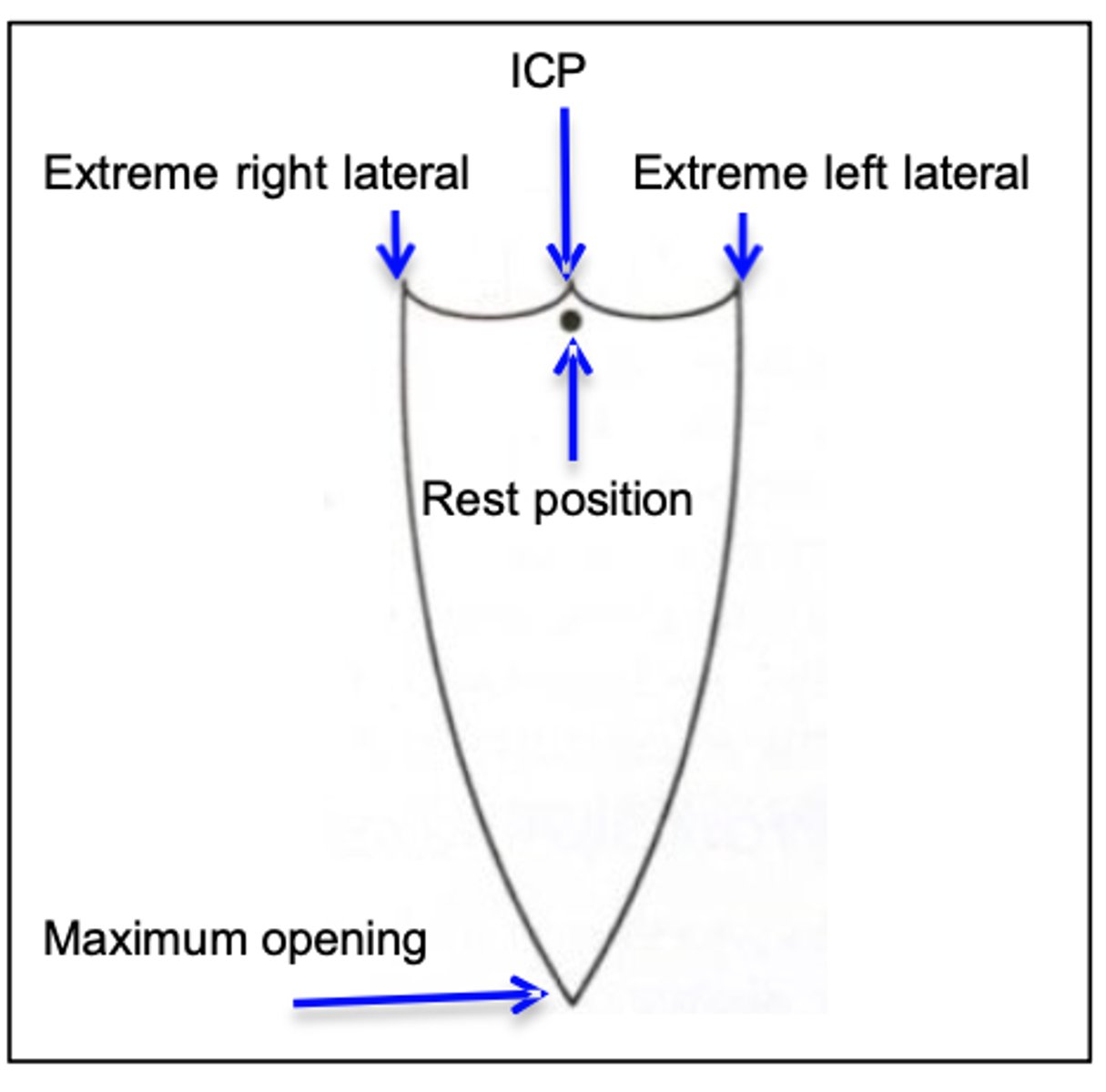
This is a trajectory of how the mandible moves in what plane?
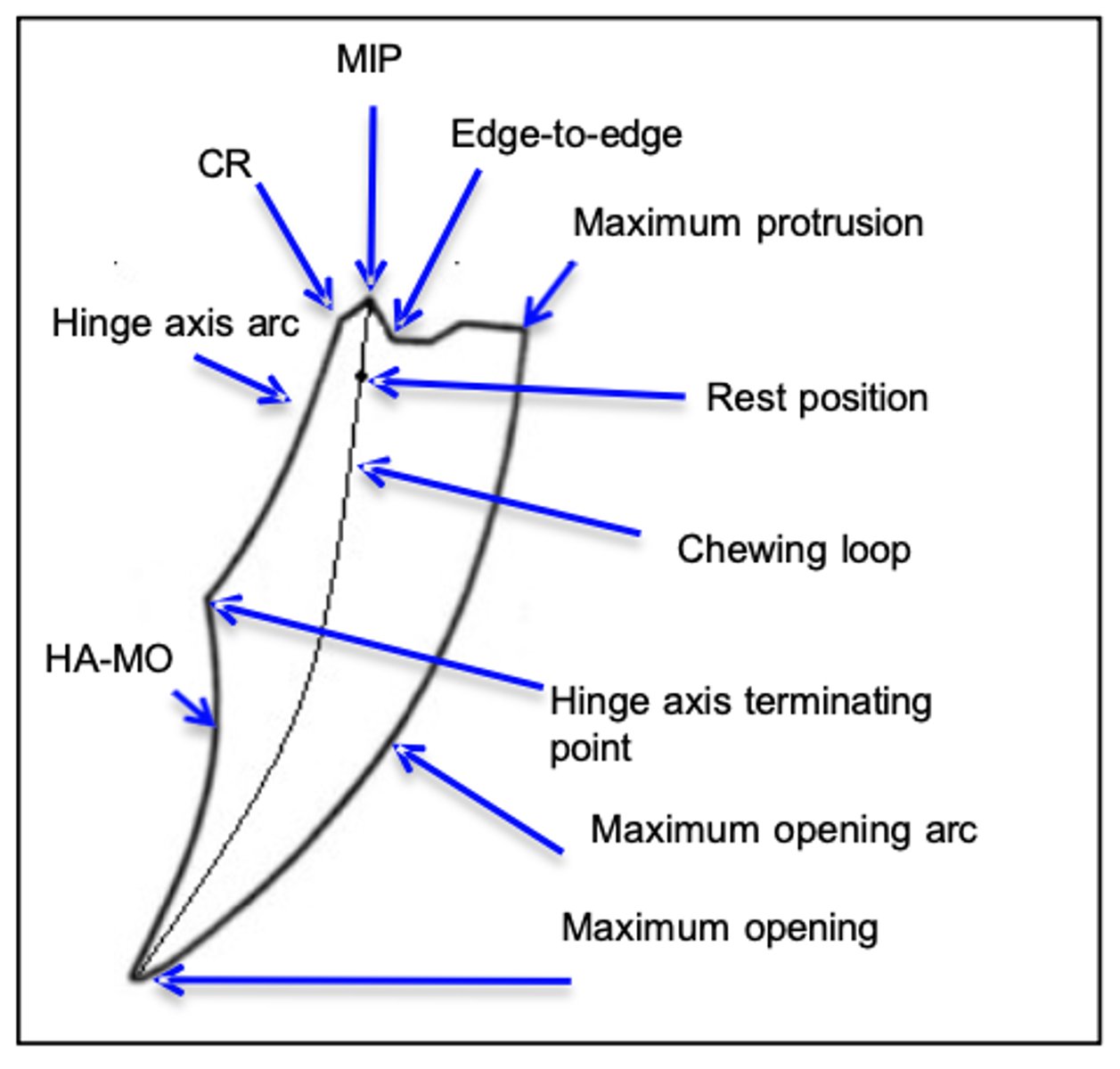
Horizontal
This is a trajectory of how the mandible moves in what plane?
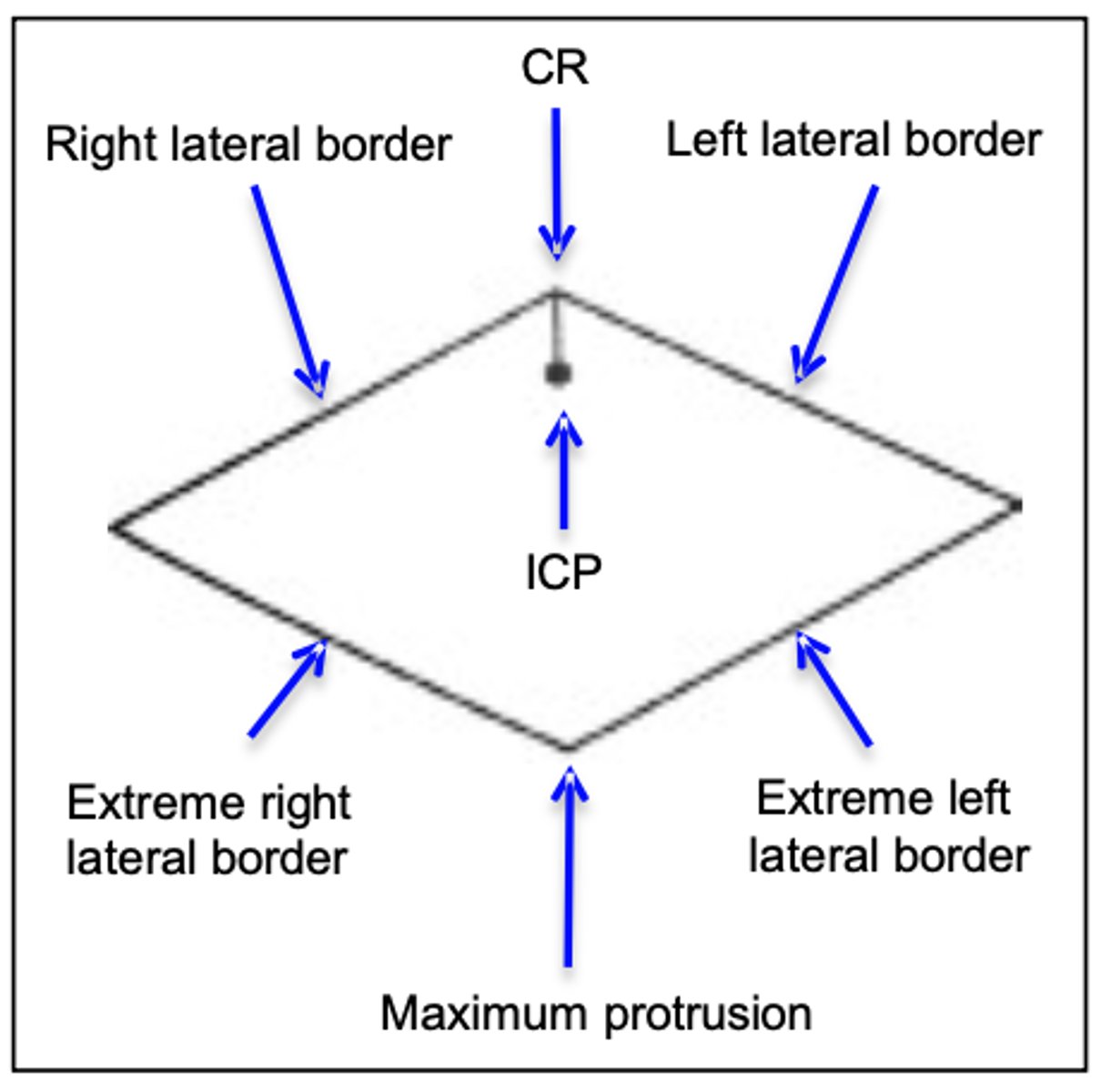
Frontal
This is a trajectory of how the mandible moves in what plane?