transport and membrane
 Call Kai
 Learn
Learn Practice Test
 Spaced Repetition
 Match
Match Flashcards
 Knowt Play
1/24

There's no tags or description
Looks like no tags are added yet.
Name | Mastery | Learn | Test | Matching | Spaced | Call with Kai |
|---|
No analytics yet
Send a link to your students to track their progress
25 Terms
Exocytosis
used to fuse a
vesicle with the plasma
membrane and release
something outside the cell or
insert a transmembrane
protein in the plasma
membrane
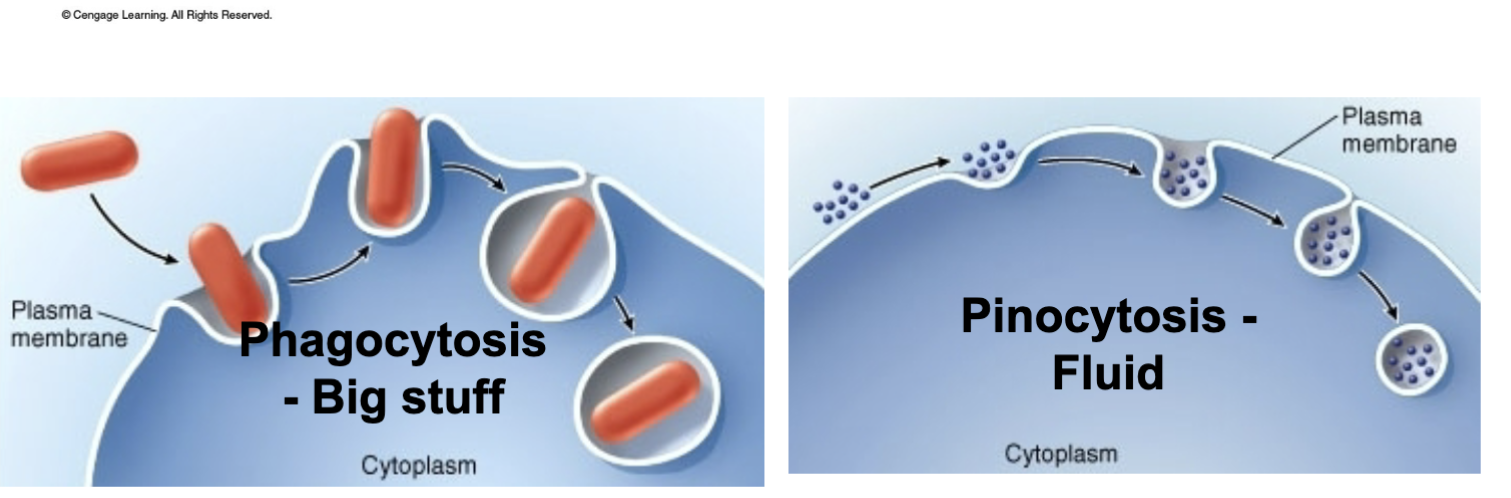
Endocytosis
things are
engulfed and brought
into the cell in a vesicle
Phagocytosis
big stuff
Pinocytosis:
water
Receptor-mediated
specific to a
bond/interaction with a protein at
the membrane
Active transport
movement of a substance from
LOW HIGH. This requires energy..
Secondary active transport
energy from one
thing moving passively down its gradient is
harnessed and used to power active transport of
another substance against its gradient
Symport
two substances are moved by a protein
helper in the same direction across the membrane
Antiport
two substances are moved by a protein
helper in opposite directions across the membrane
Primary active transport:
ATP provides energy.
The Na+/K+-ATPase (pump) is a good example.
• This is carrier-mediated and can saturate
ACTIVE
energy is required
Active transport of a substance from
LOW HIGH requires energy input.
Primary active
uses ATP
Secondary active
uses passive
movement of another substance
diffusion
Thermal motion is random and
termed
passive
no energy input required
Simple diffusion
diffusion occurs straight
through the membrane. A helper protein is NOT
needed
– selective for specific ions
– Bidirectional – diffusion gradient
– Gated
• Open & close via conformational changes
ion channels are
electrochemical gradient
Ions move down their , when they move through ion
channels: this is a combination of their concentration AND electrical gradients
Passive Transporter
- must bind the solute
Bidirectional
net transport is
determined by gradient
No change in affinity
attraction to
glucose is same facing in or out of cell
for the glucose transporter (GLUT)
specific
only transports glucose
hydrophobic substances like lipids
what substance is happy to be on the inside of the bilayer with the fatty tails?
hydrophilic like ions and proteins
what kidns of substances would have greater difficulty crossing the cell membrane?
no. glucose is hydrophilic and would like to stay in water
glucose is a large charged molecule, will it easily move across the cell membrane?

