bio1 plant transport system
 Call Kai
 Learn
Learn Practice Test
 Spaced Repetition
 Match
Match Flashcards
 Knowt Play
1/28

There's no tags or description
Looks like no tags are added yet.
Name | Mastery | Learn | Test | Matching | Spaced | Call with Kai |
|---|
No analytics yet
Send a link to your students to track their progress
29 Terms
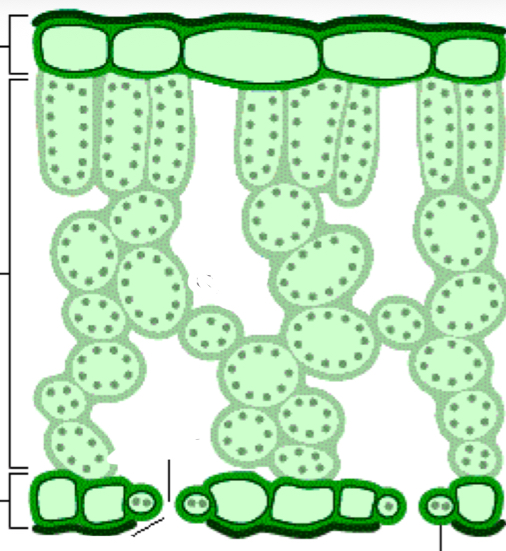
parts of the leaf
upper epidermis + cuticle
lower epidermis + stomata +guard cells
palisade mesophyll
spongy mesophyll + thin layer of water
vascular bundle
feature and function of the cuticle
thin transparent waxy layer to prevent water loss via transpiration
feature and function of the palisade mesophyll
tightly packed elongated cells contain many chloroplasts for greater rate of photosynthesis
feature and function of spongy mesophyll
loose packed irregular shaped cells that contain many intercellular air spaces for rapid diffusion of gases for quicker rate of gaseous exchange
where is chemical energy produced during photosynthesis stored in
chemical bonds of organic molecule
how does stomata open during light
-guard cell contain chloroplasts, photosynthesis produce glucose
-w.p. in guard cell decrease, water enters guarde cells via osmosis
-guard cells become turgid, bend outwards.
how does stomata close when no light
-glucose in the guard cells used up
-w.p. in guard cells increase
-water exits guard cells via osmosis
-guard ells flaccid
what controls opening and closing of stomata
turgidity of guard cells
2 functions of xylem and its adaptation
transports water and dissolved mineral salts upwards from roots to leaves
-empty hollow lumen with no protoplasm and cross walls between dead xylem cells to reduce resistance on the flow of water
provides mechanical support to the plan
-walls contain lignin to prevent collapse of the xylem vessel when exposed to high tension during transport of water and dissolved mineral salts
function and 2 adaptations of the phloem tissue
transport manufactured food substances (sucrose and amino acids) from leaves to other parts (translocation)
-companion cells have many mitochondria to provide sieve tube elements nutrients and energy to carry out metabolic processes
-pores in sieve plates allow sucrose and amino acids to flow through sieve tubes
why must have companion cell
-each sieve tube element requires companion cells to help it carry out metabolic processes by providing nutrients to sieve tube elements , help sieve tube with translocation and has numerous mitochondria to provide energy for AT of sugar into sieve tubes.
function of cambium
actively divide and differentiate into new xylem and phloem tissues, leading to thickening of stem
2 adaptations of root hair and their function
selectively permeable plasm membrane
-prevent cell sap which contains sugars amino acids and salt from leaking out, thus maintaining lower w.p. than soil
2.many mitochondria
-release energy for active transport of dissolved mineral salts into cell
word and chemical equation for photosynthesis
carbon dioxide + water —chlorophyll and light—> glucose and oxygen
6CO2 + 6H2O —chlorophyll,light—> C6H12O6 + 6CO2
what happens in the light dependent stage +photolysis
chlorophyll absorbs light energy and converts it to chemical energy
light energy splits water molecules into hydrogen atoms and oxygen (photolysis)
what happens in the light independent stage
hydrogen is used to reduce co2 to form glucose
energy for reaction comes from light dependent stage (ATP and NADPH)
what is translocation
unidirectional transport of manufactured food substance through the phloem tissues
phloem/xylem sap vs cell sap
solution found in the sieve tube/xylem lumen
any liquid found in the cell vacuole and cytoplasm
why xylem and phloem no cell sap
mature xylem and sieve tube elements have lost their vacuoles
why does stem swell during ringing experiment
removal of phloem prevents translocation of manufactured food substances to region below ring.
accumulation of manufactured food substances in region right above ring lowers wp of cells in that region
water enters region via osmosis causing swelling
where will radioactivity be detected in t.s. of stem
phloem. carbon-14 is a radioactive isotope taken up by the lead during photosynthesis, incorporated into glucose the. sucrose
radioactive sucrose in phloem cause x-ray foil to blacken, confirm sug
overall movement of water
water is loss from aerial parts of the plant during transpiration, generating a transpiration pull pulling water from the roots that entered the roots via osmosis down a concentration gradient
water movement in roots to stem
cell sap of root hair cell more conc (w. sugars and mineral salts)than soil solution outside. water enters by osmosis down a water potential gradient.
entry of water dilutes root hairs cell sap. now has higher w.p than that of next cell. water pass by osmosis from root hair cell through the cortex until it enters the xylem vessel
transpiration
loss of wv through the aerial parts of the plant mainly through stomata.
comsequence of photosynthesis
how does transpiration happen
during day, stomata open for gaseous exchange
wv lost to atmosphere by diffusion out of stomata due to lower conc of wv in atmosphere
water evaporates from surface of spongy mesophyll cells to replace water lost via transpiration
high wv conc in intercellular air spaces establishes wv conc gradient between inside leaf and atmosphere
trans pull
transpiration results in trans pull which pull water up the xylem vessel in a continuous unbroken chain
three forces during transpiration
transpiration pull (main pulling force)
capillary action (minor pulling force)
root pressure (minor pushing force)
how does water form in an unbroken column
cohesion prevents water column from breaking apart
adhesion prevents water column from slipping back

