Physics 4A - Chapter 9
 Call Kai
 Learn
Learn Practice Test
 Spaced Repetition
 Match
Match Flashcards
 Knowt Play
1/12

There's no tags or description
Looks like no tags are added yet.
Name | Mastery | Learn | Test | Matching | Spaced | Call with Kai |
|---|
No analytics yet
Send a link to your students to track their progress
13 Terms
Momentum Formula
\overrightarrow{P}=m\cdot\overrightarrow{v}, where p is momemtum
Impulse Derivative Formula
d\left(\overrightarrow{J}\right)=\overrightarrow{F}\left(t\right)dt (deriv of impulse = force)
Impulse Formula
\overrightarrow{J}=\int_{tᵢ}^{tբ}\overrightarrow{F}\left(t\right)dt
Fave Formula
F\left(ave\right)=\frac{1}{tբ-tᵢ}\int_{tᵢ}^{tբ}F\left(t\right)dt , then F\left(ave\right)=\frac{\overrightarrow{J}}{tբ-tᵢ} or F\left(ave\right)=\frac{\overrightarrow{J}}{\Delta t}
Impulse Momentum Theorem
\overrightarrow{J}=\overrightarrow{P}բ-\overrightarrow{Pᵢ}
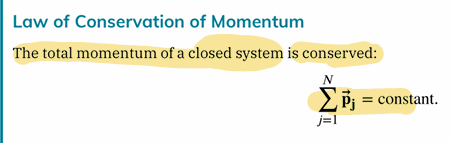
Conservation of Linear Momentum Formula Applied to Force
F1 = -F2
Conservation of Linear Momentum Formula Applied to Momentum
P1i + … + Pni = P1f + … + Pnf
or >
also P1 + … + Pn = total momentum
Center of Mass Formula
\overrightarrow{r}\left(\operatorname{cm}\right)=\frac{\left(m\left(1\right)r\left(1\right)+\cdots+m\left(n\right)r\left(n\right)\right)}{M} where M is total mass and rcm is average position of center of mass
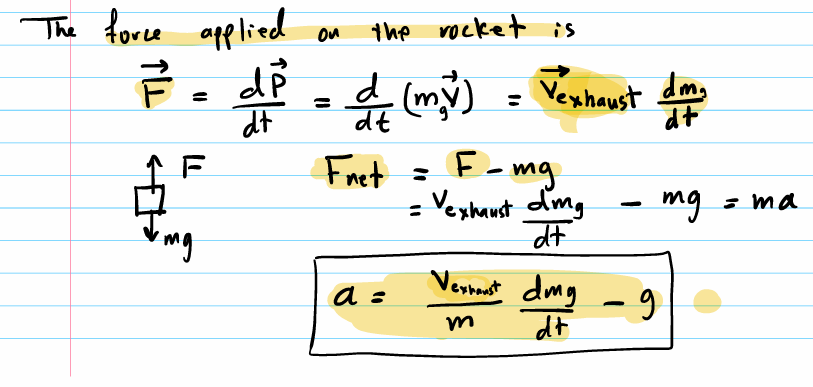
Rocket Propulsion Formula
\Delta v=u\ln\left(\frac{mᵢ}{m}\right) where u = exhaust speed and m is m(t)
Momentum of Ejected Gas
P = mgVexhaust, wher mg is the mass of the gas used
Additional Rocket Formula I Don’t Know How to Explain
Types of Collisions
Inelastic: 0 < Kf < Ki
Perfectly Inelastic: 0 = Kf
Elastic: Kf = Ki
Explosion: Kf > Ki
In a Perfectly Elastic Collision, V (velocity) = …
V1i + V1f = V2i + V2f

