metabolism midterm
 Studied by 4 people
 Call Kai
 Learn
Learn Practice Test
 Spaced Repetition
 Match
Match Flashcards
 Knowt Play
1/266

There's no tags or description
Looks like no tags are added yet.
Name | Mastery | Learn | Test | Matching | Spaced | Call with Kai |
|---|
No analytics yet
Send a link to your students to track their progress
267 Terms
glycolysis
conversion of glucose into 2 pyruvate/lactate
what tissues does glycolysis occur?
everywhere
is glycolysis active in the fed or fasted state?
fed
glycogenesis
glycogen synthesis
is glycogenesis active in the fed or fasted state?
fed --> storing glucose as glycogen
where does glycogenesis occur?
liver and muscle
gluconeogenesis
generation of glucose from non-carbohydrate carbon substrates
Where does gluconeogenesis occur?
liver (majority) & kidneys
is gluconeogenesis activity in the fed or fasted state?
fasted
glycogenolysis
breakdown of glycogen
where does glycogenolysis occur?
liver and muscle
muscle cannot breakdown ________ to _____________
glycogen to glucose
why can't muscle breakdown glycogen to glucose?
no glucose-6-phosphatase --> goes down glycolysis pathway to be oxidized
is glycogenolysis active in the fed or fasted state?
fasted
what are the steps to glucose-stimulated insulin release?
glucose transported into the B-cell via GLUT2
ATP production from glycolysis
K+ channels close --> depolarization of the cell
Intracellular concentrations of Ca 2+ increase
Insulin secretory vesicles are translocated to the cell membrane
where is glucokinase
liver and pancreatic B-cells
does glucokinase have a low or high affinity for glucose?
low affinity --> more active only after a meal when glucose concentration is high
is glucokinase inhibited by glucose-6-phosphate?
no --> allows for liver to continue taking up glucose from blood
where is hexokinase found
most tissues
does hexokinase have a low or high affinity for glucose?
high affinity --> works efficiently even when glucose concentration is low
is hexokinase inhibited by glucose-6-phosphate?
yes --> prevents continuous glycolysis and conserves energy
rate limiting reactions of glycolysis
glucose --> glucose-6-phosphate (hexokinase/glucokinase) fructose-6-phosphate --> fructose-1,6-phosphate (phosphofructokinase) phosphoenolpyruvate --> pyruvate (pyruvate kinase)
main difference between red blood cells and other tissues for glucose metabolism?
red blood cells lack mitochondria
how many ATPs are produced from one molecule glucose via glycolysis in brain cells and red blood cells?
brain: 6-8 ATP rbc: 2 ATP
where is GLUT2 distributed
pancreas and liver
how does GLUT2 respond to blood glucose and insulin
facilitates the influx of glucose into the beta-cell which triggers insulin release
where is GLUT4 distributed
muscle and adipose tissue
how does GLUT4 respond to blood glucose and insulin
respond to high levels of blood glucose and reduce circulating glucose levels
how does insulin stimulate glucose uptake? in which tissues?
in the 2nd tier response, insulin promotes the uptake of glucose into muscle and adipose tissue via GLUT4
How does insulin regulate GLUT4?
Insulin regulates GLUT4 translocation from the intracellular compartment to the cell surface
How does the pancreas maintain blood glucose levels after a meal?
Islet cells secrete insulin
How does the liver maintain blood glucose levels after a meal?
Makes glycogen from dietary glucose and converts glucose to fatty acids if the amount of absorbed glucose is more than what the body can use and store
How does muscle maintain blood glucose levels after a meal?
Takes up glucose from the circulation in an insulin-dependent manner (via GLUT4), oxidizes it for energy, and makes glycogen from it.
How does adipose tissue maintain blood glucose levels after a meal?
Takes up glucose from circulation in an insulin-dependent manner (via GLUT4)
How does the brain maintain blood glucose levels after a meal?
Primarily uses glucose for energy and takes up glucose from the circulation (22%)
How do other tissues maintain blood glucose levels after a meal?
Take up glucose from the circulation (2-3%)
How does the liver maintain blood glucose levels during starvation?
Breaks down glycogen and releases glucose to the circulation.
How do the kidneys maintain blood glucose levels during starvation?
Make glucose and release it to the circulation
How does the pancreas maintain blood glucose levels during starvation?
Islet cells stop making and secreting insulin and secrete glucagon
How do muscle and adipose tissue maintain blood glucose levels during starvation?
Slow down taking up glucose from the circulation and GLUT4 actvitiy decreases
First-tier response
high glucose levels stimulate insulin secretion from beta cells in pancreas
What triggers first-tier response?
elevated blood glucose levels
second-tier response
high insulin levels stimulate GLUT4 translocation and activity
what triggers second-tier response?
insulin and it promotes the uptake of glucose into tissues
What happens to glucose homeostasis if GLUT2 and GLUT4 is defective?
GLUT2: some uptake of glucose into the circulation but no insulin is being produced
GLUT4: Insulin and blood glucose are increased leading to insulin resistance
where does glycolysis occur in the cell?
cytoplasm
what is the final product of glycolysis under aerobic and anaerobic conditions?
Aerobic → 2 pyruvate
Anaerobic → 2 lactate
What happens to pyruvate after glycolysis in the liver in the fed and fasted state?
Fed: pyruvate is decarboxylated to acetyl-CoA and enters the TCA cycle and fatty acid synthesis occurs
Fasted: pyruvate is used to synthesis glucose via gluconeogenesis and no fatty acid synthesis occurs
at happens to pyruvate after glycolysis in the liver in the fed and fasted state?
pyruvate is reduced to lactate
How is fructose metabolized via glycolytic pathway?
Fructose → Fructose-1-phosphate → Glyceraldehyde + DHAP → Glyceraldehyde-3-phosphate
Why can a high intake of fructose cause an increase in lipogenesis (synthesis of TAGS)?
Increases glycogens and bypasses the rate-limiting reactions that build up acetyl-CoA
Which reaction does pyruvate dehydrogenase (PDH) complex catalyze?
pyruvate → acetyl-CoA
How is PDH activity regulated and what is its significance?
By levels of acetyl-CoA and NADH. If acetyl-Coa and NADH levels are too high, PDH activity will be inhibited and no longer be able to convert pyruvate to acetyl-CoA
What happens to acetyl-CoA from PDH reaction?
Transported to the TCA cycle
TCA cycle function
oxidation of acetyl-CoA to CO2
Supplies reducing equivalents for ATP production
How many ATPs are produced directly and indirectly from the TCA cycle?
Directly: 24
Indirectly: 6
final products of digestion
glucose, fructose, and galactose
main goals for glucose metabolism
to maintain circulating glucose levels
to provide sufficient energy substrates to tissues that only or heavily use glucose for ATP production
where does aerobic metabolism occur in the cell?
mitochondria
end products of aerobic metabolism
CO2 + H2O
Where does anaerobic metabolism occur in the cell?
cytosol
what are the end products of anaerobic metabolism?
lactate
glucose uptake facilitated by
glucose transporters
Insulin-independent glucose transporters
GLUT1, GLUT2, GLUT3, GLUT5
Insulin-dependent glucose transporters
GLUT4
during fasting, liver can produce and release
glucose to the circulation when glucose levels are down
does skeletal muscle release glucose into blood?
provides gluconeogenic precursors for synthesis of glucose in the liver during faster
in glycolysis, how many ATPs are produced in aerobic conditions?
6-8 ATP
In glycolysis, how many ATPs are produced in the anaerobic condition?
2 ATP
Fructose doesn’t stimulate ____ secretion and is mainly metabolized by the _______
insulin, liver
why does high fructose consumption increase obesity?
high fructose consumption → lipogenesis in liver → fatty liver + obesity
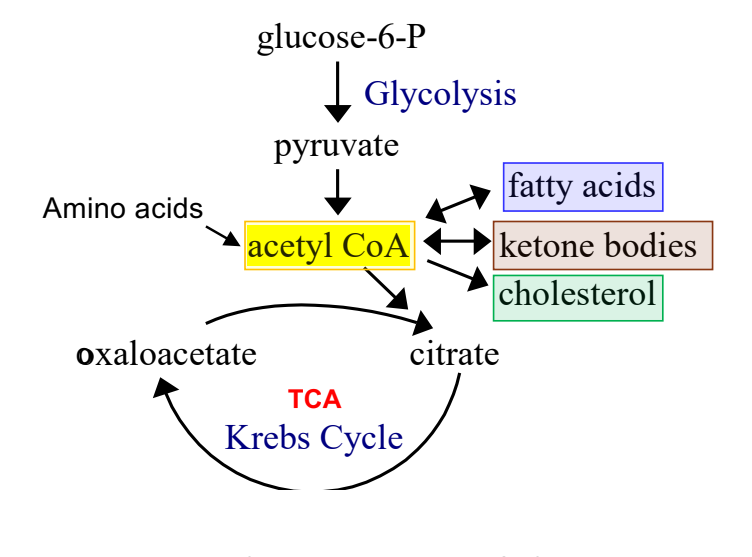
acetyl-CoA pathways
ATP production from one complete oxidation of one molecule of glucose
36-38 ATP
What physiological conditions and in what tissues does GNG occur?
Fasted state in the liver and kidney
Where does GNG occur in the cell?
Mitochondria and cytosol
What are the precursors for GNG?
pyruvate, lactate, glycerol, propionate
How does pyruvate synthesize glucose in GNG?
Pyruvate → oxaloacetate → PEP → Fructose-1,6-Biphosphate → F6P → G6P → Glucose
How does lactate synthesize glucose in GNG?
Lactate → Pyruvate → Oxaloacetate → PEP → Fructose-1,6-Biphosphate → F6P → G6P → Glucose
How does glycerol synthesize glucose in GNG?
Glycerol → Glycerol-3-Phosphate → DHAP + GADP → F6P → G6P → Glucose
How does propionate synthesize glucose in GNG?
Propionate → Oxaloacetate → PEP → Fructose-1,6-Biphosphate → F6P → G6P → Glucose
Which steps in GNG are regulated? Which enzymes catalyze these steps?
Pyruvate → Oxaloacetate (pyruvate carboxylase)
Oxaloacetate → PEP (PEPCK)
Fructose-1,6-biphosphate → F6P (Fructose-1,6-biphosphatase)
G6P → Glucose (Glucose-6-phosphatase)
Which tissues are capable of releasing glucose to the circulation during fasting? What enzyme allows tissues to do this?
Liver and skeletal muscle via G6Pase
What is the role of the liver in GNG?
glucose goes to partial oxidation in liver and muscle for sparing carbon backbone (pyruvate & lactate) for GNG in liver
What is the role of the kidneys in GNG?
GNG occurs during prolonged starvation → the longer starvation, the more active kidney is
Precursors: mostly glucogenic AAs
In what physiological conditions does insulin increase or decrease?
Fed → increase
Fasted → decrease
In what physiological conditions does glucagon increase or decrease?
Fed → decrease
Fasted → increase
In what physiological conditions does epinephrine increase or decrease?
Fed → decrease
Fasted → increase
Which substrates are involved in regulation of glucose metabolism?
Fructose-6-Phosphate
Fructose -1- Phosphate
Citrate
ATP / AMP
How do substrates and hormones regulate glucose → G6P?
+ : insulin, Fru 1-P, Glucose
- : Fru 6-P
What substrates and hormones regulate F6P → F 1,6-BP2
+ : AMP, insulin ↑enzyme ↑ F 2,6-B2
- : ATP, citrate
What substrates and hormones regulate PEP → pyruvate?
+ : insulin (protein dephosphorylation), ↑enzyme,
- : alanine, ATP, glucagon (protein phosphorylation)
What substrates and hormones regulate pyruvate → oxaloacetate?
+ : acetyl-CoA
what substrates and hormones regulate oxaloacetate → PEP
- : insulin ↓ enzyme
what substrates and hormones regulate F 1,6-BP2 → F6P
- : AMP, insulin ↑ F 2,6-B2
What substrates and hormones regulate G6P → glucose?
+ : glucagon
- : insulin
Which substrates and hormones are involved in the regulation of glucokinase activity?
Substrates: Fructose, Fru 1-P, Fru 6-P, Glucose
Hormones: Insulin
How do the substrates Fru 1-P and glucose regulate glucokinase?
Promote dissociation of GK from GKRP and GK is moved out of the nucleus to the cytosol
How does Fru 6-P regulate glucokinase?
Inhibits the dissociation of GK and GKRP causing GK to go back into the nucleus and rebind with GKRP
How does insulin regulate glucokinase activity?
Promotes GK to phosphorylate glucose
Describe the overall regulation of glucokinase
GK is bound to GKRP in nucleus
Once glucose or Fru 1-P are present, GK will dissociate from GKRP
GK will move to cytol → insulin promotes GK to phosphorylate glucose
Fru 6-P causes GK to go back into the nucleus and rebinds with GKRP inhibiting GK activity
 Note
Note  Flashcards (73)