Lecture 5 - Neuro 2, Ion movement
 Studied by 0 people
 Call with Kai
 Learn
Learn Practice Test
 Spaced Repetition
 Match
Match Flashcards
 Knowt Play
1/24

There's no tags or description
Looks like no tags are added yet.
Name | Mastery | Learn | Test | Matching | Spaced | Call with Kai |
|---|
No study sessions yet.
25 Terms
Resting membrane potential (RMP)
-70 mV
Actively maintained, dynamic equilibrium; Net flux =0, so equal ion movement in and out
Factors that contribute
Distribution of ions near plasma membrane
More (+) on outside, more (-) inside - especially large, impermeable anions
Na/K Pump
3 Na out, 2 K in (will make inside more negative)
Direct effect - between -2 and -5 mV
Indirect effect - maintains ionic gradients by active transport, drives current through leaky channels
Leaky channels - Predominant determinant of RMP
*Active transport maintains concentration gradients in resting neurons
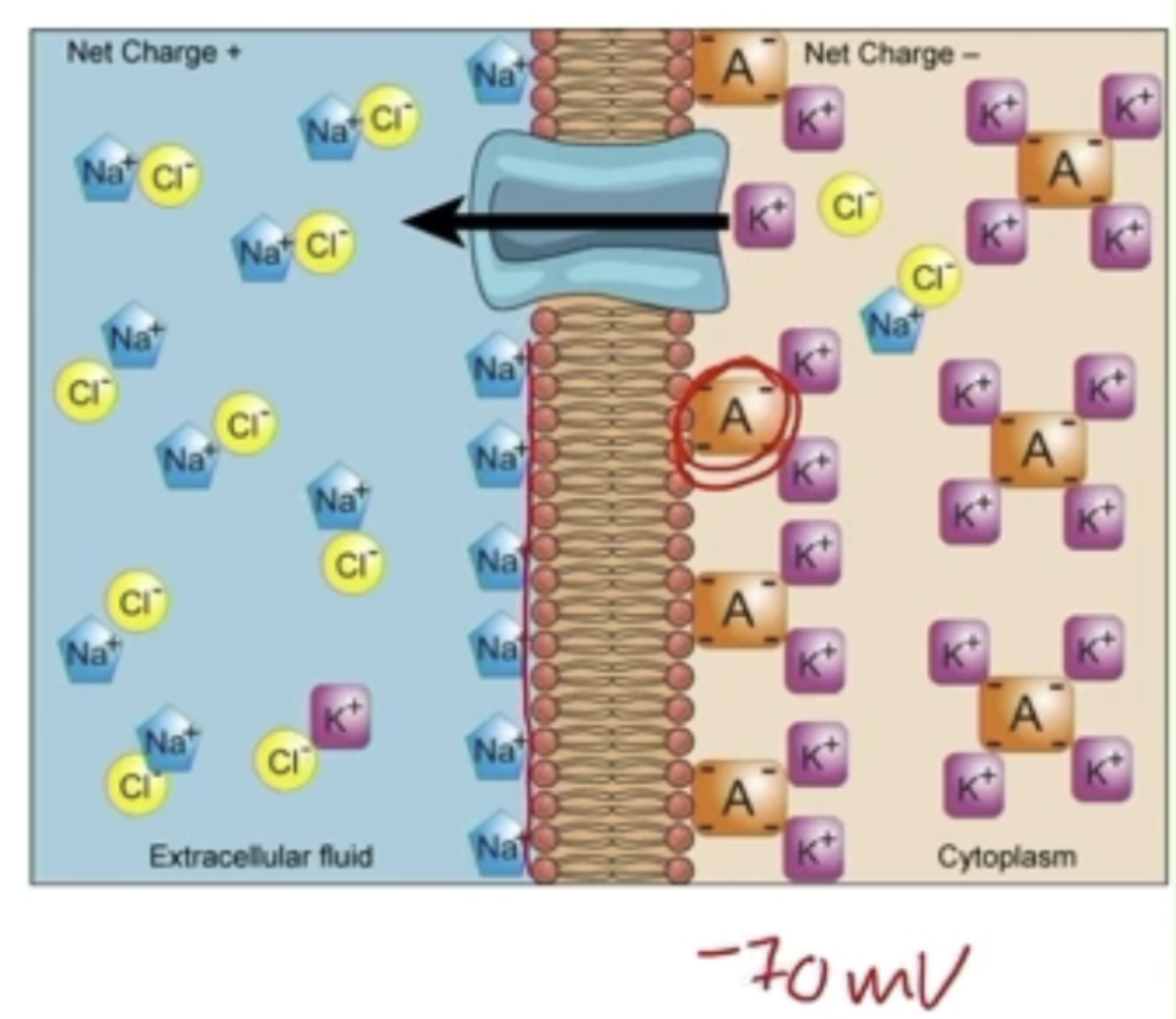
Leaky channels
Leaky channels - Somewhat constitutively active (on most of the time, though always open as a population)
K+ will flow out (down electrochemical gradient towards Equilibrium potential, which is more negative)
Inside of cell becomes more negative as K+ leaves, and stops once K+ reaches Eq (net flux K+ = 0)
Na+ will leak into the cell (more positive Equilibrium potential)
After action potential, Na/K pump moves 3 Na+ out and 2 K+ in (net negative)
Na/K pump - small contribution to returning to RMP; it most importantly maintains the gradients in concentration that allows the flow through leaky channels
AP Steps in terms of Gates
1. Resting membrane potential (before AP)
Vm ≈ −70 mV
Voltage-gated Na⁺ channels: CLOSED
Voltage-gated K⁺ channels: CLOSED
Leak channels: OPEN
📌 Only leak channels matter here
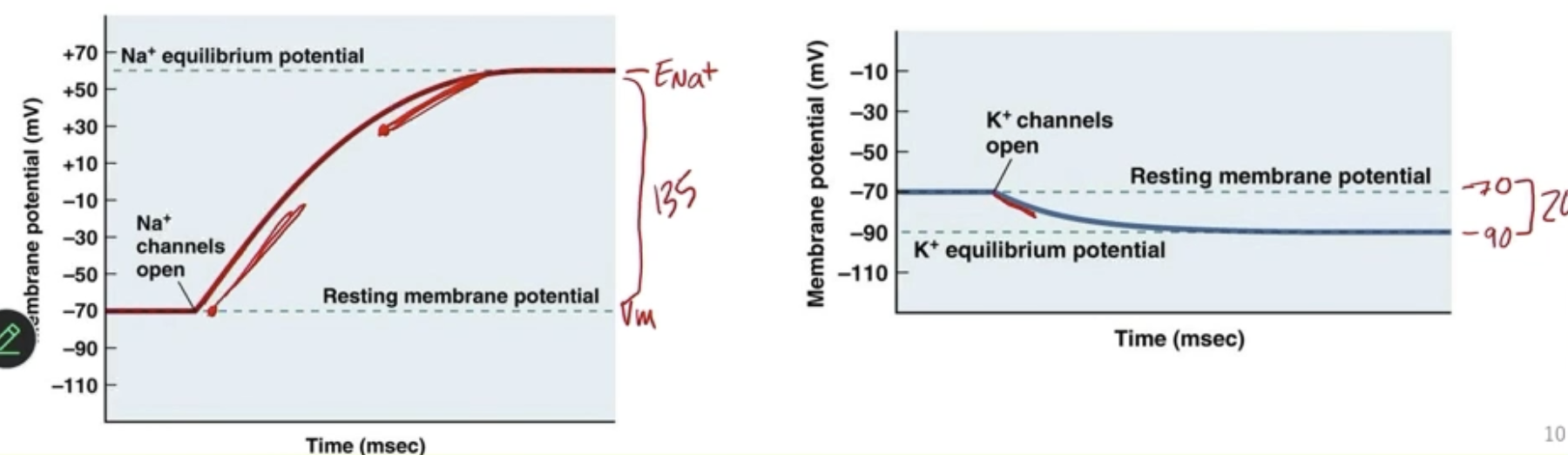
2. Depolarization (rising phase)
A stimulus depolarizes the membrane to threshold (~ −55 mV)
👉 Voltage-gated Na⁺ channels OPEN
Fast opening
Na⁺ rushes in
Membrane rapidly depolarizes toward ENa+
📌 This is when voltage-gated channels are clearly open
3. Peak of action potential
Vm ≈ +30 mV
Voltage-gated Na⁺ channels INACTIVATE
Not just closed — inactivated
Voltage-gated K⁺ channels BEGIN to open
📌 Na⁺ influx stops, K⁺ efflux starts
4. Repolarization (falling phase)
Voltage-gated K⁺ channels OPEN
K⁺ flows out
Vm becomes more negative
📌 This is the second time voltage-gated channels are open (K⁺ now)
5. After-hyperpolarization
K⁺ channels close slowly
Vm becomes more negative than RMP
6. Return to resting membrane potential
Voltage-gated K⁺ channels finally CLOSE
Voltage-gated Na⁺ channels reset from inactivated → closed
Only leak channels remain open
📌 Leak channels now dominate and pull Vm back to RMP
*Na/K Pump is kinda always working, but its impact is small on the action potential
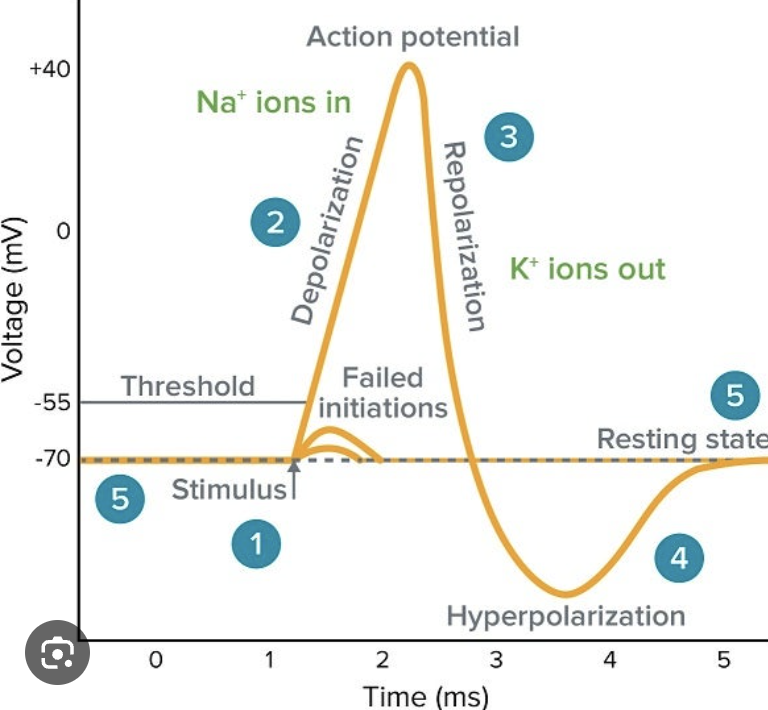
Impact of K+’s high permeability
Makes the Vm / RMP very negative
For Depolarization - Gives Na+ a very big driving force, making the membrane explosively depolarize when Na+ voltage-gated channels open
For Repolarization - Because the Vm is +30 and the EK+ is ~ -90 Vm, K+’s driving force is huge when it leaves the cell
For the Refractory period - Na+ channels inactivated, K+ channels close slowly while the membrane still is highly permeable to K+ → causes the Vm to become more negative than RMP, closer to K’s Eq
Neuron returns to RMP through the leaky channels
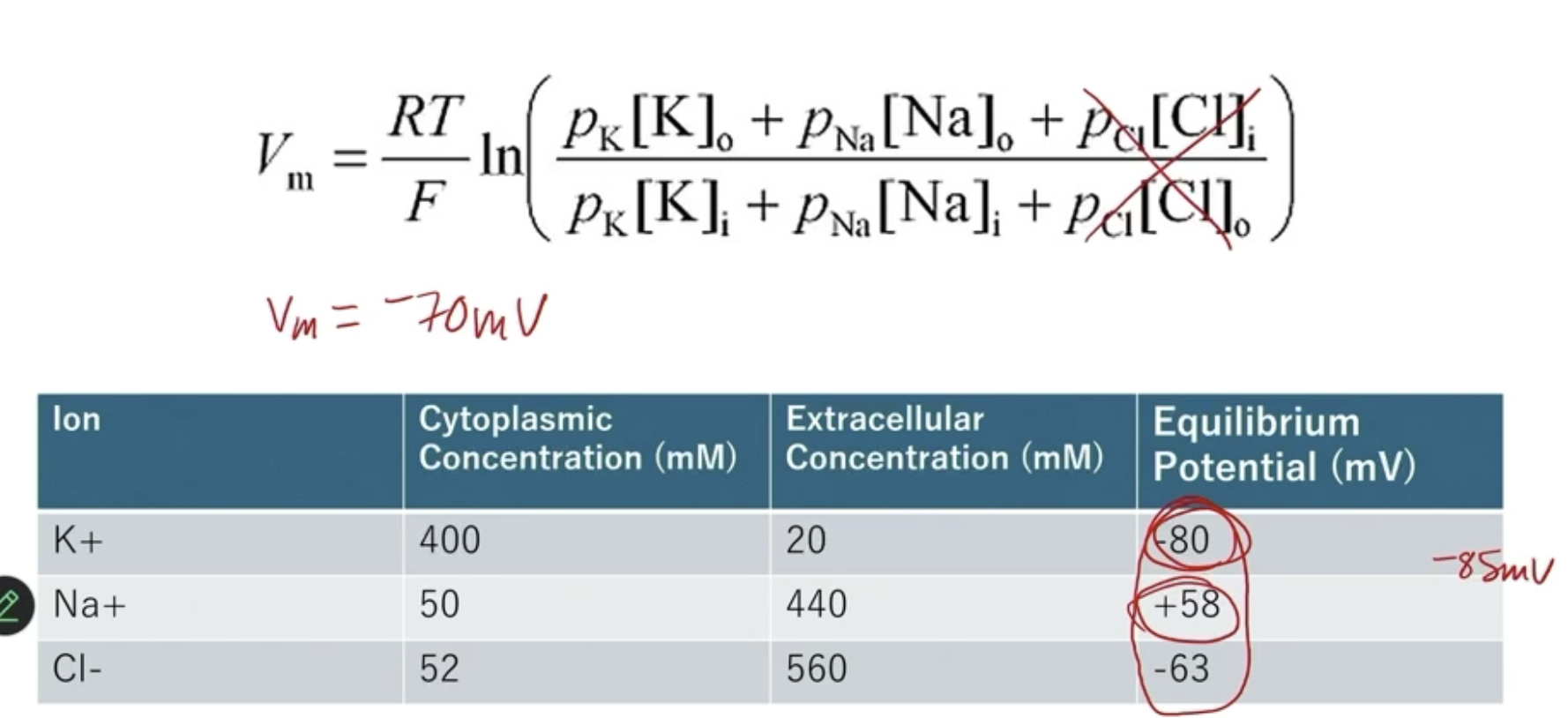
Goldman Equation - calculate Equilibrium potential
Resting membrane potential approaches (but doesn’t reach) EqK+
PM is highly permeable to K+, which is why the RMP is so close to K+’s Eq, but the presence of the more positive Eq molecules → **Na+ and Cl- (a little) → make the RMP slightly more positive
How do membranes become more permeable for firing action potentials?
Opening / closing ion channels
**Movement of a small number of ions alters the membrane potential ; this amount is too small to alter the concentration gradient
Ion concentrations don’t meaningfully change
Membrane potential is about charge separation, not total ions
Vm arises from:
Slight excess of + charge on one side
Slight excess of − charge on the other
One action potential changes ~1 in 10⁶ Na⁺ or K⁺ ions, and concentration gradients remain essentially unchanged
That’s why neurons can fire thousands of APs without “running out” of ions
**Na/K Pump is still needed since small leaks can add up, so it restores the gradients slowly, preventing long-tern drift
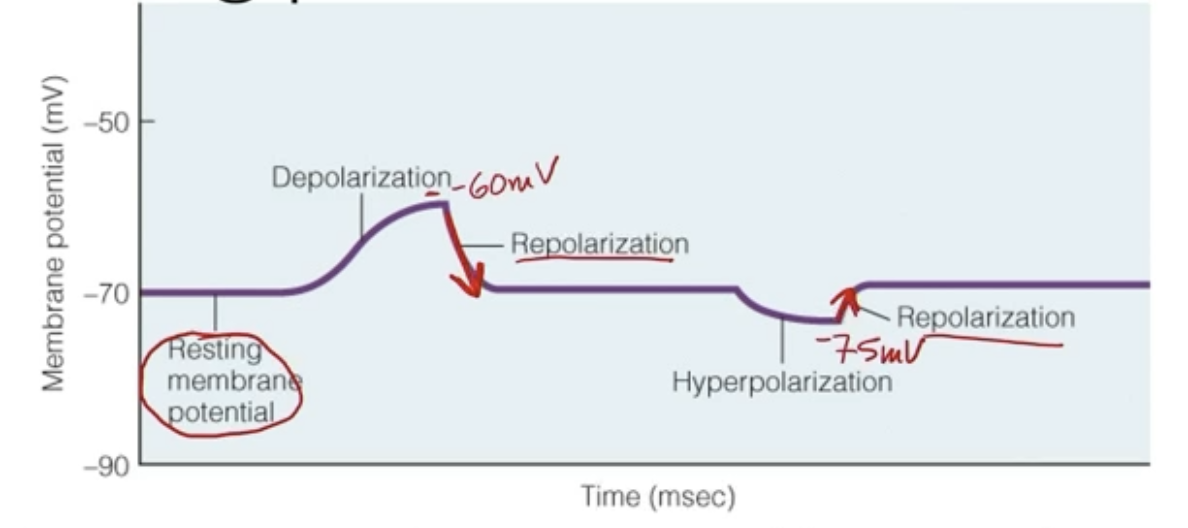
Changes in potential relative to RMP
Depolarization - Vm becomes less negative
+ ions enter, or -ions exit
Hyper polarization - Vm becomes more negative
+ions exit, or -ions enter
Repolarization - Vm returns to RMP
2 types:
During the downward of Action Potential : getting. more negative, so ions exit, or -ions enter
After Hyperpolarization: getting more positive, so + ions enter, or -ions exit
Driving force
Difference between Vm and Eq of an ion
Determines the rate of ion flow
Bigger driving force = faster rate
Not constant, depends on current Vm
Big DF = sharper slope
Little DF = flatter slope
Neuron signal reception
Dendrites
Could be:
Neurotransmitters
Sensory stimulus (for a sensory neuron)
Signal transformed from a chemical to a membrane potential
Signal reception leads to graded potentials
Graded potentials
Signal reception → graded potentials
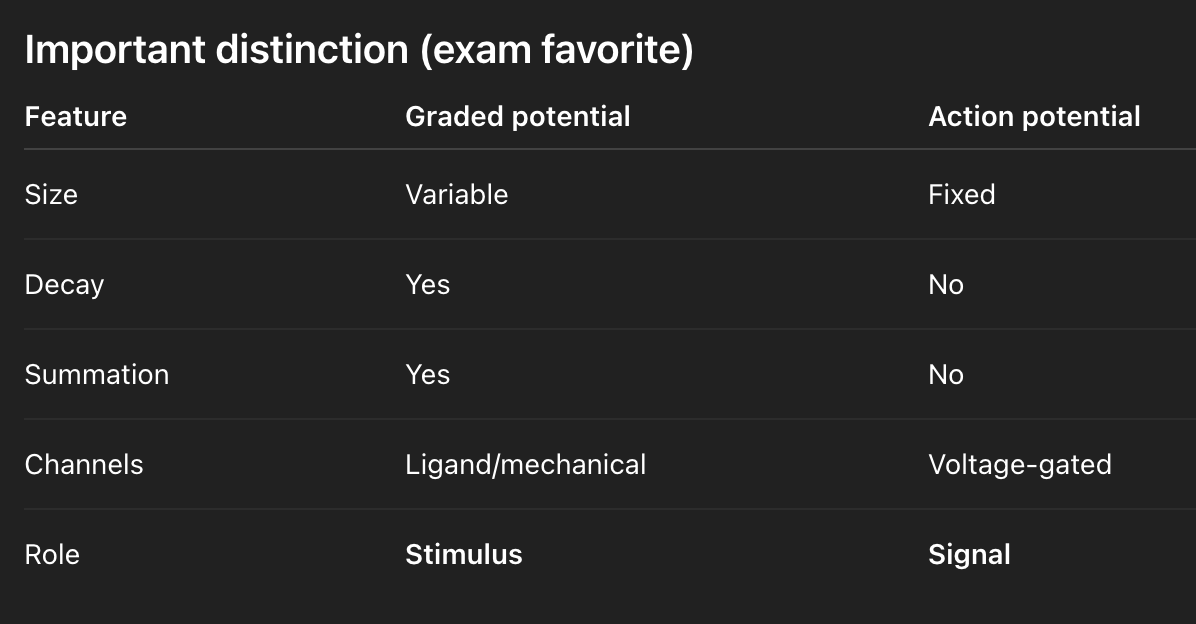
Graded potentials are the stimulus that triggers action potentials when they summate and depolarize the Vm to -55mV
Occur in dendrites and somas
Caused by ligand-gated ion channels (and mechanically gated channels)
Characteristics:
Vary in magnitude and duration, proportional to the strength of the stimulus
Transient, occur locally
Short distance signals - can degrade over a large area
Can be excitatory or inhibitory
Graded potentials can ad up at the axon hillock (spatial summation - from different synapses, & temporal summation - same rapid stimulus over time)
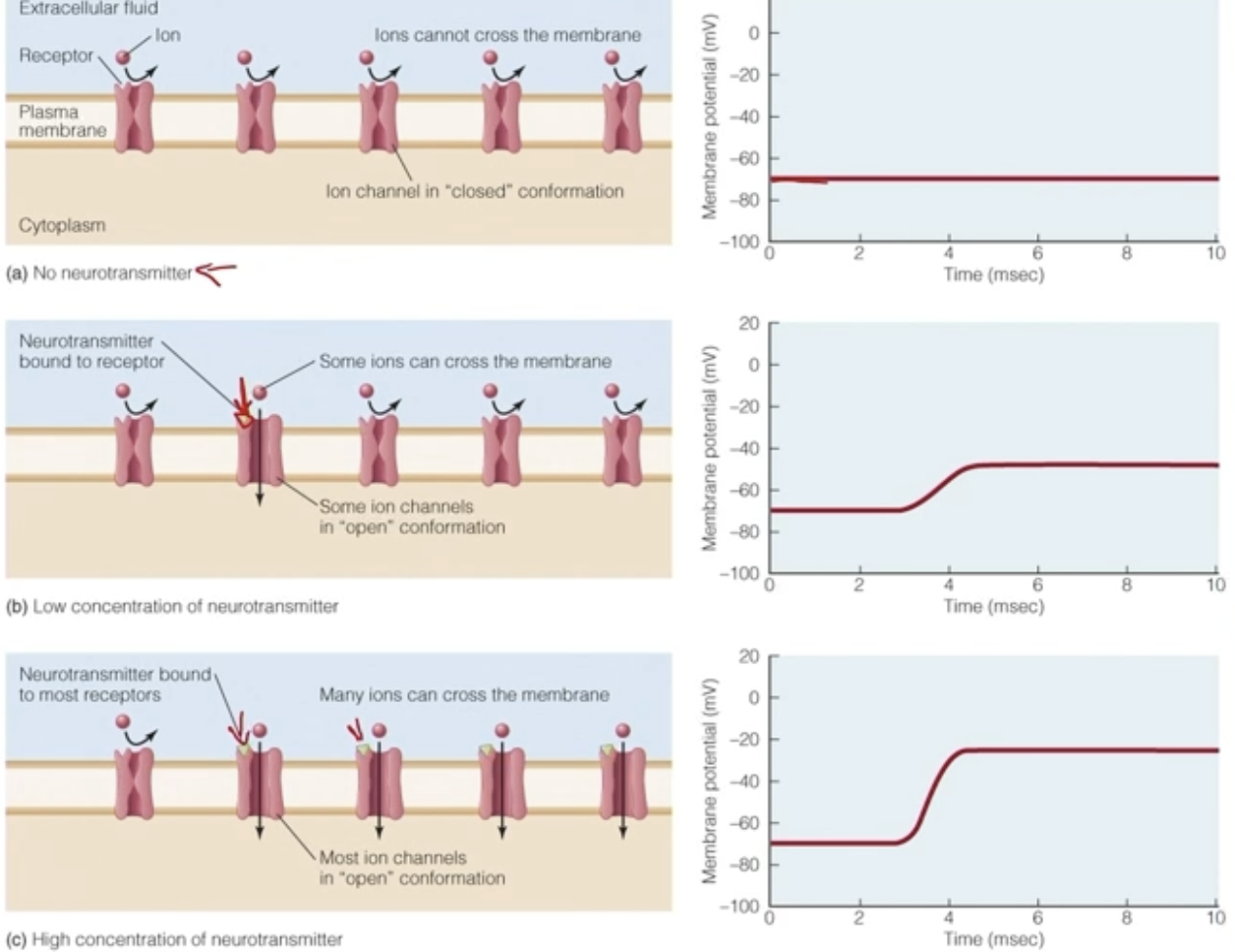
Ligand-gated channels cause Graded Potentials
Channel opening is proportional to amount of ligand present
Ligand concentration varies continuously
Ligand concentration (neurotransmitter) depends on stimulus strength ; stronger stimulus = more ligand
Channel opening probability varies continuously
Ion flow varies continuously
Therefore, the voltage change:
Can be small or large
Depends on stimulus strength
That’s the definition of a graded potential.
Graded potentials decay over short distances
Positive ion enters
Repels other + ions, attracts - ions; Electrical signal spreads over a very short distance, decays
Electrotonic - passive current due to electrical interactions within the cell
Electrotonic spread can be described by length constant 𝜆
 Note
Note  Flashcards (56)