Physiology Cumulative- After 1st Midterm. Lecture 14-26
 Call Kai
 Learn
Learn Practice Test
 Spaced Repetition
 Match
Match Flashcards
 Knowt Play
1/1032

There's no tags or description
Looks like no tags are added yet.
Name | Mastery | Learn | Test | Matching | Spaced | Call with Kai |
|---|
No analytics yet
Send a link to your students to track their progress
1033 Terms
Skeletal shape and appearance
long and cylindrical, striated
skeletal nucleus
multinucleated
skeletal regulation of contraction
voluntary
cardiac shape and appearance
shorter and branched, striated
cardiac nucleus
uninucleated
cardiac regulation of contraction
involuntary
smooth appearance
spindle-shaped, non-striated
smooth nucleus
uninucleated
smooth regulation of contraction
involuntary
which muscles are striated
skeletal and cardiac
which muscles are smooth
smooth
striated
actin and myosin proteins within the fibers (muscle cells) arranged very regularly
smooth
cytoplasm (single nucleus), has a uniform, non-striated appearance because actin and myosin are not in regular arrangement
what muscles are voluntary and involuntary
Voluntary: skeletal
Involuntary: cardiac, smooth
voluntary
action completely depends on signals from nervous system to function
involuntary
can be influenced by nervous system and hormones or other stimuli
What is the skeletal muscle's mass in regard to the body?
makes up all the voluntary muscle and represents greatest amount
where is cardiac muscle found?
only associated with heart
where is smooth muscle found?
most in layers
what are individual muscle fibers
very long cells, in long muscles there is dozens of cm
what are muscle fibers containing?
many fused cells, many nuclei
what does each muscle fiber have
sarcomeres
sarcomeres
basic unit of contratcion
what makes up the striations
boundaries of sarcomeres
A bands
Thick filament, dark because myosin is thick
I bands
Thin filament, lighter because actin is thin
what gives skeletal muscle its appearance
the way the actin and myosin are arranged
Breaking down a muscle into contraction
Tendon- muscle, muscle fascicle, muscle fiber myofibril.
what happens during muscle contraction
actin filaments slide over myosin, muscle shortens.
Beginning of muscle contraction
begins with a nerve impulse travelling down an axon. connects with a muscle fibre at the neuromuscular junction.
Step two of muscle contraction
Impulse reaches the synaptic bulb at the axon terminal.
neuromuscular junction
site at which an axon of a motor neuron contacts the muscle fiber that it innervates.
what does the synaptic bulb contain
synaptic vesicles.
what are the synaptic vesicles filled with
ACh (Acetylcholine)
Step 3 of muscle contraction
Molecules of ACh are released into the synaptic cleft, molecules bind to receptors on the muscle (motor endplate)
Step 4 of muscle contraction
binding of ACh to receptors activates sodium channels. Sodium enters the cell and produces local depolarization which initiates the electrical signal in muscle.
step 5 of muscle contraction
the electrical signal passes to t-tubule of the muscle
step 6 of muscle contraction
signal asses to inside of muscle along T tubules, which results in calcium channels openeing
T tubules
extensions of the sarcoplasmisc reticulum
Step 7 of muscle contraction
Calcium is released to interact with actin and myosin fibers
How does Ca+ initiate contraction
we need to look at myosin and actin in more detail and how they interact to understand
What does each myosin head have
two active regions
two active regions of myosin
actin binding site and ATP binding site
What does each myosin filament have
tail and head
Step 8 of muscle contraction
Calcium ions enable actin and myosin to bind and initiate sarcomere contraction. Causes change in tropomyosin and moves down to expose myosin binding sites.
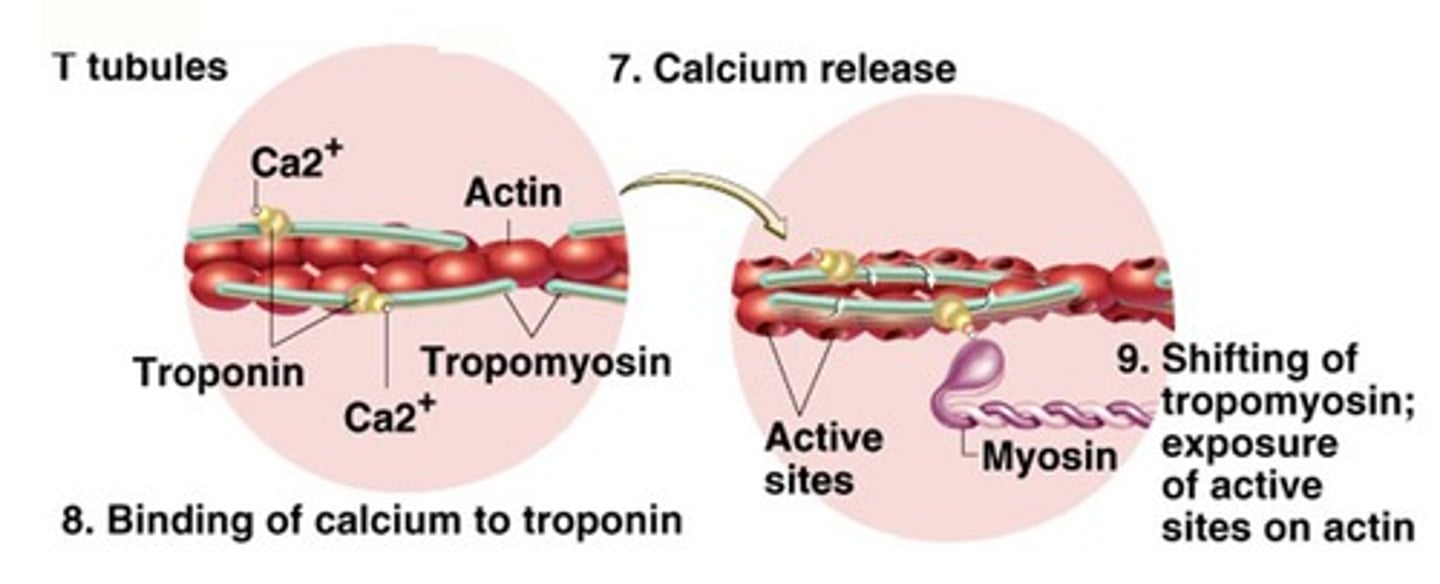
What does actin have
two proteins bound to it
proteins bound to actin
tropomyosin and troponin
Step 9 muscle contraction
attachment of the myosin head to actin causes bending of myosin to centrre of sarcomere. This shortens the sarcomere segment, and often reffered to as the "power stroke".
Step 2 of power stroke (When the binding is happening)
ADP and phosphate are bound to myosin as myosin head attaches to actin.
Step 3 of power stroke
ADP + P release causes head to change position and actin filament to move.
Step 4 of power stroke
Binding of ATP causes myosin head to return to resting position.
Step 1 of power stroke
ATP is hydrolyzed when myosin head is unattached
what happens when power stroke is over
-muscle has only shortened by 1%
-muscles can shorten up to 60%
-cross-bridges have a "cross-bridge cycle"
-once power stroke is over, ATP binds to myosin head
-myosin head detaches from actin
-new power stroke begins
-therefore, one ATP is required for the breaking up of the cross bridges after the power stroke
What stimulates muscle fibers to contract?
Nerve signals stimulate muscle fibers with acetylcholine (ACh).
What releases calcium during muscle contraction?
The sarcoplasmic reticulum releases calcium.
What does calcium (Ca²⁺) cause in muscle contraction?
Calcium leads to a conformational change of actin.
What forms when the myosin head connects to actin?
A cross bridge is formed.
What happens when the myosin head pulls the actin fiber?
The cross bridge is broken, costing 1 ATP for detachment.
What occurs multiple times during a muscle contraction?
Attachment sites form and break, recycling the cross bridge.
How does contraction occur in muscle cells?
Contraction occurs simultaneously in all sarcomeres in the cell.
What happens to the muscle cell during contraction?
The muscle cell shortens, causing the entire muscle to shorten.
What is required to move the head of myosin?
ATP
Rigor mortis
After death, ATP synthesis stops, Myosin and actin cannot separate, and muscles become stiff.
What do contractions vary in
strength and duration
muscle twitch
All muscle contractions are built on this
What is the muscle twitch
all or none, can be rarely a single cell but usually a group
what does motor units contain
consists of one neuron and all the muscle fibers that to which it connects
what will a signal from the neuron cause
all fibers contracting
how many muscle fibers may be stimulated by one nerve
several hundred or very few
what happens with fewer muscle fibers
more control over movement (fine motor skills)
what happens when a signal is sent
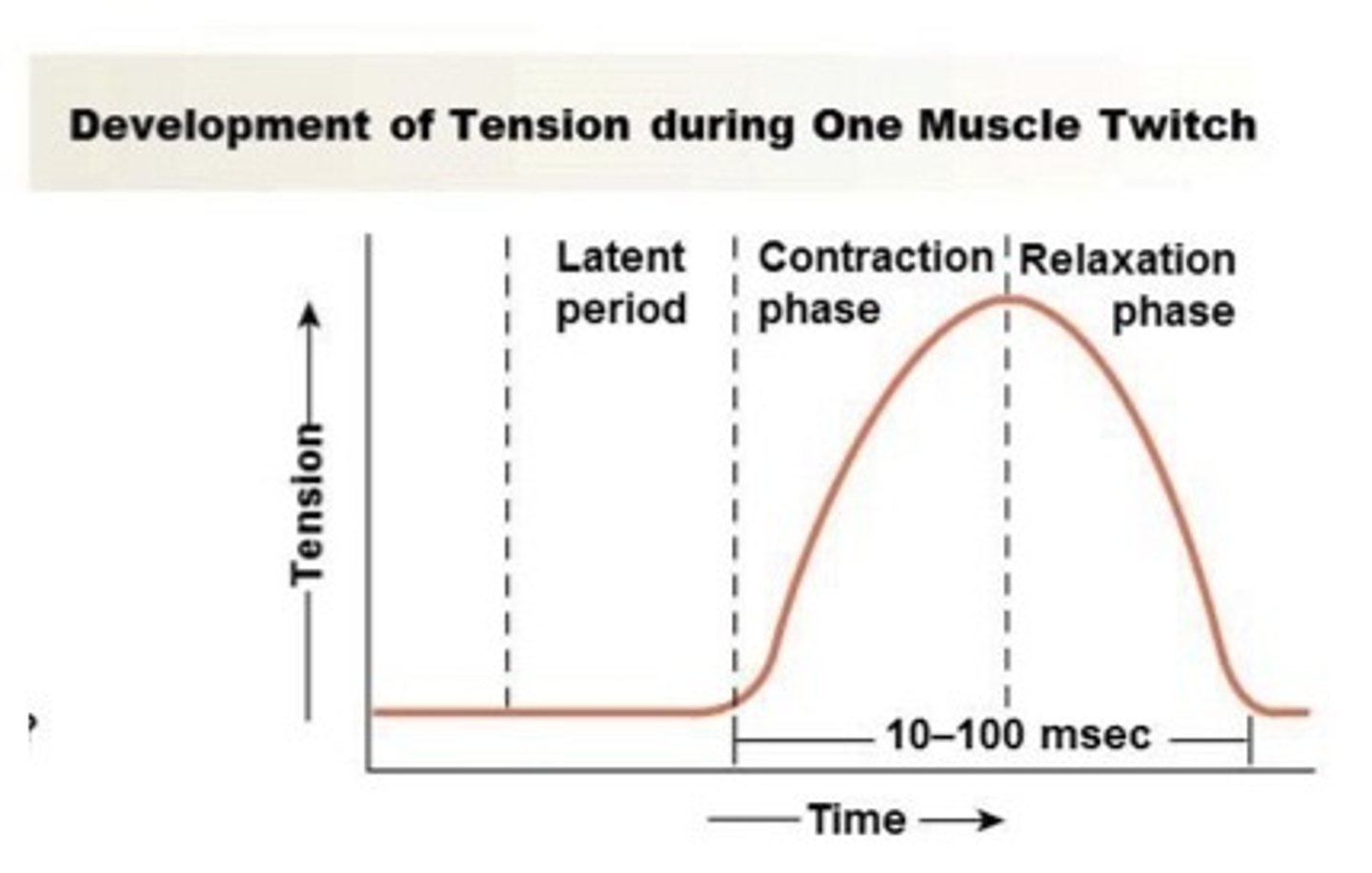
latent period, contraction, relaxation
latent period
first few milliseconds, connections between actin and myosin begin to form
contraction
actin slides over myosin, muscle shortens
relaxation
muscle returns to its initial length longest part
what is the signal?
Highly reproducible, but may vary
muscle twitch graph
- time to reach maximum contraction
- ability to sustain tension
- tonic vs. fast/slow twitch fibers
why can twitches vary
muscle fibers with a large diameter are stronger, and some fibers vary in the speed in whihhc they can activate peak force (slow and fast twitch fibers)
Three factors that modify muscle contraction so that we're not twitchy all the time
Isometric vs isotonic contractions, frequency of stimulation, strength of stimulation
Isometric vs isotonic
does not differ in how force is generated but rather if the muscle gets shorter
Isotonic contraction
muscle gets shorter, shortening brings forearm up. ex: lifting weight
Isometric contraction
muscle stays same length but creating tension. ex: holding up a chain from the ground
what happens if muscle contracts isometrically
sarcomeres still shorten, whole muscle does not, force transmitted through certain cellular components and tendons, good for maintaining posture, etc.
condition of a muscle contraction being reproducible
is a muscle is stomulated at low frequency
what happens by increasing frequency of signal sent to muscle
stronger response, second signal is added to the first
more calcium effect on tension generated
more calcium, more myosin binding sites, more cross bridges, more tension generated
Psychological tetanus
after multiple signals in sequence, muscle relaxation disappears
whats after one twitch
second signal before first twitch ends, multiple signals in sequence, next would be physiological tetanus
what is tetanus caused by
Multiple stimuli to muscles- not to be confused with the disease tetanus. caused by soil bacteria
What does tetanus release
a toxin that interferes with the release of inhibitory neurotransmitter
what does the toxin released by tetanus cause
continuous excitation of muscle fibers.
where do early manifestations of tetanus occur
in masseter muscles (lockjaw)
what happens as more muscle fibers are stimulated
strength of contraction increases
what size muscle fiber is stimulated first
smallest
when are larger fibers stimulated
as much force needed
slow and fast muscle fiber twicthes
some muscles take longer to reach peak tension during contractionn
ex of slow twicth muscle
soleus and gastrocnemius
ex of fast twitch muscles
extraocular (fast eye movements)
what does difference between slow and fast twitch reflect
type of myosin present
what does velocity of muscle contraction depend on
how quickly cross bridges recycle
What is the rate-limiting step in muscle contraction
synthesis of ATP

