Graph Theory
 Call Kai
 Learn
Learn Practice Test
 Spaced Repetition
 Match
Match Flashcards
 Knowt Play
1/41

There's no tags or description
Looks like no tags are added yet.
Name | Mastery | Learn | Test | Matching | Spaced | Call with Kai |
|---|
No analytics yet
Send a link to your students to track their progress
42 Terms
Graph is
Graph G = (V, E), where:
V - set of vertices
E - set of directed edges
Simple directed graph
graph without self-loops and parallel directed edges
Simple undirected graph
A graph G = (V, B) where B is a subset of V² is called simple undirected graph.
Order of graph
The order of graph G = (V, B) is the number |V| = n.
Empty graph
The graph G = (V, 0) is called empty graph and is denoted as On
Null graph
The graph G = (0, 0) is null graph.
Trivial graph
The graph G = ({v}, 0) is trivial graph.
Complete graph
A graph with all n * (n - 1) / 2 edges, where n is order of graph, is Complete graph and denoted as Kn
Neighborhood of vertix
For a graph G = (V, B) the neighborhood of vertex v in V is the set of all adjacent vertices:

Degree of vertex
The degree of vertex v is the number p(v) = |Г(v)|
Isolated vertex
A vertex v is called isolated if p(v) = 0.
Pendant vertex
The vertex v is called pendant if p(v) = 1.
Regular graph
A graph is called regular if all its vertices have the same degree
Adjacent vertices
Two vertices u and v in a graph G = (V, B) are called adjacent if there exists an edge {u, v} in B connecting them
Adjacent edge
Two edges in graph G = (V, B) are called adjacent if they share a common vertix.
Incident vertex and edge
A vertex v and an edge e are called incident if v is one of the endpoints of e.
Adjacency matrix
The adjacency matrix of graph G = (V, E) with n = |V| is an n*n matrix where:

Incident matrix
The incident matrix of graph G = (V, E) with n = |V| and m = |E| is an n*m matrix where:

Union of two graphs

Intersection of two graphs

The complement of a graph

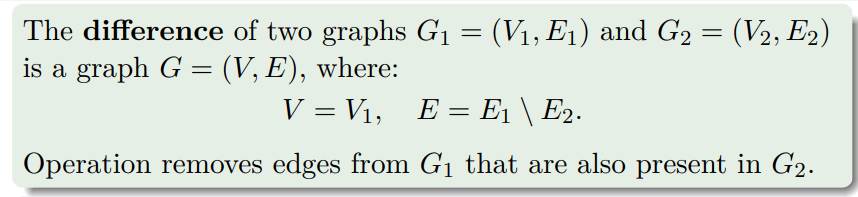
The difference of two graphs
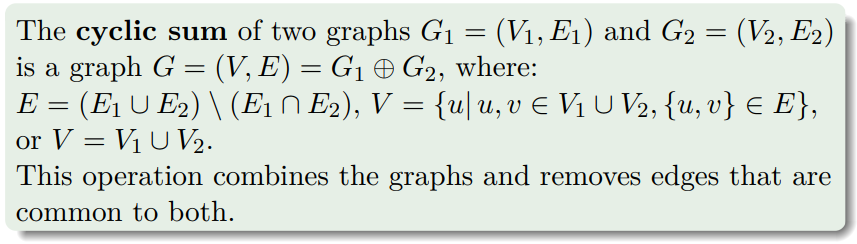
The cyclic sum of two graphs
Subgraph

Walk
A walk on the graph is a sequence of vertices and edges in a graph G = (V, E), where each edge connects the preceding and following vertices.
A chain
A chain (or trail) is a walk on a graph where no edges are repeated.
Open walk
Walk is open, if first and last vertices are different.
Closed walk
If walk start and ends with the same vertex, it called a close walk
Path
Path is a open walk in the graph where no edges and no vertices are repeated.
Cycle
A cycle is a closed walk in the graph where no edges are repeating and where only the initial and the terminal vertices are the same
Connected graph
A graph is called connected if any two vertices can be connected by a path.
Connected component
Connected component is the maximal connected subgraph of G = (V, B).
Length of path
Length of a path is defined as a number of edges in the path.
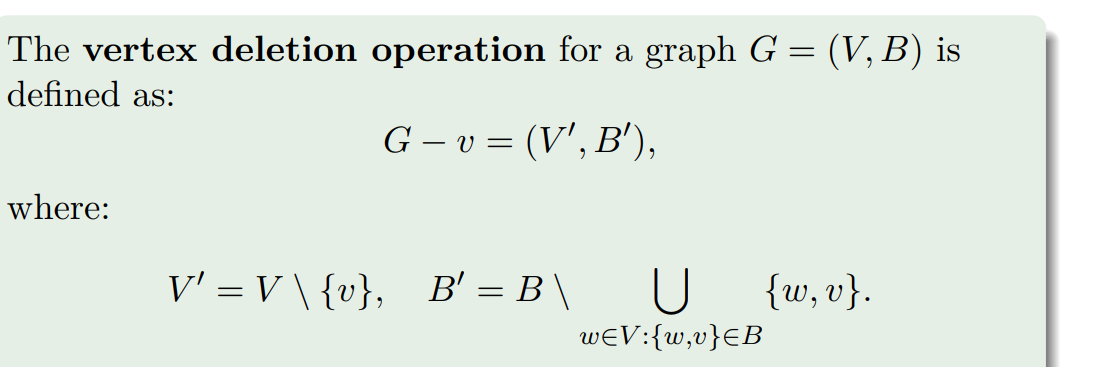
Vertex deletion operation
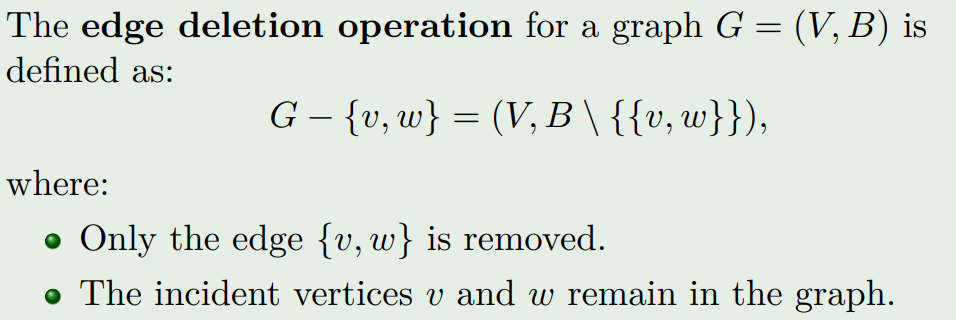
Edge deletion operation
Cut vertex
A vertex v in V of graph G = (V, E) is called a cut vector (articulation point) if the graph G - v has more connected components than G
Non-separable graph
A graph without cut vertices is called non-separable graph
Separable graph
Graph is called separable if it has a cut vertex
Block
A block of a graph G is a maximal connected non-separable graph of G.
Bridge
An edge of a graph is called bridge (cut edge) if removing it increases the number of connected components of the graph.
Separating set
A subset S sub B of the edge set of a connected graph G = (V, B) is called a separating set if the graph ((V, B \ S) is disconnected.
A cut
A cut (or minimal separating set) is a separating set from which no edge can be removed without making it connected again. Thus: K sub B a cut if:
K is separating set
For any P sub K with P ≠ K: P is not separating set.
Explore top notes

