unit 1 textbook questions
0.0(0)
 Studied by 2 people
 Call Kai
 Learn
Learn Practice Test
 Spaced Repetition
 Match
Match Flashcards
 Knowt Play
Card Sorting
1/113

Earn XP
Description and Tags
Last updated 6:18 PM on 1/19/23
Name | Mastery | Learn | Test | Matching | Spaced | Call with Kai |
|---|
No analytics yet
Send a link to your students to track their progress
114 Terms
1
New cards
Which of the following foods is NOT made by fermentation?
1. beer
2. bread
3. cheese
4. orange juice
1. beer
2. bread
3. cheese
4. orange juice
orange juice
2
New cards
Who is considered the “father of Western medicine”?
1. Marcus Terentius Varro
2. Thucydides
3. Antonie van Leeuwenhoek
4. Hippocrates
1. Marcus Terentius Varro
2. Thucydides
3. Antonie van Leeuwenhoek
4. Hippocrates
hippocrates
3
New cards
Who was the first to observe “animalcules” under the microscope?
1. Antonie van Leeuwenhoek
2. Ötzi the Iceman
3. Marcus Terentius Varro
4. Robert Koch
1. Antonie van Leeuwenhoek
2. Ötzi the Iceman
3. Marcus Terentius Varro
4. Robert Koch
antonie van leeuwenhoek
4
New cards
Who proposed that swamps might harbor tiny, disease-causing animals too small to see?
1. Thucydides
2. Marcus Terentius Varro
3. Hippocrates
4. Louis Pasteur
1. Thucydides
2. Marcus Terentius Varro
3. Hippocrates
4. Louis Pasteur
marcus terentius varro
5
New cards
Which of the following was NOT a kingdom in Linnaeus’s taxonomy?
1. animal
2. mineral
3. protist
4. plant
1. animal
2. mineral
3. protist
4. plant
protist
6
New cards
Which of the following is a correct usage of binomial nomenclature?
1. Homo Sapiens
2. *homo sapiens*
3. *Homo sapiens*
4. *Homo Sapiens*
1. Homo Sapiens
2. *homo sapiens*
3. *Homo sapiens*
4. *Homo Sapiens*
Homo sapiens (italicized)
7
New cards
Which scientist proposed adding a kingdom for protists?
1. Carolus Linnaeus
2. Carl Woese
3. Robert Whittaker
4. Ernst Haeckel
1. Carolus Linnaeus
2. Carl Woese
3. Robert Whittaker
4. Ernst Haeckel
ernst haeckel
8
New cards
Which of the following is NOT a domain in Woese and Fox’s phylogenetic tree?
1. Plantae
2. Bacteria
3. Archaea
4. Eukarya
1. Plantae
2. Bacteria
3. Archaea
4. Eukarya
plantae
9
New cards
Which of the following is the standard resource for identifying bacteria?
1. *Systema Naturae*
2. Bergey’s *Manual of Determinative Bacteriology*
3. Woese and Fox’s phylogenetic tree
4. Haeckel’s *General Morphology of Organisms*
1. *Systema Naturae*
2. Bergey’s *Manual of Determinative Bacteriology*
3. Woese and Fox’s phylogenetic tree
4. Haeckel’s *General Morphology of Organisms*
bergey’s manual of determinative bacteriology
10
New cards
Which of the following types of microorganisms is photosynthetic?
1. yeast
2. virus
3. helminth
4. algae
1. yeast
2. virus
3. helminth
4. algae
algae
11
New cards
Which of the following is a prokaryotic microorganism?
1. helminth
2. protozoan
3. cyanobacterium
4. mold
1. helminth
2. protozoan
3. cyanobacterium
4. mold
cyanobacterium
12
New cards
Which of the following is acellular?
1. virus
2. bacterium
3. fungus
4. protozoan
1. virus
2. bacterium
3. fungus
4. protozoan
virus
13
New cards
Which of the following is a type of fungal microorganism?
1. bacterium
2. protozoan
3. algae
4. yeast
1. bacterium
2. protozoan
3. algae
4. yeast
yeast
14
New cards
Which of the following is not a subfield of microbiology?
1. bacteriology
2. botany
3. clinical microbiology
4. virology
1. bacteriology
2. botany
3. clinical microbiology
4. virology
botany
15
New cards
Thucydides is known as the father of _______ ________.
scientific history
16
New cards
Researchers think that Ötzi the Iceman may have been infected with _____ disease.
lyme
17
New cards
The process by which microbes turn grape juice into wine is called _______________.
fermentation
18
New cards
In binomial nomenclature, an organism’s scientific name includes its ________ and __________.
genus, species
19
New cards
Haeckel proposed adding the kingdoms ________ and ________ to his phylogenetic tree.
protist, monera
20
New cards
__________ are organisms without membrane-bound nuclei.
prokaryotes
21
New cards
______ are microorganisms that are not included in phylogenetic trees because they are acellular.
viruses
22
New cards
A ________ is a disease-causing microorganism.
pathogen
23
New cards
Multicellular parasitic worms studied by microbiologists are called ___________.
helminths
24
New cards
The study of viruses is ___________.
virology
25
New cards
The cells of prokaryotic organisms lack a _______.
nucleus
26
New cards
What did Thucydides learn by observing the Athenian plague?
survivors had immunity
27
New cards
Why was the invention of the microscope important for microbiology?
led to discovery of microbes
28
New cards
What are some ways people use microbes? (also discovered by Robert koch)
fermentation, pasteurization, vaccines
29
New cards
What is a phylogenetic tree?
diagram representing relationships among bacteria, archaea, & eukarya
30
New cards
Which of the 5 kingdoms in Whittaker’s phylogenetic tree are prokaryotic, and which are eukaryotic?
monera are prokaryotic. plantae, animalia, protista, & fungi are eukaryotic
31
New cards
What molecule did Woese and Fox use to construct their phylogenetic tree?
rRNA
32
New cards
Name some techniques that can be used to identify and differentiate species of bacteria.
biochemical, serological, rRNA & DNA sequencing
33
New cards
Describe the differences between bacteria and archaea.
genetics, metabolic pathways, composition of cell walls
34
New cards
Name three structures that various protozoa use for locomotion.
cilia, flagella, pseudopods
35
New cards
Describe the actual and relative sizes of a virus, a bacterium, and a plant or animal cell.
virus is 100nm. 10x smaller than bacterium. bacterium is 1um. 10x smaller than cell. cell is 10-100um.
36
New cards
Explain how the discovery of fermented foods likely benefited our ancestors.
to preserve and enhance food
37
New cards
What evidence would you use to support this statement: Ancient people thought that disease was transmitted by things they could not see.
they quarantined people with disease & developed hygiene practices.
38
New cards
Why is using binomial nomenclature more useful than using common names?
a common name could fit the description of many organisms
39
New cards
what are the three Domains found on modern phylogenetic trees from left to right?
bacteria, archaea, eukarya
40
New cards
Contrast the behavior of a virus outside versus inside a cell.
outside: inactive. inside: adopt’s hosts cellular mechanisms & can multiply
41
New cards
Which of the following has the highest energy?
1. light with a long wavelength
2. light with an intermediate wavelength
3. light with a short wavelength
4. It is impossible to tell from the information given.
1. light with a long wavelength
2. light with an intermediate wavelength
3. light with a short wavelength
4. It is impossible to tell from the information given.
light with a short wavelength
42
New cards
You place a specimen under the microscope and notice that parts of the specimen begin to emit light immediately. These materials can be described as _____________.
1. fluorescent
2. phosphorescent
3. transparent
4. opaque
1. fluorescent
2. phosphorescent
3. transparent
4. opaque
fluorescent
43
New cards
Who was the first to describe “cells” in dead cork tissue?
1. Hans Janssen
2. Zaccharias Janssen
3. Antonie van Leeuwenhoek
4. Robert Hooke
1. Hans Janssen
2. Zaccharias Janssen
3. Antonie van Leeuwenhoek
4. Robert Hooke
robert hooke
44
New cards
Who is the probable inventor of the compound microscope?
1. Girolamo Fracastoro
2. Zaccharias Janssen
3. Antonie van Leeuwenhoek
4. Robert Hooke
1. Girolamo Fracastoro
2. Zaccharias Janssen
3. Antonie van Leeuwenhoek
4. Robert Hooke
zaccharias janssen
45
New cards
Which would be the best choice for viewing internal structures of a living protist such as a *Paramecium*?
1. a brightfield microscope with a stain
2. a brightfield microscope without a stain
3. a darkfield microscope
4. a transmission electron microscope
1. a brightfield microscope with a stain
2. a brightfield microscope without a stain
3. a darkfield microscope
4. a transmission electron microscope
a darkfield microscope
46
New cards
Which type of microscope is especially useful for viewing thick structures such as biofilms?
1. a transmission electron microscope
2. a scanning electron microscopes
3. a phase-contrast microscope
4. a confocal scanning laser microscope
5. an atomic force microscope
1. a transmission electron microscope
2. a scanning electron microscopes
3. a phase-contrast microscope
4. a confocal scanning laser microscope
5. an atomic force microscope
a confocal scanning laser microscope
47
New cards
Which type of microscope would be the best choice for viewing very small surface structures of a cell?
1. a transmission electron microscope
2. a scanning electron microscope
3. a brightfield microscope
4. a darkfield microscope
5. a phase-contrast microscope
1. a transmission electron microscope
2. a scanning electron microscope
3. a brightfield microscope
4. a darkfield microscope
5. a phase-contrast microscope
a scanning electron microscope
48
New cards
What type of microscope uses an annular stop?
1. a transmission electron microscope
2. a scanning electron microscope
3. a brightfield microscope
4. a darkfield microscope
5. a phase-contrast microscope
1. a transmission electron microscope
2. a scanning electron microscope
3. a brightfield microscope
4. a darkfield microscope
5. a phase-contrast microscope
a phase-contrast microscope
49
New cards
What type of microscope uses a cone of light so that light only hits the specimen indirectly, producing a light image on a dark background?
1. a transmission electron microscope
2. a scanning electron microscope
3. a brightfield microscope
4. a darkfield microscope
5. a phase-contrast microscope
1. a transmission electron microscope
2. a scanning electron microscope
3. a brightfield microscope
4. a darkfield microscope
5. a phase-contrast microscope
a darkfield microscope
50
New cards
What mordant is used in Gram staining?
1. crystal violet
2. safranin
3. acid-alcohol
4. iodine
1. crystal violet
2. safranin
3. acid-alcohol
4. iodine
iodine
51
New cards
What is one difference between specimen preparation for a transmission electron microscope (TEM) and preparation for a scanning electron microscope (SEM)?
1. Only the TEM specimen requires sputter coating.
2. Only the SEM specimen requires sputter-coating.
3. Only the TEM specimen must be dehydrated.
4. Only the SEM specimen must be dehydrated.
1. Only the TEM specimen requires sputter coating.
2. Only the SEM specimen requires sputter-coating.
3. Only the TEM specimen must be dehydrated.
4. Only the SEM specimen must be dehydrated.
only the SEM specimen requires sputter-coating
52
New cards
When you see light bend as it moves from air into water, you are observing _________.
refraction
53
New cards
A microscope that uses multiple lenses is called a _________ microscope.
compound
54
New cards
Chromophores that absorb and then emit light are called __________.
fluorochromes
55
New cards
In a(n) ____ ___ microscope, a probe located just above the specimen moves up and down in response to forces between the atoms and the tip of the probe.
atomic force
56
New cards
What is the total magnification of a specimen that is being viewed with a standard ocular lens and a 40⨯ objective lens?
400x
57
New cards
Ziehl-Neelsen staining, a type of ____-___ staining, is diagnostic for *Mycobacterium tuberculosis.*
acid-fast
58
New cards
The ____ ___ is used to differentiate bacterial cells based on the components of their cell walls.
gram stain
59
New cards
Explain how a prism separates white light into different colors.
as white light. passes through prism, shorter wavelengths refract more than longer wavelengths & the colors separate
60
New cards
Why did the cork cells observed by Robert Hooke appear to be empty, as opposed to being full of other structures?
They were dead & filled w/air, only rigid cell walls provided structure
61
New cards
What is the function of the condenser in a brightfield microscope?
Contains series of lenses that focus light onto specimen
62
New cards
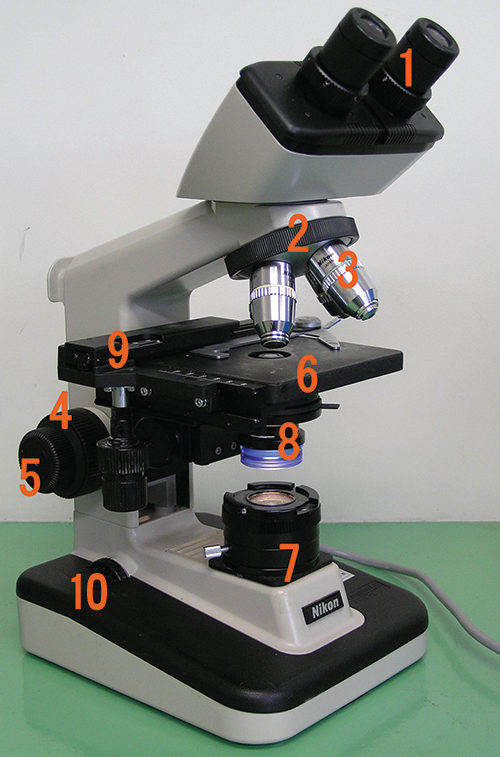
Label each component of the brightfield microscope.
1. ocular lens 2. revolving nose piece 3. objective lenses 4. coarse focus 5. fine focus 6. stage 7. illuminator 8. diaphragm/condenser 9. mechanical stage 10. rheostat
63
New cards
Which of the following has the lowest energy? \n A.visible light \n B.X-rays \n C.ultraviolet rays \n D.infrared rays
infrared rays
64
New cards
When focusing a light microscope, why is it best to adjust the focus using the coarse focusing knob before using the fine focusing knob?
The coarse focus is for larger scale movements while the fine focus is for smaller scale movements-- so it's important to focus larger picture before trying to focus the smaller picture
65
New cards
You need to identify structures within a cell using a microscope. However, the image appears very blurry even though you have a high magnification. What are some things that you could try to improve the resolution of the image? Describe the most basic factors that affect resolution when you first put the slide onto the stage: then consider more specific factors that could affect resolution for 40x and 100x lenses.
Two factors are wavelength( short wavelengths need electron microscopes and long wavelengths can use light microscopes) and numerical aperture (lens's ability to gather light- increase numerical aperture=better resolution). \n If you increase contrast you'll be able to detect different structures easier in specimens \n For oil immersion lens make sure the oil bridge is still there
66
New cards
You use the Gram staining procedure to stain an L-form bacterium (a bacterium that lacks a cell wall). What color will the bacterium be after the staining procedure is finished?
pink
67
New cards
Which of the following individuals argued in favor of the theory of spontaneous generation?
1. Francesco Redi
2. Louis Pasteur
3. John Needham
4. Lazzaro Spallanzani
1. Francesco Redi
2. Louis Pasteur
3. John Needham
4. Lazzaro Spallanzani
john needham
68
New cards
Which of the following individuals is credited for definitively refuting the theory of spontaneous generation using broth in swan-neck flask?
1. Aristotle
2. Jan Baptista van Helmont
3. John Needham
4. Louis Pasteur
1. Aristotle
2. Jan Baptista van Helmont
3. John Needham
4. Louis Pasteur
louis pasteur
69
New cards
Which of the following scientists experimented with raw meat, maggots, and flies in an attempt to disprove the theory of spontaneous generation?
1. Aristotle
2. Lazzaro Spallanzani
3. Antonie van Leeuwenhoek
4. Francesco Redi
1. Aristotle
2. Lazzaro Spallanzani
3. Antonie van Leeuwenhoek
4. Francesco Redi
francesco redi
70
New cards
Which of the following individuals did not contribute to the establishment of cell theory?
1. Girolamo Fracastoro
2. Matthias Schleiden
3. Robert Remak
4. Robert Hooke
1. Girolamo Fracastoro
2. Matthias Schleiden
3. Robert Remak
4. Robert Hooke
girolamo fracastoro
71
New cards
Whose proposal of the endosymbiotic theory of mitochondrial and chloroplast origin was ultimately accepted by the greater scientific community?
1. Rudolf Virchow
2. Ignaz Semmelweis
3. Lynn Margulis
4. Theodor Schwann
1. Rudolf Virchow
2. Ignaz Semmelweis
3. Lynn Margulis
4. Theodor Schwann
lynn margulis
72
New cards
Which of the following developed a set of postulates for determining whether a particular disease is caused by a particular pathogen?
1. John Snow
2. Robert Koch
3. Joseph Lister
4. Louis Pasteur
1. John Snow
2. Robert Koch
3. Joseph Lister
4. Louis Pasteur
robert koch
73
New cards
Which of the following terms refers to a prokaryotic cell that is comma shaped?
1. coccus
2. coccobacilli
3. vibrio
4. spirillum
1. coccus
2. coccobacilli
3. vibrio
4. spirillum
vibrio
74
New cards
Which bacterial structures are important for adherence to surfaces? (Select all that apply.)
1. endospores
2. cell walls
3. fimbriae
4. capsules
5. flagella
1. endospores
2. cell walls
3. fimbriae
4. capsules
5. flagella
fimbriae, capsules
75
New cards
Which of the following cell wall components is unique to gram-negative cells?
1. lipopolysaccharide
2. teichoic acid
3. mycolic acid
4. peptidoglycan
1. lipopolysaccharide
2. teichoic acid
3. mycolic acid
4. peptidoglycan
lipopolysaccharide
76
New cards
Which of the following terms refers to a bacterial cell having a single tuft of flagella at one end?
1. monotrichous
2. amphitrichous
3. peritrichous
4. lophotrichous
1. monotrichous
2. amphitrichous
3. peritrichous
4. lophotrichous
lophotrichous
77
New cards
Bacterial cell walls are primarily composed of which of the following?
1. phospholipid
2. protein
3. carbohydrate
4. peptidoglycan
1. phospholipid
2. protein
3. carbohydrate
4. peptidoglycan
peptidoglycan
78
New cards
Which of the following organelles is not part of the endomembrane system?
1. endoplasmic reticulum
2. Golgi apparatus
3. lysosome
4. peroxisome
1. endoplasmic reticulum
2. Golgi apparatus
3. lysosome
4. peroxisome
peroxisome
79
New cards
Which type of cytoskeletal fiber is important in the formation of the nuclear lamina?
1. microfilaments
2. intermediate filaments
3. microtubules
4. fibronectin
1. microfilaments
2. intermediate filaments
3. microtubules
4. fibronectin
intermediate filaments
80
New cards
Sugar groups may be added to proteins in which of the following?
1. smooth endoplasmic reticulum
2. rough endoplasmic reticulum
3. Golgi apparatus
4. lysosome
1. smooth endoplasmic reticulum
2. rough endoplasmic reticulum
3. Golgi apparatus
4. lysosome
golgi apparatus
81
New cards
Which of the following structures of a eukaryotic cell is not likely derived from endosymbiotic bacterium?
1. mitochondrial DNA
2. mitochondrial ribosomes
3. inner membrane
4. outer membrane
1. mitochondrial DNA
2. mitochondrial ribosomes
3. inner membrane
4. outer membrane
outer membrane
82
New cards
Which type of nutrient uptake involves the engulfment of small dissolved molecules into vesicles?
1. active transport
2. pinocytosis
3. receptor-mediated endocytosis
4. facilitated diffusion
1. active transport
2. pinocytosis
3. receptor-mediated endocytosis
4. facilitated diffusion
pinocytosis
83
New cards
Which of the following is not composed of microtubules?
1. desmosomes
2. centrioles
3. eukaryotic flagella
4. eukaryotic cilia
1. desmosomes
2. centrioles
3. eukaryotic flagella
4. eukaryotic cilia
desmosomes
84
New cards
Exposure to air is necessary for microbial growth.
\
true/false
\
true/false
false
85
New cards
Bacteria have 80S ribosomes each composed of a 60S large subunit and a 40S small subunit.
\
true/false
\
true/false
false
86
New cards
Mitochondria in eukaryotic cells contain ribosomes that are structurally similar to those found in prokaryotic cells.
\
true/false
\
true/false
true
87
New cards
The assertion that “life only comes from life” was stated by Louis Pasteur in regard to his experiments that definitively refuted the theory of _____ ______.
spontaneous generation
88
New cards
John Snow is known as the Father of _____________.
epidemiology
89
New cards
The ____________ theory states that disease may originate from proximity to decomposing matter and is not due to person-to-person contact.
miasma
90
New cards
The scientist who first described cells was ______ _______.
robert hooke
91
New cards
Prokaryotic cells that are rod-shaped are called _____________.
bacilli
92
New cards
The type of inclusion containing polymerized inorganic phosphate is called _____________.
volutin
93
New cards
Peroxisomes typically produce ______ _______, a harsh chemical that helps break down molecules.
hydrogen peroxide
94
New cards
Microfilaments are composed of _____________ monomers.
actin
95
New cards
Explain in your own words Pasteur’s swan-neck flask experiment.
the bend in the neck catches the air particles so that they don’t contaminate the broth (unless the neck breaks). it proved that spontaneous generation is false.
96
New cards
Explain why the experiments of Needham and Spallanzani yielded in different results even though they used similar methodologies.
Both boiled broths to test the theory of spontaneous generation, but Needham didn't boil his long enough. Therefore, there were still microbes in his broth, but he believed they came from spontaneous generation. While Spallanzani boiled his longer, and found that no new microbes formed in his broth unless exposed to the air.
97
New cards
How did the explanation of Virchow and Remak for the origin of cells differ from that of Schleiden and Schwann?
Schwann and Schleiden: cells form from crystallization. \n Virchow and Remak: cells form from other cells (cell division)
98
New cards
What evidence exists that supports the endosymbiotic theory?
Genetic sequencing & phylogenetic analysis show that mitochondria & chloroplasts have similar DNA sequences & chromosome structure to their bacterial counterparts. Also, ribosomes of mitochondria & chloroplasts resemble the ribosomes of bacteria
99
New cards
What were the differences in mortality rates due to puerperal fever that Ignaz Semmelweis observed? How did he propose to reduce the occurrence of puerperal fever? Did it work?
mortality rate of women with physicians was 10-20 %. \n mortality rate of women with midwives was 1%. \n He suggested that physicians wash their hands with chlorinated lime water before & after each patient, & it dropped mortality rates
100
New cards
What is the direction of water flow for a bacterial cell living in a hypotonic environment? How do cell walls help bacteria living in such environments?
Hypotonic environment is where the solute concentration inside the cell is greater than outside the cell, so the water will move by osmosis INTO the cell. \n Cells that have a cell wall can better withstand changes in osmotic pressure & maintain their shape.
 Note
Note  Flashcards (169)