Markey Efficiency and Stock Valuation
 Call Kai
 Learn
Learn Practice Test
 Spaced Repetition
 Match
Match Flashcards
 Knowt Play
1/57

There's no tags or description
Looks like no tags are added yet.
Name | Mastery | Learn | Test | Matching | Spaced | Call with Kai |
|---|
No analytics yet
Send a link to your students to track their progress
58 Terms
What is an efficient market?
A well functioning financial market where prices reflect all relevant information
What is the Efficient market Hypothesis (EMH)?
A stock market is efficient if the market price of a company’s shares rapidly and correctly reflects all relevant information as it becomes available.
When the stock market is efficient what is the best estimate of the true value of a share given by?
It’s current market value
When do share prices change?
new information
information differs from what was anticipated
In an efficient market, how will new information be incorporated into the market price of the share?
quickly
rationally
What is assumed in an efficient market?
A large number of analysts are assessing the true value of firms
What are analysts trying to find? and what does it do to the market price?
Stock that is mis-priced to buy or sell
Drives the market price towards the true value of the security
What does competition do to market prices?
Pushes prices to their true value
How often do stock prices change?
Very often, when new information flows into the marketplace.
Who does the concept of an efficient capital market concern the most?
financial manager - concerned with the maximisation of the value of the company’s shares
Why does the financial manager need to be able to reply on the capital market?
For:
Financial projects
determine cost of capital
value the company’s shares
What did Eugene Fama discover? and what does it posit?
Efficient Market Hypothesis (EMH)
A market is ‘informationally efficient’ if market prices ‘instantly and fully reflect all relevant available information’
What 3 forms is EMH classified under?
weak form
semi-strong form
strong form
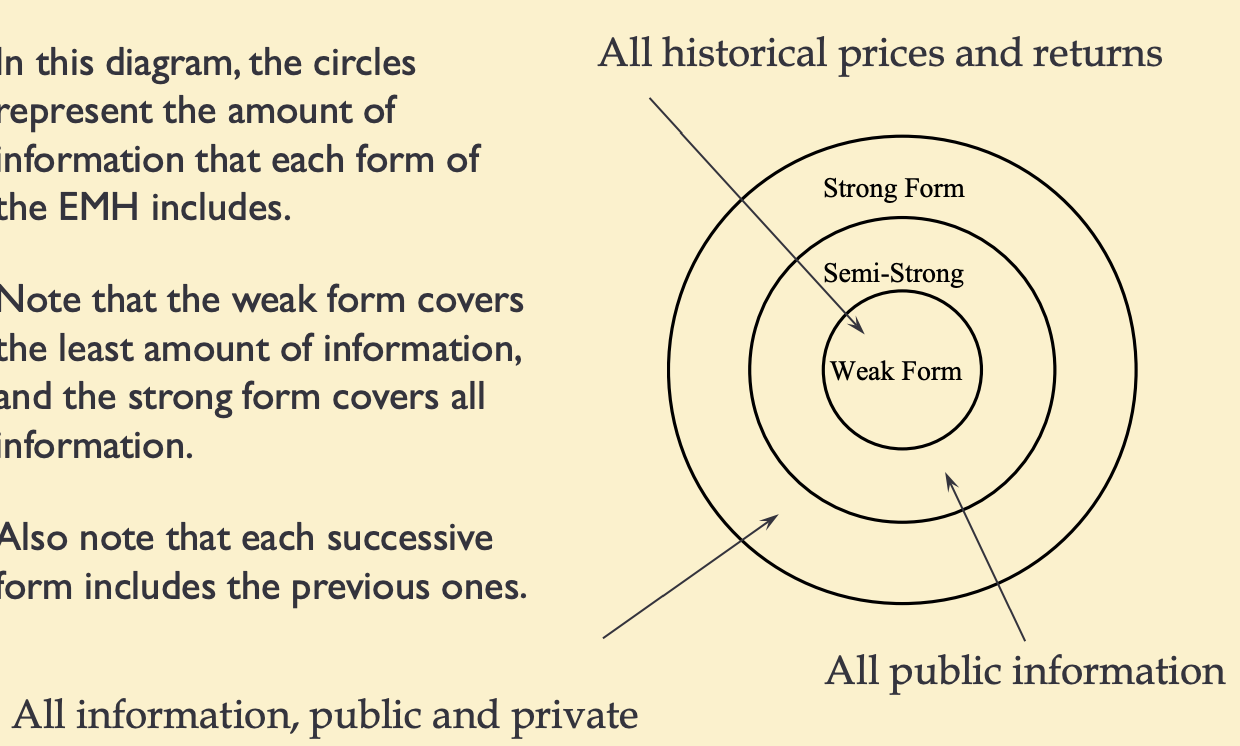
What do the circles in the EMH diagram represent?
the amount of information that each form of the EMH includes
What covers the least and most information in the EMH diagram?
Least - Weak
Most - Strong
Does each successive form of EMH include the previous one?
Yes
What is the EMH diagram?
What does the weak form suggest?
Current stock prices already include all information from past price movements
so analysing historical price data cannot reliably predict future prices.
What past information are we looking at for weak form?
prices of stocks
volume of trading
patterns, trends, graphs etc
What is the random walk hypothesis?
Suggests the stock price movements do not follow any pattern or trend
How are the Weak Form Efficient Market Hypothesis (EMH) and the Random Walk Hypothesis (RWH) related?
The weak-form EMH is broader than the RWH. If the RWH holds, it strongly suggests that weak-form EMH also holds. However, if weak-form EMH holds, then the RWH must necessarily hold.
How do we test for the weak form?
Technical analysis
What is technical analysis?
A process that uses analysis of past price behaviour and volumes traded —> To predict future price change in financial markets
What do chartists believe in technical analysis?
Patterns repeat themselves over time, helps predict future security prices
What happen if weak form of efficient market hypothesis is valid?
Technical analysis becomes ineffective
What does the semi-strong form state?
that security prices instantly and fully reflect all past and publicly available information.
What does the semi-strong form imply is useless?
to analyse publicly available information as it is rapidly incorporated into security prices
What information are we looking at for semi-strong form?
past price movements and trading volume
company fundamentals, example sales, earnings
company events, example stock splits, dividends, right issues, director resignations and deaths, mergers
macroeconomic information such as inflation, interest and exchange rates, unemployment, GDP
What are fundamental analysts?
Investment analysts who try to estimate or predict a security’s future value based on a company’s fundamental information
What sources of information do fundamental analysts rely on?
past price and volume information (technical analysis)
company fundamentals - earnings, sales
macroeconomic fundamentals - employments, inflation
What happens if semi-strong form of EMH is valid?
Then fundamental analysis becomes ineffective
How is semi-strong hypothesis been tested?
Mainly tested through event studies
What behaviours are examined when testing the semi-strong hypothesis?
annual earnings
dividend increases or decreases
mergers
stock splits
Etc
What does the strong form hypothesis state? and what does it imply?
the security prices instantly and fully reflect all available (past, public, and private) information
Implies few privileged company insiders who normally have more information about the firm, cannot trade and make profit on their private information
How has the strong form hypothesis been tested?
By studies based on observing market participations who might reasonably be expected to have access to private information.
if participants can consistently earn excess returns, then there would be prima facie evidence against the strong form of the EMH.
How is the strong form tested?
managed funds
company insiders
financial analysts
How do managed funds test the strong funds?
Managed funds use advanced techniques to try to earn excess returns
If they fail to consistently earn excess returns, it supports the strong form of EMH
Any excess returns that are found are often reduced or eliminated by fees
How do company insiders test the strong funds?
Studies the impact of share purchases by company insiders (directors/managers)
Insider trading must be publicly reported by law
Helps understand if insiders’ actions signal future company performance
How do financial analysts test the strong funds?
Analysts often have more access to company information
Their forecasts and recommendations aren’t always public
Some investors might earn excess profits by using these recommendations
What are market anomalies and how do they undermine the validity of the EMH?
january effect - higher returns
monday effect - increase/decrease in share price
turn of the month effect - temporary increase in stock prices
holiday effect - stock market gains
How is the price of a share determined?
By traders in the secondary market, and how volatile that price can be
What is the equation for the book value of equity?

Does the book value equal equal the stock price?
No, investors in the stock market do not buy and sell at the book value per share,
What is the liquidation value?
The amount of cash per share a company could raise if it sold off all its assets in secondhand markets and paid off all its debts.
Does the share price equal the liquidation value?
No, share price > liquidation value (for a successful company)
What is the ‘going concern’ value?
The difference between a company’s actual value, and its liquidation value
What 3 factirs is the ‘going concern’ value made up of?
extra earning power
intangible assets
value of future investments
What is the market value?
The amount that investors are willing to pay for the shares of the firm and it depends on the earning power of today’s assets and the expected profitability of future investments.
When should you buy or sell a share?
Current market price > intrinsic value = overpriced, SOLD
Current market price < intrinsic value = underpriced, BOUGHT
What is the intrinsic value?
The present value of all future amounts to be received in respect to ownership of that share, computed at an appropriate discount rate.
What are the major receipts?
the annual dividends and the sale proceeds of the share at the end of the holding period.
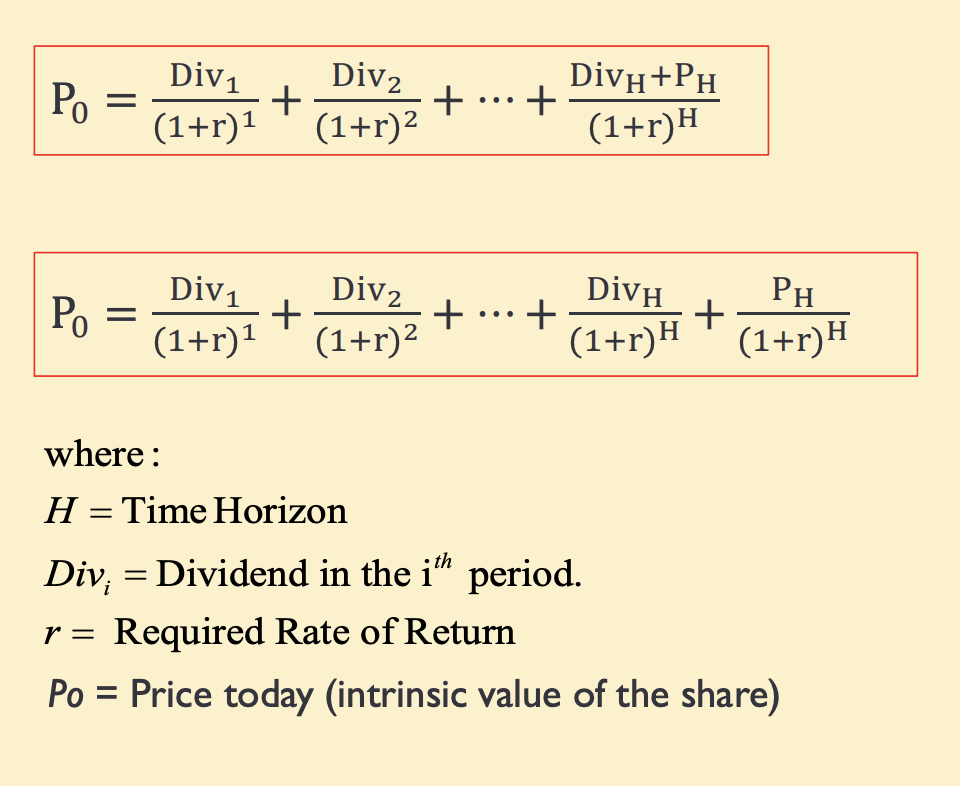
What does the Dividend Discount Model (DDM) state?
stock’s value equals the present value of all future dividends plus the present value of the expected stock price when the investor plans to sell.
What is the equation for DDM? (multi-period)
What is the equation for DDM? (one period)
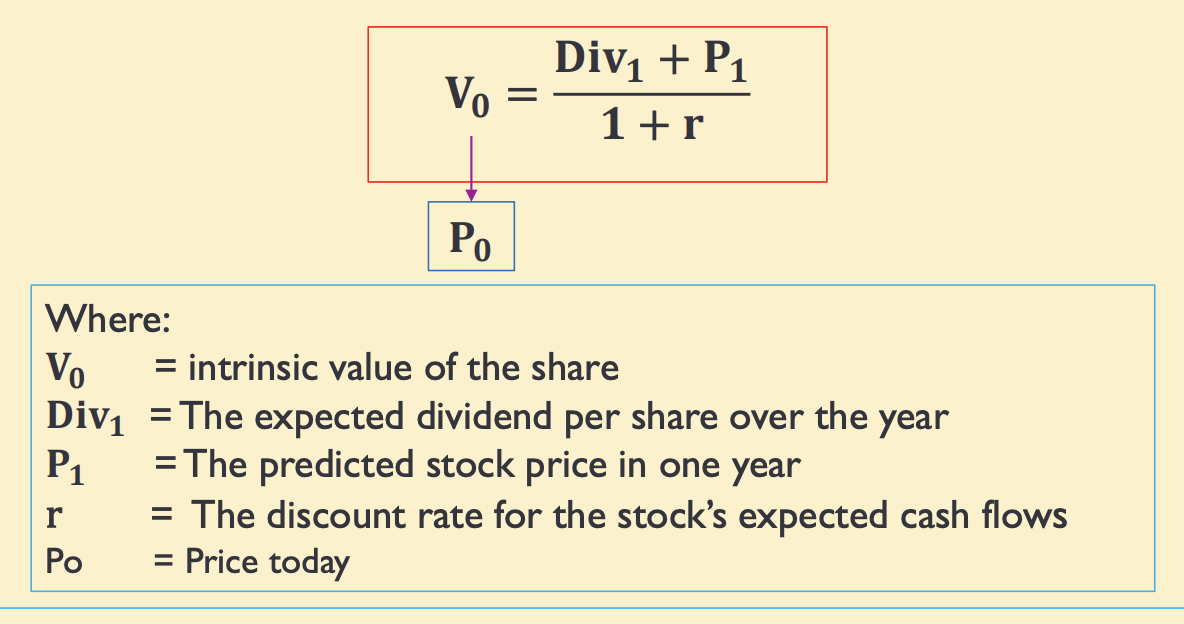
What will today’s price equal? (DDM)
the present value of dividend payments plus the present value of future price
According to the Dividend Discount Model (DDM), do investors with different time horizons value a stock differently?
No.
investors with different time horizons should reach the same valuation because the stock’s price reflects the present value of all future dividends.
What is the equation for constant dividend growth?
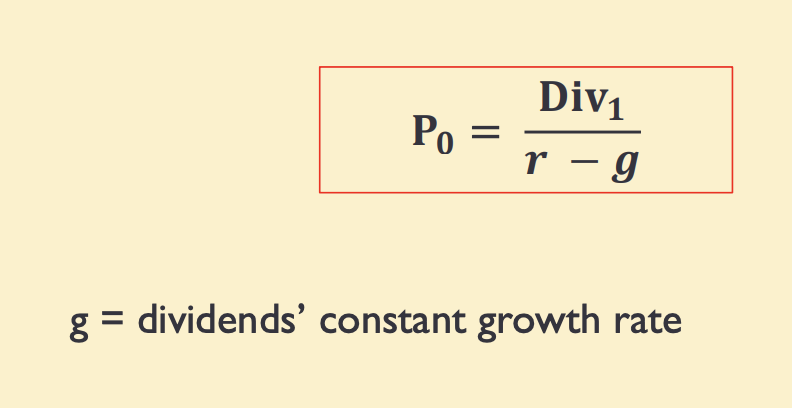
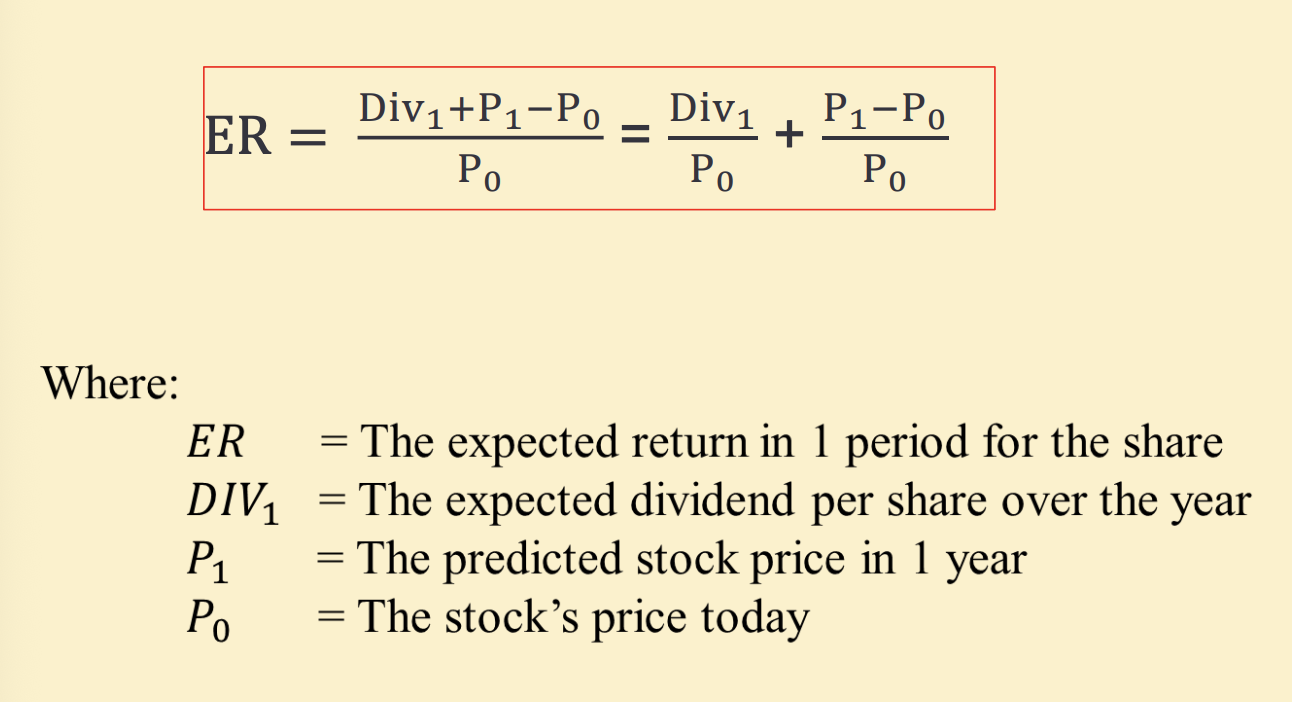
What is the equation for expected return?