Module 4: Severe Weather
 Call Kai
 Learn
Learn Practice Test
 Spaced Repetition
 Match
Match Flashcards
 Knowt Play
1/49

There's no tags or description
Looks like no tags are added yet.
Name | Mastery | Learn | Test | Matching | Spaced | Call with Kai |
|---|
No analytics yet
Send a link to your students to track their progress
50 Terms
Troposphere
90% of air molecules
Stratosphere
location of ozone layer
Thermosphere
Right above the mesosphere and in direct contact with high-energy radiation
Daily net radiation
balance between incoming shortwave and outgoing longwave radiation
Pressure gradient
generates wind from high to low pressure regions
Coriolis Force
arises due to Earth’s rotation
surface wind
_________ _________ is affected by pressure gradient, Coriolis force, and friction
Latent heat
heat associated with some changing phase
absorbed energy when going from solid to liquid or liquid to gas
releases energy when going from gas to liquid (condensation)
Air masses
Large volume of air that has roughly similar temperature and humidity
Front
transition zone between two different air masses (cold to warm or warm to cold)
More dense thing under less dense thing so warm air rises and cold air goes underneath
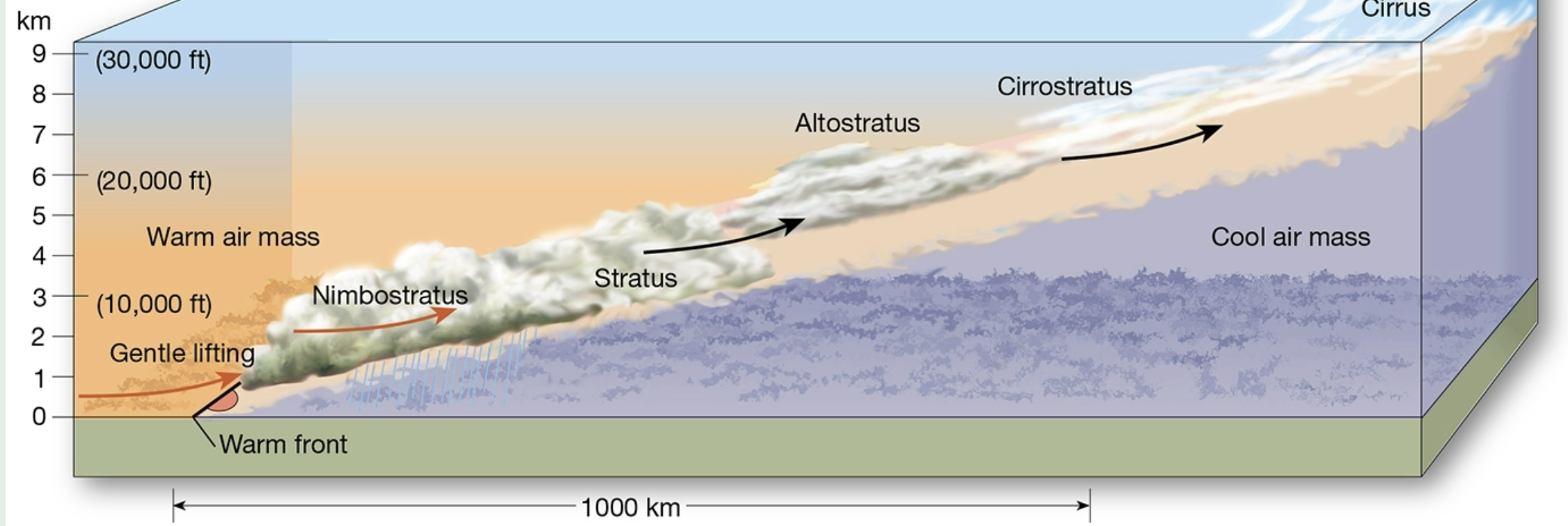
Warm front
temperatures rise when warm front passes
as air in a warm front over cooler air, it cools
forms a gentle slope and a large area of atmospheric lifting
Wide zone of clouds, precipitation before the warm front arises
Cold front
brings in colder air when it passes; often associated with violent weather
displaces the warm air upwards
warm air rises more quickly than at a warm front
the speed of the cold front advance is also much faster
Pressure
________ is higher at the Earth’s surface and decreases with altitude
nitrogen and oxygen
Constant gases in atmosphere mostly ________ and _________ with the first one being more
wind & water
Energy transport occurs via atmospheric _______ and _________ (ocean currents)
gravity, pressure gradient force, coriolis force, and friction
What creates and influences wind?
Pressure gradient force
generated by differences in pressure at same elevation
Friction
surface winds only
Isobar
each line represents a different pressure
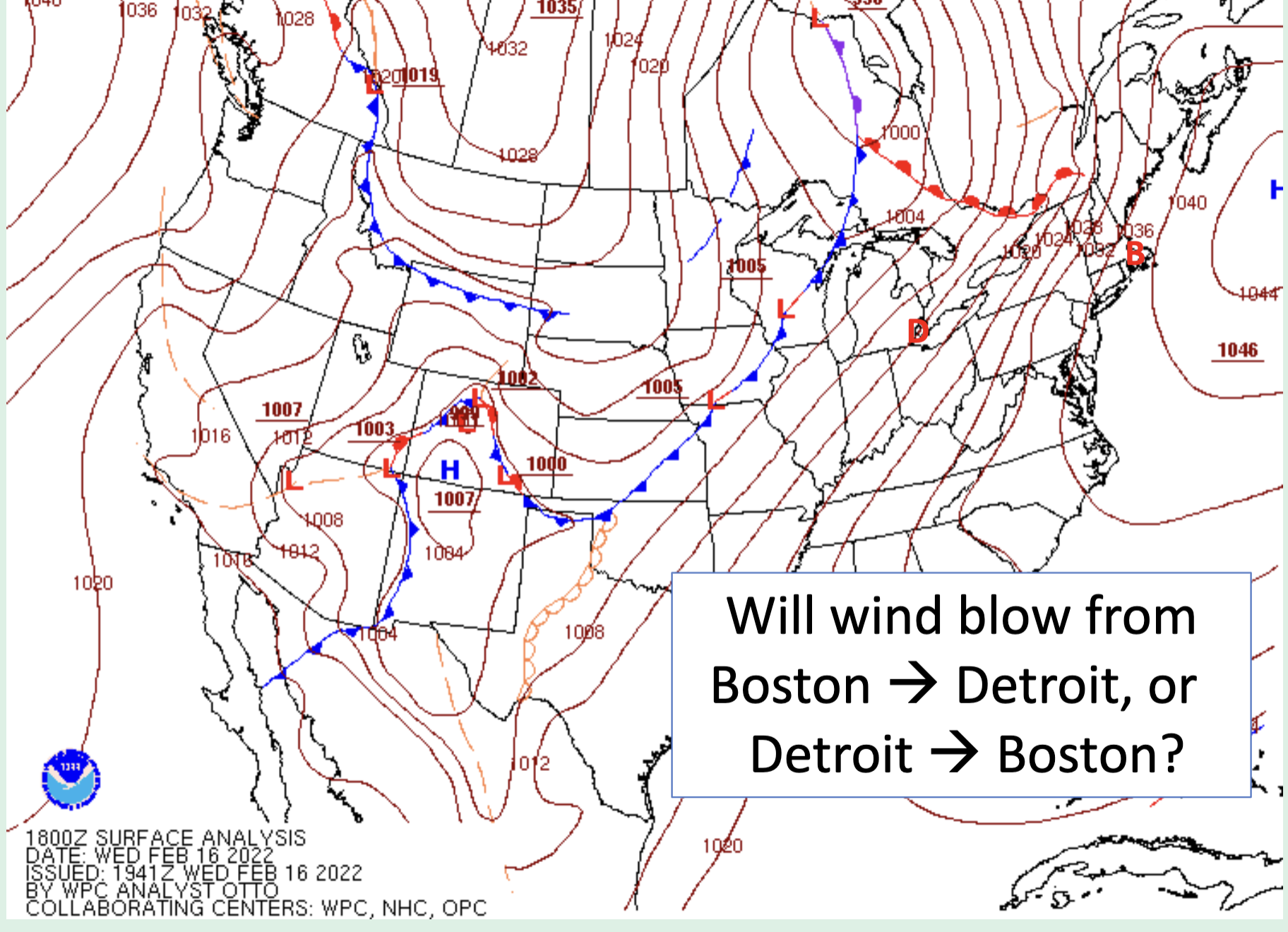
high to low
Wind is created when air moves from ________ to ___________ pressure
North hemisphere
wind deflects right
South hemisphere
wind deflects left
warm; low
______ air rises at areas like the equator and creates _____ pressure region at the surface
cold; high
_______ air sinks at mid-latitudes and at the poles, creating _____ pressure region at the surface
Clouds
______ form due to water vapor in the atmosphere
Water
_______ absorbs or releases heat as it changes phases
Latent
________ heat is heat associated with changing phase
absorbed
Latent heat is _______ when ice melts and becomes liquid water or when liquid water becomes water vapor
absorb
Transitions that _________ heat is when water is in a high-energy phaes
Latent heat is _________ to the environment when vapor becomes liquid water through condensation or liquid water becomes ice
release
Transitions that _____ heat when water is at a low energy phase
Humidity
water vapor in the atmosphere
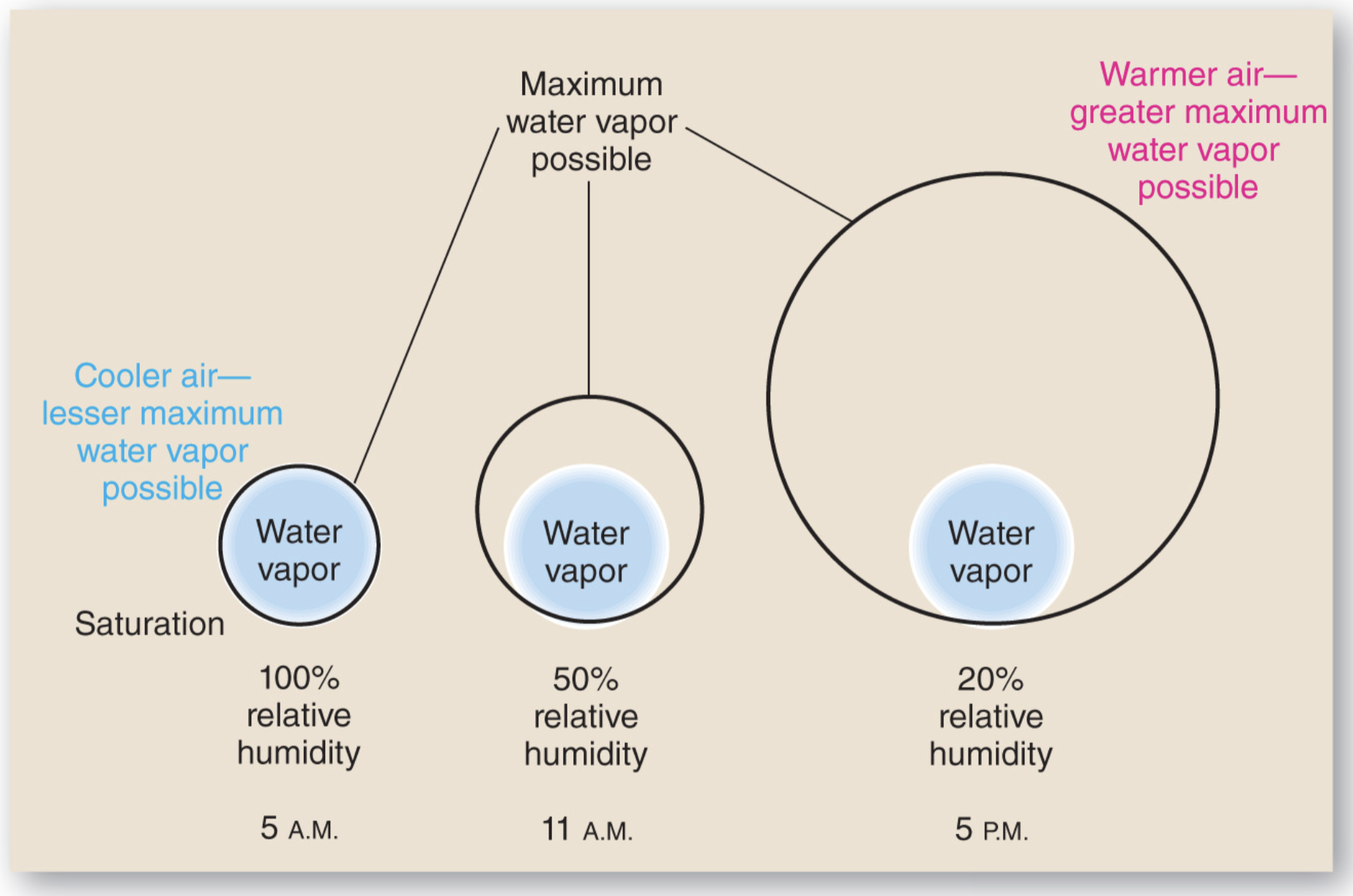
warmer
______ air can hold more water vapor
Relative humidity
how much vapor is in the air compared to the amount of vapor possible at that temperature
down; warms
Relative humidity goes __________ as air _________
Cloud condensation nuclei
tiny particles on which water can condense
Clouds
mixtures of water droplets and crystals
SW
Winds from ______ bring warmth
NW
Winds from ________ brings cold
air masses
Day to day weather patterns depend on the movement of large bodies of air called ____ _________
Air mass
huge volume of air with similar temperature and humidity
air masses
Movement of _____ _________ causes changes in temperature and humidity
Mid-latitude cyclones
migrating low pressure weather system
air spirals inward in N. Hemisphere
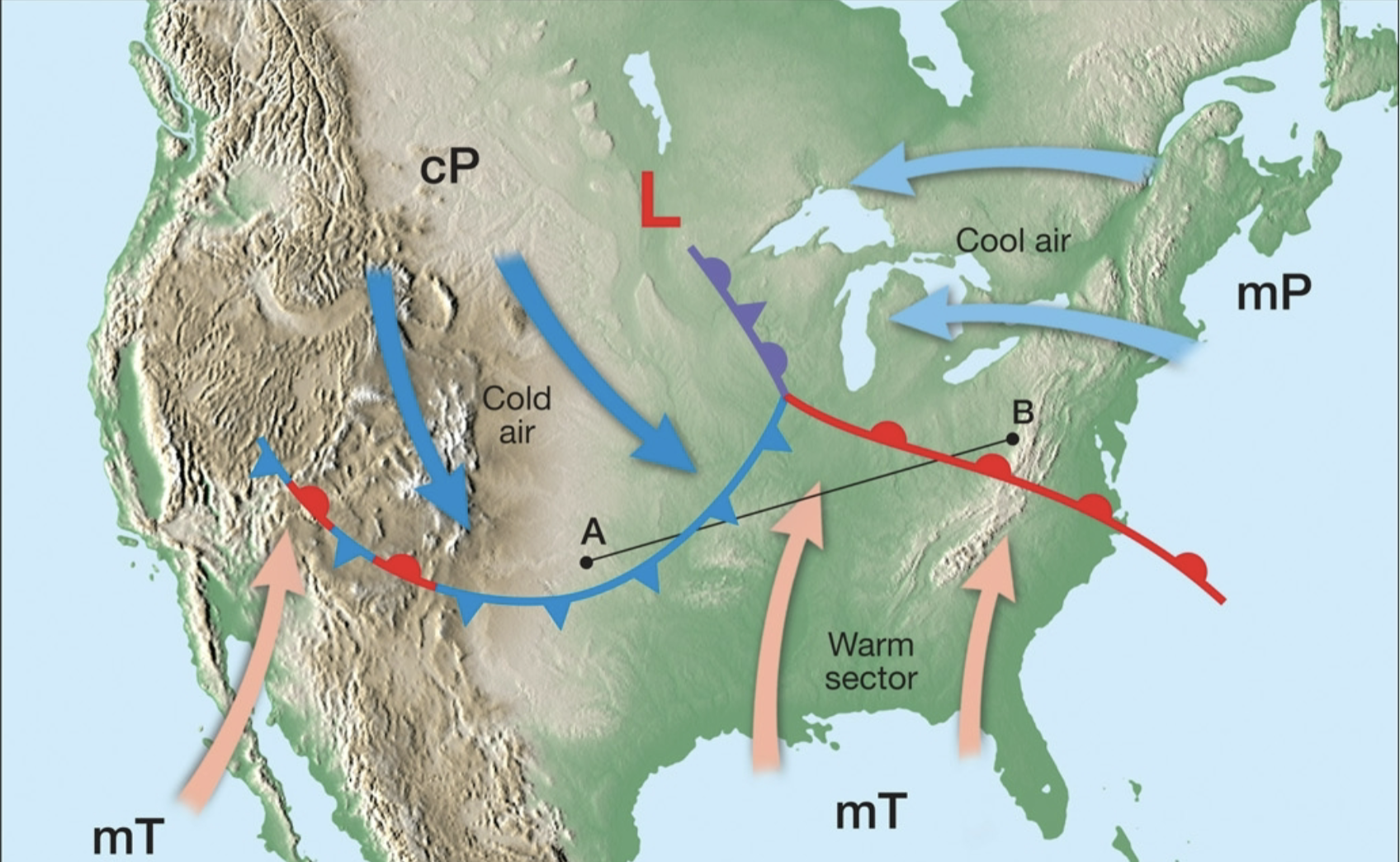
cyclogenesis, open stage, occluded stage, dissolution
4 stages of a midlatitude cyclone
cyclogenesis
first stage of formation of midlatitude cyclone
Midlatitude cyclones (storms) develop at boundary between warm and cold air masses
Stationary front develops at boundary between air masses
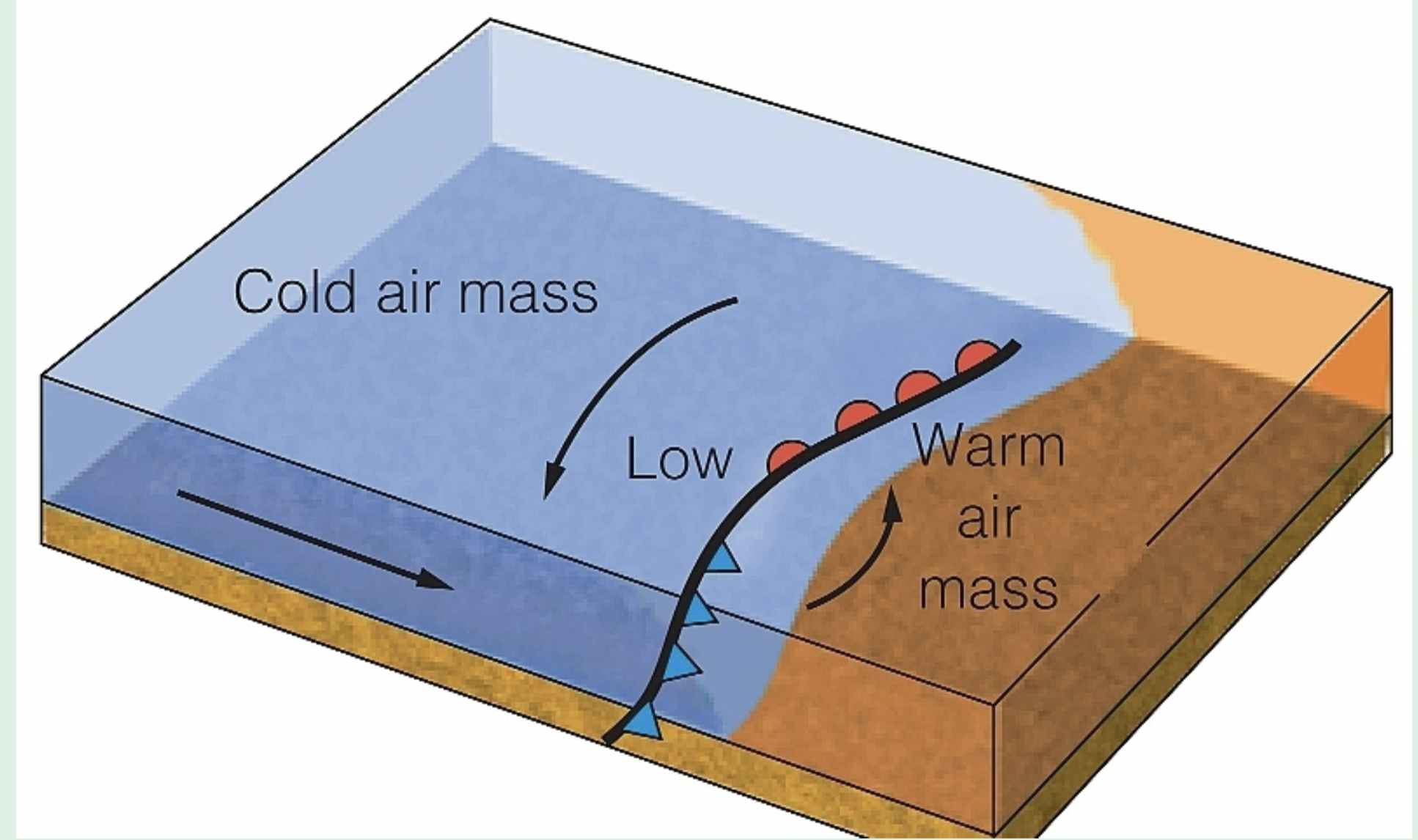
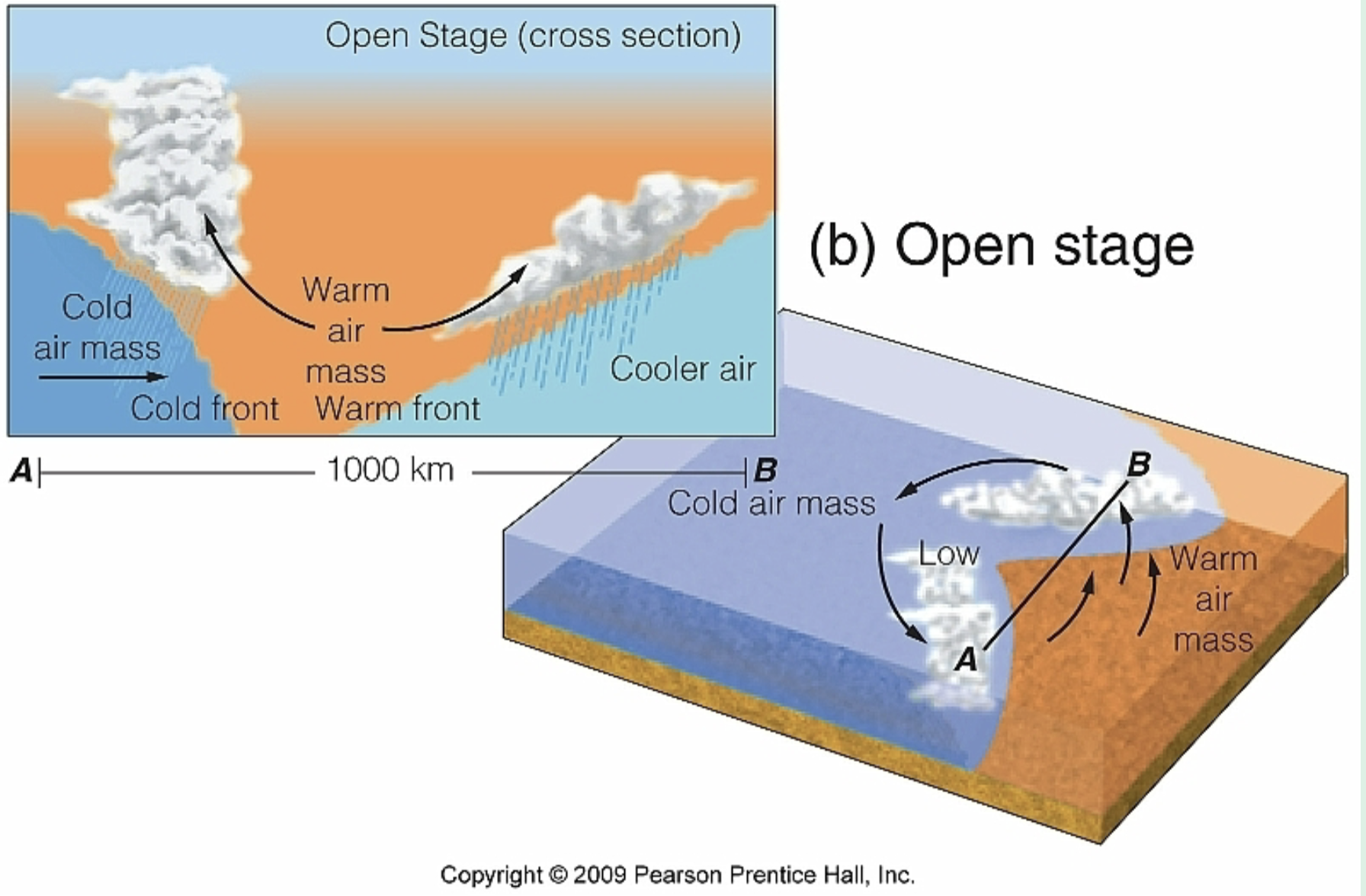
open stage
second stage of formation of midlatitude cyclone
• Cold air moves south (along cold front)
• Warm air moves north (along warm front)
• Gives counterclockwise winds around low pressure
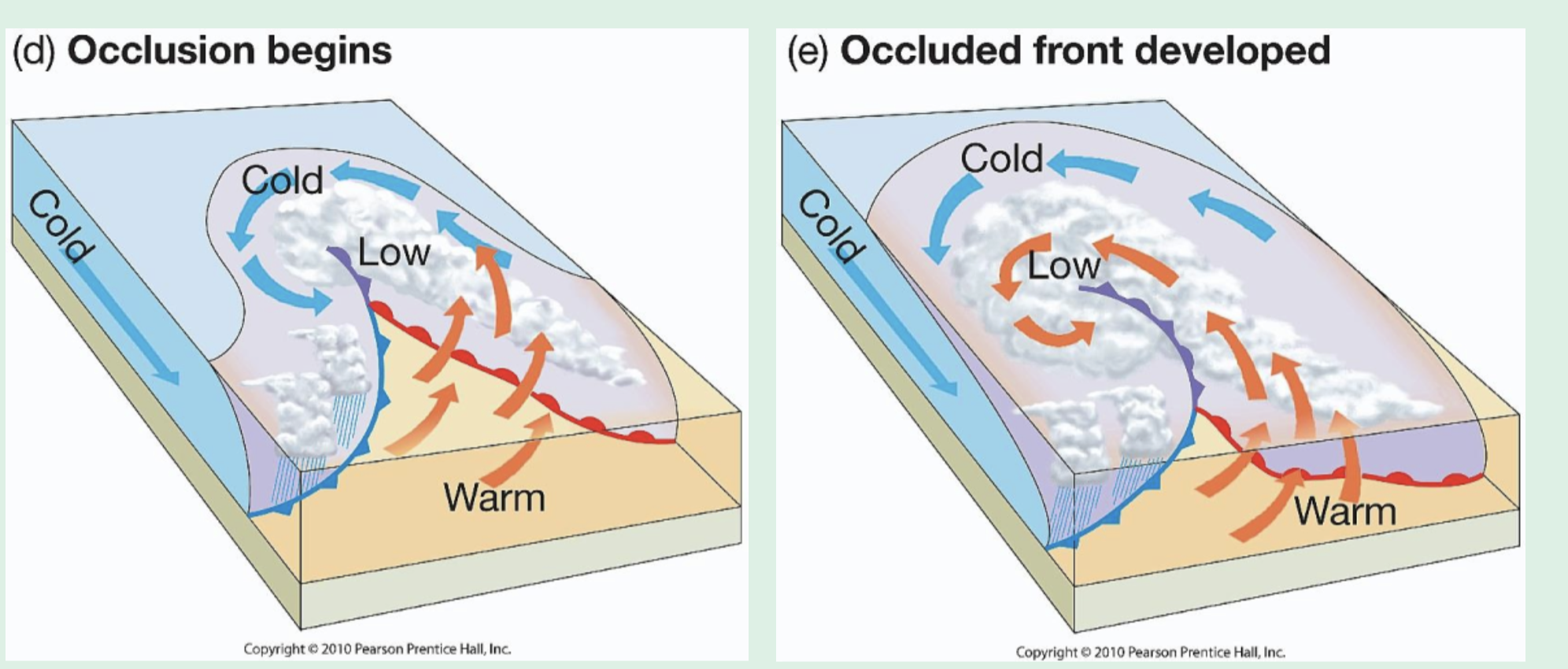
occluded stage
third stage of formation of midlatitude cyclone
• Cold fronts move faster than warm fronts
• Eventually, it catches up with warm front
• Creates an occluded front
• Intense precipitation can be generated as all warm, humid air is lifted upwards
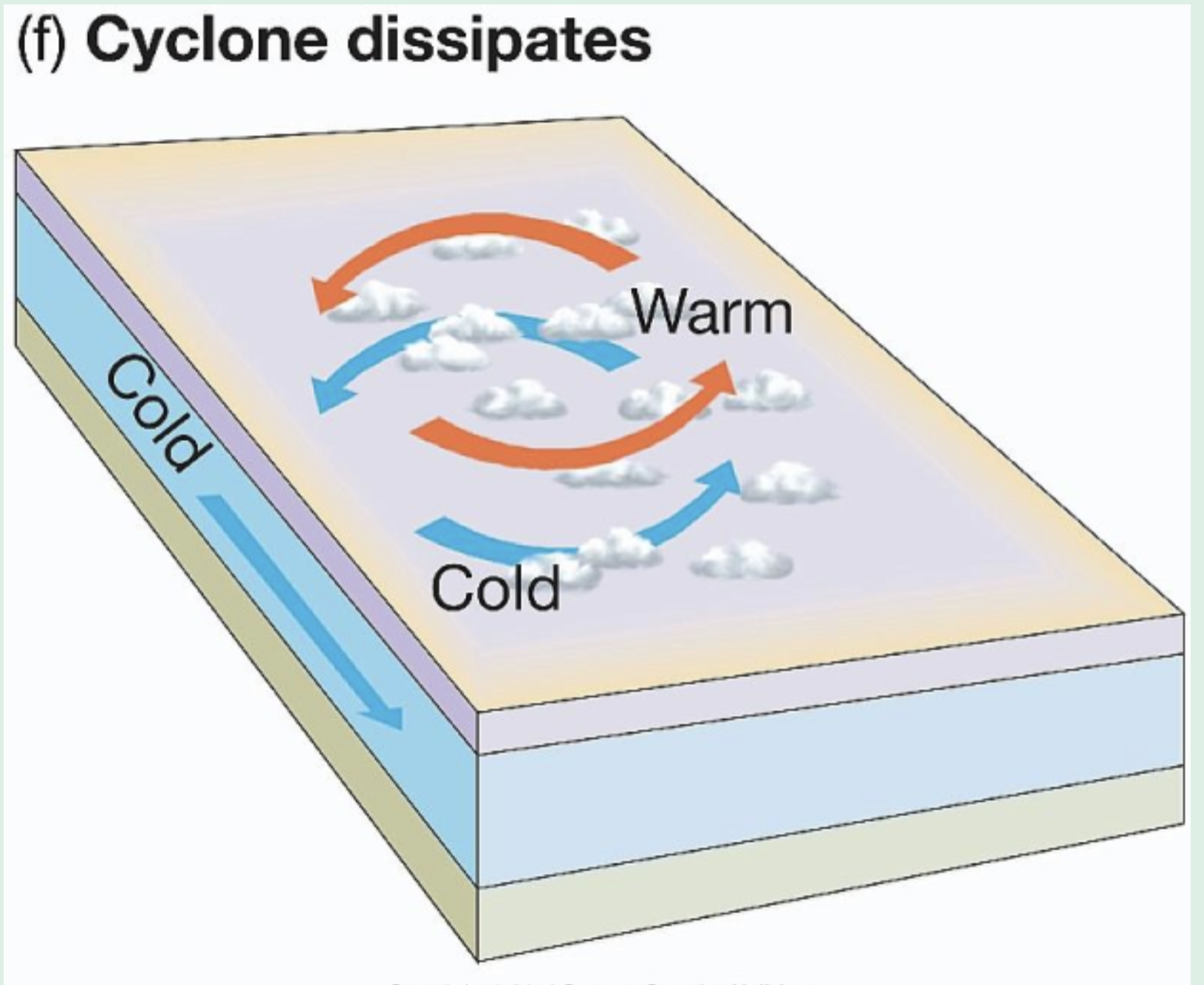
dissolution
final stage of formation of midlatitude cyclone
dissipation
no warm air remains at the surface
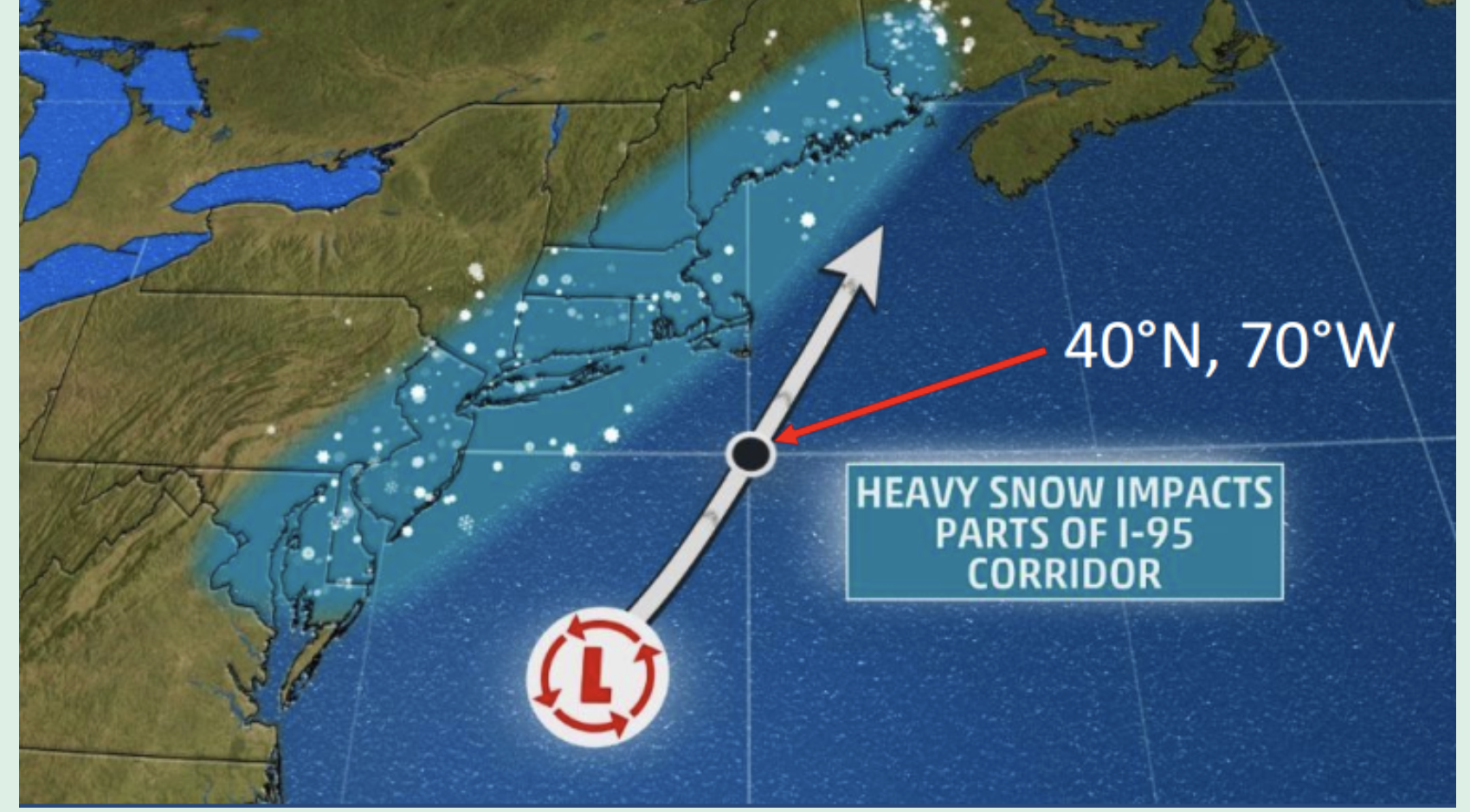
nor’easters
For ___________, to remain snowy in MA, storms needs to stay south and east of coastline