APBI 419 - Anatomy + Physiology
 Call Kai
 Learn
Learn Practice Test
 Spaced Repetition
 Match
Match Flashcards
 Knowt Play
1/25

There's no tags or description
Looks like no tags are added yet.
Name | Mastery | Learn | Test | Matching | Spaced | Call with Kai |
|---|
No analytics yet
Send a link to your students to track their progress
26 Terms
Fins
anatomical features on body of fish and provide stability in the water
supported by skeleton of fish
are either paired or unpaired
paired = pectoral + pelvis
unpaired = dorsal, caudal, adipose, anal
rays on either can be soft + flexible or modified into spines to strengthen fins
Dorsal fin
mainsail along back of fish between tail fin and head; provides stability so fish can swim in straight line
can't swim --> won't live long --> can't compete for food or evade predators
some tropical fish have a doubled dorsal fin; part of it is a spine that resembles a straight razor and can inflict puncture wounds while second part is a stabilizer
used to intimidate + threaten
can also use an erect and locked fin as a wedge to jam into tight areas of coral so predator can't pull it out
Caudal fins
tail fin; sudden forward movements and for fast swimming patterns
also used to slow forward movement and to help make turns
can lengthen the fin through artificial selection → produced slower moving fish for aquariums → wouldn't survive long in wild
Anal fin
on the underside of fish between pelvic and caudal fins; provides stability, keeps fish from rolling over and going belly up
in some species, male's anal fin acts as sexual organ and is known as gonopodium
some characins develop breeding tubercles / small hooks that're on the fins of males and not specifically for attaching to mates
Pectoral fins
stability as fish moves through water, hovers, and makes slow turns; near bottom of fish beneath gill openings
used for navigation and always in motion
many tropical species use them during incubation of eggs, fanning eggs w/ water during brooding period
Pelvic fins
homologous to legs and are supported by pelvic girdle; stabilizers
might be highly modified like in freshwater angelfishes and gouramis so they're threadlike
some might use them as "feelers" to sense surroundings
Adipose fin
few tropical fish species and most of aquaculture-reared fish (salmonids) have extra fin located on back between dorsal and tail
these contain mechanosensory and proprioceptive functions
helps detect water flow and might help with swimming performance
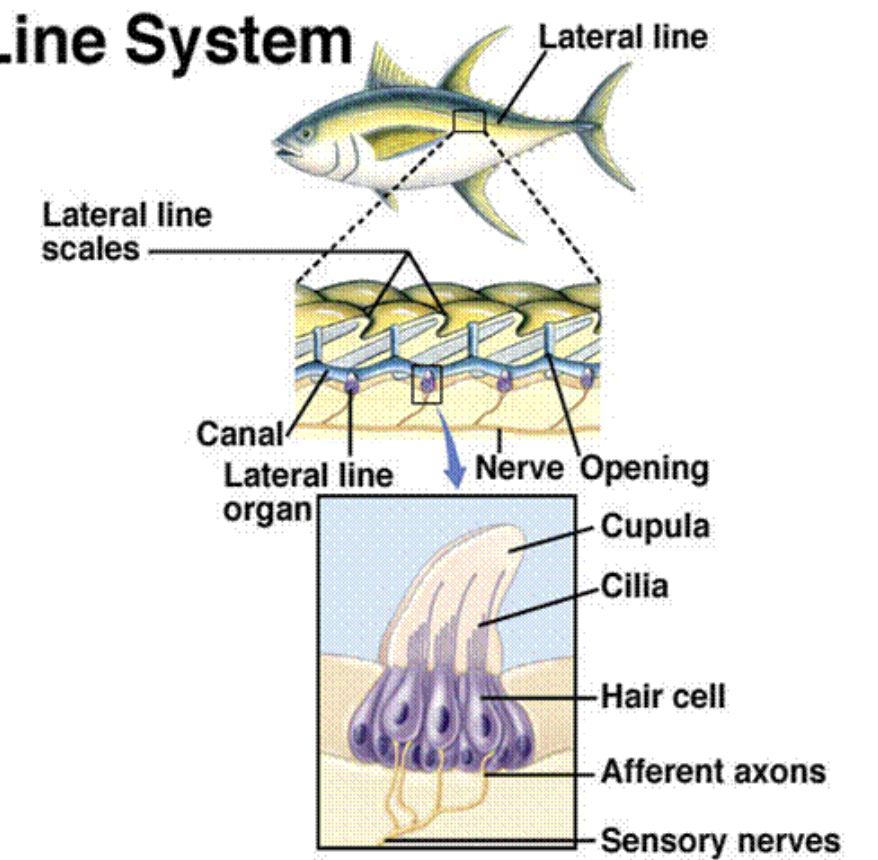
Lateral line
on both sides of body and runs from back of eye to base of tail fin
made of small neuromasts that contain cilia in fluid-filled canals + superficial (surface-level) neuromasts
detects vibrations in water (low freq pressure waves)
fish feel → forms mental map for them; like hydrodynamic map / mechanosensory field
Skin
first barrier to environment; maintains osmotic integrity of fish
freshwater: osmotic challenge is water flooding IN (hypoosmotic environment) so fish has to expel excess water and retain ions
marine: vice versa, they lose water to the hyperosmotic environment
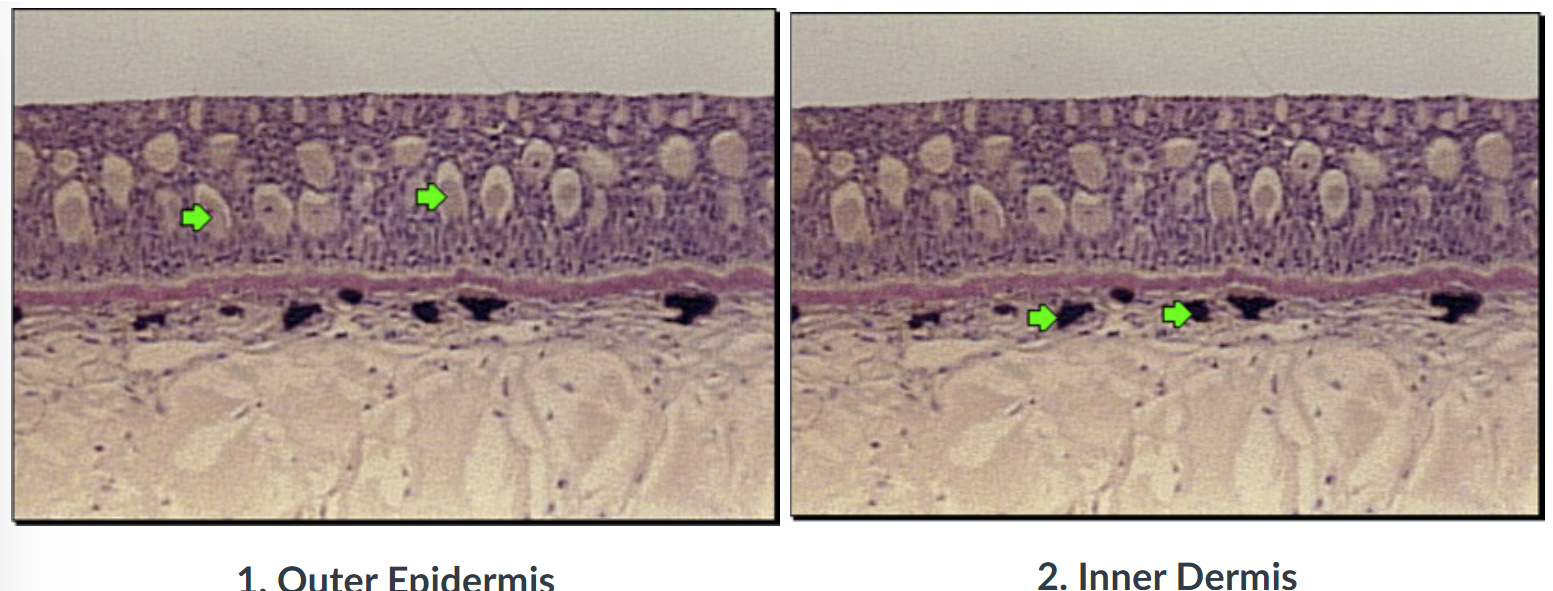
2 main layers:
outer epidermis overlaid by v delicate clear covering of secreted material that lays over the scales (the mucus layer)
inner dermis
Mucus
protective and forms slimy outer covering of fish
can get small particles of material that can irritate fish (parasites, bacteria, heavy metal salts that're sloughed off)
increases when fish becomes stressed
Dermal skeleton
various types of scales / plates that develop early in life (fry stage)
salmonids: cycloid scales
once fish has all scales no more develop as it grows
scales will grow and become larger w/ the fish
not all fish have scales (catfish + eels)
Gills
vascularized structures (blood moving systems) contained in chambers located on both sides of head region
water is continually passed over
imp site for excretion of nitrogenous wastes
Operculum
bony flap; gill cover that protects gill structures
4 cartilaginous branchial arches in each chamber that have forward facing cartilaginous projections called gill rakers
vary in morphology
long and thin, short and knobby
species and diet dependent
Gill rakers
help filter feeding fish trap food particles from the water and help piscivorous species prevent escape of prey through gill slits
tend to vary in #, length, spacing based on diet
gill arches support gill filaments that're directed away from mouth opening
Lamellae
Gill filaments further subdivided into feather like structure
these contain fine, flattened capillaries and are thinly covered by cells
primary lamellae = actual gill filaments
secondary lamellae = extend perpendicular from/are arranged on primary lamellae
essential in respiration / breathing of fish and are location where gas exchange occurs
Branchial pump
how water is passed through gills
water drawn into mouth as opercula closes → expelled across gills 60-80% (peak efficiency = 85%) O2 extracted by secondary lamellae
oxygen depleted water discarded
Pseudobranch
inner side of gill cover on salmonids
receives oxygenated blood only; doesn't function in respiratory gas exchange
might secrete O2 to retina of eye but still confusion as to exact function
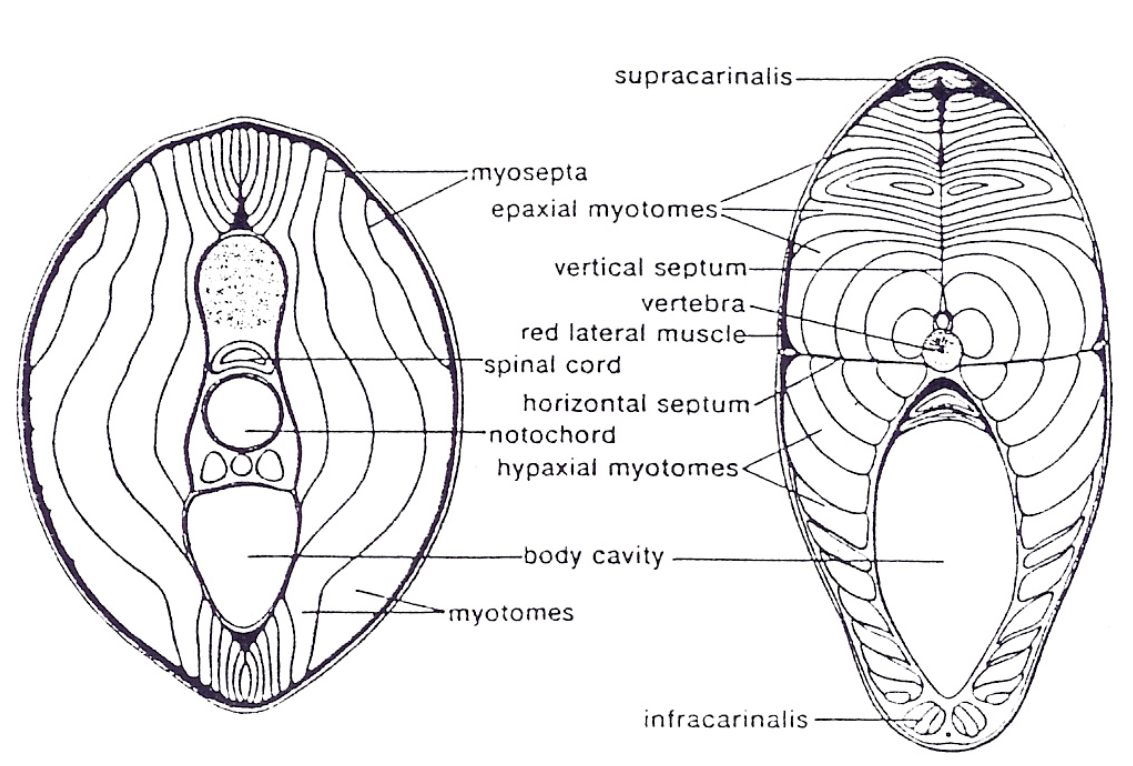
Striated/skeletal muscle
major portion of fish muscle
white muscles - fast-twitch, anaerobic muscle for burst swimming (bulk of myotomes)
red muscle - slow-twitch aerobic muscle tissue for sustained swimming; typically found as thin lateral strip along body often near lateral line
arranged in symmetrical fashion down each side of body in series of similar segments (myotomes) that're attached to flexible spine
segments prominent at surface of skinned or sectioned fish
divided by lateral line into upper and lower sections in salmonids
Axillary muscles
muscles at base of pectoral fins
Digestive system
degrades large particles of food into smaller components that're able to absorb across intestinal wall and into circulatory system for transport to cells of body
cells utilize nutrients brought by blood as building blocks for number of functions (maintenance of existing tissues, growth of new tissue, source of energy for locomotion and metabolic processes, components of body fluids, production of enzymes and hormones)
modified according to feeding habits and food material they consume aka ecologically diverse habitats
carnivorous fishes: short gut + herbivorous fishes have long digestive tracts
Pylorus
constriction of digestive trat that acts as boundary between stomach and intestine
one way valve preventing passage of large food particles
Pyloric caeca
finger like structures extending from intestine; vary in size and number depending on species
have digestive and absorptive functions and usually surrounded by adipose tissue
Pancreas
makes digestive enzymes and is found between pyloric caeca in salmon
is diffuse in salmonids (scattered among pyloric caeca and mesentery)
involved in many viral infections: IPN, IHN, VHS
also site for other bacteremias and some parasites
contained in pyloric caeca structure scattered throughout fatty tissue
it secretes digestive enzymes through pancreatic duct into intestine and secretes hormones into bloodstream
v significant in viral disease because it's a common site for multiplication of several viral agents associated w/ fish disease
Liver
large organ located in front of stomach
pinkish-brown in colour, soft, and easily ruptured
acts as accessory digestive organ
involved in detoxifying the system
secretes bile through duct into gall bladder (small greenish sac)which temporarily stores bile
has secondary duct leading from gall bladder and discharges bile into anterior intestine past pylorus → breakdown of fat
abnormalities: buildup of unhealthy fats → increase in liver size + parasite invasion
pale, enlarged, whitish nodules → health problem
Swim bladder
organ responsible for maintaining hydrostatic (pressure) equil within environment
depending on hydrostatic pressure at any depth in water column, gas bladder fills / secretes gas to maintain fish at desired depth w/ minimum expenditure of energy

