CHEM 103 Exam 2 Ultimate Combined
 Call Kai
 Learn
Learn Practice Test
 Spaced Repetition
 Match
Match Flashcards
 Knowt Play
1/153

There's no tags or description
Looks like no tags are added yet.
Name | Mastery | Learn | Test | Matching | Spaced | Call with Kai |
|---|
No analytics yet
Send a link to your students to track their progress
154 Terms
Valence Electrons
Electrons in the highest occupied energy level (n level). S & P sublevels. Up to 8. Group number = number of valence lectrons.
Lewis Dot Symbols
Represent valence electrons as dots around atomic symbol. (1-4 valence electrons = single dots; 5-8. valence electrons = pairs of dots).
The Octet Rule
An atom is stabilized by having its valence energy level filled.
Noble gases fulfill the octet rule. Other atoms fulfill the octet rule by: Gaining/losing electrons (Ionic compounds) or Sharing electrons (Covalent compounds).
How do atoms other than noble gases fulfill the octet rule?
By Gaining/losing electrons (Ionic compounds) or Sharing electrons (Covalent compounds).
Ions
Atoms or groups of atoms that have an overall charge. Charges are superscript.
Ag Ion Charge
1+.
Zn Ion Charge
2+.
Cd Ion Charge
2+.
Cations
Positively charged ions. Main group metals fulfill the octet rule by forming Cations. (Losing electrons).
Naming Cations
Metal cations have the same name as the neutral metal (i.e. Na+ = Sodium).
Metals with variable charges: Use Roman numerals to indicate the charge (i.e. Fe²⁺ = iron (II)).
Name the following cations:
Ag+, Pb2+, Pb4+
Silver, Lead(II), Lead(IV).
Anions
Negatively charged ions. Most nonmetals fulfill the octet rule by gaining electrons.1
Naming Anions
Change ending to -ide. (i.e. Cl- = Chloride).
Polyatomic Ions
Groups of atoms with a charge.
Oxyanions
Contain oxygen (and another element). (i.e. CO3²⁻, or PO4³⁻).
Ionic Charge Trends
Group 1A: 1+.
Group 2A: 2+.
Group 3A: 3+ (only for Al).
Ag+, Cd2+, Zn2+.
Group 5A: 3-.
Group 6A: 2-.
Group 7A: 1-.
Ionic Bond
Attraction between oppositely charged ions. (Metals, Polyatomics)
Ionic Compound
- Oppositely charged ions (Between Metals & Nonmetals, or including Polyatomics ions).
- Do NOT form molecules.
- Formula unit or empirical unit.
- May use roman numeral.
Ionic Bond vs. Ionic Compound
Ionic Bond: Attraction between oppositely charged ions.
Ionic Compound: Opposite ions forming a compound, consists of a + & - charge.
Ionic Bond Compound Notation Rules
- Cation listed first, then Anion listed second.
- Subscripts tell how many of each atom.
- Subscripts are placed after the atom they are used for.
- Parenthesis are used when there are multiple of the SAME polyatomic ion.
- Ionic bonds occur between oppositely charged ions.
- In ionic compounds, total charge = 0.
Ionic Lattice
An array of positive & negative ions.
Chemical Formulas
Show the type and amount of each element present.
Empirical Formula
The smallest whole-number ratio of atoms (always used for ionic compounds).
Formula Unit
The smallest number of ions necessary to form a compound.
Empirical Formula vs. Formula Unit
Empirical Formula: The smallest whole-number ratio of atoms (always used for ionic compounds).
Formula Unit: The smallest number of ions necessary to form a compound.
Write the formula for a compound composed of potassium and sulfide ions
K2S
Write the formula for a compound composed of Mn4+ and O^2-
MnO2
Write a formula for a compound composed of calcium and carbonate ions
CaCO3
Write the formula for a compound composed of aluminum and sulfate ions
Al2(SO4)3
Write the formula for ammonium sulfide
(NH4)2S
Name the compound Fe(NO2)2
Iron (II) Nitrite
Covalent Bond
Valence electrons shared between 2 atoms. Fulfill the octet rule by sharing electrons.
The 7 Elements that Form Diatomic Molecules
H2, N2, F2, O2, I2, Cl2, Br2. (Have No Fear Of Ice Cold Beer).
Have No Fear Of Ice Cold Beer
H2, N2, F2, O2, I2, Cl2, Br2 (How to remember the 7 elements that form diatomic molecules).
Double Covalent Bond
Shares 2 pairs of electrons.
Triple Covalent Bond
Shared 3 pairs of electrons.
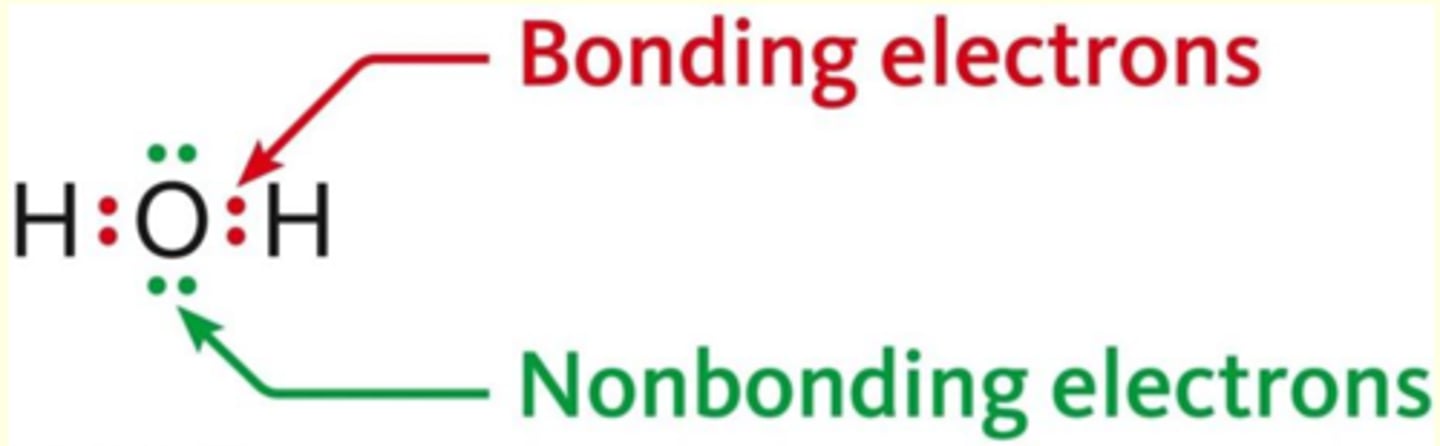
Bonding Electrons vs. Nonbonding Electrons
Bonding Electrons: Electrons in bonds, usually signified by N-N, N=N, etc.
Nonbonding Electrons (lone pairs): Unshared electrons that are not in bonds, usually signified as the dots (i.e. :H=H:).
Naming Binary Covalent Compounds: Prefixes (1-10)
1: Mono- (omit for first element).
2: Di-
3: Tri-
4: Tetra-
5: Penta-
6: Hexa-
7: Hepta-
8: Octa-
9: Nona-
10: Deca-
Name these compounds: PCl3 & PCl5
Phosphorus Trichloride & Phosphorus Pentachloride.
Nitrogen and oxygen form 2 covalent compounds, NO2 and N2O4. Name each of these compounds.
Nitrogen Dioxide and Dinitrogen Tetroxide.
Do you simplify Ionic Compound and/or Covalent Compound formulas?
You simplify Ionic Compounds to their empirical formula, but you do NOT simplify Covalent Compound formula.
Ionic Compounds vs. Covalent Compounds
Ionic Compounds: Oppositely charged ions (Between Metals & Nonmetals, or including Polyatomics ions). Do NOT form molecules. Formula unit or empirical unit. May use Roman Numeral.
Covalent Compounds: Share electrons. Between nonmetal atoms (or B & Si). Usually form molecules. Molecular formula. Uses prefixes.
Covalent Compound
- Share electrons.
- Between nonmetal atoms (or B & Si).
- Usually form molecules.
- Molecular formula.
- Use prefixes.
Identify these compounds as ionic or covalent, and name each one:
MgF2
P2O4
Fe(NO3)3
SCl6
Ionic: MgF2 & Fe(NO3)3.
Covalent: P2O4 & SCl6.
MgF2: Magnesium Fluoride.
P2O4: Diphosphorus Tetroxide.
Fe(NO3)3: Iron (III) Nitrate.
SCl6: Sulfur Hexachloride.
Aqueous Solution
Homogenous mixture where the main component is water (solvent).
Soluble
Able to dissolve in water.
Dissociation
Ions are pulled apart in an aqueous solution. (i.e. NaCl -> Na+ + Cl-). (Only for ionic compounds, covalent molecules do not dissociate).
Do Ionic Compounds and/or Covalent Molecules Dissociate?
Ionic do, Covalent do not.
(Because it is about ions being pulled apart, so only ionic is capable of that).
Reactant vs. Product
Reactant are the beginning of a chemical reaction and Products are what result from the reaction.
Balanced Equation (and Strategies)
When the number and type of each atom are the same on both sides of the arrow.
Strategies: Balance solo elements last, start with the compounds. Balance polyatomic ions as units when present on both sides of the equation. Use a fractional coefficient when needed, but decimal coefficients are NOT allowed.
How to do Fractional Coefficient in Balancing Equations
Total on the right / subscript on left. (i.e. 7/2)
Phase Notations
Show phase or state of reaction components. (s) means Solid, (l) means Liquid, (g) means Gas, & (aq) means Aqueous solution (dissolved in water).
(aq)
Indicates the substance is dissolved in water.
Decomposition Reaction
One forms two or more.
Synthesis (Combination) Reaction
Two form one.
Single Displacement Reaction
One element replaces another.
(A compound reacts with an element to make a new compound and a new element).
Double Displacement Reaction
Two ions replace each other.
(2 compounds react to form 2 new compounds).
Metal + Nonmetal ->
Ionic Compound (has charge)
Oxidation
Loss of electrons (charge goes up)(+).
Reduction
Gain of electrons (charge goes down)(-).
Ionic Compound vs. the Metal + Nonmetal
Ionic Compound has charge, whereas the Metal and Nonmetal are neutral.
How do we know what is oxidized and reduced?
- Look at charges.
- Compounds follow our charge rules for ionic compounds.
- Pure elements (including the diatomics) are net neutral.
Reactions between Metals and Nonmetals Examples
What is being Oxidized and Reduced?
Ca (s) + S (s) -> CaS (s)
Mg (s) + Cl2 (g) -> MgCl2 (s)
2Fe2O3 -> 3O2 + 4Fe
Ca was oxidized, S was reduced.
Mg was oxidized, Cl was reduced.
O was oxidized, Fe was reduced.
Combustion Reactions
Reactions in which oxygen gas combines with elements or compounds to produce oxides. (i.e. Sn + O2 -> SnO2).
Hydrocarbons
Compounds composed of hydrogen and carbon.
Combustion of Hydrocarbons
Hydrocarbon + oxygen -> carbon dioxide + water.
# C#H# + # O2 -> # CO2 + # H2O.
Write a balanced equation for the combustion of calcium metal
2Ca + O2 -> 2CaO.
Write a balanced equation for the combustion of propane gas, C3H8. Then do it for C9H20.
C3H8 + 5 O2 -> 3 CO2 + 4 H2O.
C9H20 + 15 O2 -> 9 CO2 + 10 H2O.
Ionic compounds ________ when dissolved in water.
Dissociate.
Molecular Equation
Shows ions together as only compounds. KBr (s) -> KBr (aq).
Ionic Equation
Shows dissociated ions as separate species. KBr (s) -> K+ (aq) + Br- (aq).
Show this process as an ionic equation (dissociation equation)
Mg(NO3)2 (s) -> Mg(NO3)2 (aq)
Mg(NO3)2 (s) -> Mg^2+ + 2 NO3^- (aq)
Molecular Equation vs. Ionic Equation
Molecular Equation: Shows ions together as only compounds. KBr (s) -> KBr (aq).
Ionic Equation: Shows dissociated ions as separate species. KBr (s) -> K+ (aq) + Br- (aq).
Soluble ionic compounds ________ in water. Some ionic compounds are _______ in water.
Dissociate; Insoluble.
Compounds that are soluble in water are
More stable in the solvated state than as a solid. (Lower energy = more stable).
Factors affecting solubility
- Charge on ions.
- Size of ions.
- How tightly the ions are packed together.
Halogens: Solubility Rules
Halogens (F-, Br-, Cl-, I-) are soluble. Unless bonded to Ag+ or Pb2+.
Precipitation Reaction
2 aqueous (aq) solutions that when mixed, produce an insoluble product (s).
Precipitate
The solid product that is formed.
Driving force for Precipitation Reaction
To form the solid, which is more stable than the ions in solution.
Molecular Equation vs. Complete Ionic Equation vs. Net Ionic Equation
Molecular Equation: Shows neutral compounds.
Balanced equation that has all the normal stuff.
Complete Ionic Equation: Shows all ions present.
All (aq) are broken into ions, but solid stays together. Bring subscripts out in front as coefficients. Multiply by the coefficients from the molecular equation.
Net Ionic Equation: Omits spectator ions; only shows ions that react.
Only contains the ions to make the solid. Others are "spectator ions".
Complete Ionic Equation
- All (aq) are broken into ions, but solid stays together.
- Bring subscripts out in front as coefficients.
- Multiply by the coefficients from the molecular equation.
Net Ionic Equation
Only contains the ions to make the solid. Others are "spectator ions".
Spectator Ions
Ions that do not take part in the reaction that is making the solid.
Steps to Completing Double Displacement Reactions
Step 1: Break the reactants into their respective ions.
Step 2: Swap the cations.
Step 3: Criss-Cross to form the product compounds.
Step 4: Balance the equation.
Boom, now you have molecular formula, then you can go through complete ionic equation, then net ionic equation when necessary.
Formula Mass
The mass of a single molecule (covalent) or formula unit (ionic compound). (i.e. Formula Mass of a water molecule, H2O is 2(1.008) + 1(16.00) = 18.016 u). Do not round.
Formula Mass of the compound K2CO3
138.21 u.
Percent Composition
Percent composition of one element = mass of one element / mass of compound x 100%.
Molecular Formula C8H18. Determine Percent Composition of Carbon and Hydrogen.
Carbon: 84.09%
Hydrogen: 15.91%
Mass Spectrometry
A technique used to measure the mass of molecules.
Elemental Analysis
A technique used to measure percent composition. Uses combustion reactions to form simpler products (CO2, H2O).
Avogadro's Number
6.02 x 10^23 particles of atom/molecule (which is equal to 1 mol of atom/molecule).
Formula Mass & Molar Mass of Carbon Dioxide
1 molecule of CO2 = 44.01 u.
1 mol CO2 = 44.01 g.
Molar Ratio
ANY 2 components can be related through the molar ratio of a balanced reaction.
Example: CH4 + 2 O2 -> CO2 + 2 H2O
Can do Reactant:Reactant, Reactant:Product, or Product:Product.
So, examples: 1 mol CH4 = 2 mol O2. 1 mol CH4 = 1 mol CO2. 1 mol CO2 = 2 mol H2O.
Stoichiometry
Using the amount of one material to predict the amount of another, based on the balanced equation.
Molar Ratio is always
Exact.
Grams A <-> Moles A
Use Molar Mass.
Moles A <-> Particles A
Use Avogadro's Number.
Moles A <-> Moles B
Use Molar Ratio from the balanced equation.
Limiting Reagent
Completely consumed; limits the amount of product formed. The reagent that forms the least amount of product is the limiting reagent.

