Global Communication Quiz 2 studying
 Call Kai
 Learn
Learn Practice Test
 Spaced Repetition
 Match
Match Flashcards
 Knowt Play
1/52

There's no tags or description
Looks like no tags are added yet.
Name | Mastery | Learn | Test | Matching | Spaced | Call with Kai |
|---|
No analytics yet
Send a link to your students to track their progress
53 Terms
Impression management theory
People try to manage others’ impressions of them
Identity from a Social Science Perspective
Identities are…
• Self-created
• Formed through identity conflicts and crises
• Formed through identity diffusion and confusion
Three universal aspects of identity
Individualized identity
Familial identity
Spiritual identity
Identity negotiation theory
People have the need to be part of groups. But people also have the need to be differentiated.This leads to tension that everyone must negotiate
Interpretive perspective
Identities are…
• Negotiated, co-created, reinforced, challenged in communication
• Emerge through interpersonal exchange
• Not a simple process
Core symbols (Cultural values)
Fundamental beliefs/central concepts that define an identity. Expressed, created, shaped through communication
Labels
Core symbols that act as names or markers used to classify groups. For example: African American, Latinx, white, Black
Identity from a critical perspective
Identities are…
• Dynamic
• Contextual and conflicting
• Constrained by societal structures and institutions
Contextual identity formation
• We are born into some identities
• Identities are constructed in particular historical and cultural contexts
• Ex. “heterosexual,” “white”
Interpellation
• Identity is formed through interpellation by people, media,
institutions
• When enjoying a TV show, for example, we take on the identity that the TV show creates for us
Minority Identity
A sense of belonging to a non dominant group. Tend to develop before majority identity
four stages to developing minority identity
1. Unexamined identity
2. Conformity
3. Resistance and separatism
4. Integration
Majority Identity
A sense of belonging to a dominant group.
5 stages to developing majority identity
1. Unexamined identity
2. Acceptance
3. Resistance
4. Redefinition
5. Integration
3 stages of developing biracial identity
1. Cycling
2. Struggle for acceptance
3. Self-acceptance and self-assertion
How do we know race is socially constructed?
1. Different racial categories, and ways of classifying, throughout the world
2. U.S. law uses a variety of definitions to determine racial categories
3. Racial categories change over time
Global nomads (Third-culture kids)
People who grow up in many different cultural contexts because of family relocation. These people might become culture brokers.
Encapsulated marginal
A person who feels trapped by their marginalization
Constructive marginal
A person who thrives in their marginalization
Utilitarian function of prejudice
Might be beneficial to share prejudices with your inner group
Ego-defensive function of prejudice
Easier to stereotype others than to confront one’s own weaknesses
Value-expressive function of prejucide
Reinforce valued aspects of life. In order for certain beliefs to be right, others must be wrong.
Why Language matters
• Language reflects cultural values and worldviews.
• It shapes how we think (Sapir-Whorf Hypothesis).
• It can unite or divide communities.
Sapir-Whorf Hypothesis
Theory that language structures our perceived reality. Language guides thought, not just describes it.
Gendered languages
objects and roles reflect societal views.
Political correctness
how word choices shape inclusivity
Algospeak
coded language to bypass moderation (e.g., “unalive,” “spicy accountant”)
Co-Cultural Communication Theory
Focuses on how marginalized groups communicate within dominant cultures.
Three orientations of co-cultural communication theory
• Assimilation
• Accommodation
• Separation
three strategies of co-cultural communication theory
• Nonassertive
• Assertive
• Aggressive
Dominant Group Theory
Examines how dominant groups respond to co-cultural communication. Strategies: Acceptance, avoidance, or support.
Why code switch?
1. Happens unconsciously
2. To fit in
3. To get something, like tips or better prices
4. To say something in secret
5. To make a point
English as global lingua franca
A commonly shared language that is used as a medium of communication between people of different languages
Hybridity
mixing global and local speech.
Dialectic thinking
a reasoning method that reconciles opposing or contradictory ideas to find a more comprehensive truth
Cultural–Universal
Some non-verbals are universal, others vary by culture
Personal–Contextual
We each have our own habits, but they’re shaped by our social settings
Static–Dynamic
Some gestures are old and stable; others evolve over time
Expectancy violations theory
We have ideas about how people will act in any given situation. Violations of these expectations are interpreted to be significant. Not always conscious
Semiotics
Signifier is the physical form of the sign (image, word, sound) as we perceive it through our senses. Signified is the meaning we associate with the sign. Signifier + Signified = Sign
signifiers
images, poses, colors, music
signified meanings
what ideas or emotions do they suggest
ideologies or values
beauty, youth, gender, class, etc
Types of Intercultural Transitions
• Travel for work
• Live abroad for work (expat)
• Immigrants
• Refugees
Four types of migrant group
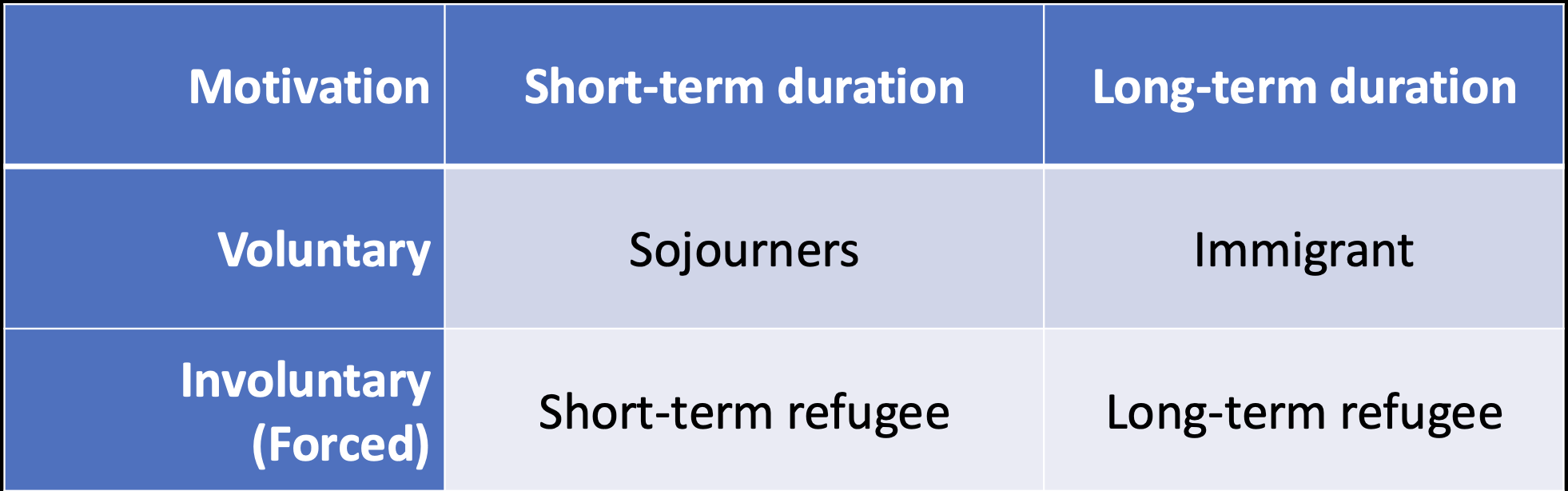
Assimilation
A type of cultural adaptation in which an individual gives up his or her own cultural heritage and adopts the mainstream cultural identity.
Separation
Choose to retain original culture and avoid interaction.
Anxiety and Uncertainty Management (AUM) model
managing the discomfort of unpredictability
Transition model
Fight or flight in reaction to transitions
Integrative Model
Adapt to new context in complex ways
U-curve model
• Honeymoon, crisis, adjustment, adaptation
• When you first came to college, did you experience a ‘honeymoon’ stage?
W- Curve model
• Second U-curve when we return home!
• Sojourners, exchange students, or immigrants who visit home often describe this second ‘dip’ in the W-curve — realizing they now belong partly to both worlds.

