Unit D - Electricity
 Call Kai
 Learn
Learn Practice Test
 Spaced Repetition
 Match
Match Flashcards
 Knowt Play
1/23

Earn XP
Name | Mastery | Learn | Test | Matching | Spaced | Call with Kai |
|---|
No analytics yet
Send a link to your students to track their progress
24 Terms
Series circuits
Components connected in a line, end to end, between +ve and -ve of power supply
If you remove/disconnect one component, circuit is broken + all stop working
Not very useful, only a few things are practically connected in series e.g. fairy lights
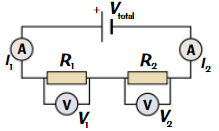
Voltage in series circuit
There’s a bigger supply p.d. when more cells are connected in series
Total p.d. of supply is shared between components
p.d. of each component depends on its resistance
Current in series circuit
Current same everywhere, I₁ = I₂
Size of current depends on total p.d. and total resistance of circuit
Resistance in series circuit
Total resistance of circuit depends on number + type of components
Total resistance is sum of resistance of each component in circuit
Parallel circuits
Each component is separately connected to +ve and -ve of supply
If you remove/disconnect one component, others are hardly affected
This is how most things are connected
e.g. cars and household electrics
Each light switch in your house is part of branch of parallel circuit (turns one light on/off)Everyday circuits often contain mixture of series and parallel parts - rules of series circuits apply to components on same branch
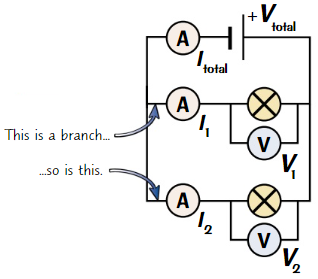
Current in parallel circuit
Current shared between branches
Total current flowing around circuit = total of all currents through separate components
There are junctions where current splits or rejoins
Total current going into junction = total current leaving it
Current through branch depends on resistance, higher resistance = lower current
Voltage in parallel circuit
P.d. is same across all branches, V₁ = V₂
Resistance in parallel circuit
Total resistance of circuit decreases if you add second resistor in parallel
Wire voltage-current characteristics
Current through wire is proportional to voltage
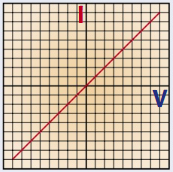
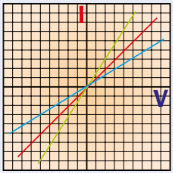
Resistor voltage-current characteristics
Current through resistor is proportional to voltage
Different resistors have different resistances
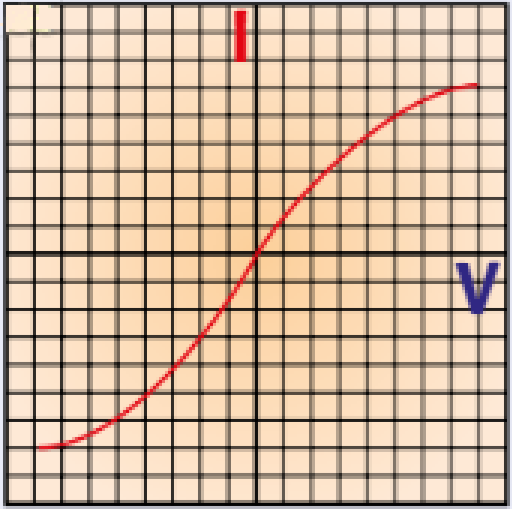
Metal filament lamp voltage-current characteristics
As temp of metal filament increases, resistance increases
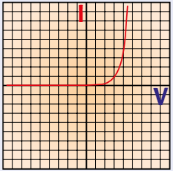
Diode voltage-current characteristics
Current only flows through diode in one direction
Ammeter
Measures current (in amps) through component
Must be placed in series anywhere in main circuit

Voltmeter
Measures voltage (in volts) across component
Must be placed in parallel around component
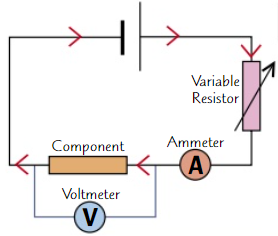
Investigating V-I characteristics
Component, ammeter and variable resistor are in series, so can be put in any order
Voltmeter must be placed in parallel around component under test
As you vary variable resistor, it alters current flowing through circuit
Allowing you to take pairs of readings from ammeter and voltmeter
Effect of changing resistance on current
More resistance = less current
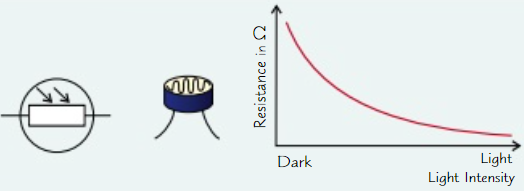
LDR
Changes resistance depending on how much light it receives
In bright light, resistance falls
In darkness, resistance is highest
Useful for various electronic circuits e.g. burglar detectors
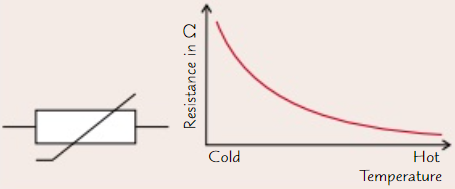
Thermistor
Temperature-dependent resistor
Hot = resistance drops
Cool = resistance increases
Useful for temperature detectors e.g. car engine temp sensors, thermostats
LED
Light-emitting diodes emit light when current flows through them in forward direction
Used for numbers on digital clocks and traffic lights
Unlike light bulb, don’t have filament that can burn out
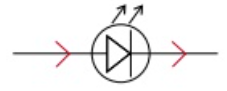
LEDs and lamps can be used to…
indicate presence of current in circuit
Often used in appliances to show they’re switched on
Equation: Voltage, Current and Resistance
V = IR
Voltage = Current x Resistance
[V] = [A] x [Ω]
![<p>V = IR</p><p>Voltage = Current x Resistance</p><p>[V] = [A] x [<span>Ω</span>]</p>](https://knowt-user-attachments.s3.amazonaws.com/8d3e5016-7bdf-45be-a3be-74364c696460.jpeg)
Current
Rate of flow of charge around a circuit
Equation: Charge, Current and Time
Q = It
Charge = Current x Time
[C] = [I] x [s]
In solid metal conductors, current is…
a flow of negatively charged electrons

