Exam 1 Study Set
0.0(0)
 Studied by 0 people
 Call Kai
 Learn
Learn Practice Test
 Spaced Repetition
 Match
Match Flashcards
 Knowt Play
Card Sorting
1/118

Earn XP
Last updated 7:05 PM on 2/23/23
Name | Mastery | Learn | Test | Matching | Spaced | Call with Kai |
|---|
No analytics yet
Send a link to your students to track their progress
119 Terms
1
New cards
1. What is ecology?
1. The study of interactions between organisms and their environments
2
New cards
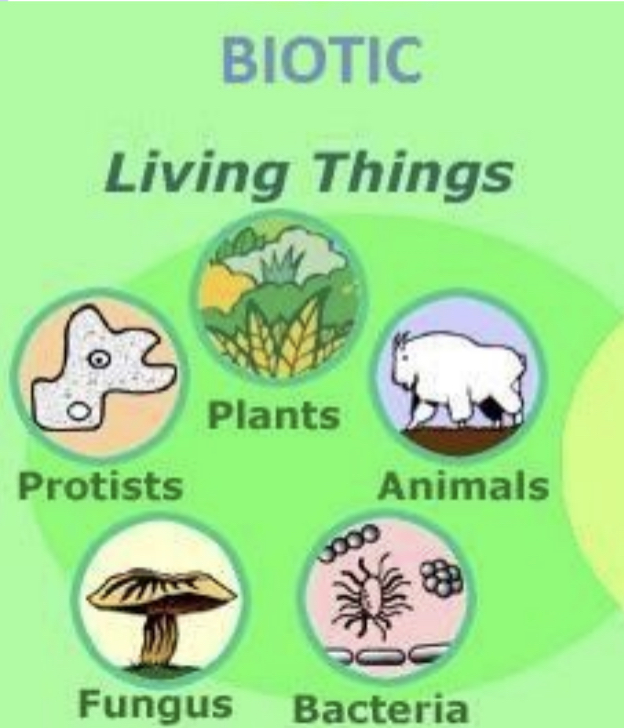
Biotic Factors
Living things
All the organisms living in the area
All the organisms living in the area
3
New cards
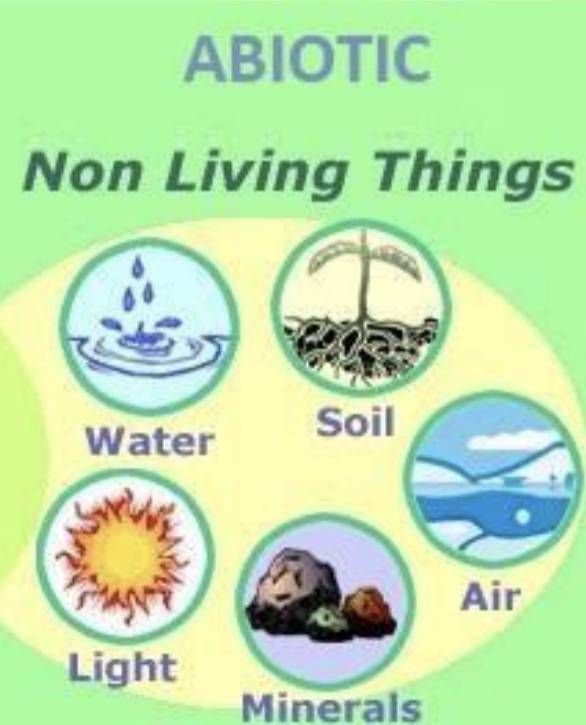
Abiotic Factors
The non living components of an environment
ex. carbon, water, nitrogen, dirt etc.
ex. carbon, water, nitrogen, dirt etc.
4
New cards
What is an example of a biotic factor in a desert environment?
Lizard, snake, tarantula, cactus, bush, etc
5
New cards
What are the three main types of ecosystems? and give an example of each.
Terrestrial(desert, forest, cave), Freshwater(river, lake, pond), Marine(Kelp forest, coral reef, tidepool)
6
New cards
What are the components of a terrestrial ecosystem?
A terrestrial ecosystem must be on dryland
7
New cards
What components are shared between all types of ecosystems?
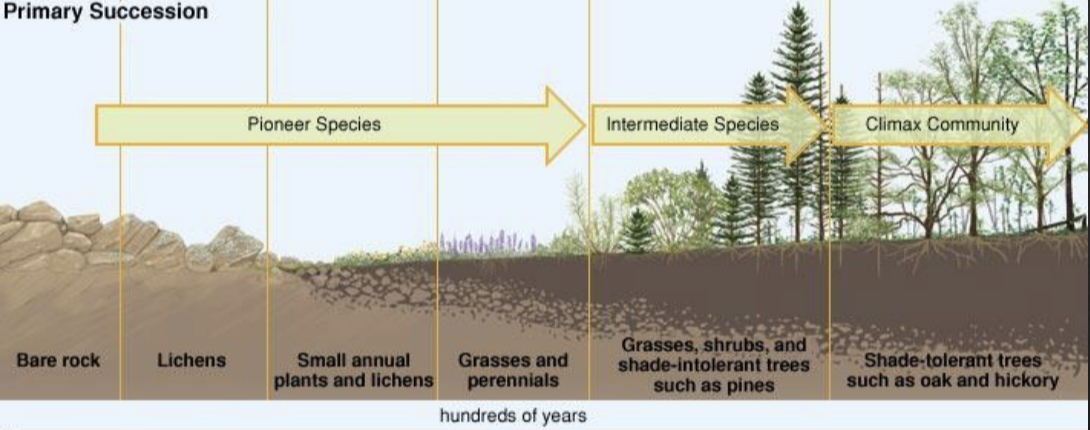
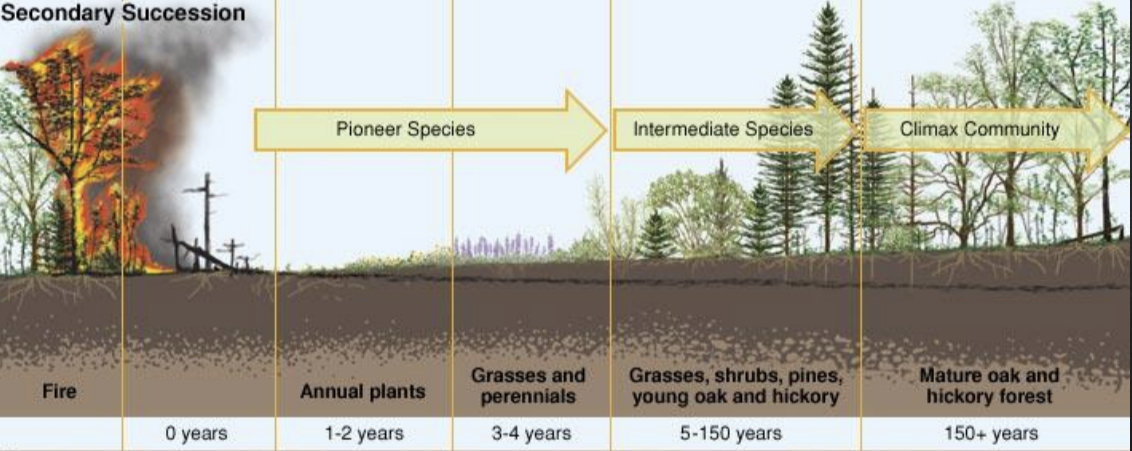
All ecosystems share abiotic components, but the biotic components differ
8
New cards
Define habitat.
the specific environment that an organism lives in, this includes both the biotic and abiotic factors of its surroundings.
9
New cards
Define niche.
An organisms niche refers to how an organism uses the biotic and abiotic components of its environment.
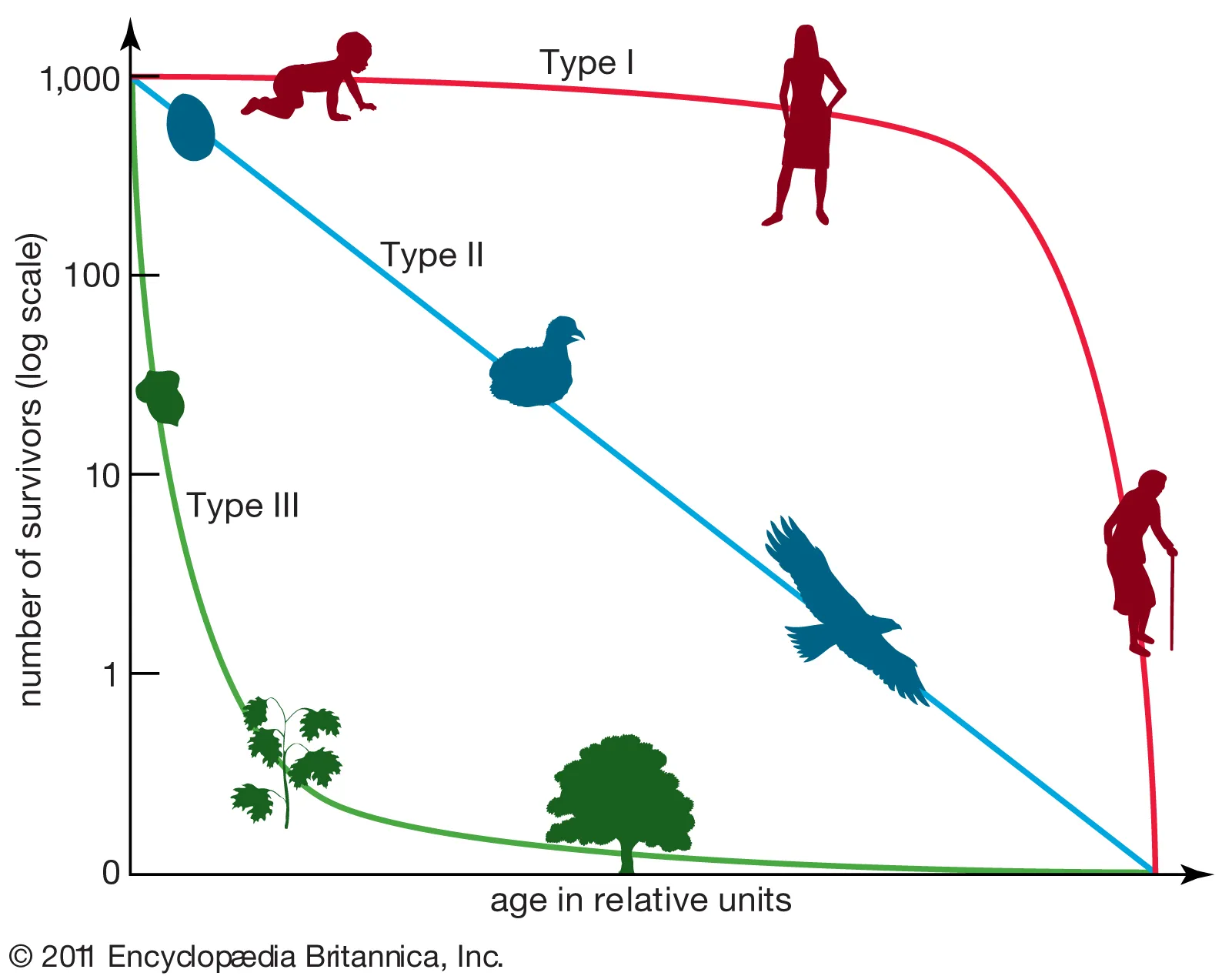
10
New cards
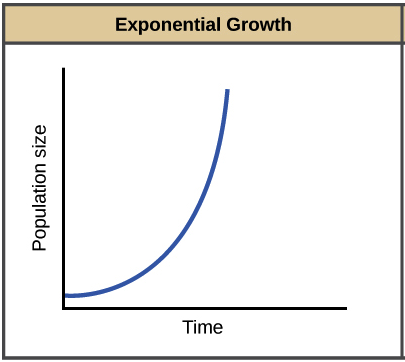
What are the trophic levels and how are they related to each other?
11
New cards
Define autotroph.
Organisms that produce their own food.
12
New cards
Define heterotroph.
Organisms that consume other organisms
13
New cards
Define Scavengers.
Organisms that feast on carcasses, like crows and vultures
14
New cards
Define Detritivores.
Organisms that consume decaying organic material, like earthworms and millipedes.
15
New cards
Define decomposer.
Organisms that secrete enzymes that digest molecules in organic material, like prokaryotes and fungi.
16
New cards
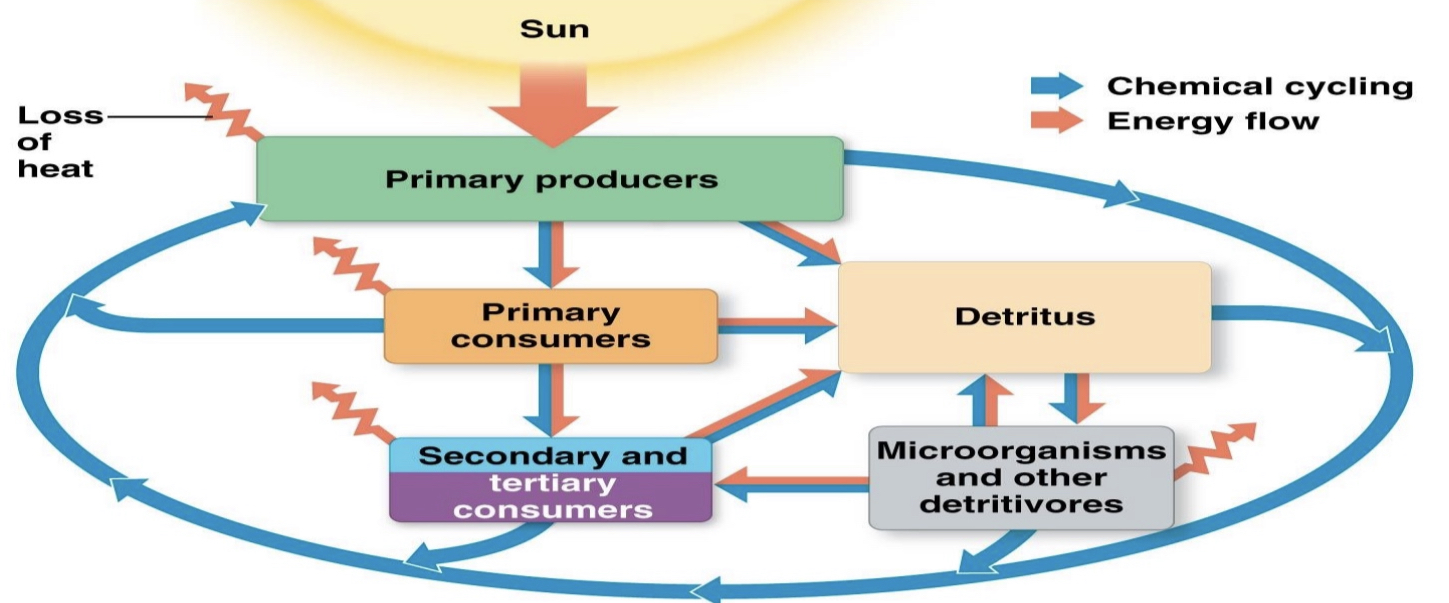
What are the two main ecosystem processes?
energy flow and chemical cycling
17
New cards
Do ecosystems need to recycle energy? Why?
Ecosystems dont need to recycle energy because the sun is an infinite source of energy which producers can use for photosynthesis and continue the flow.
18
New cards
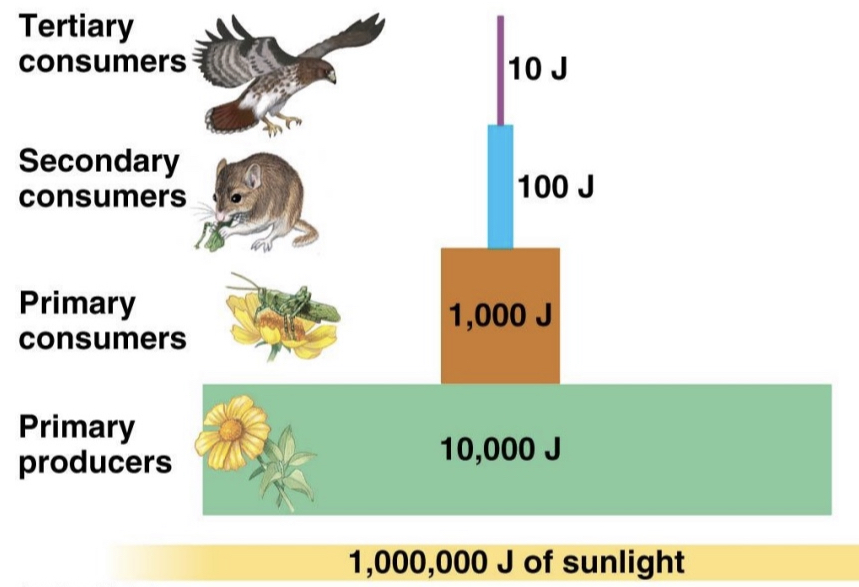
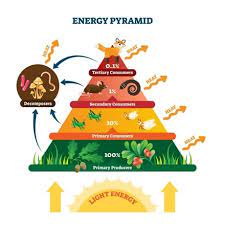
How efficient are energy transfers?
Energy transfers are about 10% efficient
19
New cards
What do organisms require energy for?
Growth, maintenance, reproduction, and locomotion(in many species)
20
New cards
Define chemical cycle
Chemicals are available in a limited/finite amount in each ecosystem, chemicals are recycled within and between ecosystems. Living organisms acquire nutrients and release waste, at death, decomposers return the molecules to the environment.
21
New cards
Explain/Draw the steps of the water cycle
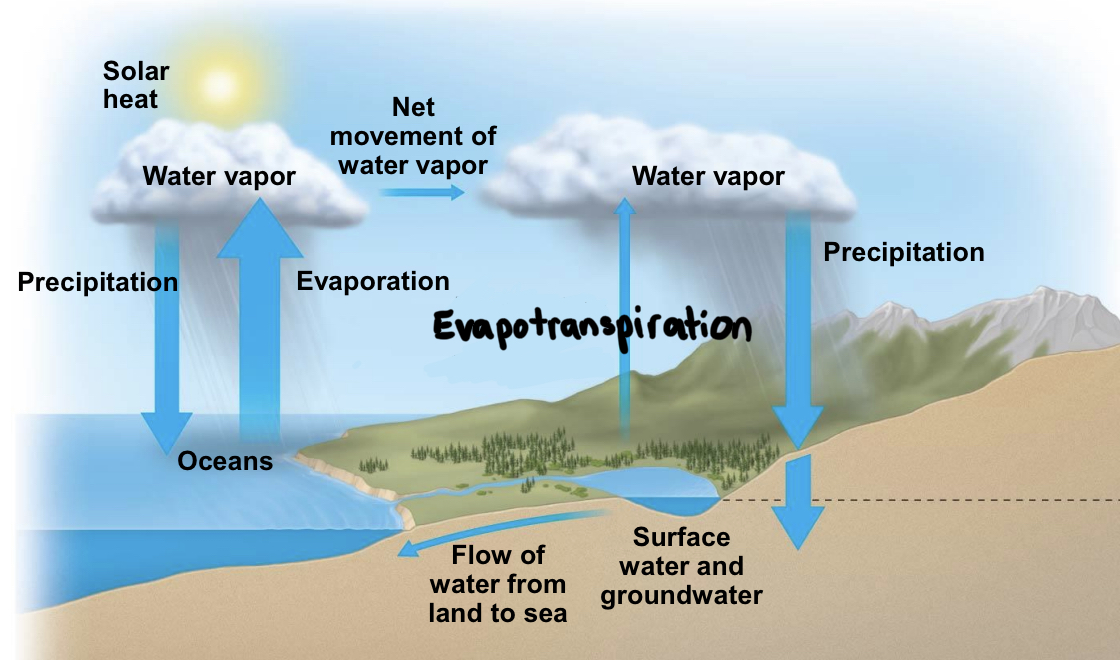
22
New cards
Explain/draw the carbon cycle
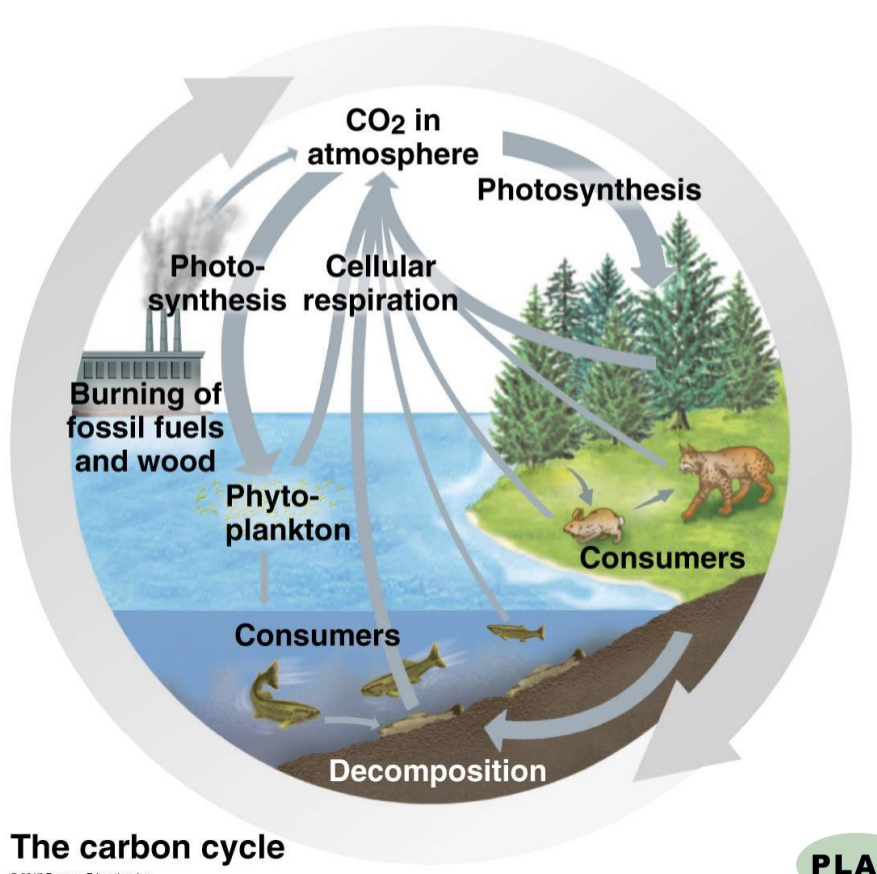
23
New cards
Explain/Draw the nitrogen cycle.
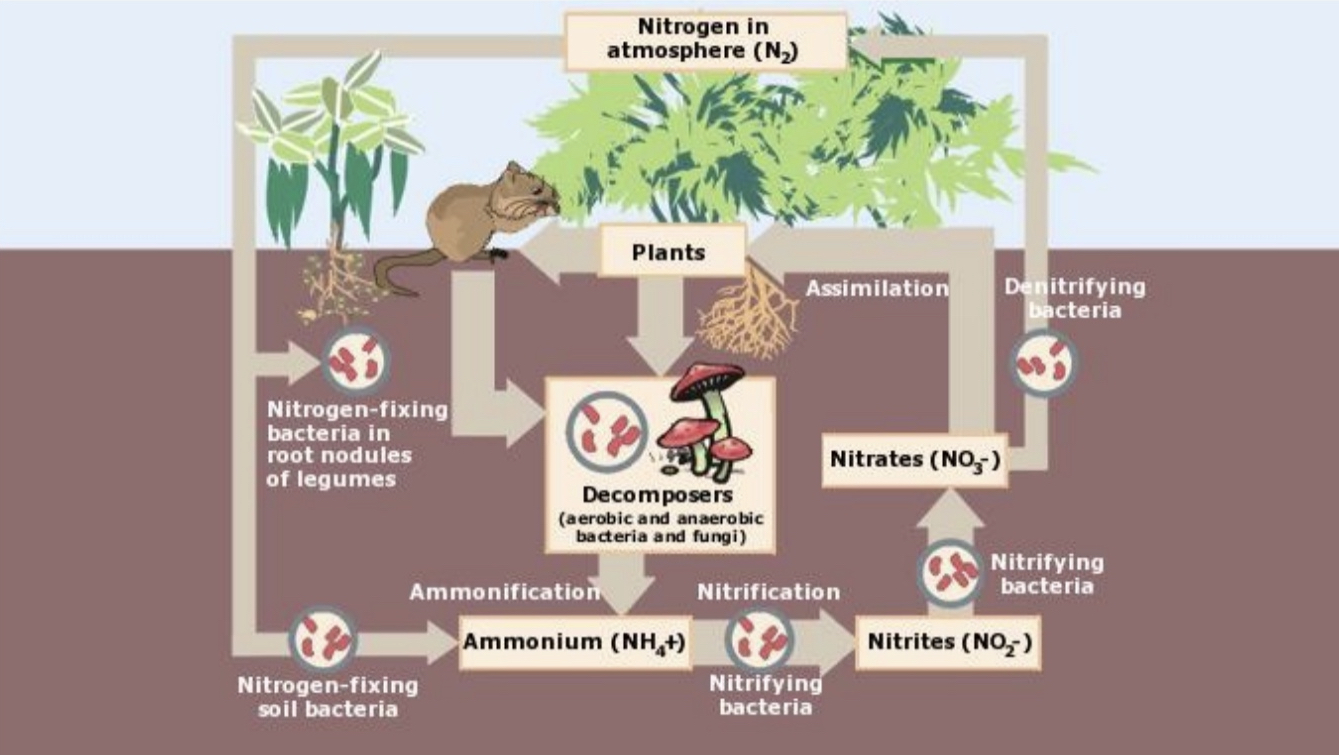
24
New cards
What would happen if you were to remove a species from an ecosystem?
The ecosystem won’t run optimally. It will either adapt or die
25
New cards
Define Interspecific relations.
Interactions between species
26
New cards
What are the types of interspecific interactions?
1. Competition(-/-), Mutalism(+/+), Predation(+/-), Herbivory(+/-), Parasitism(+/-), Commensalism(+/0)
27
New cards
Define symbiosis.
interaction between two different organisms living in close physical association.
28
New cards
What are the three types of symbiosis?
Mutualism(+/+), Parasitism(+/-), and Commensalism(+/0)
29
New cards
Define Competition
Organisms are competing over the same niche. Competition negatively impacts both organisms
30
New cards
Define competitive exclusion principle.
IF two species have an ecological niche that is too similar, the two species cannot coexist in the same place.
31
New cards
Define resource partitioning.
Organisms adapt so that their niches are similar but not 100% the same. For example, 5 birds that nest in the same tree will nest in different parts of the tree to avoid competition.
32
New cards
Define mutualism.
Both Species benefit from an interaction for example a certain fungus that grows on plant roots increases the amoun of water that the plant roots receive and in return the plant shares carbs with the fungus.
33
New cards
Define predation.
Interactions in which one species(the predator)
kills and eats another species(the prey). This interaction benefits the predator and negatively impacts the prey.
kills and eats another species(the prey). This interaction benefits the predator and negatively impacts the prey.
34
New cards
What are the adaptations that prey have evolved to avoid predators?
1. Mechanical Defense- structural in nature, porcupine quills
2. Chemical Defense- spray of skunk, toxins in plants
3. Cryptic Coloration- camouflage, a way to hide from predators, seahorse hiding in coral
4. Warning Coloration- brightly colored pattern that warns predators that the animal has an effective chemical defense, poison dart frogs
1. Mimicry- a form of defense in which one species looks like another species, can resemble twigs, leaves, bird droppings, predators, king snake mimics a coral snake
35
New cards
Define herbivory.
The consumption of plant parts or algae by an animal. This interaction negatively affects the plants/algae and benefits the animal. Ex. zebra eating grass
36
New cards
What are some defenses that plants have evolved to have against herbivores?
spines(mechanical defense), thorns(mechanical defense), and chemical toxins(chemical defense)
37
New cards
Define parasitism
A form of symbiosis where the animal lives in or on/outside of a host from which they obtain nutrients.
38
New cards
What are the two types of parasites?
Endoparasites(live inside of host), and ectoparasites(live outside of host).
39
New cards
Define commensalism.
A form of symbiosis where one organism benefits and the other is neither harmed nor benefits. Ex. birds nesting in trees, birds feeding off of insects that live on cattle.
40
New cards
What are the different types of community characteristics?
Biodiversity, Species Richness, Relative Abundance, Foundation Species, Keystone Species, and Invasive Species.
41
New cards
Define Biodiversity.
Measured by the number of different species in a particular area and their abundance.
42
New cards
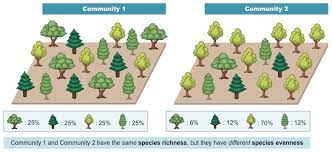
Define Species Richness
The number of different species in the community. Diversity increases the productivity and stability of a community.
43
New cards
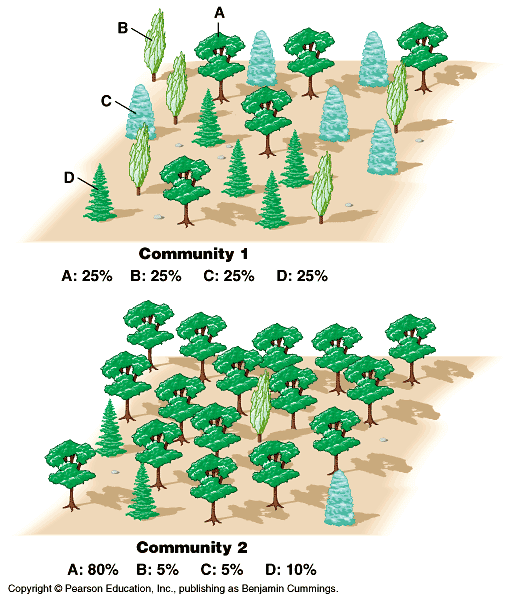
Define Relative Abundance.
The number of individuals in a species relative to the total number of individuals within an ecosystem.
44
New cards
Define Foundation Species.
base of a community, greatest influence on overall structure, usually have the highest relative abundance in an ecosystem, usually a primary producer/autotroph. ex. kelp, algae, plants, coral
45
New cards
Define keystone species.
Organism whose presence is key to maintaining biodiversity within an ecosystem.
Aids in upholding a community’s structure.
Aids in upholding a community’s structure.
46
New cards
Define Invasive Species.
Nonnative organisms that threaten the balance of the habitat they live in.
47
New cards
How do invasive species get to nonnative habitats?
People introduce species to new environments.
48
New cards
Define disturbance.
An event that changes a community. The two types of disaturbances are Natural( Drought, fire, extreme weather) and Anthropogenic(Human caused-development, invasive species, habitat fragmentation, pollution, trawling, eutrophication).
49
New cards
draw a diagram depicting eutrophication
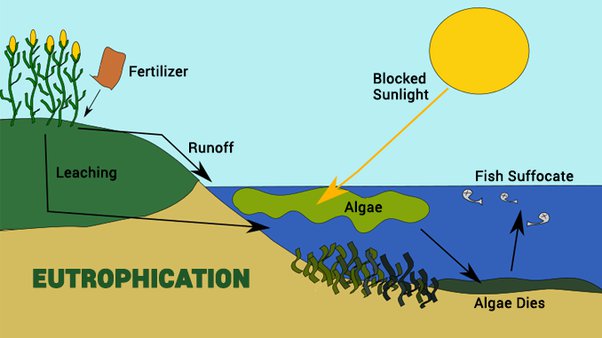
50
New cards
Define ecological succession.
The recolonization of disturbed areas. There are two types of ecological succession, primary and secondary.
51
New cards
Define Primary succession.
Begins with a pioneer species in an environment where life is not already present( lava islands, glaciers…etc)
52
New cards
Define Secondary succession.
Life was already present in the disturbed environment.
53
New cards
Define Population Ecology.
refers to how biotic and abiotic factors influence the abundance, dispersion, and age structure of populations.
54
New cards
Define Density.
The number of individuals per unit area or volume.
Example of high density- ants
Example of low density- tigers
Example of high density- ants
Example of low density- tigers
55
New cards
Population size.
total number of individuals in a population.
Generally estimated.
Quadrat method- used for organisms that do not move(cecile) or are slow moving.(ex. plants, bacteria, soil invertabrates).
Mark-Recapture Method-used for estimating the population size of motile organisms(animals)
N=(sn)/x
x-number of marked animals captured the second sampling.
n=total number of animals captured in the second sampling
s-number of individuals marked/released in the first sampling
N-estimated population size
Animal marking methods-tag in fin/ear, small sharpie mark
Generally estimated.
Quadrat method- used for organisms that do not move(cecile) or are slow moving.(ex. plants, bacteria, soil invertabrates).
Mark-Recapture Method-used for estimating the population size of motile organisms(animals)
N=(sn)/x
x-number of marked animals captured the second sampling.
n=total number of animals captured in the second sampling
s-number of individuals marked/released in the first sampling
N-estimated population size
Animal marking methods-tag in fin/ear, small sharpie mark
56
New cards
Density and Population size are constantly changing due to…
Births, Deaths, Immigration, Emmigration, Competition, Disease, Predation, Territoriality, Toxic Waste.
57
New cards
Define Species Distribution/Dispersion.
Patterns of spacing among individuals within the boundaries of the population.
58
New cards
What are the 3 types of dispersion?
1. Clumped Dispersion-organisms clustered together within population, grouped either around resources of for protection.
1. Examples-flocks of birds, wolf packs, plants, mushrooms, insects.
2. Uniform Dispersion-Organisms are evenly spaces within population area due to territoriality or allelopathy(plants that secrete chemicals that prevent seed germination and the growth of other plants)
1. Example-Penguins
3. Random Dispersion-Organisms randomly dispersed within a population
1. Example-Plants with wind blown seeds, dandelions
\
59
New cards
What are the three types of survivorship curves?
Type I-low death rate/high survivorship-humans, elephants
Type II-limited parental care-rodents, birds
Type III-organisms with lots of offspring but little to no care-reptiles, fish, plants, invertabretes
Type II-limited parental care-rodents, birds
Type III-organisms with lots of offspring but little to no care-reptiles, fish, plants, invertabretes
60
New cards
Draw the three types of survivorship curves.
61
New cards
Describe the exponential population growth model
Describes population in an idealized, unlimited environment
62
New cards
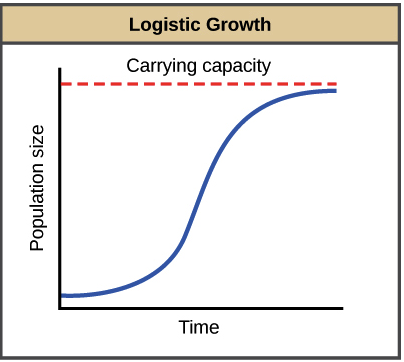
Describe the Logistic Population Growth Model
Logistic model describes how a population grows more slowly as it nears its carrying capacity(limits growth)
63
New cards
Define K-selected species.
1. mature late
2. greater longevity/longer generation time
3. Increased parental care
4. fewer offspring
5. larger offspring
1. ex. trees, elephants
64
New cards
Define r-selected species
1. mature early
2. Lower longevity/shorter generation time
3. decreased parental care
4. more offspring
5. smaller offspring
6. ex. dandelion, jellyfish
(populations can recover faster)
65
New cards
Which type of species is more successful in nature?(k-selected or r-selected)
Both are successful in their own way
66
New cards
Define Semelparity
one time reproduction, ex. salmon, plants that produce one flower.
67
New cards
Define Iteroparity.
repeated reproduction, ex. mammals, reptiles, birds, fish, flowering plants.
68
New cards
Define evolution.
Descent with modification(Darwin’s Mechanism)
69
New cards
Define Macroevolution.
evolutionary change above the species level.
evolution of a new group of organisms following many speciation events(takes a really long time)
ex. new species.
evolution of a new group of organisms following many speciation events(takes a really long time)
ex. new species.
70
New cards
Define Microevolution.
1. Evolution at its smallest scale
2. change in allele frequencies of a population over time
3. requires genetic variation
1. can happen in a single generation
71
New cards
Define alleles.
alternate forms of a gene
72
New cards
Define genotype.
A combination of alleles that dictates an organisms phenotype.
RR=homozygous dominant
Rr=heterozygous
rr=homozygous recessive
RR=homozygous dominant
Rr=heterozygous
rr=homozygous recessive
73
New cards
What are the sources of genetic variations?
1. Mutations
1. Happens when errors occur during DNA copying
2. change in the DNA or RNA of an organism
3. Forms new alleles
2. Altering gene number or position
1. Chromosomal changes-deletion, duplication, inversion, insertion, translocation
3. Rapid Reproduction increases mutation rates
1. more potential for mutations to occur
4. Sexual Reproduction
1. Combining genetic information from 2 different individuals produces genetic variation in the offspring
74
New cards
What are the Hardy Weinberg Equations?
p+q=1
p^2+2pq+q^2=1
p^2+2pq+q^2=1
75
New cards
What are the mechanisms of microevolution?
1. Natural Selection
2. Gene Flow
3. Genetic Drift
76
New cards
Define Natural selection.
The differential survival and reproduction of individuals within a population.
The primary mechanism of evolutionary change
Environment selects organisms that are most fit
Only mechanism that causes adaptive evolution, increases frequency of alleles that provide reproductive advantage
Acts more directly on phenotype.
Three types Disruptive, Directional, Stabilizing.
\
The primary mechanism of evolutionary change
Environment selects organisms that are most fit
Only mechanism that causes adaptive evolution, increases frequency of alleles that provide reproductive advantage
Acts more directly on phenotype.
Three types Disruptive, Directional, Stabilizing.
\
77
New cards
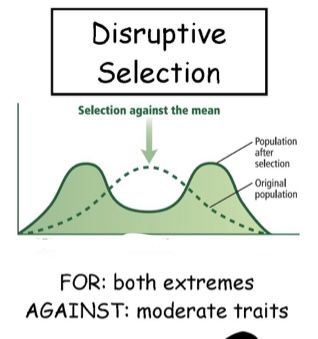
Define Disruptive selection and draw a graph
Conditions favor individuals at both extremes
ex. Birds with intermediate sized beaks are at a disadvantage for both seed types(unable to open large seeds, and to large to efficiently process small seeds5
ex. Birds with intermediate sized beaks are at a disadvantage for both seed types(unable to open large seeds, and to large to efficiently process small seeds5
78
New cards
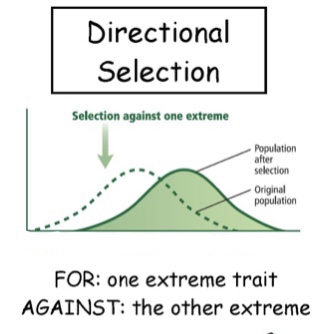
Define Directional Selection and draw a graph
Acts to eliminate one extreme
often occurs in nature when environment changes
\
often occurs in nature when environment changes
\
79
New cards
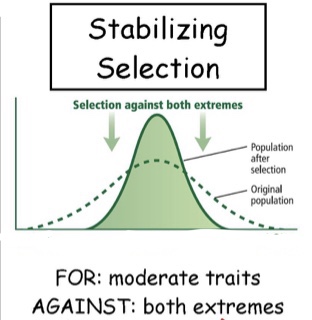
Define Stabilizing Selection and draw a graph
Acts to eliminate both extremes, makes intermediate more common
ex. in humans, infants with intermediate weight at birth have the highest survival rate.
ex. in humans, infants with intermediate weight at birth have the highest survival rate.
80
New cards
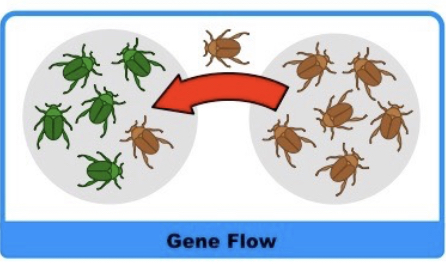
Define gene flow and draw a diagram
Movement of individuals of gametes
Tends to reduce variation between populations
Tends to reduce variation between populations
81
New cards
Define genetic drift.
change due to random chance events
magnitude of genetic drift is negatively related to population size
2 examples of genetic drift, Founder effect, and Bottleneck effect
magnitude of genetic drift is negatively related to population size
2 examples of genetic drift, Founder effect, and Bottleneck effect
82
New cards
Define the founder effect
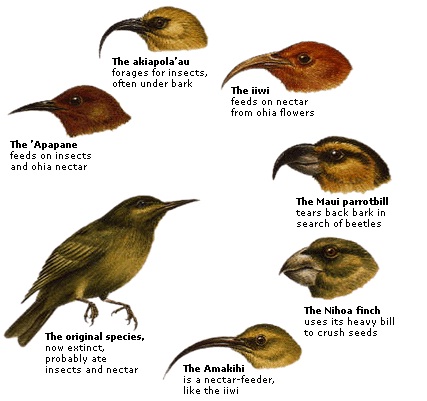
A form of genetic drift when one of a few individuals migrate and become the founders of a new, isolated population. The alleles that they carry become a significant fraction of the new populations genetic endowments.
A serties of small populations that are isolated from one another may come to differ strongly as a result of genetic drift.
Ex. Island Species
(finches on galápagos islands)
\
A serties of small populations that are isolated from one another may come to differ strongly as a result of genetic drift.
Ex. Island Species
(finches on galápagos islands)
\
83
New cards
Define the bottleneck effect.
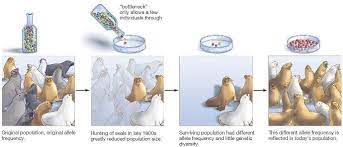
(genetic drift) A drastic reduction in the number of individuals due to a random event can dramatically change the genetic makeup of a population
ex. Northern elephant seals
nearly hunted to extinction, as a result the species lost all of its genetic variation. The population number is now in the tens of thousands bu that genetic diversity is still low
ex. Northern elephant seals
nearly hunted to extinction, as a result the species lost all of its genetic variation. The population number is now in the tens of thousands bu that genetic diversity is still low
84
New cards
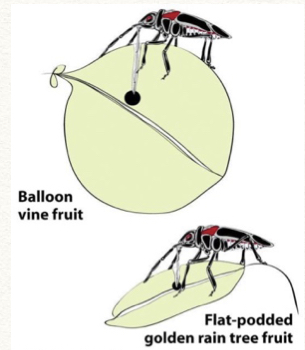
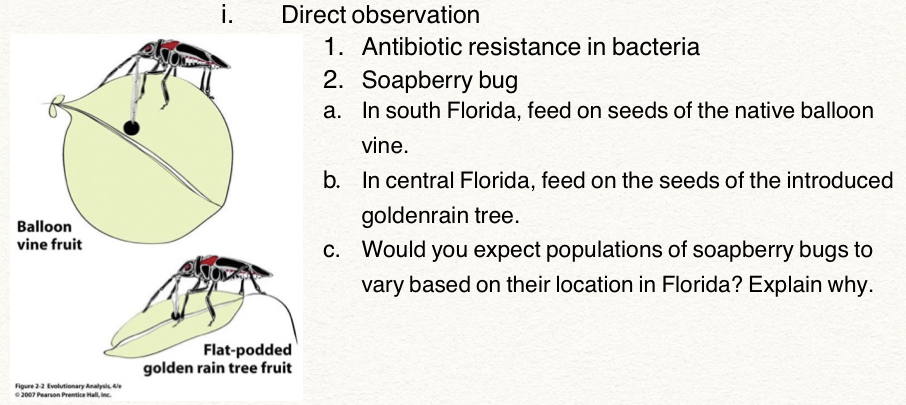
Describe how soapberry bugs in Florida provide evidence for evolution.
85
New cards
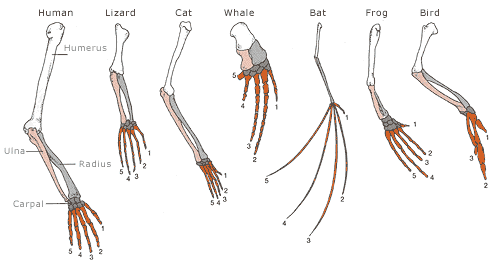
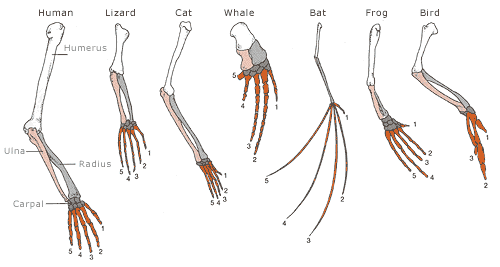
Describe how the picture below provides evidence for evolution.
Comparative Anatomy- the comparison of the body structure of different species
Attests that evolution is a remodeling process in which ancestral structures become modified as they take on new functions.
Homology- The similarity in structures(but not function) due to descent from a common ancestor
ex. remodeling of the pattern of bones forming the forelimbs of mammals for different functions
Attests that evolution is a remodeling process in which ancestral structures become modified as they take on new functions.
Homology- The similarity in structures(but not function) due to descent from a common ancestor
ex. remodeling of the pattern of bones forming the forelimbs of mammals for different functions
86
New cards
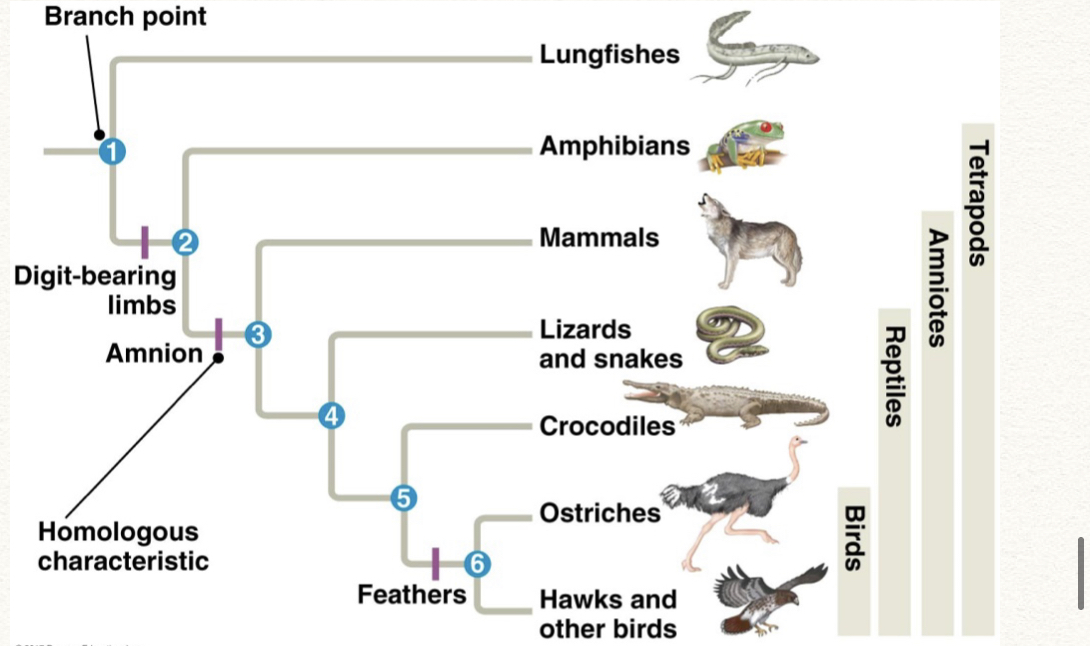
Define Homology/Homologous structures
The similarity in structure(but not function) due to descent from a common ancestor
87
New cards
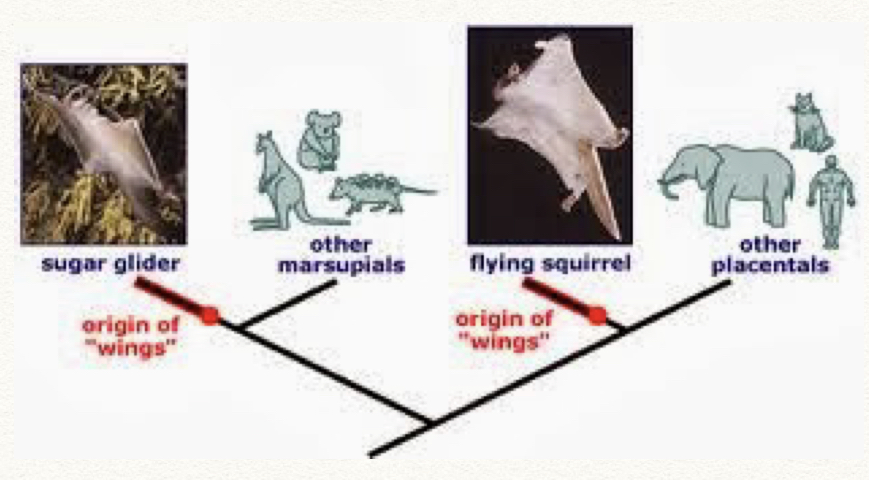
Define analogous structures.
Similarity in function due to common environmental selective pressures.
88
New cards
Define vestigial structures.
remnants of features that served important functions in an organism’s ancestors and now have only marginal, if any, importance.
ex. rear pelvis of whale
tail bone in humans
ex. rear pelvis of whale
tail bone in humans
89
New cards
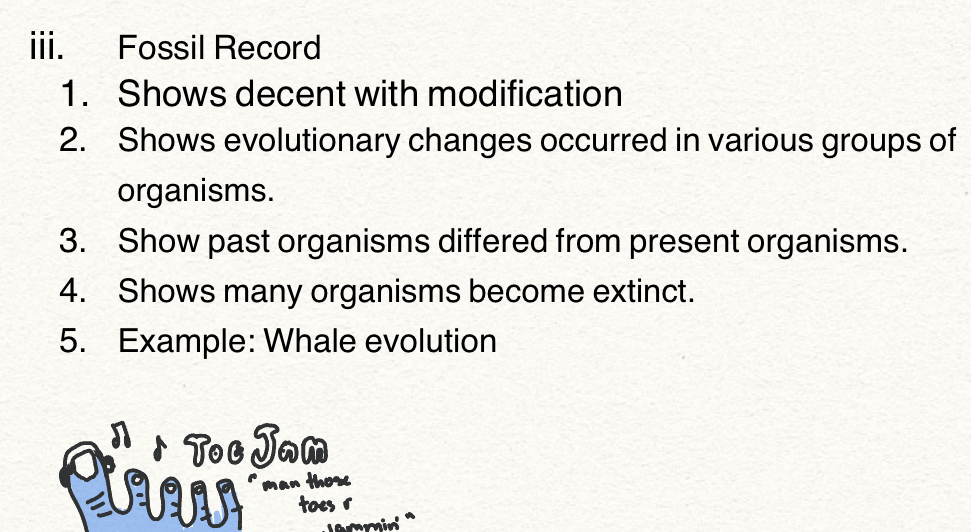
Describe how fossil records provide proof of evolution.
Shows descent with modification
Shows what evolutionary changes occurred in various groups of organisms
Shows how past organisms differed from present organisms
Shows what evolutionary changes occurred in various groups of organisms
Shows how past organisms differed from present organisms
90
New cards
Define Speciation.
Process by which one species splits into two or more species
Intermediary between micro and macroevolution.
Species concepts: Phylogenetic, Morphological, Ecological, Biological.
Intermediary between micro and macroevolution.
Species concepts: Phylogenetic, Morphological, Ecological, Biological.
91
New cards
Define phylogenetic as a species concept
If organisms DNA differs, then the organisms are different species
92
New cards
Define morphological as a species concept.
If two organisms look the same, then they are the same species.
93
New cards
Define ecological as a species concept.
If two organisms inhabit different niches, they are different species.
94
New cards
Define Biological as a species concept.
A group of populations whose members have the potential to interbreed in nature and produce viable, fertile offspring, but do not produce viable fertile offspring with members of other groups.
Cannot be applied to all species, doesn’t work with asexual reproducing organisms(bacteria).
Cannot be applied to all species, doesn’t work with asexual reproducing organisms(bacteria).
95
New cards
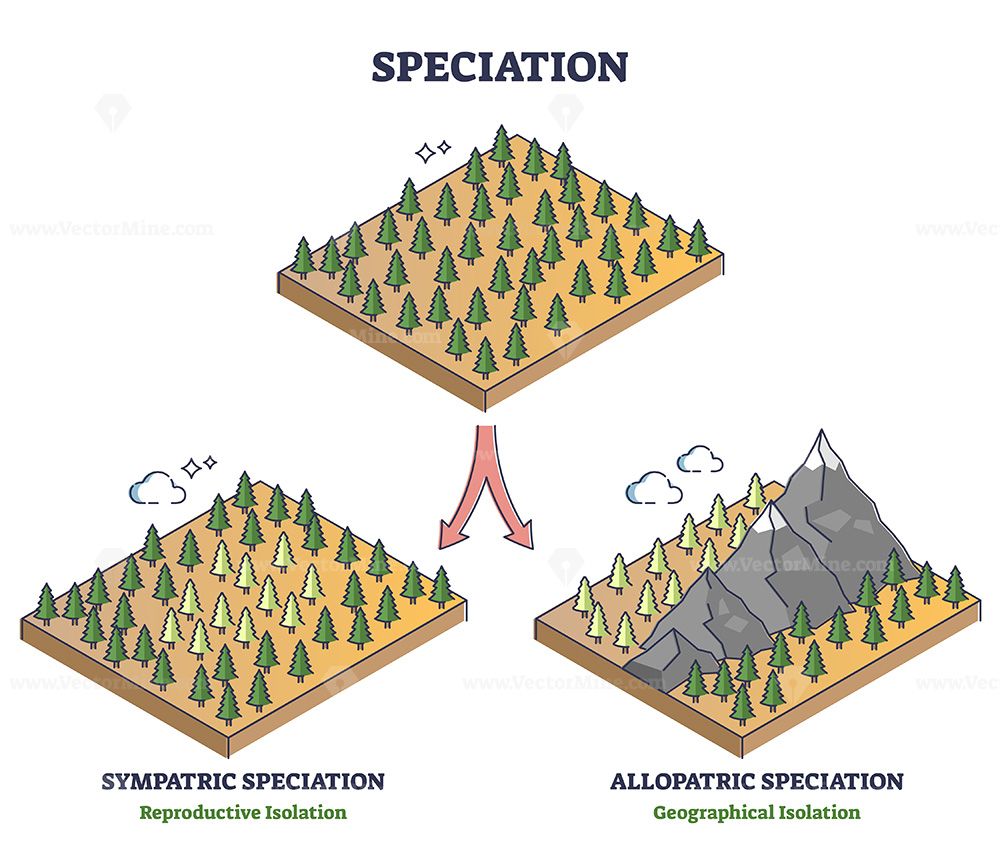
What are the two types of speciation?
Sympatric- reproductive isolation
Allopatric- geographical isolation
Allopatric- geographical isolation
96
New cards
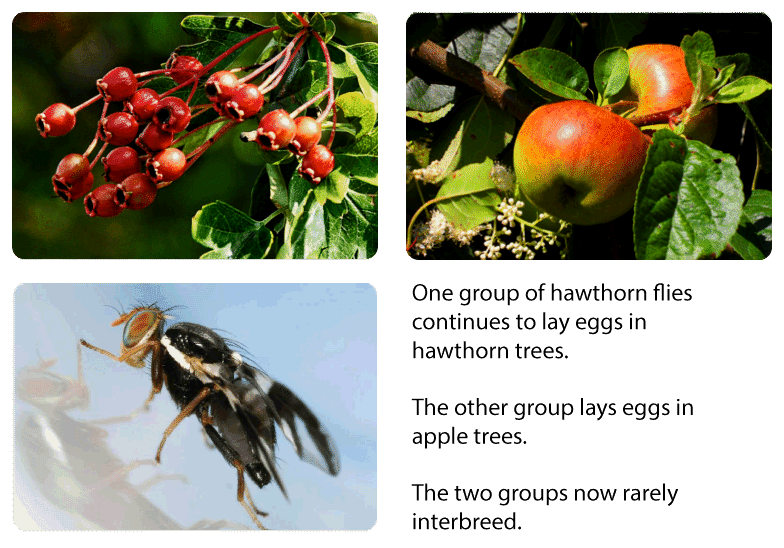
Define Habitat isolation and give an example.
habitat preferences lower the probability of mating between individuals associated with differing habitats.
ex. flys eat different fruits and reproduce on different fruits. Over time this can lead to speciation.
ex. flys eat different fruits and reproduce on different fruits. Over time this can lead to speciation.
97
New cards
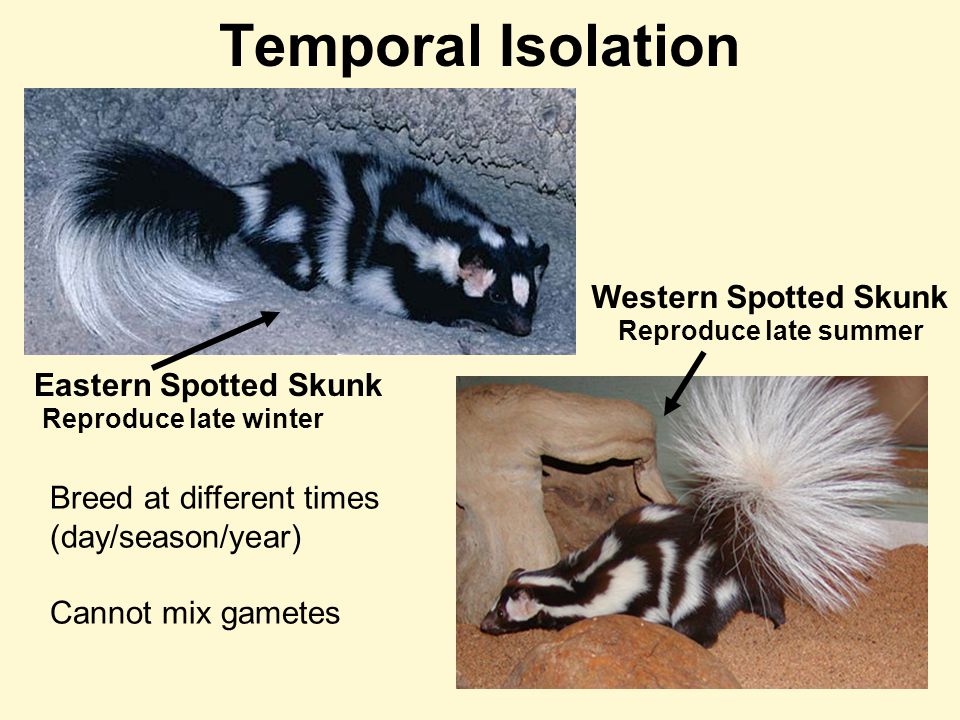
Define Temporal Isolation and give an example.
Organisms mate in different seasons or are out at different times.
\
\
98
New cards
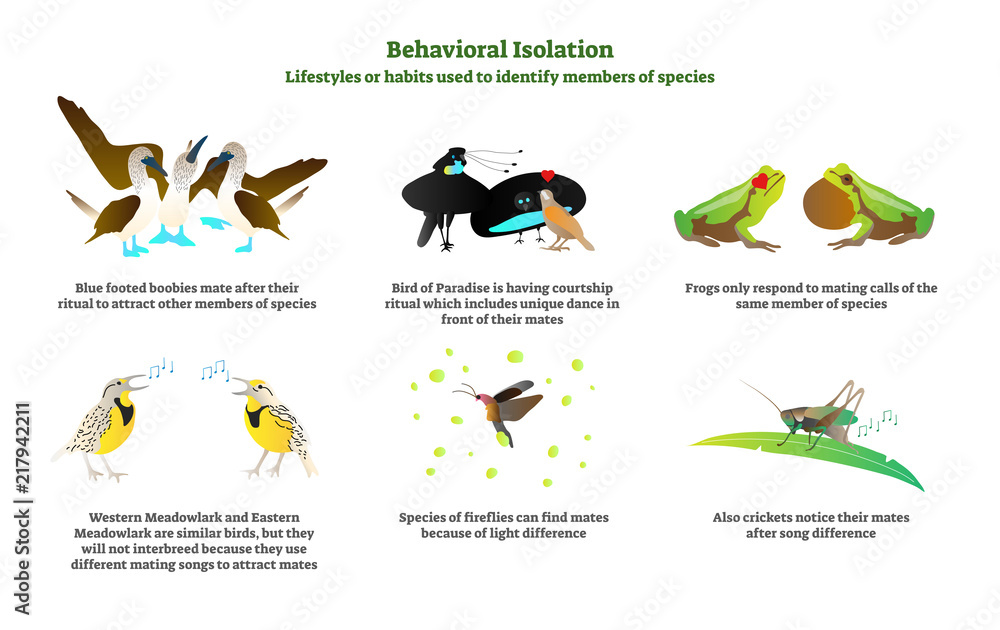
Define behavioral isolation and give an example.
Some behavior limits the interaction between two individuals.
\
\
99
New cards
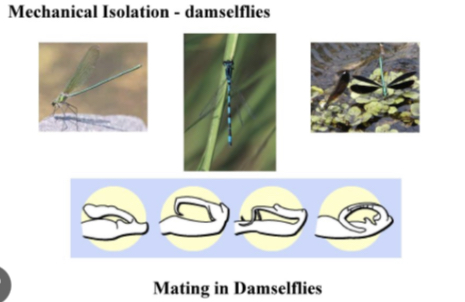
Define Mechanical Isolation and give an example.
Reproductive structures aren’t compatible.
\
\
100
New cards
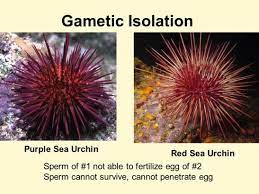
Define Gametic Isolation and give an example.
Gametic isolation happens when the egg and sperm are released but a zygote is not formed. The sperm can’t fertilize the eggs even if they come into contact.
 Note
Note  Flashcards (50)