Electronics in IT Lecture
 Call Kai
 Learn
Learn Practice Test
 Spaced Repetition
 Match
Match Flashcards
 Knowt Play
1/50

There's no tags or description
Looks like no tags are added yet.
Name | Mastery | Learn | Test | Matching | Spaced | Call with Kai |
|---|
No analytics yet
Send a link to your students to track their progress
51 Terms
Voltage
Difference in electric potentials between two points in space
Currents
Flows when two points of different electric potential (e.g. the battery terminals) have a conductive medium between them
Density of electron flow in conductive medium
Conventional current
Arrow in a schematic
Flows from the higher to lower electric potential, regardless of medium
Actual current
Uses charge carriers (any freely moving charged particles) to propagate the electric field
Metals
Have freely roaming electrons as charge carriers
negatively charged, higher
Electrons are _____ charged and attracted to the node with _____ potential
From - to +
Describe the flow of electrons in wires
Voltage Source
Voltage is constant, tries to deliver as much as the load draw
Batteries, accumulators, USB power, AC-DC wall wart adapters
Current Source
Current is constant, tries to adjust the voltage to have the load draw the correct current
Mostly occurs inside chips or as part of very specific circuit steps, test equipment
Conductor
Abundant charge carriers
High conductivity → low electric resistance
Usually is a metal, e.g. copper, aluminum
Used to create electric connections between components, devices, etc.
Insulator
No free charge carriers
Low conductivity → high electric resistance
Usually is a compound, e.g. rubber, mineral oil, …
Used to ensure no electric connection happens between components, devices, and especially people and wires
Will become a conductor at high enough voltage
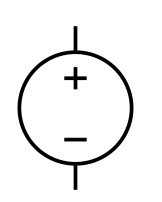
Voltage source
Identify the symbol
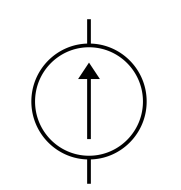
Current source
Identify the symbol
Crystal structures with abundant charge carriers
What type of structure do conductors usually have?
~17 nΩ/m (17 × 10⁻⁹ ohms per meter)
What is the resistance of copper per meter at room temperature?
It vibrates more, causing electrons to bump into stuff instead of flowing on
What happens to a metal’s crystal lattice when temperature increases?
Worse
Do metals conduct better or worse when heated?
Air
What is an OK insulator for smaller voltages?
Rubber and plastics
What are some good insulators for higher voltages?
Batteries, PSUs
Voltage sources with predefined max. current they can deliver, exceeding that current may lead to shut-off or overheating
Semiconductor
A so-so conductor and so-so insulator
Optical Semaphore
A system of towers using visual signals to transmit messages limited by earth’s curvature and obstacles (hills, mountains)
Claude Chappe
Who coined the word Telegraph and invented the Optical Semaphore Line?
Electric Telegraph
Invented to battle issues posed by the earth’s curvature and terrain and improve the process
Telegraph
Applicable to any technology that allows fast propagation of information over a distance
Galvanometer
A device that shows if current is flowing through a conductor
Makes use of electromagnetism: a wire shaped into a dense coil becomes an inductor
When current flows through an inductor, it creates a proportional magnetic field: This field can be detected with a permanent magnet, e.g. a compass needle
A breakthrough product of early research on electricity
High resistance weakens the signal
What problem occurs in long telegraph wires of the electric telegraph?
Using re-amplification
How was weak signal over long distances solved?
Electric relay
Mechanic switch actuated by an electromagnet
Extremely simple in construction
Industry standard for re-amplifying telegraph signals
Simple construction, mechanically robust, can pass a lot of current
Pros of Electric Relays
Faster than towers but still speed-capped, Has moving parts (mechanical) that will deteriorate over time, Can malfunction due to high current welding the switch
Cons of electric relays
Vacuum tubes
Served a similar purpose as relay but it is purely electronic, not electromechanic: boost in speed, better reliability, resistance to weather
Tubes are lambs and burn out
Major drawback of vacuum tubes
Seebeck effect
A phenomena where some materials (e.g. silver sulfide) drop resistance when heated up and create an electromotive force when heated unevenly
copper/copper oxide (metal-semiconductor)
What kind of junction rectifies AC (removes the negative half)?
Russel Ohl
Observed a difference in resistance between zones of a germanium crystal containing different impurities
He found a P-N junction: a diode
Solid-state electronics
No moving parts or vacuum tubes
Silicon, Gemranium, Gallium Arsenide
What are some famouse semiconductor materials?
Silicon has 4 valence electrons
Forms 4 covalent bonds with neighbors
Each atom effectively has 8 outer electrons
No free charge carriers → poor conductivity
Explain Silicon’s rigid structure
By adding phosphorus (adding an atom of many electrons)
By adding boron (adding an atom of few electrons)
= Doping
How can we make silicon conduct better when it has no free charge carriers?
N-type semiconductor
Doped semiconductors with free electrons and negative majority charge carriers
P-type semiconductor
Doped semiconductors with free holes (electron absences) and positive majority charge carriers
P-N junction
Having a P-type semiconductor next to a N-type semiconductor
Free holes from the P side meet free electrons from the N side at the border, they recombibe
What happens when the PN junction is created?
Depletion Zone
This is a result of the recombination of free holes and free electrons in a P-N junction border
An electromagnetic field emerges
What emerges because of the difference of potentials of atoms in a P-N junction border?
context:
The atoms on the P side of the depletion region together hold a negative charge now (too many electrons)
The atoms on the N side now hold a positive charge (too many holes)
Charged ions
What appears when particles diffuse in an electromagnetic field (emf opposes diffusion)?
Barrier voltage is formed
What happens when diffusion in emfs reach equilibrium?
0.7 V
Potential difference in depletion zone of silicon PN junctions
forward-biased diode
positive voltage applied to P side and negative to N side → current flows
reverse-biased diode
positive voltage applied to N side and negative to P side → no current flows

