Cell Bio Lecture 19
 Call Kai
 Learn
Learn Practice Test
 Spaced Repetition
 Match
Match Flashcards
 Knowt Play
1/26

There's no tags or description
Looks like no tags are added yet.
Name | Mastery | Learn | Test | Matching | Spaced | Call with Kai |
|---|
No analytics yet
Send a link to your students to track their progress
27 Terms
How are transgenic plants made using recombinant DNA techniques optimized for plants?
Leaf discs cut out from plant
Leaf discs incubated with AGROBACTERIUM, which carries the recombinant plasmid
The wounded plant cells attract bacteria, which inject their DNA. Only cells expressing the selectable marker survive and proliferate into a callus
Manipulation of growth factors to form shoots, these shoots grow into adult plants W THE ENGINEERED GENE
What is Agrobacterium?
These are the bacteria that carry a recombinant PLASMID with a selectable marker and the desired gene.
Selectable marker allows for the filtering out of other cells that do not have the selectable marker
What was made to combat vitamin A deficiencies?
Development of “Golden Rice” HIGH LEVELS OF β-CAROTENE in endosperm
How can large amounts of mRNA be produced from an inserted gene?
By utilizing a PLASMID with a HIGHLY ACTIVE PROMOTER
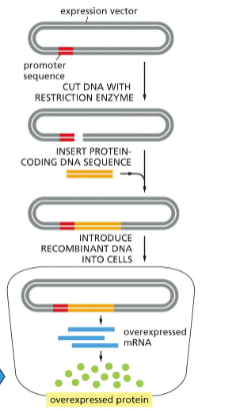
How can we experimentally move from protein to gene?
A purified protein is analyzed via mass spec to obtain a partial amino acid sequence
Sequence is ran through DNA database, we design primers, and clone the gene by PCR from a sequenced genome
Gene is inserted into an expression vector which can then be used to reproduce the protein
What are cell membranes?
These are barriers that separate cells from their environments
Also in eukaryotes, they enclose organelles, preventing free mixing of molecules
What are the functions of plasma membranes?
Receiving information via RECEPTOR PROTEINS
Facilitating the import and export of small molecules via TRANSPORTERS AND CHANNEL PROTEINS
Provides flexibility for expansion and cell growth, MOVEMENT AND EXPANSION
What does a cell membrane consist of?
Lipid bilayer and embedded proteins
What makes up the lipid bilayer?
Phospholipids
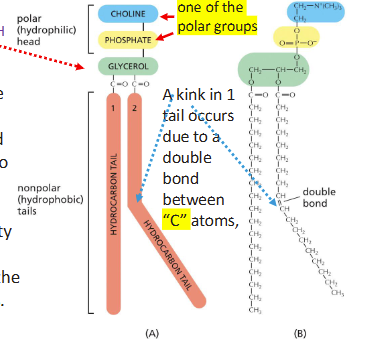
Hydrophilic head and TWO hydrophobic tails
What is the most common phospholipid in cell membranes?
Phosphatidylcholine
Hydrophilic head
Choline linked to a phosphate group
Glycerol
linking head and tail
Hydrophobic tails
2 hydrocarbon tails, one with a KINK (C=C)
What characteristic do all membrane lipids share?
They are all AMPHIPATHIC
Hydrophilic + hydrophobic parts
What bonds form between polar molecules?
Electrostatic bonds and hydrogen bonds
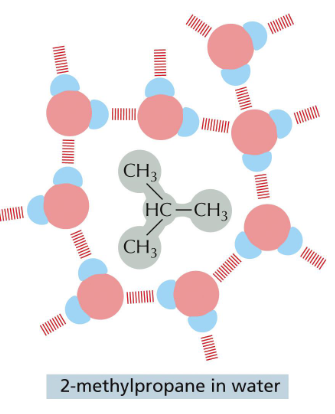
How do nonpolar molecules interact with water?
Water molecules surround the nonpolar molecule without forming any bonds with it.
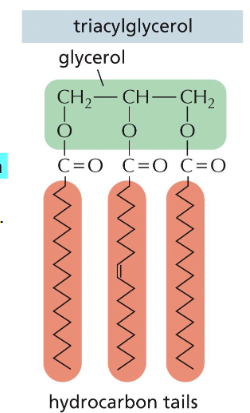
Are fat molecules hydrophobic or hydrophilic?
Highly hydrophobic, TAGS (triacylglycerols) make up fats and are nonpolar due to their hydrocarbon structure
Why do phospholipid bilayers enclose themselves?
To be more ENERGETICALLY FAVORABLE, polar sides should interact with water while the non-polar sides are shielded from the water
How does the lipid bilayer behave?
Behaves as a two-dimensional fluid, LIPID MOLECULES MOVE AROUND
How do the lipid molecules move?
Lateral movement ← and →
Flexion
Rotation
RARELY DO THEY FLIP FLOP
Which molecule is responsible for stabilizing the membrane?
CHOLESTEROL
Also amphipathic, hydroxyl group with polar heads, hydrophobic region with the tails
KEEPS MEMBRANE IN BALANCE
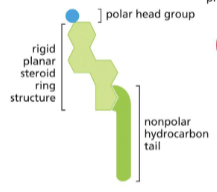
How does Cholesterol play a role in regulating membrane fluidity and stability at different temperatures?
High temperatures
cholesterol reduces fluidity by preventing phospholipids from moving too freely
Lower temperatures
prevents membrane rigidity
Prevents phospholipids from packing too closely together
Where does membrane assembly begin?
ER ENDOPLASMIC RETICULUM
ER membrane
Cytosolic side and ER lumen side
Biosynthetic enzymes synthesize and insert phospholipids to cytosolic side
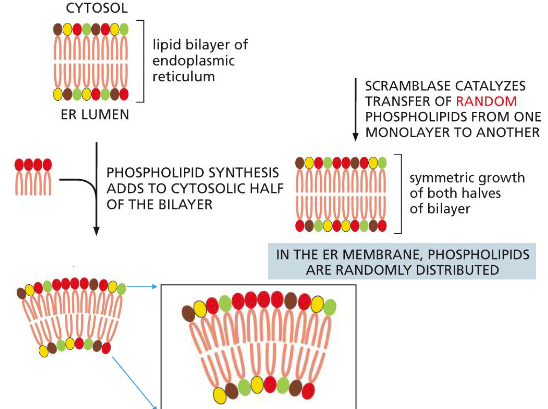
What does the enzyme SCRAMBLASE do?
Scramblase is responsible for the transfer of RANDOM PHOSPHOLIPIDS from one monolayer to another (cytosol to ER side
What do FLIPPASES do?
Responsible for maintaining ASYMMETRIC phospholipid distribution in cell membranes
What do flippases in the GOLGI do?
Transfer phosphatidylserine and phosphatidylethanolamine to the CYTOSOLIC MONOLAYER
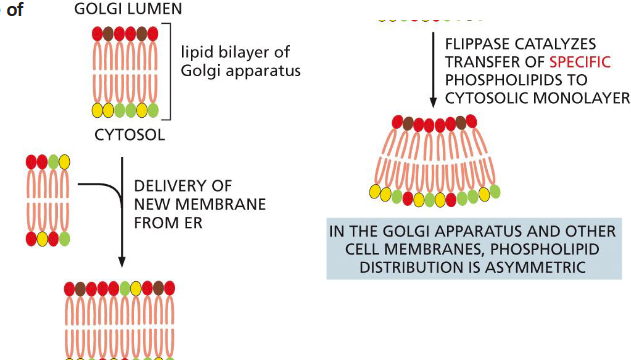
How are phospholipids and glycolipids distributed asymmetrically in the lipid bilayer of the cell plasma membrane?
Noncytosolic monolayer (Outer membrane)
Phosphatidylcholine
sphingomyelin
glycolipids
Cystolic monolayer (Inner membrane)
Phosphatidylserine
phosphatidylethanolamine
phosphatidylinositol
What are the different functions of plasma membrane proteins?
Transporters
Na pump
Anchors
Integrin proteins
Receptors
insulin receptors
Enzymes
Cyclase
What are the different ways that membrane proteins associate with the lipid bilayer?
Integral Proteins (Interact in some way with the inner lipids)
Transmembrane - spans through both ends of the bilayer
Monolayer-associated
Lipid linked
Peripheral membrane proteins (found only on the surfaces of the bilayer)
protein attached
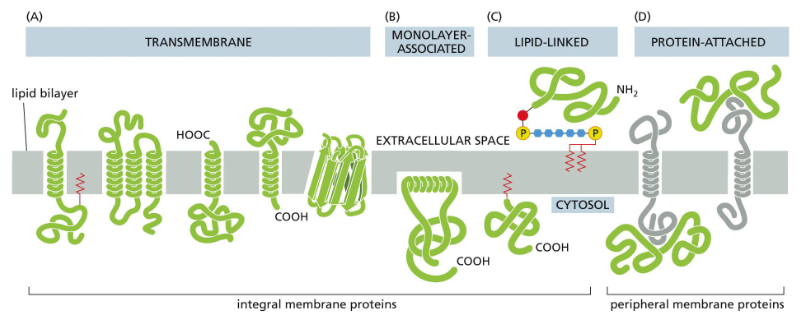
What structure does a polypeptide usually form to cross the lipid bilayer?
a-Helix structure
about 20 amino acids are needed to span the membrane
5 a-helices are needed to form a channel

