M23 Problems with the Big Bang Model
 Call Kai
 Learn
Learn Practice Test
 Spaced Repetition
 Match
Match Flashcards
 Knowt Play
1/28

There's no tags or description
Looks like no tags are added yet.
Name | Mastery | Learn | Test | Matching | Spaced | Call with Kai |
|---|
No analytics yet
Send a link to your students to track their progress
29 Terms
Big Bang Model
Is a thoroughly tested model in science with its essentials largely confident
However, there are a few problems that require solutions
Big Bang Model Problems
The Flatness Problem
The Horizon Problem
The Hubble Tension
Why did the Big Bang occur
The Flatness Problem
Our universe is geometrically flat. But why? There are an infinite number of possible ways for the universe to be closed or open but total density is just right to make the universe flat
Ω = 1
Fine-Tuning Problem
Encompasses the flatness problem
A broader concept that asks why do the fundamental conditions/constants of the universe have such precise values?
Observable Universe
A spherical region centered on an observer
Radius is the max distance light could have traveled since the Big Bang
Age and Radius of the Universe
13.8 billion years is the age of the universe. But due to spacetime expansion, the radius is actually 46.5 billion ly
The Horizon Problem
Although opposite sides of our sky have had time to send light to us since the Big Bang, they have not had the chance to share info about their physical conditions
No Causal Contact
Causal Contact
Two regions can influence each other because a signal (like light) has had time to travel between them
Cosmic Microwave Background
In the CMB, causal contact is observed
Almost the same temperature/wavelength in every direction
Inflation
A modification to the Big Bang theory that solves both the Flatness and Horizon problems
Inflation Mechanism
Posits that in the first few moments of the universe’s existence, the universe expanded at a vastly greater rate than it currently does
Inflation and Flatness Problem
Any universe experiencing inflation would appear flat, similar to how a small region of Earth’s surface appears flat
A period of exponential expansion would make any initial curvature virtually impossible to measure in the present day
On very small scales, any curved surface looks flat
Inflation and Horizon Problem
Prior to inflation, opposite sides of our sky were in contact with one another
Inflation dragged them apart at speeds much higher than the speed of light
Makes it appear that they were never in contact, and thus unable to communicate
Inflation and Horizon Problem and Relativity
Spacetime moving faster than the speed of light is not a violation of relativity
It only says that objects moving through spacetime can’t move at or above the speed of light
Spacetime can move at any speed it wants
Universe Possible Curvature
It’s possible the universe could have a curvature, but our observable universe is only a tiny part of a much bigger whole
Inflation Evidence
Proving inflation happened is very difficult but is still an active area of research
Hubble’s Constant
(H0) Measures the rate of the universe’s expansion
There are multiple ways to measure H0 (just as there are many ways to measure distance in the universe)
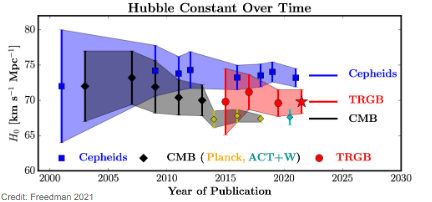
The Hubble Tension
The different ways to measure the Hubble constant gave basically the same answer, however, as these methods got more precise, they stopped agreeing within their uncertainties
Also known as the “Crisis in Cosmology”
Scientific Response to Discrepancy
When predictions disagree with observations our options are:
Our model of reality is wrong
Our observations of reality are wrong
Hubble Tension Discrepancy Response
After about a decade of work, it has only strengthened the disagreements in the data
Hubble Tension Hypotheses
A clue is that each method measuring H0 probes different eras in the history of the universe
The expansion rate may have changed in an unexpected way
Dark energy might be behaving differently
Dark Energy Recent Research
In March 2026 two research collaborations announced results implying dark energy varies in time rather than being a cosmological constant
Dark energy would be a factor that evolves for reasons not known yet
Future Dark Energy Research
The Euclid Space Telescope and the Nancy Grace Roman telescopes will give us a better idea of how dark energy behaves
Will help resolve whether dark energy has actually evolved over time, and hopefully resolve the Hubble tension
Why did the Big Bang happen?
Remember that the Big Band Model (ΛCDM, Lambda Cold Dark Matter) explains that approximately 13.8 billion years ago, the universe originated from a hot, dense state and has been expanding since
The model does not explain what happened prior to this state or why this state came into existence
Big Bang Hypotheses
Cyclic Universe
Eternal Inflation
Black Hole Spawning
Cyclic Universe
Suggests a universe that undergoes an infinite series of Big Bangs and Big Crunches
The end of one universe marks the beginning of another
Eternal Inflation
Proposes that within a larger “universe",” pockets undergo inflationary periods, effectively spawning new universes, which can spawn more.
This is unlike our standard model which assumes the entire universe underwent a Big Bang simultaneously (inflation happened everywhere, and just once)
Black Hole Spawning
Suggests black holes could spawn new universes
Current State of Knowledge
The origin of the Big Bang is currently unknown
This fuels scientific curiosity and wonder

