Topic 7 — Magnetism & Electromagnetism
 Call Kai
 Learn
Learn Practice Test
 Spaced Repetition
 Match
Match Flashcards
 Knowt Play
1/98

Earn XP
Description and Tags
99 Terms
Where is the magnetic field around a magnet the strongest?
At the poles
What happens when two magnets are brought close together?
They exert a force on each other.
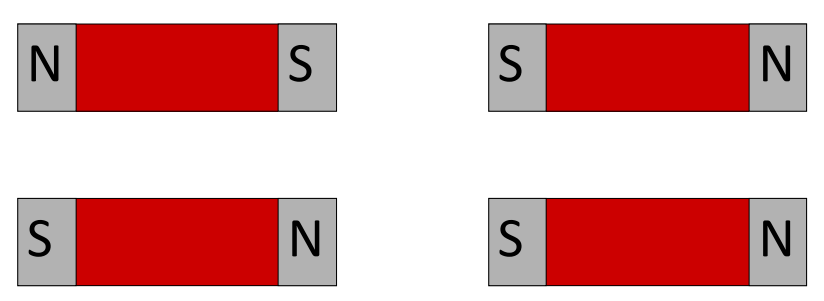
Two like poles ______ each other.
Two unlike poles ______ each other.
Attraction and repulsion between two magnetic poles are examples of a __________ _______.
repel
attract
non-contact force
What is a non-contact force?
A force that acts on objects that are physically separated.
What is a permanent magnet?
A magnet that produces its own magnetic field.
What is an induced magnet?
A material that becomes a magnet when it is placed in a magnetic field.
Induced magnetism always causes a force of ___________.
attraction
What happens when an induced magnet is removed from a magnetic field?
It loses most/all of its magnetism quickly.
What is a magnetic field?
The region around a magnet where a force acts on another magnet or on a magnetic material.
What are four magnetic materials?
Iron
Steel
Cobalt
Nickel
The force between a ________ and a _________ ___________ is always one of attraction.
magnet
magnetic material
What does the strength of the magnetic field between a magnet and a magnetic material depend on?
The distance from the magnet.
The direction of the magnetic field at any point is given by the direction of the _______ that would act on another ________ pole placed at that point.
The direction of a magnetic field line is from the ______ (seeking) pole of a magnet to the ______ (seeking) pole of the magnet.
force
north
north
south
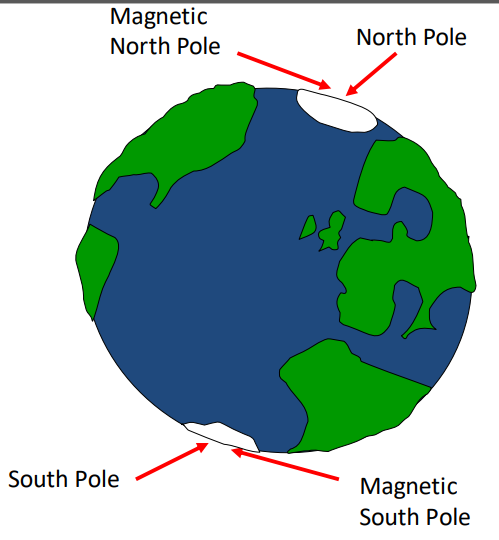
How is the behaviour of a magnetic compass evidence that the core of the Earth must be magnetic?
A magnetic compass contains a small bar magnet.
The Earth has a magnetic field.
The compass needle points in the direction of the Earth’s magnetic field.
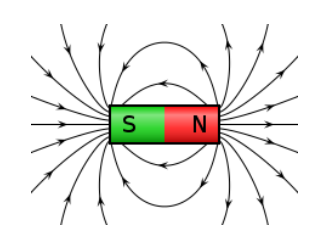
Why are the magnetic field lines on a diagram more concentrated at the poles?
That is where the magnetic field is strongest.
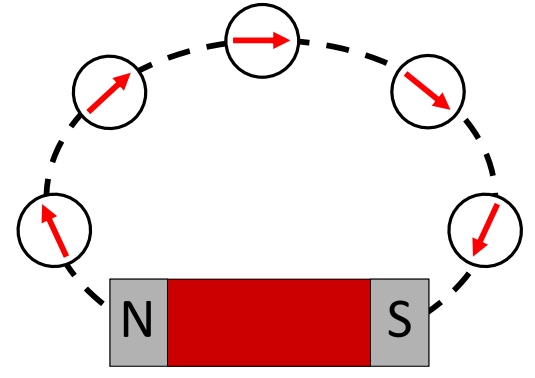
How do you plot the magnetic field pattern of a magnet using a compass?
Place a plotting compass near to a magnet
Plot which way it points
Move it and repeat
What happens when current flows through a conducting wire?
A magnetic field is produced around the wire.
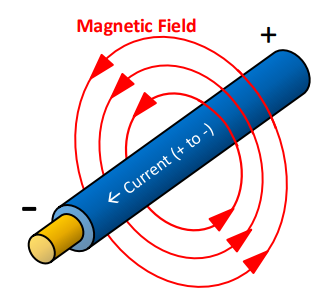
When a current flows through a conducting wire a magnetic field is produced around the wire.
What does the strength of the magnetic field depend on?
The current through the wire
The distance from the wire
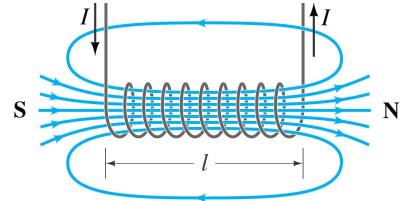
Shaping a wire to form a _________ increases the strength of the __________ _______ created by a _________ through the wire.
solenoid
magnetic field
current
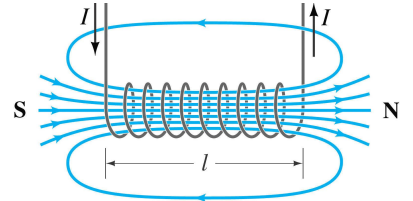
How do you describe the magnetic field inside a solenoid? (2)
Strong
Uniform
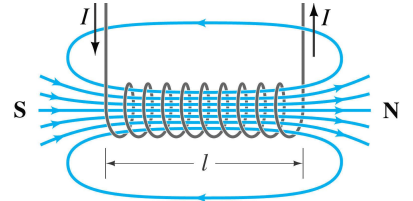
How do you describe the magnetic field outside a solenoid?
Similar shape to a bar magnet
Adding an ______ _______ increases the strength of the magnetic field of a solenoid.
iron core
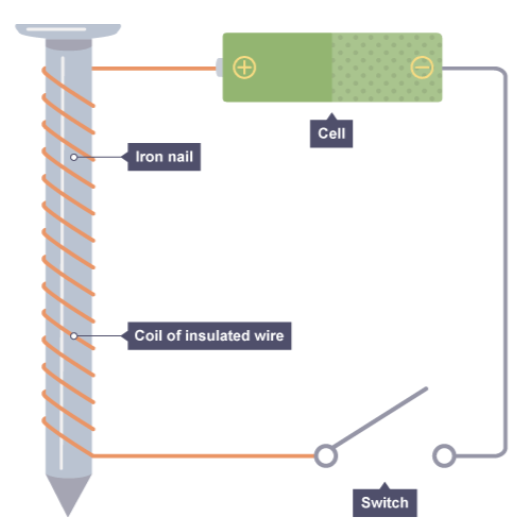
What is an electromagnet?
A solenoid with an iron core.
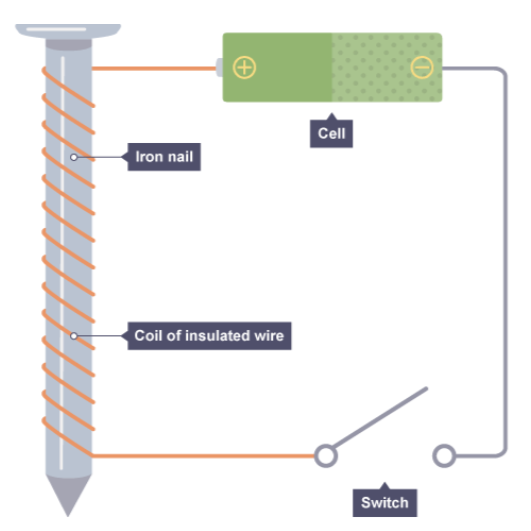
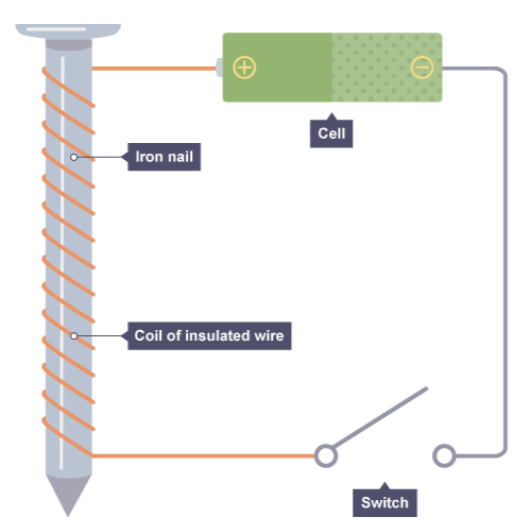
Why does the iron core of an electromagnet increase the strength of the magnetic field?
The magnetic field created by the solenoid magnetises the iron bar.
The magnetic field around a wire with current flowing through it is a different pattern to the magnetic field caused by a permanent magnet — it is __________ ______.
concentric circles
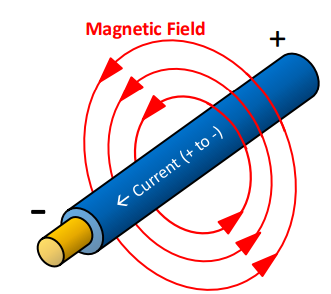
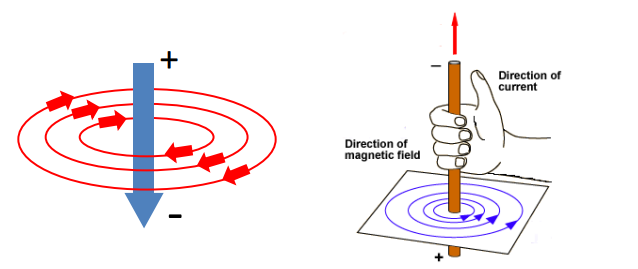
How can you use the ‘right hand grip rule’ to know the direction of the current and magnetic field around a wire with current flowing through it?
Your thumb tells you the direction of the current (positive to negative)
Your other fingers tell you the direction of the magnetic field (concentric circles)
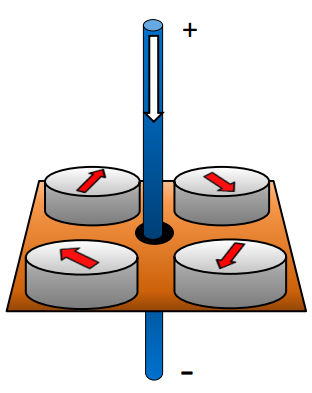
How do you demonstrate a magnetic field?
Thread a wire through a piece of card.
Place plotting compasses on the card, around the wire.
The plotting compasses will make a circular pattern.
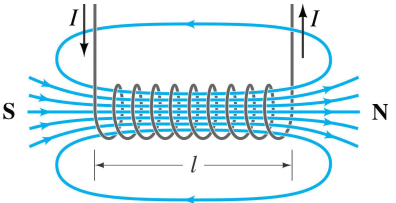
What is a solenoid?
A long coil of insulated wire with current flowing through it.
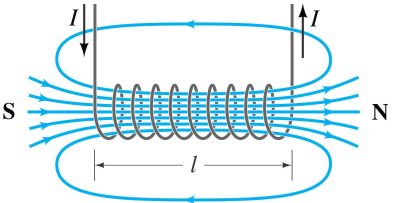
The magnetic field inside the solenoid is strong and uniform.
What does uniform mean in this context?
The magnetic field lines are all in the same direction.
parallel to the axis of the solenoid
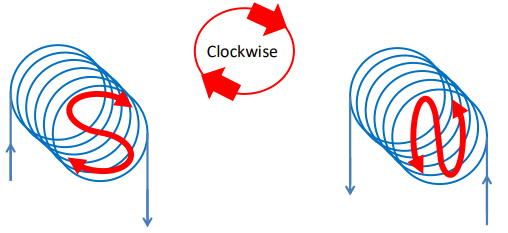
If you look at the end of a solenoid, the end where the direction of the current is ____________ will be the south pole.
clockwise
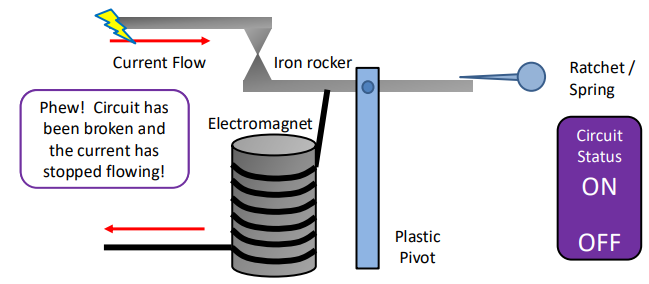
What is a circuit breaker?
A switch that is in series with an electromagnet.
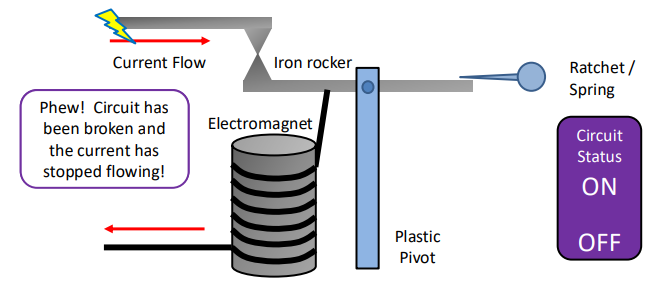
How a Circuit Breaker Works:
The current flows through the _____ parts of the circuit, including through the _____.
The coil is wrapped around an _____ _____, which makes it an ____________.
The current flowing through the electromagnet causes a __________ _____.
If the current in the circuit gets too _____ the magnetic field will become strong enough to ________ the iron rocker (which is held on a ________ ______).
This ______ the circuit, and current stops flowing.
The _______ / ______ stops the iron rocker from returning to its normal position until a button is pressed.
If this didn’t happen, the ________ would flow again immediately.
iron
coil
iron core
electromagnet
magnetic field
high
attract
plastic pivot
breaks
ratchet
spring
current
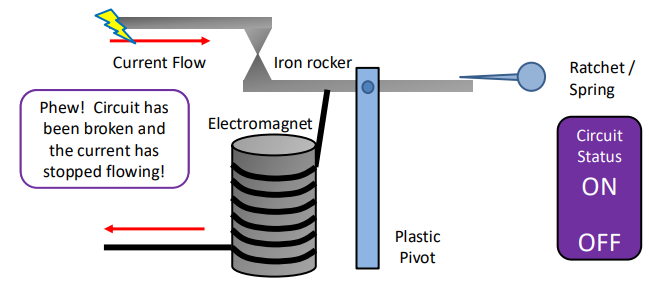
What would happen is the ratchet/spring in a circuit breaker wasn’t there?
As soon as the rocker moved the current would stop flowing.
With no current flowing through the coil, the electromagnet would stop attracting the rocker.
The rocker would return to its normal position, closing the circuit.
The current would flow again and the whole process would start again.
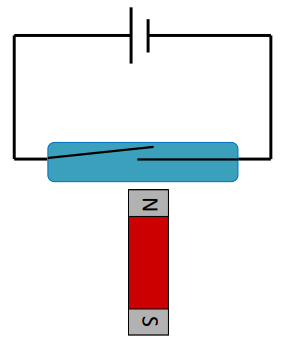
What is a relay?
Any switch operated by a magnet or electromagnet.
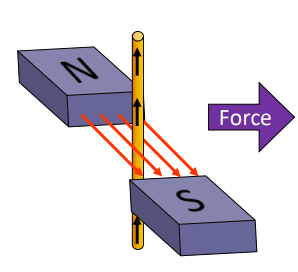
What is the motor effect?
When a conductor carrying a current is placed in a magnetic field the magnet producing the field and the conductor exert a force on each other.
What is the equation for a conductor at right angles to a magnetic field and carrying a current?
force = magnetic flux density × current × length
F = BIl
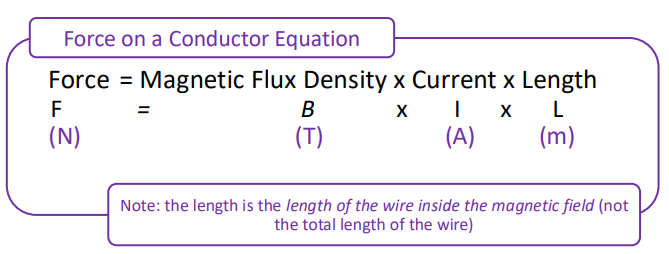
What are the units for magnetic flux density?
Tesla
The Motor Effect:
When a ___________ carrying a ________ is placed in a _________ ______ the magnet producing the field and the conductor exert a ______ on each other.
This is called the motor effect.
The size of the force also depends on the angle between the ______ and the ___________ ______.
The force is greatest when the wire is _____________ to the magnetic field, and weakest if it is _________ to the magnetic field lines.
conductor
current
magnetic field
force
wire
magnetic field
perpendicular
parallel
In Fleming’s Left Hand Rule, what does your thumb represent?
Movement/direction of force
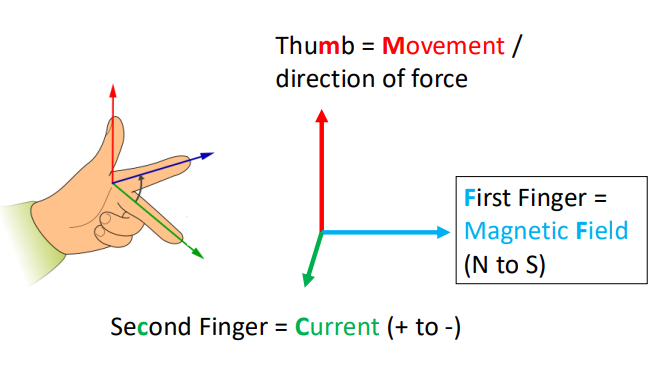
In Fleming’s Left Hand Rule, what does your first finger represent?
Magnetic field (N to S)
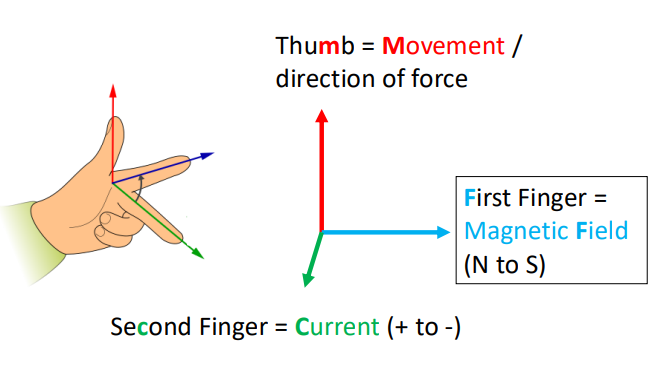
In Fleming’s Left Hand Rule, what does your second finger represent?
Current (+ to -)
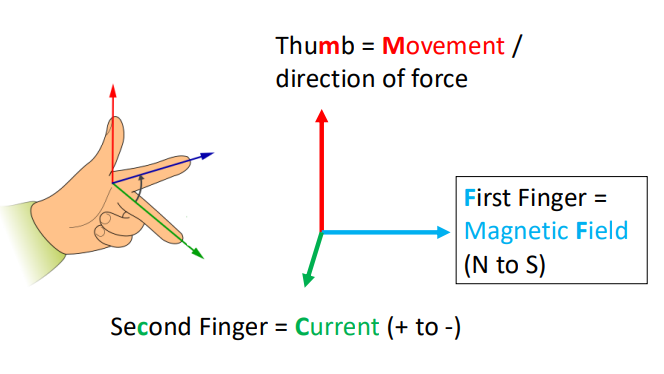
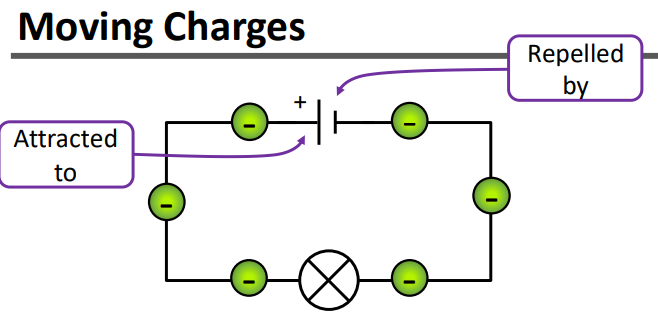
Electrons are negative and so they move:
from the ___________ end of the cell because like charges ______.
towards the _________ end of the cell because the opposite charges ________.
negative
repel
positive
attract
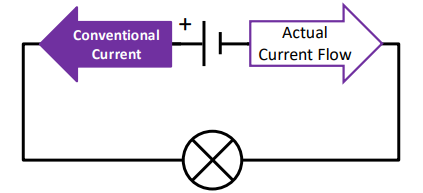
Conventional current flows from __________ to __________.
positive
negative
What are the three factors that affect the size of the force on a conductor in a magnetic field?
Strength of the magnetic field
Amount of electric current flowing through the wire
Length of the conductor that is inside the magnetic field
What is the basis of an electric motor?
How does an electric motor work?
A coil of wire carrying a current in a magnetic field tends to rotate.
You can make an electric motor rotate faster by increasing the force.
How can you do this? (4)
Increasing the current
Increasing the strength of the magnetic field
Use more coils
Reduce the distance between the coils and the magnets
You can reverse the direction of the motor by reversing the direction of the force.
How can you do this? (2)
Reversing the direction of the current
Swapping over the magnets
So the magnetic field runs the other way
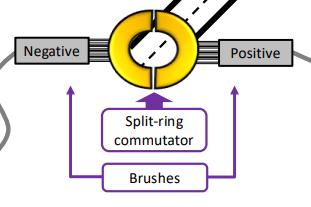
Why would an electric motor built without a split ring commutator not do a full turn?
The forces on the coil depend on the direction of the current.
After half a turn, the sides of the coil have swapped positions.
Without reversing the current, the forces would act in the opposite direction to the rotation.
It would just turn 180° one way and then immediately flip and turn 180° back.
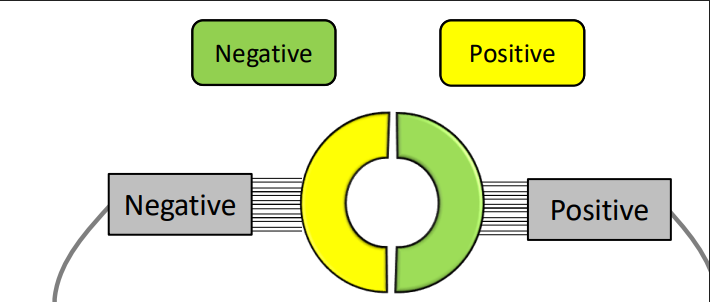
Why are metal or carbon brushes used in a split ring commutator?
They allow current to flow through to the commutator, but still allow the commutator to move freely.
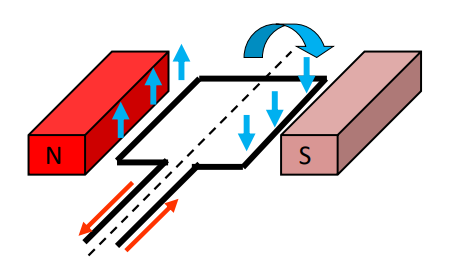
How does the idea of moments explain why a coil rotates in a magnetic field?
The forces are in different directions but they both act in a clockwise direction.
Therefore the clockwise moment is greater than the anticlockwise moment (which is zero) so the object rotates.
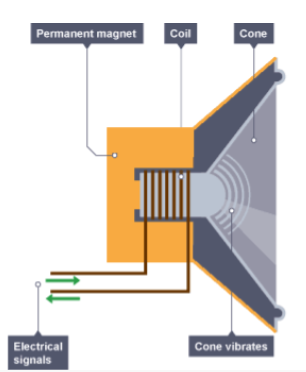
Loudspeakers and headphones use the ______ effect to convert variations in ________ in __________ ______ to the ___________ ___________ in ________ ________.
motor
current
electrical circuits
pressure variations
sound waves
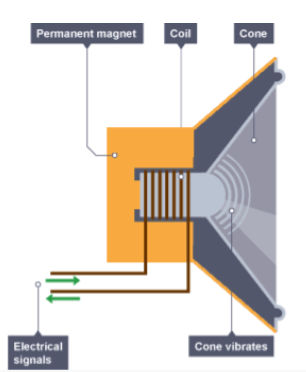
How does a loudspeaker work?
A current passes through the coil.
This current creates a magnetic field.
This magnetic field interacts with the magnetic field formed by the permanent magnet.
This causes a force on the coil.
The current is alternating and changes direction.
This changes the direction of the magnetic field and therefore the force.
The changing force vibrates the cone
This causes air particles to vibrate and creates sound.
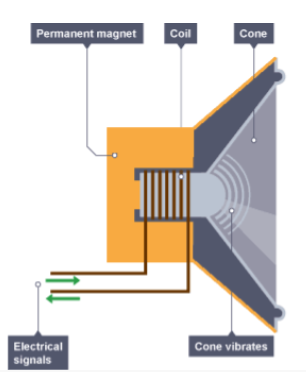
How does a generator work?
A coil is moved in a magnetic field.
The coil experiences a change in magnetic field.
The coil ‘cuts’ through magnetic field lines.
This induces a potential difference.
If there is a complete circuit, then a current is also induced.
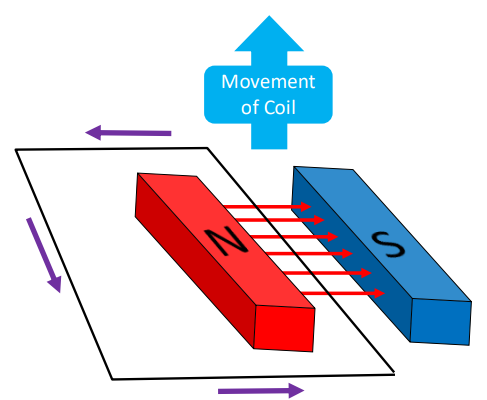
What is the generator effect?
If an electrical conductor moves relative to a magnetic field or if there is a change in the magnetic field around a conductor, a potential difference is induced across the ends of the conductor.
If the conductor is part of a complete circuit, a current is induced in the conductor.
What does an induced current generate?
A magnetic field that opposes the original change, either the movement of the conductor or the change in magnetic field.
How can you increase the size of the induced potential difference or current? (4)
Having the magnet closer to the coils
Moving the magnet faster
Using a stronger magnet
Using a coil with more turns
How can you change the direction of the induced potential difference or current? (2)
Reverse the movement of the conductor or magnet.
Swap the poles of the magnet.
Electromagnetic Induction:
A ___________ ___________ is induced across the ends of the conductor when it is moved relative to the ___________ _____.
This also happens if we change the __________ ______ around the conductor.
potential difference
magnetic field
magnetic field
Explain how a potential difference and current are produced when a coil moves in a magnetic field.
The coil is cutting across the magnetic field lines so a potential difference is induced across the coil.
The coil forms a complete circuit so a current is induced.
How is the generator effect used in an alternator?
To generate alternating current.
How is the generator effect used in a dynamo?
To generate direct current.
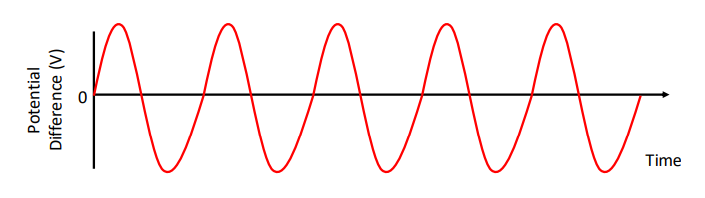
What is alternating current?
It is caused by rapidly changing potential difference.
This means that the direction the electrons flow changes.
So the electrons move backwards and forwards — they alternate.
What is an alternator?
An alternating current generator.
What do alternators use to produce alternating current?
Slip rings
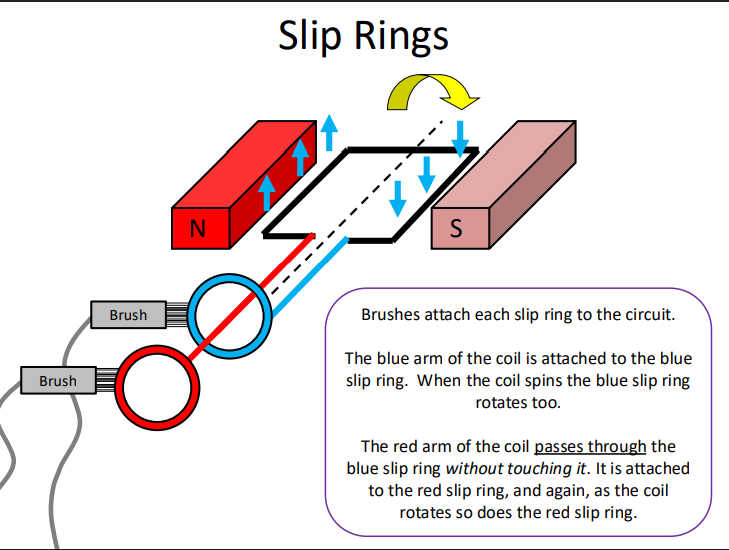
How do slip rings and the movement of the coil produce alternating current?
The coil spins inside the magnetic field.
One side of a coil in a generator moves up during one half-turn, and then down during the next half-turn.
Therefore the induced current reverses direction every half-turn.
This can happen because of the two slip rings.
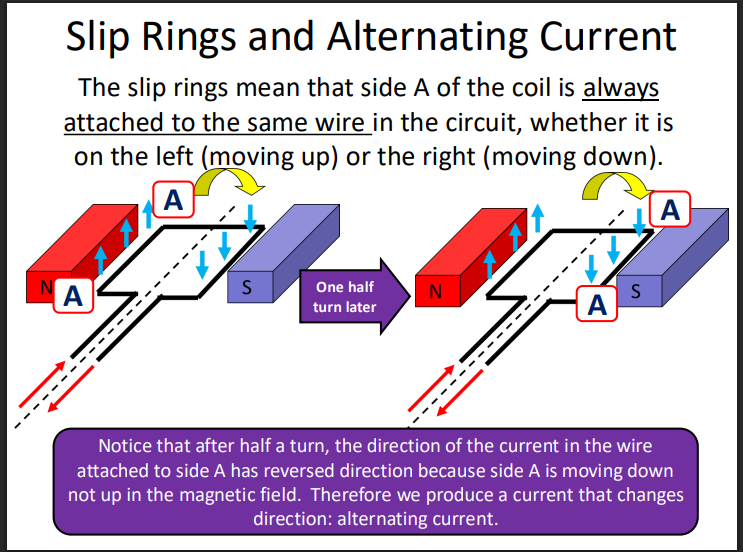
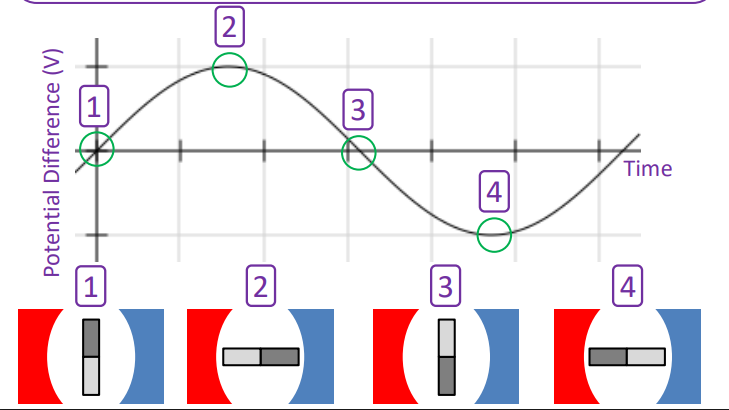
An Alternator:
The peak value is greatest when the plane of the coil is _______ to the direction of the magnetic field as the sides of the coil cross the __________ _______ ______.
This is shown at points 2 and 4.
When the plane of the coil is ___________ to the direction of the magnetic field then the sides of the coil move ________ to the magnetic field lines and the induced potential difference is _______.
This is shown at points 1 and 3.
parallel
magnetic field lines
perpendicular
parallel
zero
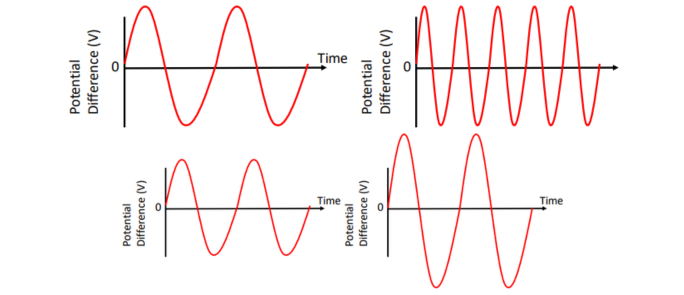
What happens when the coil in an alternator rotates faster? (2)
The more cycles per second
the higher the frequency
The bigger the peak value of the alternating current
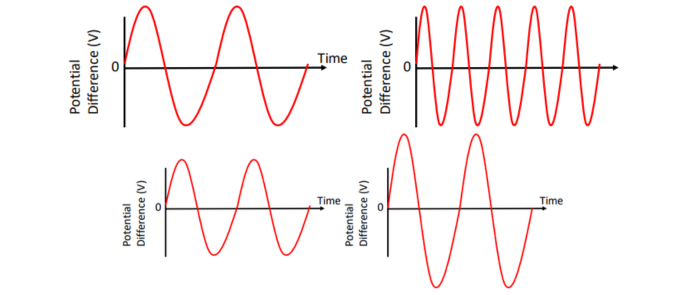
How can you increase the peak value of the alternating current in an alternator? (3)
Increasing the speed the coil rotates at
Using a stronger magnet
Using a coil with a bigger area or more turns on it
What do dynamos use to produce direct current?
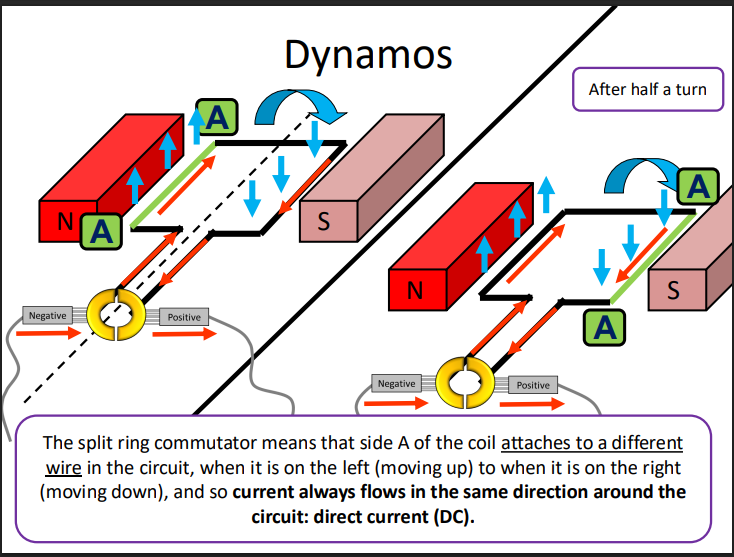
Split ring commutators
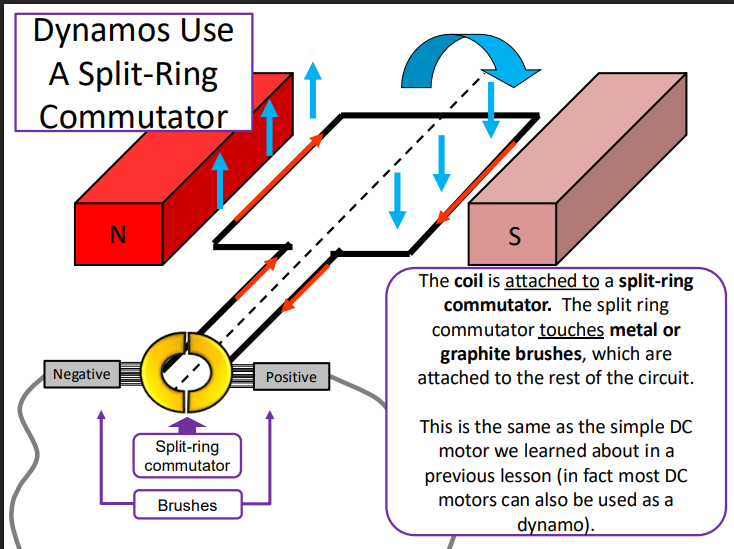
How does a split ring commutator produce a direct current?
It ensures that side A of the coil attaches to a different wire in the circuit, when it is on the left (moving up) to when it is on the right (moving down)
So current always flows in the same direction around the circuit: direct current (DC).
What is the difference between direct current from a cell and direct current from a dynamo?
Cell — The potential difference is constant and doesn't change over time.
Dynamo — The potential difference goes from zero to maximum twice in each cycle but never goes negative.
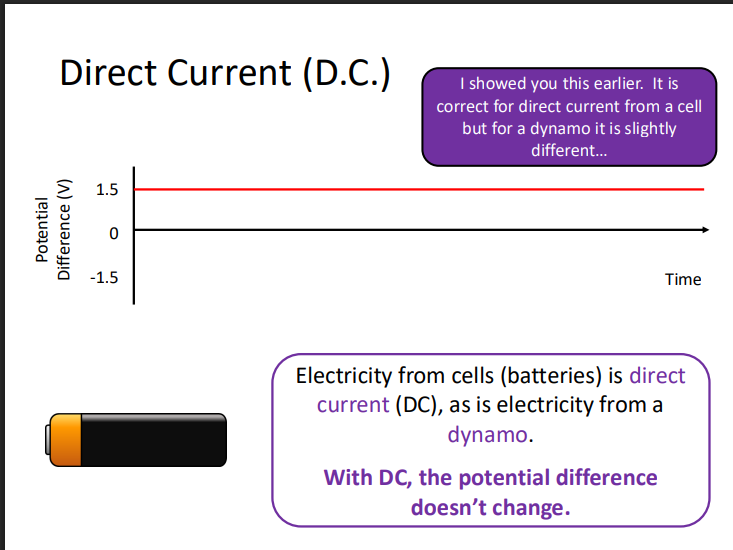
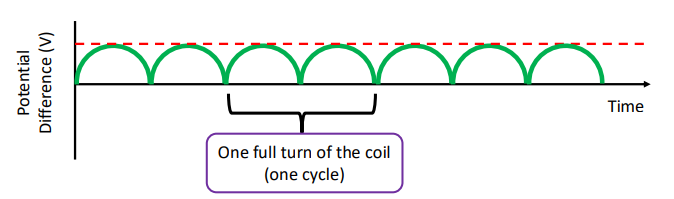
Direct Current from a Dynamo:
The induced potential difference does not reverse its __________, but goes from zero to maximum _______ in each cycle. It never reverses _______ unlike AC.
direction
twice
polarity
Fully explain how an alternator produces an alternating current.
A coil is moved in a magnetic field.
The coil experiences a change in magnetic field.
The coil ‘cuts’ through magnetic field lines.
This induces a potential difference.
If there is a complete circuit, then a current is also induced.
One side of the coil will always be attached the same side of the circuit,
therefore current in each wire flows forwards then backwards.
Fully explain how a dynamo produces a direct current.
A coil is moved in a magnetic field.
The coil experiences a change in magnetic field.
The coil ‘cuts’ through magnetic field lines.
This induces a potential difference.
If there is a complete circuit, then a current is also induced.
One side of the coil will attach to a different side of the circuit each half turn,
therefore current in each wire flows in the same direction each time.
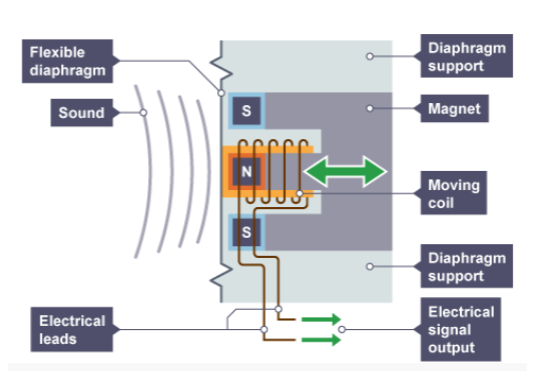
Microphones use the __________ effect to convert the __________ _________ in ________ _______ into variations in ________ in __________ _______.
generator
pressure variations
sound waves
current
electrical circuits
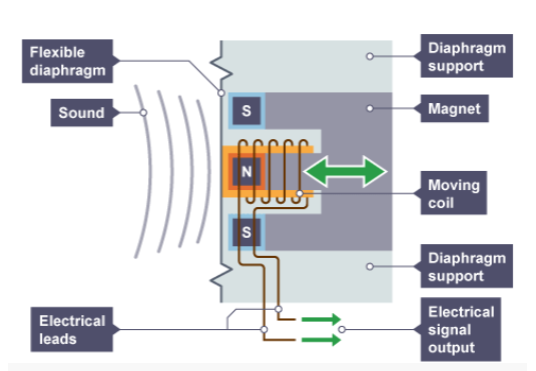
How does a microphone work?
Sound waves vibrate the diaphragm.
The diaphragm moves the coil.
The coil experiences a change in magnetic field.
The coil ‘cuts’ through magnetic field lines.
This induces a potential difference.
If there is a complete circuit, a current is also induced.
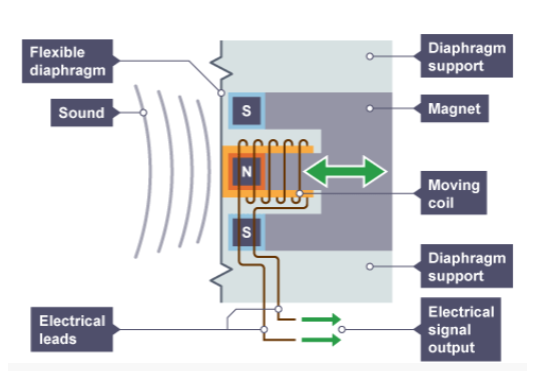
What does a basic transformer consist of?
A primary coil and a secondary coil wound on an iron core.
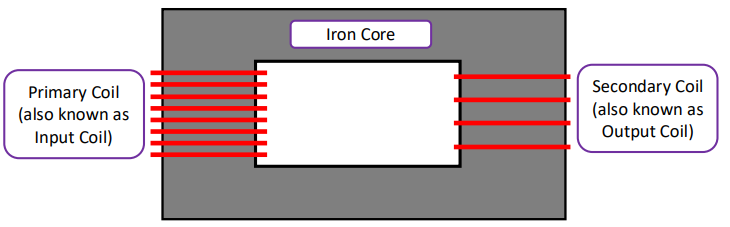
Why is iron used in a basic transformer?
It is easily magnetised.
What does the ratio of the potential differences across the primary and secondary coils of a transformer Vp and Vs depend on?
The ratio of the number of turns on each coil, np and ns.
The ratio of the potential differences across the primary and secondary coils of a transformer Vp and Vs depends on the ratio of the number of turns on each coil, np and ns.
What is the equation for this?
VsVp=nsnp
For this equation:
VsVp=nsnp
In a step-up transformer Vs __ Vp.
>
For this equation:
VsVp=nsnp
In a step-down transformer Vs __ Vp.
<
What would happen if transformers were 100% efficient?
The electrical power output would be equal to the electrical power input.
Transformers only work with __________ current.
alternating
What do transformers do?
They change the potential difference and current.
They lower one and increase the other (P = I × V).
They use electromagnetic induction to do so.
What does a step-up transformer do?
Increases alternating potential difference.
What does a step-down transformer do?
Decreases alternating potential difference.
How do transformers work?
A transformer is made of an iron core.
Two coils of insulated wire are wrapped around the core.
the coils are separate – current cannot flow from one coil to the other.
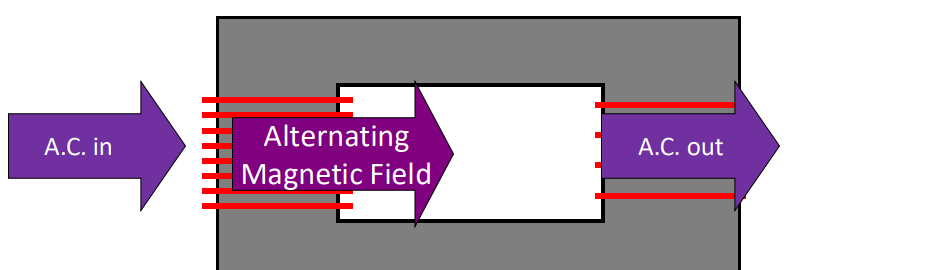
The primary coil is attached to an AC supply, the secondary coil is attached to a circuit.
EM-Induction in Transformers:
The alternating current in the primary coil induces an ____________ __________ ______ in the coil.
The _____________ ________ ______ lines pass through the second coil.
This induces an _____________ __________ _________ in the second coil.
If the second coil is connected to a _________ ________ an alternating current will be produced.
alternating magnetic field
alternating magnetic field
alternating potential difference
complete circuit
Why would transformers not work with direct current?
Direct current would produce a magnetic field that doesn’t change.
What is a step-up transformer?
A transformer where there are more turns in the secondary coil than the primary coil.
What is a step-down transformer?
A transformer where there are more turns in the primary coil than the secondary coil.
What is the equation for a 100% efficient transformer, and what does it represent?
Vs × Is = Vp × Ip
Where Vs × Is is the power output (secondary coil) and Vp × Ip is the power input (primary coil).
Why are step-up transformers used in the National Grid?
They increase the potential difference and decrease the current.
Lower current reduces the heating effect in the transmission cables.
This minimises energy loss, making the transmission of electricity more efficient over long distances.
Why must the coils on a transformer be insulating?
To prevent the electrical current from flowing directly into the iron core.
This ensures the current travels through the entire coil to properly generate a magnetic field.
It keeps the primary and secondary coils completely electrically separate from one another.
Write out VsVp=nsnp in full.
potential difference across primary coil / number of turns in primary coil = potential difference across secondary coil / number of turns in secondary coil
What happens to the potential difference if there are more coils in your secondary coil?
The potential difference increases
This creates a step-up transformer
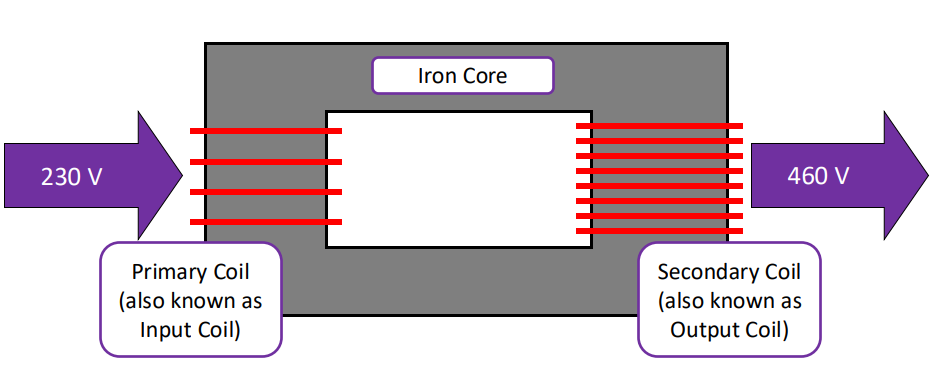
What happens to the potential difference if there are more coils in your primary coil?
The potential difference decreases
This creates a step-down transformer