Localisation of Function
 Call Kai
 Learn
Learn Practice Test
 Spaced Repetition
 Match
Match Flashcards
 Knowt Play
1/13

There's no tags or description
Looks like no tags are added yet.
Name | Mastery | Learn | Test | Matching | Spaced | Call with Kai |
|---|
No analytics yet
Send a link to your students to track their progress
14 Terms
structure of the brain
There are two cerebral hemispheres (cerebral cortex of each hemisphere is divided into 4 lobes)
Soft-avocado like texture
Corpus callosum allows communication between hemispheres
It is a bundle of nerve fibres, enabling messages to enter the right hemisphere to be conveyed to the left hemisphere and vice versa
what is the holistic theory
Perspective that the functions of the brain are a result of the brain working as whole
According to this perspective, functions cannot be assigned to specific brain regions as brain activity can only be understood in terms of the workings of the entire organ
Opposed to this argument are the concepts of localisation of function and hemispheric lateralisation
what is the theory of localisation of function
Localisation of function is the idea that different areas of the brain are responsible for specific physical and psychological functions (e.g. language, memory)
If a certain area of the brain is damaged, the function associated with that brain area will also be affected
There are three brain areas which receive information via electrical signals from sensory organs and converts them into physical sensations
One brain area sends impulses to control voluntary movements, all other brain areas are associated areas
brain structure image
look
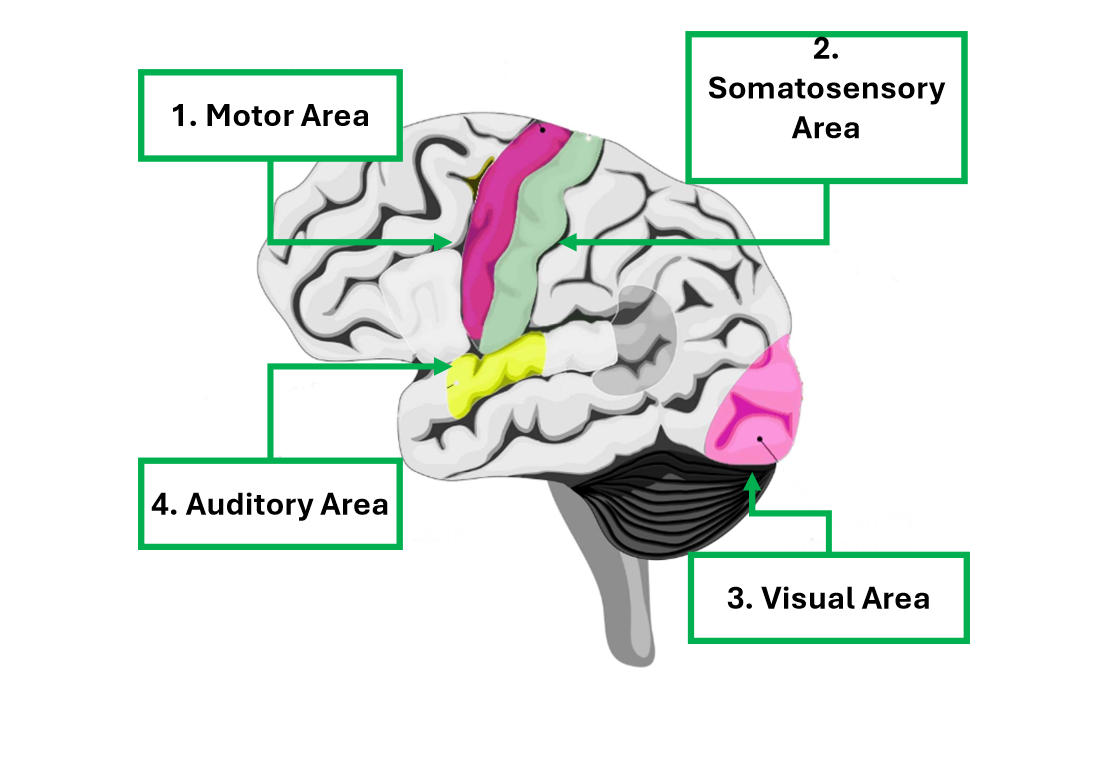
function of the motor cortex/area
Motor area - located in the frontal lobe on both sides of the brain
Responsible for voluntary movements by sending signals to the muscles in the body
Different parts of the motor cortex control different parts of the body
function of somatosensory cortex/area
Somatosensory area - located in the parietal lobe on both sides of the brain
Receives incoming sensory information from the skin
Produces sensations related to pressure, pain, temperature
Different parts of the somatosensory area receive messages from different locations of the body
function of the visual area/cortex
Visual area - located in occipital lobe on both sides of the brain
Receives and processes visual information (e.g. shape, colour, movement, arrangement of items in visual field)
Visual area contains different parts that process different types of information
RIGHT side of the brain processes info from LEFT half of the body (visual info from left side is processed in the right hemisphere)
LEFT side of the brain processes info from RIGHT half of the body (visual info from right side is processed in left hemisphere)
function of the auditory area/cortex
Auditory area - located in temporal lobe on both sides of the brain
Sound waves processed by the cochlea (inner ear) converted to nerve impulses are received by the thalamus
Then they travel to the auditory cortex
Responsible for analysing and processing acoustic information (e.g. loudness, tempo and pitch)
location of Broca’s and Wernicke’s
look
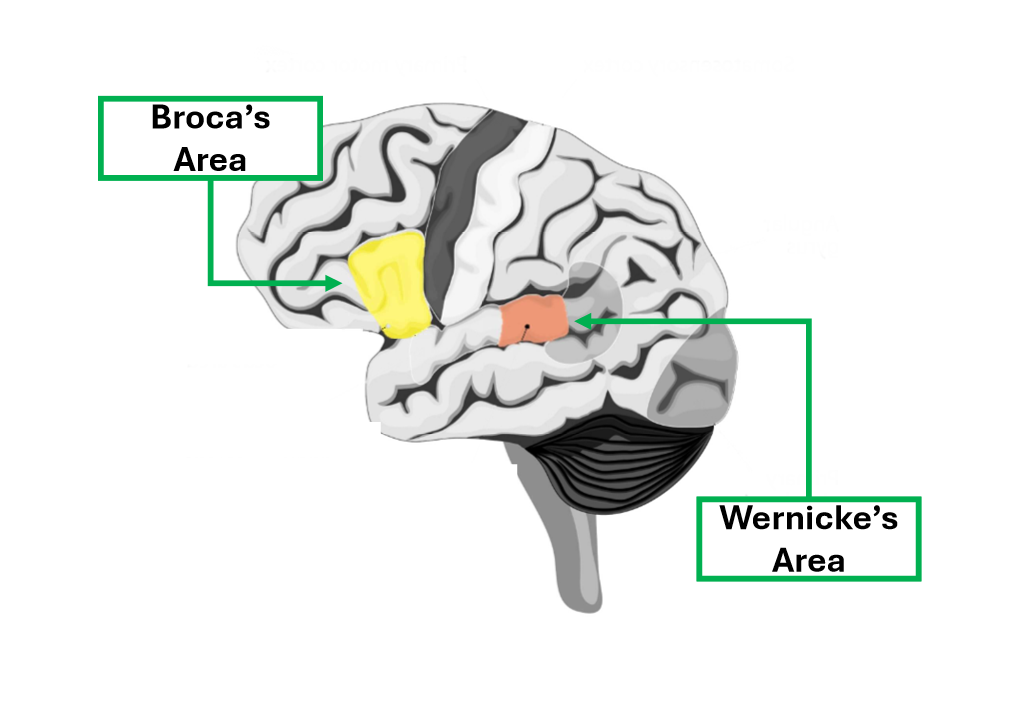
what is the Broca’s area
Broca's area - named after physician Paul Broca
Patient Tan - could only say 'Tan' (one syllable~) and otherwise unable to speak
Post-mortem examination, damage on left frontal lobe (Broca's area)
Responsible for speech production (referred to as the language centre)
Broca's aphasia - speech which is slow, laborious (takes times and effort) and is lacking in fluency
Difficulty in producing sounds and may only be able to make certain sounds
Speech reproduction (repeat this) may be easier than speech production (answer this)
what is the Wernicke’s area
Wernicke's area - named after physician/psychiatrist Carl Wernicke
Patients who had no problem with speech production but could not understand language that they are saying
Can understand other people's language
Their own speech is hindered because they want to say something, but they can't word it correctly and don't realise that they are not making sense (it seems to them that they are saying the right thing)
Lesion to left temporal lobe
Responsible for language comprehension
Wernicke's aphasia - produce nonsense words as part of their speech content
Speech is fluent but meaningless, language produced lacks meaning and may involve inappropriate/repeating words
how communication is impacted by the two areas
Ability | Broca's aphasia | Wernicke's aphasia |
Sign language production | Impaired - similar to speech production | Fluent but non-sensical |
Understanding sign language | Able to understand signs | Difficulty in understanding signs |
Writing | Impaired, slow and grammatically simple | Fluent but incoherent |
Understanding written language | Relatively preserved | Significantly impaired |
strengths of localisation of function
Wealth of case studies on patients with damage to Broca's and Wernicke's areas that have demonstrated that functions are localised
For example, Broca's aphasia is impaired ability to produce language; in most cases caused by brain damage in Broca's area
Wernicke's aphasia is an impairment of language perception, demonstrating the important role played by this brain region in the comprehension of language
Both Broca and Wernicke were physicians and their work was with patients who had these conditions so more valid
Patient Tan - one syllable speaking patterns due to the fact that he had a damaged Broca's area
However, case studies can be criticised for taking idiographic approach to research because it is difficult to generalise the findings from one unique individual to others who do not have the same impairments
Also not possible to make before and after comparisons to know to what extent cognitive deficits were only caused by lesion/brain injury
Suggests that some of the evidence supporting localisation of function lacks validity as many of the case studies cannot establish cause and effect between a particular cognitive problem and a certain area of the brain
Evidence from brain scans support the claim that some brain functions are localised
Petersen 1988 was able to show that Wernicke's area was active during listening tasks and Broca's area was active during reading tasks
Research into LTM suggests that semantic memories are stored in the prefrontal cortex, episodic memories stored in hippocampus and procedural memories in motor cortex
In contrast to case study evidence, evidence derived from the use of brain scans using larger samples with normal cognitive abilities is more objective in identifying localisations of functions
Also improves the generalisability of the findings
However, potentially cause-and-effect is harder to establish, and it only shows one day/snapshot
Provides sound scientific evidence that some mental functions are localised to different brain areas
weaknesses of localisation of function
Some psychologists argue that the idea of localisation fails to take into account individual differences
Herasty 1997 - found that women have proportionally larger Broca's and Wernicke's areas than men, which can perhaps explain the greater ease of language use amongst women
This, however, suggest a beta bias in the theory: the differences between men and woman were originally ignored
There is also large variability amongst people's pattern of brain activation when doing language tasks e.g. some people show neural activity in the right temporal lobe
Therefore we are unable to generalise research examining localisation of function to males and females equally, as the different brain structures/sizes suggest that different considerations are required when considering different people
Claim that functions are localised to certain areas of the brain has been criticised
Lashley 1950 proposed the equipotentiality theory, suggests that the basic motor and sensory functions are localised but higher mental functions are not
Claimed that intact areas of the cortex could take over responsibility for specific cognitive functions following brain injury
Shown when some humans regain cognitive abilities following damage to specific brain areas - functional recovery
Critics like Lashley argue that theories of localisation are biologically reductionist as they reduce very complex cognitive processes to one specific brain region
Brain imaging techniques show that language abilities are more holistically distributed throughout the whole brain than was originally thought
Language streams have been identified across the cortex, including regions in right hemisphere
Therefore casts doubt on theories about the localisation of functions, suggesting that not all functions are localised to just one region
Now thought to be more important to understand how areas of the brain work together rather than identifying separate functions

