Anatomy and Physiology exam 3

0.0(0)
Studied by 0 people
call kaiCall Kai
learnLearn
examPractice Test
spaced repetitionSpaced Repetition
heart puzzleMatch
flashcardsFlashcards
GameKnowt Play
Card Sorting

1/227

flashcard set

Earn XP

Description and Tags

UNI Dr. Cline-Brown

Last updated 9:40 PM on 4/1/26
Name
Mastery
Learn
Test
Matching
Spaced
Call with Kai

No analytics yet

Send a link to your students to track their progress

228 Terms

1
New cards

What are the functions of muscles?

movements, protection, heat production, joint stability

2
New cards

Why are muscles an organ?

2 types of tissues, has blood vessels, nervous tissue, and connective tissue

3
New cards

What characteristics do all muscles have?

extensibility, elastibility, excitability, contractability

4
New cards

Extensibility

can be pulled

5
New cards

Elastibility

can go back to normal shape

6
New cards

Excitability

can have electrical changes and send action potentials

7
New cards

Contractibility

the ability to contract

8
New cards

What are the 3 types of muscles?

smooth, skeletal, and cardiac

9
New cards

Characteristics of skeletal muscle

voluntary, mutinucleated, striated

10
New cards

Muscle fiber

a cell of muscle

11
New cards

Fascicle

a group of muscle fibers

12
New cards

Epimysium

a membrane that goes around a muscle

13
New cards

Perimysium

a membrane that goes around a fascicle

14
New cards

Endomysium

a membrane that goes around a fiber

15
New cards

Myofibril

a protein structure inside a muscle cell

16
New cards

What is the contractual unit of a muscle?

a myofibril (specifically sarcomeres)

17
New cards

What does the contraction for the myofibril?

myofilament

18
New cards

Types of myofilaments

myosin or actin

19
New cards

What are the functions of muscular fascia?

separate muscles from surrounding tissues and organs, reduces function between muscles, attachment point for skeletal muscles

20
New cards

Types of muscular fascia?

superficial fascia and deep fascia

21
New cards

Superficial fascia

under skin

22
New cards

Deep fascia

a tough layer between muscles

23
New cards

What is between fascicles?

blood vessels

24
New cards

Myoblasts

build skeletal muscle

25
New cards

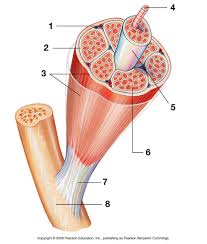
What is 1 pointing to?

blood vessels

26
New cards

What is 2 pointing to?

perimysium

27
New cards

What is 3 pointing to?

epimysium

28
New cards

What is 4 pointing to?

muscle fiber/cell

29
New cards

What is 6 pointing to?

fascicle

30
New cards

What is 5 pointing to?

endomysium

31
New cards
Sarcolemma
a plasma membrane of a muscle cell
32
New cards
What are the folds in the sarcolemma called?
t tubules
33
New cards
What do t tubules do?
allows ions or impulses inside to generate muscle contraction
34
New cards
Sarcoplasma
muscle cell plasma
35
New cards
Myoglobin
stores oxygen in muscle cells, caused the dark look
36
New cards
Glycosomes
stores glucose for muscle cells
37
New cards
Sarcoplasmic reticulum
goes around myofilaments and stores calcium for contraction
38
New cards
Terminal cisternae
enlarged portions on either end of the SR next to t tubules
39
New cards
Triad
2 terminal cisternae and 1 t tubule
40
New cards
Sarcomere
join end to end to form basic building blocks of microfibrils
41
New cards
What causes the striations in skeletal muscle?
sarcomeres
42
New cards
Actin myofilament
made of spherical shaped actin molecules, THIN
43
New cards
Myosin myofilament
pulls actin to make actin slide during contraction, THICK
44
New cards
What does calcium do for muscles?
causes contraction
45
New cards
What are the structure of actin?
2 actin chains twisted together, have an active site
46
New cards
Tropomyosin
a strand like protein in grooves created by the twisted actin that supports the chains, when muscle is relaxed it blocks the actin active sites
47
New cards
Troponin
binds tropomyosin, actin, and calcium. Allows muscle contraction
48
New cards
What is the function of myosin?
to slide actin towards the middle of sarcomere
49
New cards
What is the structure of myosin like?
2 golf clubs twisted together (myosin heads)
50
New cards
What do myosin heads do?
point towards the actin and grabs them
51
New cards

What is the myosin hinge region?

rod and head joining area, allows myosin head to flex towards rods

52
New cards
Components of myosin heads
actin binding site, ATP binding site, enzyme port to break down ATP
53
New cards
M line
the middle of the sarcomere
54
New cards
Z disks
the ends of the sarcomere
55
New cards
A band
where myosin and actin overlap
56
New cards
H zone
where there is only myosin (middle)
57
New cards
I band
where there is only actin (goes over the Z disks)
58
New cards
Crossbridge
the area where myosin heads bind with actin active sites
59
New cards
Titin
an elastic filament that acts like a spring so myofilaments don’t move out of alignment
60
New cards
List the parts of the muscle from smallest to largest
actin/myosin, sarcomeres, myofibril, muscle fiber, endomysium, fascicle, perimysium, epimysium
61
New cards
What is tropomyosin also known as, and why?
a regulatory protein, it can hinder or cause muscle contraction
62
New cards
What happens to the H zone when a muscle contracts?
gets smaller or disappears
63
New cards
What is the “sliding filament theory of muscle contraction”?
actin filaments slide over myosin, thereby shortening the sarcomere
64
New cards
Do actin and myosin filaments get shorter during contraction?
no, they slide over each other
65
New cards

What is the first step of muscle contraction (think inside a sarcomere)

a reason to contract causes Ca2+ flooding muscle cell and bind with troponin on actin.

66
New cards

What is the second step of muscle contraction? (think inside a sarcomere)

myosin heads to “cock” to bind actin active sites and form cross bridge

67
New cards

What is the third step of muscle contraction? (think inside a sarcomere)

Once actin has been pulled, the myosin heads will let go and bind an active site further up on the actin

68
New cards

Cross bridge cycling

all sarcomeres contract in unison to make a large muscle contract
69
New cards
What 2 molecules are needed for muscle contraction?
calcium and ATP
70
New cards
What happens if calcium or ATP is gone?
no muscle contraction
71
New cards
Neuromuscular junction
where a neuron and muscle meet, and where action potentials are exchanged
72
New cards
What is the “Excitation contraction coupling”?

skeletal muscle requires an impulse to contract, the impulse creates an action potential across the sarcolemma and SR triad that opens calcium channels that flood the cytosol of the muscle cell

73
New cards
What is the first step of Excitation Contraction Coupling?
A neuron sends an AP to skeletal muscle
74
New cards
What is the second step of Excitation Contraction Coupling?
T tubules release calcium into the cell
75
New cards
What is the third step of Excitation Contraction Coupling?
troponin binds with calcium allowing tropomyosin to bind
76
New cards
What is the fourth step of Excitation Contraction Coupling?
myosin heads bind to actin active sites (cross bridge)
77
New cards
What is the fifth step of Excitation Contraction Coupling?
myosin heads pull the actin, release, pull again (cross bridge cycling)
78
New cards
What happens in muscle relaxation?

Impulse stops,

calcium stops flowing (contraction stops)

troponin is released

and active sites are covered by tropomyosin

79
New cards

What causes rigor mortis?

decrease in O2 depressed ATP

without ATP the calcium leaks into cytoplasm

calcium bind troponin, and tropomyosin moves

allowing crossbridges to form.

Without ATP, the myosin heads can’t let go
80
New cards
Why does rigor mortis stop after a while?
tissues degrade to the point that myosin heads let go without ATP
81
New cards
Motor unit
a neuron and all the muscle cells it interacts with
82
New cards
What is the function of dendrites?
collect signals from other cells, neurons, and sensory receptors
83
New cards
What is the function of the axon?
passes signals
84
New cards
myelin/myelin sheath
a fatty substance that allows for faster movement of electricity
85
New cards
Terminal branches
the ends of the axon
86
New cards
Axon terminals
ends of the terminal branches
87
New cards
Neuromuscular junction
where the axon terminals interact with muscle cells
88
New cards
What do all motor units have in common?
all muscle cells are the same muscle, if the neuron sends an impulse ALL muscle cells connected contract
89
New cards
What is the difference between motor units?
differ in the number of muscle cells connected, and sensitivity to stimuli
90
New cards
What is the function of the neuromuscular junction?
where the motor neuron impulse is transmitted to muscle cells, and where the neuron axon terminal meets with the folded sarcolemma
91
New cards
Synapse
where an impulse is transmitted from one cell to another
92
New cards

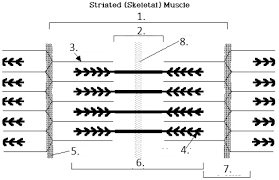
What is 1 pointing at?

a sarcomere

93
New cards

What is 2 pointing at?

H band

94
New cards

What is 3 pointing at?

actin filament

95
New cards

What is 4 pointing at?

myosin/myosin head

96
New cards

What is 5 pointing at?

Z disk

97
New cards

What is 6 pointing at?

A band

98
New cards

What is 7 pointing at?

I band

99
New cards
How many times does ATP break to form a cross bridge?
1
100
New cards
After the myosin heads form a cross bridge, how many ATP molecules are needed to break off and attach again?
1 (one to release and rebind)

Explore top notes