Psych 102 Week 1
 Studied by 0 people
 Call Kai
 Learn
Learn Practice Test
 Spaced Repetition
 Match
Match Flashcards
 Knowt Play
1/20

There's no tags or description
Looks like no tags are added yet.
Name | Mastery | Learn | Test | Matching | Spaced | Call with Kai |
|---|
No analytics yet
Send a link to your students to track their progress
21 Terms
Definition of psychology over time
“the science of mental life”
(William James, 1890)
“the study of human or animal behaviour”
(Webster’s Dictionary, 1988)
“Psychology is the science that studies behaviour and the physiological and cognitive processes that underlie it, and it is the profession that applies the accumulated knowledge of this science to practical problems.”
(Weiten & McCann, 2019)
four main goals of psychology
Description
Description of what they observe
Explanation
Explanation of why a mental process of behavior is occurring
Prediction
Prediction of the circumstances that lead to a certain behavior or mental process
Control
Provide advice on how to control behavior a mental processes
levels of psychological analysis
When studying behaviours and mental processes, psychologists can study the influences of:
The brain
Neuronal activity, brain structure, genes
The person
Emotions, ideas, thoughts
The group
Friends, family, population, environment, culture
birth of psychology
Wihelm Wundt (1832-1920)
Until the mid-1800's, psych-type questions were being investigated both by physiologists and philosophers
However, Wundt (trained as a physiologist) is considered to have created psychology as a unique and distinct field of inquiry.
Wilhelm Wundt
studied consciousness (one’s awareness of immediate experience)
established first independent psychology lab at University of Leipzig 1879
established first psychology journal 1881
Birth of psychology in North America
G. Stanley Hall (1844-1924)
established first research lab in US at John Hopkins, 1883
established first US psychology journal, 1887
established APA, 1892
Structuralism
task of psychology was to analyze consciousness into its basic elements/components and to investigate the relationship among these elements
Structuralism- Introspection
the careful, systematic observation of conscious experience
Edward Titchener
Functionalism
psychology should investigate the function of consciousness
“stream of consciousness”
Emphasized the functions of the mind adapting to a changing environment
Functionalist scientists used empirical methods that focused on the causes and consequences of behavior
Emphasis was also placed on studying animals, children, and individuals with mental disorders
Gestalt Psychology
Arose in Germany during 1920’s
Said consciousness CANNOT be broken down into elements
What if we are always perceiving things whole perceptual units?
The whole is greater than the sum of its parts
Learning is tied to what we perceive
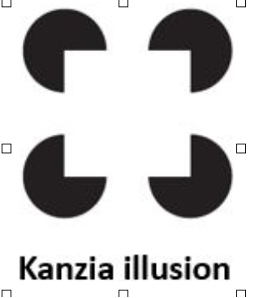
Gestalt Psychology- Kanzia illusion
This visual illusion causes your visual system to create a floating square that does not actually exist.
To see this for yourself, cover all four circles and the square will disappear.
Psychoanalysis: Sigmund Freud
Freud created a theory of personality and a method of psychotherapy known as psychoanalysis
Emphasizes unconscious motives and conflicts that influence behaviour
Freud’s beliefs were loved by many, AND hated by many
Mainstream momentum – Freud’s ideas had profound influence on psychology and beyond (medicine, art, literature, pop culture, etc.)
Prominent followers: Carl Jung, Alfred Adler
Much critique in academic circles due to poor scientific rigor and lack of supporting data
Behaviorism
Psychological research should only focus on behaviour you can outwardly observe
Determinism
focus on stimulus
often referred to as S-R psychology (i.e., stimulus-response)
positive/negative reinforcement-behaviourism
increases and punishment decreases the likelihood of a behavior
people of behaviourism
Ivan Pavlov (1849-1936)
Classical conditioning:
Discovered dogs could learn to associate a bell with an automatic behaviour (e.g., salivating for food)
John B. Watson (1878-1958)
Emphasized importance of “nurture” over “nature”
Conducted the “Little Albert” experiment, demonstrating that children (people) could be classically conditioned
B.F. Skinner (1904-1990)
Developed operant conditioning to shape behaviour
Used reinforcement to change the frequency of the expression of a behaviour
Albert bandura
Described learning by social observation in children
We now know that this type of learning can be observed in several species of primates
Humanistic Psychology
A greater focus on the capacity for personal, positive growth
Believe a person has the freedom to choose their destiny
Our subjective perceptions of the world are unique and are more important than behaviour itself
People of Humanistic psychology
Carl Rogers (1902-1987)
Developed “client-centred therapy”
The client is an equal, and a client’s thoughts and feelings should be mirrored
The atmosphere should have unconditional support and positive regard
Abraham Maslow (1908-1970)
Developed a theory of motivation that consists of a hierarchy of needs (ranging from basic to more complex)
Cognitive psychology
Cognitive psychologists compared the human mind to a computer, emphasizing cognitive development, problem-solving and mental processes
People of Cognitive Psychology
Jean Piaget (1896-1980)
was interested in how children come to develop cognitive abilities
Contemporary psychology uses various approaches
Cultural Psychology
The study of how cognitive processes vary across different populations due to socio-cultural environments
Cross-Cultural psychology
The study of the cognitive processes that are universal regardless of culture
Relevance of historical perspective?
Why bother learning about historical perspectives
Some ideas stand the test of time and are, therefore, still relevant
Some ideas are discarded or evolve, so understanding the origins helps us understand more fully where the field is now and where it might be heading
Learning about critiques of past events and approaches helps us be more critically-minded (and, hopefully, avoid the same mistakes!)
Consider as you study psychology this semester:
Whose voices are missing from the discussion?
What perspectives are not being considered here?
Could there be biases in the conclusions and, if so, how does that impact the interpretation?
 Note
Note  Flashcards (29)