Avian Exotics
 Call Kai
 Learn
Learn Practice Test
 Spaced Repetition
 Match
Match Flashcards
 Knowt Play
1/96

There's no tags or description
Looks like no tags are added yet.
Name | Mastery | Learn | Test | Matching | Spaced | Call with Kai |
|---|
No analytics yet
Send a link to your students to track their progress
97 Terms
What questions are asked when feeding captive birds?
What is consumed by the bird?
Are supplements provided?
How is food presented?
What is offered and how often (daily/weekly)?
Does the bird have a favorite food?
What are the required percentages of water, protein, lipid content, and calcium for psittacines?
Water- 2.4%
Protein- 10-15%
Lipid- 4-5%
Calcium- 0.5%
What is the recommended diet for passerines (granivorous)?
50% ½ seed and ½ pellets
50% vegetables> fruits
Dried insects as treats
Carotenoids for feather colour
State the drinking mechanism, recommended diet, and which type of columbiformes (granivores) require higher nutrient content?
Drink via suction
Commercial avian crumble or pellets, Seed and legumes, small quantity of diced vegetables and insects
High requirement for racing pigeons or laying females
What parameters are used to assess nutritional status of exotic birds?
Weight
BCS; keel and pectoral muscle mass
Skin and subcutaneous tissue for fat deposit
Feather quality and colour, presence of stress bars on feather shaft
List the diet for companion birds
Seed based mixes
Formulated diets
Pulse mixes
Fresh produce
What issues are associated with traditional seed based mixes?
>20% High fat content (Obesity, Atherosclerosis, Hepatic lipidosis, lipomas)
Chronic malnutrition
Fungal contamination possible (mycotoxins)
Inappropriate Ca/P, iron, copper, manganese, iodine (Hypocalcemia, Iodine deficiency)
Low vitamin A, C, D3, B (Hypovitaminosis A)
Low protein and amino acids (Plumage colour abnormalities, dry skin/hyperketatosis)
What are some disadvantages of formulated diet?
Cost, difficulties with transitioning, lack of variety, decreased forage opportunities
What are the constituents for pulse mixes?
Mix of beans (mung, soy, black-eye, chickpeas) soaked for 24hrs to allow sprouting.
What advantages and disadvantages of pulse mixes?
Pros: Increase digestibility
Cons: High carbs, low calcium, Increase change of microbial contamination
What is a recommended diet for psittacines?
75% formulated pellets
15-25% produce; more veggies than fruits
<5% healthy human food
1-2 nuts per day as treats
Possible recommendations converting to pellet diets
Gradual transition: 20-25% increments over 1-2 weeks at a time
Try various shapes, sizes, and colour pellets
Monitor weight and fecal output throughout
How often is molting and what can occur in malnourished birds?
Once a year
malnutrition → dull friable feathers → feather destructive behavior
What are the contributing factors to obesity in companion birds?
Reduced energy requirement in captivity
Selective feeding and inappropriate diet
What species of birds are commonly affected by obesity?
Budgies, cockatiels, cockatoos, amazon, african grey
What are some clinical signs associated with hypovitaminosis A in birds?
Squamous cell metaplasia
Blunted choanal papillae
Oral plaque
Pododermatitis
Uropygial gland impaction
Renal failure, air sac hyperinflation, recurrent URI
What are some physical signs of vitamin A deficiency?
Dry and flaky skin
Beaks and toenails grow rapidly but deformed
Abnormal feather colouration; amazon parrot
Brittle and friable feathers
Sources of vitamin A for birds
Spinach, Cod liver oil (2-3 times a week), pumpkin, mango, egg yolk
What clinical signs are seen in calcium deficient birds?
Reproductive disease
Seizures, tetany, cardiac arrhythmias
Impaired bone development
Which species of bird are susceptible to hypocalcemia?
African grey with hypocalcemic seizures
Cockatiels and lovebirds with egg binding
State the three causes of Ca deficiency
Too little Ca
Too little active Vitamin D
Too much P
Calcium metabolism is regulated by?
Vitamin D, parathyroid hormone, calcitonin
What are some clinical signs of nutritional secondary hyperparathyroidism?
Juvenile osteodystrophy, seizures, fractures, poor reproductive performances
What is the predisposing factor for hepatic lipidosis?
Diets high in saturated fats
State the diagnosis for hepatic lipidosis
Coelomic palpation, imaging
Serum liver enzymes, bile acids
Liver biopsy
What are the possible treatments for hepatic lipidosis?
Hepatoprotectives (milk thistle)
Diet changes
Supportive care
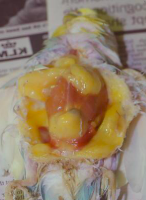
State the condition, species affected, lesions, diagnosis and treatment
Lipoma; benign proliferation of lipocytes
Budgies
Subcutis of the sternum and abdomen
FNA and cytology
Correct diet and exercise, iodine supplements to increase metabolism of fatty tissues, surgical removal
What are some risk factors associated with atherosclerosis in birds?
High energy, high fat diet
Dyslipidemia
Species predilection
Female >30 yrs
Low physical activity
What are some clinical signs associated with atherosclerosis?
Cardiac dysfunction, hypertension
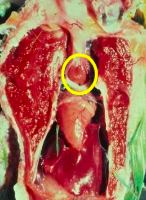
State the condition, species affected, clinical signs, diagnosis, treatment/therapy
Iodine deficiency (goiter)
Budgies on all seed diet
Cervical swelling, voice changes, dyspnea, regurgitation
History, physical examination
Oral iodine supplementation, lugol’s iodine in water, pink iodine blocks
Scales on the plantar surface of feet indicate?
Biotin deficiency
What are associated with stress bars?
Methionine and Hypovitaminosis D deficiency
Feather pecking is due to a deficiency in?
Sulphur containing amino acids; methionine and cysteine
What can cause splayed legs?
Excess Vitamin A and E
Cu and Manganese deficiency
Seizures, ascending paralysis and opisthotonos are caused by?
Thiamine deficiency
Pododermatitis and bumblefoot are caused by?
Hypovitamin A
Biotin
Excess fat
What parameters are evaluated in bird feces?
Colour
Volume
Consistency
Undigested food
What diagnostic tests are done in feces (fresh sample)?
Fecal float
Direct wet mount
Gram stain
Acid fast stain
Culture and sensitivity
EM
PCR for enteric viruses
What diagnostic tests are done in the oral cavity or crop?
Direct wet mount
Gram stain
Cytology
Culture and sensitivity
PCR
What are the predisposing factors for sour crop/ crop stasis?
Food fed at the wrong temperature or consistency
Not allowing the crop to empty between feedings
Poor hygiene
Incorrect incubation temperature
Humidity
Concurrent disease
What diseases cause plaques in the UGIT?
Poxvirus
Trichomoniasis
Vitamin A deficiency
Candidiasis
Capillariasis
Bacterial stomatitis
Mucosal papillomatosis
Neoplasia
Candidiasis is common in?
Young immunosuppressed lorikeets on antibiotics and high on sugar nectar
What lesions are common with candidiasis?
White oral plaque with caseous exudate
What are the species affected, organs involved, and etiological agent of trichomoniasis?
Pigeons, raptors, budgies
White caseous plaque in oral cavity, crop, esophagus, proventriculus
Trichomonas gallinae
Avian gastric yeast is caused by and state the characteristics
Macrorhabdus ornithogaster
Large cigar shaped
What are the organs affected and clinical signs of avian gastric yeast?
Proliferate at proventriculus isthmus and ventriculus
Chronic weight loss (going light)
Apathy
Whole seed fecal passage
Macrorhabdus ornithogaster affects which species of birds?
Psittacines (canary, toucan, zebra finch)
Passerines (budgies)
Columbiformes (pigeons)
Galliformes (broiler, turkey)
What are used to treat Macrorhabdus ornithogaster?
Oral amphotericin B for 10 days
Fluconazole
What bacteria cause enteritis and septicemia in psittacines?
Enterococcus hirae
What cause yellowish diarrhea and enteritis in psittacines, passerines and waterfowl?
Campylobacter jejuni
What does Clostridium perfringens cause in psittacines and ostriches?
Necrotic enteritis and foul smelling feces
Clostridium tertium cause what in cockatoos?
Megacolon and foul diarrhea
Clostridium species can cause
Lymphoplasmacytic inflammatory reaction in colon
What can be used to treat Clostridium?
Metronidazole and Clindamycin
What can be used to treat Isospora canaria and serini?
Trimethoprim sulfa drugs
Amprolium
Toltrazuril
Why is liver disease hard to detect early in birds?
A large percentage of liver tissue must be affected before clinical signs appear.
Birds on poor diets often already have reduced hepatic functional mass.
The liver’s ability to regenerate can mask early disease.
What history factors increase suspicion of hepatic disease in birds?
Dietary issues (poor diet, high fat, low protein)
Toxins (e.g., aflatoxins)
Medications or supplements
New animals (infectious risk)
Obesity
Duration & severity of illness
Key clinical signs of liver disease in birds
Anorexia
Lethargy
Weight loss or obesity
Coelomic distension ± ascites
Dyspnea (enlarged liver compresses air sacs)
Integumentary changes:
• Overgrown beak/nails
• Poor feather quality
• Darkened feather pigmentGI signs: PU, diarrhea, regurgitation
Neurologic signs (hepatic encephalopathy)
Why is icterus not seen in birds with liver disease?
Birds excrete biliverdin, not bilirubin.
Thus green/yellow urates or feces occur instead of jaundice.
Biliverdinuria can occur with hepatic disease OR hemolysis.
What causes abnormal bleeding in birds with liver disease?
Liver dysfunction → coagulopathies, leading to:
Bruising
Melena or fresh blood in droppings
Physical exam findings of avian hepatic disease
Hepatomegaly, especially on the right side
Coelomic distension ± fluid wave (ascites)
Dyspnea due to mass effect
Poor feathers, abnormal keratin growth
Weakness, depression
Diagnostic tests for avian liver disease
CBC: anemia, inflammation
Biochemistry: AST, cholesterol, bile acids, lipids, proteins
Radiographs: hepatomegaly, coelomic fluid
Ultrasound-guided FNA
Coelomic fluid analysis
Liver biopsy: gold standard
Coelioscopy: direct visualization + sample
Medical management — general support for liver disease
Fluid therapy
Maintain POTZ (temperature)
Oxygen supplementation if needed
Correct negative energy balance
Gavage feeding or tube feeding if necessary
Dietary management for hepatic disease in birds
High-quality, easily digestible proteins & fats
Low carbohydrates
High fiber
Ensure adequate caloric intake
Reverse catabolic state
Supplements used in avian liver disease
Vitamins B, E, K
Essential amino acids
Essential fatty acids
SAMe (S-adenosyl-methionine):
• Methionine/carnitine precursor
• Anti-oxidative, stabilizes hepatocyte membranesSilymarin (milk thistle): antioxidant
Denamarin® = SAMe + Silybin
Species most affected by iron storage disease
Toucans
Toucanettes
Aracari
Mynah birds
Birds of paradise
(Not all softbills are affected.)
Organs commonly affected in iron storage disease
Liver
Spleen
Heart
Excess iron accumulates as hemosiderin in hepatocytes + macrophages.
Causes of iron storage disease
Multifactorial:
Dietary excess
Genetic predisposition
Environmental factors
Often a combination.
Histological appearance of iron storage disease
Hepatocytes and macrophages heavily loaded with brown pigment
Pigment stains positive with Prussian Blue (iron-specific stain)
Clinical signs of iron storage disease
Lethargy
Anorexia
Ascites
Biliverdinuria
Severe hepatic enlargement or cirrhosis
Diagnostics for iron storage disease
Signalment + signs
CBC (often high Hct: 60–80%)
Biochemistry (↑ AST, ↑ bile acids)
Radiographs or ultrasound
Endoscopy
Liver biopsy with Prussian blue staining (definitive)
Serum iron + TIBC not useful.
Treatment of iron storage disease
Phlebotomy
Remove ~1% body weight
Often every 2 weeks lifelong
Chelators:
Deferoxamine (SC/IM) — limited success
Deferipirone PO 50 mg/kg q8h — effective in poultry/pigeons
Diet:
<80 ppm iron
Avoid citrus or foods increasing iron absorption
Provide tannins (e.g., tea)
Causes of bacterial hepatitis in birds and exotics
Usually secondary to:
Sepsis, or
Spread via enterohepatic circulation
Common organisms:
Gram negatives
Mycobacterium avium
Chlamydia psittaci (birds)
C. pneumoniae (reptiles)
Diagnostics for bacterial hepatitis
FNA or liver biopsy
Cytology & histopathology
PCR
Culture
Blood cultures if septicemia suspected
Species commonly affected by hepatic lipidosis
Birds:
Amazon parrots
Cockatoos
Budgerigars
Lorikeets
Reptiles:Savannah monitors
Bearded dragons
Chameleons
Monitors
All reptiles: during hibernation, vitellogenesis, illness.
Causes of hepatic lipidosis
High-fat, low-protein diet
Sedentary lifestyle
Nutrient deficiencies (EFAs, sulfur AAs, vit B & E)
Low carnitine
Hereditary factors
Negative energy balance from comorbidities
Clinical signs of hepatic lipidosis
Severe depression
Weakness, flaccid musculature
Regurgitation, diarrhea
Hepatomegaly
Distended coelom
Biliverdinuria
Poor body condition
Diagnostics for hepatic lipidosis
CBC: anemia, inflammation
Biochemistry: lipemia, ↑ AST, ↑ bile acids, abnormal proteins, ↑ uric acid
Imaging: radiographs, ultrasound, endoscopy
FNA or biopsy (definitive)
Histopathology
Treatment of hepatic lipidosis
Reverse negative energy balance
High-quality digestible protein
Fluid therapy
SAMe
Vitamins B & E
Long-term nutritional correction
What is the purpose of nebulization therapy?
To deliver medications directly to diseased tissues and hydrate airways to improve clearance of exudate and debris.
Common toxins affecting birds?
PTFE fumes (overheated non-stick cookware)
Cigarette smoke
Air fresheners, candles
Wildfire smoke
Vitamin A deficiency
What species are affected by avian chlamydiosis (zoonotic)?
Psittacines, turkeys, ducks, pigeons, cage birds, wild birds.
Which genotype of Chlamydia psittaci affects psittacines?
Genotype A
Transmission route for Avian chlamydiosis/ parrot fever?
Horizontal: primarily inhalation of chlamydia in feces and ingestion
Diagnostic methods for parrot fever?
Cytology showing intracytoplasmic inclusions (Giemsa/PVK stains)
PCR (cloacal + orochoanal swabs)
Culture (yolk sac inoculation)
IHC
Indirect immunofluorescence (but false positives possible)
What is used to treat parrot fever?
Doxycycline or azithromycin (intracellular penetration required).
What is used to treat aspergillosis?
Voriconazole
What are tracheal/ air sac mites?
Sternostoma tracheacolum
Which birds are most affected by air sac mites?
Finches and canaries
Clinical signs of air sac mites?
Clicking, wheezing, gasping, coughing, neck stretching.
What is the diagnostic test for tracheal mites?
Tracheal transillumination (wet the feathers).
Transmission route for poxviruses?
Mosquito vectors
Skin trauma
AI in turkeys
Aerosolized scabs
Cannibalism
What are the clinical forms of poxviruses?
Dry pox: scabs on comb, wattle, eyelids.
Wet pox: diphtheritic yellow plaques in mouth, esophagus, trachea → respiratory distress.
What are the histological hallmarks of poxviruses in exotics?
Bollinger bodies — eosinophilic intracytoplasmic inclusion bodies.
What are some characteristics of the bird brain?
Lissencephalic — smooth-surfaced; no cortical folding.
Cortical cells located within the cortex but not on the surface of the telencephalic complex.
Lack a neocortex; their cerebral cortex is relatively underdeveloped.
What is the corpus striatum responsible for in birds?
Association center — involved in learning, behavior, motor control.
Which non-parrot species have high neuron counts?
Corvids (songbirds): Raven, Rook, Jackdaw, Magpie.