PERCEPTION: ch. 11 - sound localization
 Call Kai
 Learn
Learn Practice Test
 Spaced Repetition
 Match
Match Flashcards
 Knowt Play
1/41

There's no tags or description
Looks like no tags are added yet.
Name | Mastery | Learn | Test | Matching | Spaced | Call with Kai |
|---|
No analytics yet
Send a link to your students to track their progress
42 Terms
What is the ACCESSORY STRUCTURE of the auditory system?
The Pinna
What is the PINNA (structurally)?
The external fleshy covering on each side of one’s head
What 3 FUNCTIONS does the PINNA serve? HOW are its functions SHAPED?
Acts as a funnel to catch sound waves and channel them into the ear
Provides minor amplification of the signal
May serve additional functions (such as heat dispersion)
Shaped by evolution to aid survival and reproduction
WHERE does AUDITORY TRANSDUCTION occur?
Outer ear
Middle ear
Inner ear
What STRUCTURES in OUTER EAR are in charge of AUDITORY TRANSDUCTION?
External Auditory Canal
Eardrum
What does the EXTERNAL AUDITORY CANAL do in AUDITORY TRANSDUCTION (1 functions)? What FREQUENCIES does it AMPLIFY? How BIG is it (height & diameter)?
Conducts/channels vibrations to middle ear
Amplifies certain frequencies–2000-5000 Hz
~1 inch long, 0.3 inch in diameter
What IS (structurally) the EARDRUM?
HOW does the EARDRUM CONDUCT its part of AUDITORY TRANSDUCTION?
What OTHER FUNCTIONS does it serve?
Thin, fibrous membrane–easily damaged
Vibrates in response to sound wave coming through external auditory canal
Ear’s only main defense against damage
WHAT STRUCTURE in the MIDDLE EAR helps AUDITORY TRANSDUCTION?
The ossicles
WHAT are THE OSSICLES composed of?
Three bones:
malleus,
incus,
stapes
What 2 FUNCTIONS do THE OSSICLES serve in AUDITORY TRANSDUCTION?
Receives and delivers vibrations (to oval window of cochlea)
Can decrease amplification to protect against very intense sounds
What is UNIQUE about the OSSICLES?
they can fuse/degenerate; a cause of conduction loss—They are replaceable!
WHAT STRUCTURE in the INNER EAR helps AUDITORY TRANSDUCTION?
The Cochlea
WHAT 2 FUNCTIONS does the COCHLEA serve in AUDITORY TRANSDUCTION?
Where Transduction Occurs–converts sound waves into neural responses
Origin of Auditory Nerve–takes signal to the brain
WHAT 3 STRUCTURES is the COCHLEA composed of? HOW MANY of each are there?
Three Canals
Three Membranes
One Critical Structure
WHAT THREE CANALS is the COCHLEA composed of? WHERE are they located?
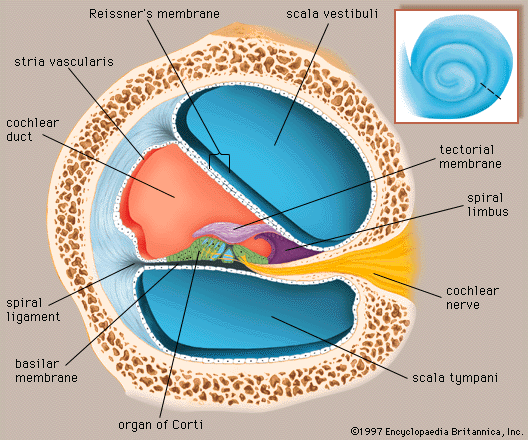
Scala vestibuli (upper)
Scala media (middle)
Scala tympani (lower)
Run the length of cochlea
WHAT THREE MEMBRANES is the COCHLEA composed of? WHERE are they located?
Reissner’s membrane–separates top & middle
Tectorial membrane
Basilar membrane–separates middle & lower; CRITICAL for processing
What CRITICAL STRUCTURE is in the COCHLEA?
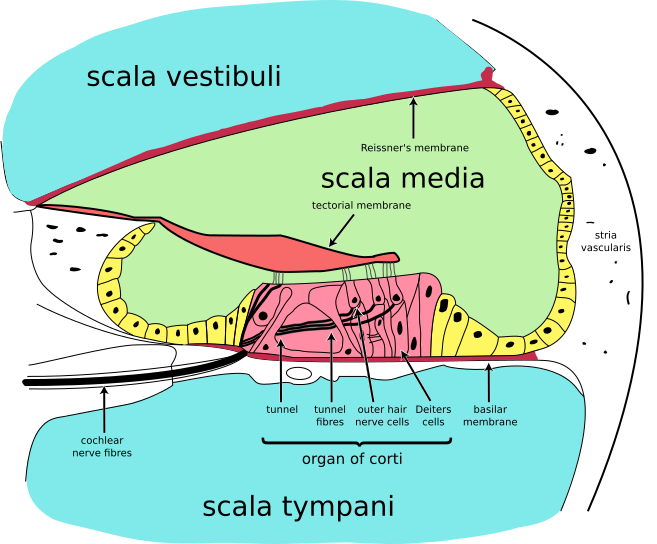
The organ of Corti
WHAT is the ORGAN OF CORTI (structure/location)?
Structure on the basilar membrane covered by the tectorial membrane
WHAT FUNCTION does the ORGAN OF CORTI serve in AUDITORY TRANSDUCTION? WHAT does it CONTAIN?
Conducts transduction–contians auditory sensory receptors
WHAT are the AUDITORY SYSTEM’S SENSORY RECEPTORS?
WHERE are they located?
HOW MANY RECEPTORS are there?
WHAT TYPES of receptors are there? HOW MANY are there of each type?
HOW MANY in TOTAL are there?
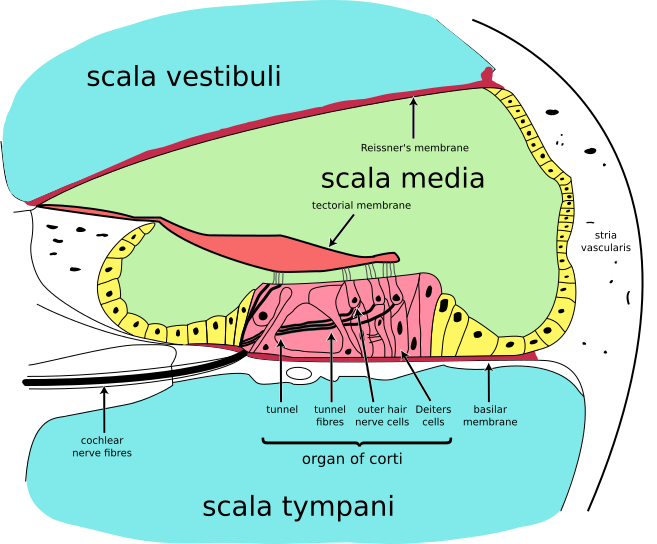
Columns of hair cells (cilia)
located in ORGAN OF CORTI
~24,000 NONREGENERATIVE hair cells
3500 inner (TRANSDUCERS); 20,000 outer hair cells (AMPLIFIERS).
50-300 cilia–OVER 1 MILLION total receptors
HOW does the INNER EAR conduct AUDITORY TRANSDUCTION? What do the structures DO?
hair cells making CONTACT with the tectorial membrane—sound waves making the basilar membrane rise
CONTACT = conversion from sensory energy to NEURAL RESPONSES
HOW SHOULD the HAIR CELLS touch the TECTORAL MEMBRANE in AUDITORY TRANSDUCTION? WHY?
GENTLY
Intense signals lead hair cells press too hard against the tectorial membrane—may cause damage (snapping)
HOW can the ORGAN OF CORTI be STIMULATED? HOW is it ORGANIZED - what does this MEAN?
WHERE do SIMILAR frequencies go?
WHERE do HIGHER frequencies go?
stimulated by bone conduction
Listening to voice in our head vs. in recordings
Organized tonotopically–specific frequencies are mapped to certain locations/nerve fibers
Similar frequencies in adjacent regions.
Higher frequencies closer to stapes.
What MODERN MEDICAL MIRACLE was made for the ORGAN OF CORTI?
Cochlear implants
What is the AUDITORY SYSTEM’S (4-step) TRANSMISSION PATHWAY TO THE BRAIN?
Superior Olive Complex
Inferior Colliculus
Medial Geniculate Nucleus (MGN) of Thalamus
Primary Auditory Cortex in Temporal Lobe
What FUNCTION does the SUPERIOR OLIVE COMPLEX have in AUDITORY TRANSMISSION?
Sound localization–VITAL
hindbrain
What FUNCTION does the INFERIOR COLLICULUS have in AUDITORY TRANSMISSION?
Auditory Reflexes
midbrain
What FUNCTION does the MGN of the THALAMUS have in AUDITORY TRANSMISSION?
Sensory Relay Station
midbrain
What FUNCTION does the PRIMARY AUDITORY CORTEX have in AUDITORY TRANSMISSION (through WHAT KIND of representations)? Where is it LOCATED?
processing of pitch and loudness—Tonotopical representations
Forebrain
HOW MANY AUDITORY SIGNALS do RECEPTOR CELLS respond to in PRIMARY AUDITORY CORTEX? WHICH 2 COMPONENTS OF SOUND does it help us code?
Each cell responds best to ONE tone (HOW WE CODE FOR FREQUENCY/PITCH)
WHAT SECONDARY AUDITORY CORTEX (structure)? What 2 FUNCTIONS does it have in AUDITORY TRANSMISSION?
Surrounds primary auditory cortex
Forebrain
sound localization
Analyzes complex combinations of sounds
What is CONDUCTION HEARING LOSS?
Problems in signal transmission (hearing actual sound)
What CAUSES CONDUCTION HEARING LOSS (5)?
External ear infection–Otitis externa (swimmer’s ear)
Middle Ear infection–Otitis media
Ruptured eardrum
Earwax buildup
Otosclerosis (abnormal bone growth)
What is SENSORINEURAL HEARING LOSS?
Damage to auditory nerve
What CONDITIONS EMERGE from SENSORINEURAL HEARING LOSS (4)?
Tinnitus (persistent ringing in ear(s))
Presbycusis (age related changes)
Hair Cell Loss, HBP, Diabetes, Medication Effects, Reduced Elasticity, Otosclerosis, etc
Noise-Induced Hearing Loss
Meniere's disease
HOW does the AUDITORY SYSTEM CODE (D.I.L.T.)?
Duration: Onset and offset of firing; well identified.
Intensity: Number of neurons firing and firing rate
Location: Excellent for both distance (firing rate) and spatial location (interaural time differences).
Type: Different types of sounds–speech, music, background noise
THROUGH WHAT COMPONENT OF SOUND do we ORGANIZE TYPES of sound?
by PITCH.
HOW do we code for PITCH? (2 theories)
Place Theory of Pitch Perception
Frequency Theory of Pitch Perception
WHAT is the PLACE THEORY OF PITCH PERCEPTION of AUDITORY CODING? WHERE do high & low pitches GET MAPPED?
What is its PROBLEM?
What is its REVISION?
Pitch perception = WHICH neurons fire—different pitches activate different places on the basilar membrane (von Helmholtz)
High pitch = base of cochlea
Low pitch = apex (top) of cochlea
PROBLEM = Doesn’t explain ability to make PRECISE PITCH DISCRIMINATIONS
REVISION = “Traveling wave form”: different frequencies peak at different locations along the basilar membrane. (von Bekesy)
WHAT is the FREQUENCY THEORY OF PITCH PERCEPTION of AUDITORY CODING?
What is its PROBLEM?
What is its REVISION?
Pitch Perception = neuronal firing RATE—Basilar membrane vibrates at the same frequency as the sound (Rutherford) –EX: vibrates 100x per sec. for 100 Hz sound
PROBLEM = LIMIT TO NEURON FIRING RATE LOWER THAN AUDITORY CAPACITY (1000x per sec. < 23,000 Hz)
REVISION = Neurons work together to match frequency (Wever)
WHICH of the 2 theories of AUDITORY CODING is CORRECT?
BOTH! (The Duplex Theory)
What is the DUPLEX THEORY of AUDITORY CODING? WHAT TYPE OF FREQUENCY corresponds to each component?
Neurons work together to match the original frequency–Combination of PLACE AND FREQUENCY THEORIES OF PITCH PERCEPTION
PLACE THEORY = higher frequencies
FREQUENCY THEORY = lower frequencies

