art of film final
 Studied by 0 people
 Call Kai
 Learn
Learn Practice Test
 Spaced Repetition
 Match
Match Flashcards
 Knowt Play
1/50

There's no tags or description
Looks like no tags are added yet.
Name | Mastery | Learn | Test | Matching | Spaced | Call with Kai |
|---|
No analytics yet
Send a link to your students to track their progress
51 Terms
What does the term mise-en-scène refer to?
French for “what is put into the scene,” “staging or putting on an action or scene”
Overall look and feel of a movie
Sum of what we see and experience
Everything we see in every shot –
every object, person, and their surroundings
how each of these components is arranged, illuminated, and moved around
What motivates the mise-en-scène?
The needs of a film’s story
The particular style of a certain director
The conventions of a specific genre
What are the four major components of mise-en-scène?
Design: the process by which the look of the settings, props, lighting, and actors is determined
Lighting
Composition: the organization of elements within a frame, including light, shape, color, and movement
Movement
What are the 3 aspects of lighting?
Quality
Ratio
Direction
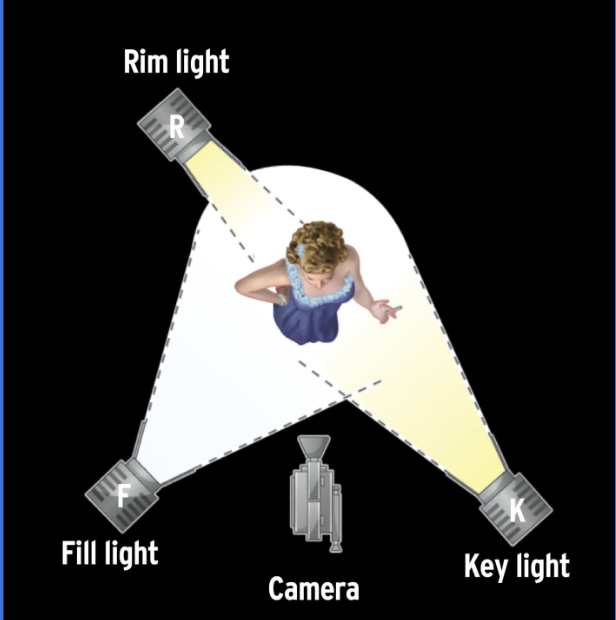
What is three-point lighting?
Key light, Fill light, backlight
What is soft versus hard lighting?
The spectrum between hard light…
Direct from the lighting source onto the subject
Creates clear, sharp borders between areas of bright illumination and dark shadows
High contrast, with details crisp and defined
…and soft light
Diffused
Beams of light are broken up or scattered on their way from the source to the subject
Low contrast, with illumination and shadow not fully distinct, and details thus less defined
Low-key versus high-key?
Low-key: high contrast effect when little or no fill light is used, so the ratio between bright illumination and deep shadow on the subject is high
High-key: produces an image with very little contrast between the darks and lights on the subject; relatively even illumination is unobtrusive, doesn’t call attention to itself
What is shot composition?
the organization, distribution, balance, and general relationship of objects, figures, light, shade, line, color, and movement within the frame
Types and rules of composition?
rule of thirds: Breaks frame into three vertical sections and three horizontal sections that provide a grid and guide with which filmmakers can balance visual elements in the frame
symmetry
compositional stress
What is deep versus shallow focus?
Deep focus - visual and narrative information placed on two or more of the three planes of depth – foreground, middle ground, and background
shallow focus - visual and narrative information placed on just one of the three planes of depth – foreground (and not middle ground or background)
What are the types of movement that impact mise-en-scène and what is the effect of such movement?
Movement – figure or camera – changes the shot composition
The shot compositions that emerge with movement must be planned out in advance
The shot compositions that emerge change our perception of elements that were until then arranged differently, i.e. when the camera reveals or conceals something
What is cinematography?
the process of capturing moving images on film or a digital storage device
every aspect of a movie’s pre-production – the script, casting, look of the film, set and costume design, shot composition – leads to the vital step of representing the mise-en-scène on film or video
What are the responsibilities of the DP?
Cinematographic properties of the shot – film stock, lighting, lenses
Framing of the shot – proximity to the camera, depth, camera angle and height, scale, movement
Speed and length of the shot — slow/fast motion, duration
Special effects – mechanical, optical, CGI
What is the difference between a shot, take, and a setup?
Shot: one unbroken span of action captured by an uninterrupted run of the camera
Take: the number of times a particular, planned shot is captured
Setup: one camera position and everything associated with it
What are the major differences between film stock and digital cinema?
Film stocks are available in various sizes and speeds, while there are a variety of digital media formats
Film stock has been the standard since the 1880s up until the advent of digital cinema in the 1980s, which became popularized after Star Wars I: The Phantom Menace (dir. George Lucas, 1999) was shot on a high-definition digital camera
By about 2012 at least half of top-grossing feature films were shot digitally, and today nearly all are
What is aspect ratio?
the proportional relationship between an image's width and its height, expressed as two numbers separated by a colon
What is color temperature and color grading?
Color Temperature: the degree of warmth or coolness reflecting light as different colors in a graded spectrum
The movie camera translates color differently than the human eye.
Choice of film stock, digital settings, or filters may be used to balance or cut out portions of the color spectrum.
Color Grading (correction): the process of altering and enhancing the color of a motion picture
Post-production manipulation of color may include changes to exposure, shadows, highlights, saturation, and hues.
What are the basic properties of camera lenses?
Lens: The “eye” of the camera that reflects subjects in front of the camera into images on the film or a sensor inside a digital camera
Aperture: An adjustable iris (or diaphragm) that controls the amount of light passing through the lens
The bigger the aperture, the more light it admits into the lens
Focal Length: Distance (in millimeters) from the center of the lens to a point on the film stock or sensor when the image is in focus
Focal length influences how we perceive perspective (depth) in a shot.
What are the four major lenses?
Short Focal Length (Wide-Angle Lens) - Produces wide-angle views and stretches appearance of depth
Makes subjects on screen appear farther apart than they are
Long Focal Length (Telephoto Lens) -Compresses appearance of depth, which makes distant subjects or objects on different planes of depth look closer to each other
Long lenses are literally long, bigger than camera itself
Middle Focal Length (Normal Lens) - Most shots in feature films use this lens
Creates images that correspond to our everyday experience of depth and perspective
Zoom (Variable-Focal-Length Lens) - Permits reduction or decrease of focal length of lens between takes or setups without having to change lenses
Changing the focal length during a shot makes the image “zoom” in or out, thus simulating the effect of movement toward or away from the subject
The short, long, and middle focal length lenses are considered prime lenses because they are used most often by feature films, whereas the zoom lens is not used as often except for in documentaries and documentary-style films
What do the four major lenses produce in terms of depth of field?
Short-focal-length lenses offer a nearly complete depth of field, rendering almost all objects in the frame in focus
Long-focal-length lenses have a narrow range for depth of field; focus upon one plane in particular makes others become blurry
What is framing?
The process by which the frame — boundaries and dimensions of the moving image — determines what and how we see elements on screen, which is shaped by borders including:
the four sides of the frame
the farthest visible depth in the image
the fourth wall behind the lens of the camera
Includes composition – the organization, distribution, balance, and general relationship of actors and objects within the space of each shot
what elements are involved in framing?
Requires decisions about several elements:
aspect ratio
implied proximity between camera and subjects on screen
depth of the composition
camera angle and height
relation between space within and outside of the frame
point of view
type of camera movement
What are different kinds of camera angles and POVs?
Eye-level – approximates how we see in everyday life
High-angle – looks down at the subject, bears the implications of that spatial relationship
Low-angle – positioned below eye-level, looking up at the subject, which also suggests various relationships
Dutch angle – tilted positioning so that horizontal and vertical lines on set appear as diagonals in the frame, causing the world on-screen to appear off-balance or misaligned
Birds-eye view or overhead/aerial shot – directly over the subjects from an elevated view
What are the aspects of camera movement?
Any movement of the camera within a shot changes the image because the elements of framing (shot types, angles, level, height) are modified.
Opens up cinematic space and introduces us to more details than would be possible with a static image
May follow the movements of a character or object
Leads the viewer’s eye, guiding which details we should look at or ignore
Conveys relationships between figures in the frame — spatial or causal
To make steady moving shots, the camera is usually mounted on a tripod or on a dolly, crane, car, helicopter, or other moving vehicle.
What are the types of camera movement?
Pan
Tilt
Dolly / Tracking
Crane
What is the difference between a zoom versus camera movement?
A zoom utilizes a lens that has a variable focal length, which permits the camera to shift from the wide-angle lens (short focus) to the telephoto lens (long focus) or vice versa
Not actually camera movement, but provides the illusion of the camera moving toward or away from the subject
The image is magnified or demagnified.
With dolly-in, the camera moves through space; with zoom-in, the camera doesn’t move and rather just magnifies.
Zoom shots depict movement through space differently than we experience it with our own eyes; a zoom shot can feel artificial.
What is the relation between on- and off-screen space?
The frame of the camera’s viewfinder indicates the limited boundaries of the camera’s framed perspective on the world.
On-Screen Space: space inside the frame
Offscreen Space: space outside the frame
The entire visual composition of a shot depends on the existence of both on-screen and off-screen space; both spaces are equally important to the composition and to the viewer’s experience of it
Characters may enter or exit the frame from any direction
The image on-screen may represent what a character off-screen is looking at
Sounds, shadows, characters, or context might hint at the presence of someone or something in the space off-screen
Suspecting that something may be hidden outside the frame can increase our participation in the unfolding narrative as we try to figure out who or what it is; creates suspense as we predict and anticipate, or surprise as the frame reveals information
What is the speed versus the length of the shot?
The speed of movement within the shot can appear faster or slower than normal speed.
A shot can be as long (in duration) as necessary to do its part in telling the story.
How are fast and slow motion cinematography achieved?
Slow motion - Achieved by filming at higher frame rate
To create a shot that appears at half the normal speed, the camera frame rate would be doubled to 48 fps and played back at 24 fps, taking up twice the screen time.
Often used to suggest a heightened awareness, impart significance, or suspend viewers in a moment that would otherwise be fleeting
fast motion - Achieved by filming at a lower frame rate
To create a shot that appears twice as fast, the cinematographer would shoot an action at 12 fps so that when projecting at normal speed (24 fps) the same action takes up only half as much screen time.
Often used for comic effect
Can suggest the passing of time or the idea that time is malleable
What is editing?
The process (art and technique) by which the editor selects, arranges, and assembles the visual, sound, and special effects to tell a story
Most editing is designed to go unnoticed
Because the sequential arrangement of shots can so effectively represent the unfolding action so as to seem effortless and inevitable, people often mistakenly think of editing as simply a selection and assembly process that removes mistakes and strings together the best takes
what are the basic building blocks of editing?
Shot: basic building block of film editing.
What is within the shot?
How is the shot situated?
Cut: the fundamental tool of film editing; either digitally or physically, editors join separate shots to form a continuous whole
The editor determines an in-point (the frame at which the shot will appear) and out-point (final frame we will see before the shot is replaced)
When watching a film, the cut is also the instantaneous transition from one shot to the next
Any edited version of a sequence, scene, or movie is also a “cut” of it
Coverage: multiple angles and shot types covering the same action
What is coverage and what is a shooting ratio?
Coverage: multiple angles and shot types covering the same action
Filmmakers plan and capture action in ways that facilitate editing
Coverage offers multiple angles and shot types of the same action in order to provide the editor freedom to select the best possible structure and form for each moment
Camera positions, framing, and blocking of different shots for a single scene are planned and executed in ways that ensure the editor will be able to preserve spatial and temporal continuity when constructing the scene
A commercial narrative feature film’s shooting ratio (proportion of footage shot to footage used in the completed movie) is commonly as high as 20:1 (for every 1 minute on-screen, 20 minutes has been discarded)
Can be even higher for stunt-heavy action movies
Documentaries are also lopsided because filmmakers capture unrehearsed activity and may enter the project with no clear idea of what story will ultimately emerge from their accumulated footage, so the story is largely discovered in post-production
What are the functions of film editing?
Organize fragmented action and events.
Create meaning through juxtaposition.
Create spatial relationships between shots.
Create temporal relationships between shots.
Establish and control shot duration, pace, and rhythm.
What are some types of fragmentation in the editing process? i.e. shot/reverse shot, parallel editing, montage or intellectual editing
Breaking up visual and narrative information into multiple shots that provide a diversity of combinations with which to convey meaning
Master scene technique: a method of capturing footage to construct a scene in which the action is photographed multiple times with a variety of different shot types and angles; allows the editor to construct the scene using the particular viewpoint that is best suited for each dramatic moment
Classical cutting: selecting from the coverage, the editor constructs the scene using the viewpoint best suited for each moment
Master shot: a shot (typically wide) showing the entirety of the action from beginning to end
Shot/reverse shot: a technique covering conversations from an angle that frames one character, and a complimentary, similar angle that frames the other character
Parallel editing (or crosscutting): two or more actions happening at the same time in different places
Intercutting: editing of two or more actions that take place at different locations and/or different times but give the impression of one scene
Flashbacks/flash-forwards: cutting away from the present scene to a scene of past or future events
What is the Kuleshov effect?
a filmmaking principle demonstrating that a viewer's interpretation of a shot is altered by its relationship to surrounding shots, rather than from the shot itself
What is the relationship of editing to space and time in film?
One of the most powerful effects of film editing is to create a sense of space in the mind of the viewer
No need for filmmakers to ensure that a real space exists whose dimensions correspond to the one implied by editing, because we are made to believe the entire space exists even show we are only shown fractions of the implied space
Spatial relationships between shots aid the viewer in developing a mental map of the physical space within the scene.
Example: placement of a shot of a person’s reaction (look of concerned shock) after a shot of an action by another person (falling down the stairs) creates in viewers’ minds the thought that the two people are occupying the same space.
Nearly every cut an editor makes provides an opportunity to expand or condense time
The pace of an exchange between characters can be sped up or slowed down by either trimming or maximizing the actor’s pauses between lines
Time nearly always elapses between the last shot of one scene and the first shot of the next
Unnecessary action—and the time it consumes—is routinely removed from within scenes in a way that we’ve become conditioned to accept and understand without even noticing the missing time
What is duration, pace, and rhythm in editing?
Duration of shots (in frames, seconds, or minutes) determines the speed with which audiences perceive a given sequence.
Pace: the speed at which a shot sequence flows, accomplished by using shots of the same general duration
Rhythm: applies to the practice of changing the pace, either gradually or suddenly, during a scene or sequence
The rhythm of scenes creates larger patterns of shot duration, patterns which can be built and broken for dramatic emphasis and impact.
What is the content curve?
the interplay between duration and the information that needs to be absorbed
the point at which we have absorbed everything we need to know in a particular shot and are ready to see the next shot
peak represents the optimum duration where a cut will typically occur, which editors often use
What are the conventions of continuity editing?
What happens on the screen makes as much narrative sense as possible
Keeps viewers oriented in space and time
Screen direction is consistent from shot to shot
Graphic, spatial, and temporal relations are logically maintained from shot to shot and scene to scene
Unfolds “invisibly,” – the spectator doesn’t question it because each film recombines familiar devices within fairly predictable patterns and the spectator will almost never be at a loss to grasp a stylistic feature
What are the conventions of discontinuity editing?
Emphasizes dynamic, often discontinuous relationships between shots, including contrasts in movement, camera angle, and shot type
Deliberately incorporates abrupt spatial and temporal shifts between shots, especially if doing so conveys meaning or provokes reaction
Instead of seeking viewers to forget they are watching a movie, discontinuity editing calls attention to itself as an element of cinematic form
Techniques: overlapping editing, elliptical cutting
What is montage or intellectual editing?
a film technique where unrelated shots are cut together to create a new, complex idea, concept, or meaning in the viewer's mind, going beyond the literal content of individual clips
What is the relation between continuity editing, discontinuity editing, and intellectual montage? Can these coexist in the same film?
distinct editing approaches that manipulate time, space, and meaning in different ways. They can and often do coexist within the same film, with filmmakers selecting the appropriate technique for a specific effect or scene.
What is the 180 degree rule?
Applies to both the movement of subjects in the frame and to the direction each subject faces in relation to other characters
If either is inconsistent from shot to shot, the scene risks losing its spatial coherence
Uses an imaginary line or axis of action
Once determined the camera remains on the same side of the line as it moves from position to position to capture different shots
As long as the camera stays within that circle, the characters on-screen will remain in the same relative spatial orientation
What is the 30 degree rule?
Camera should shift at least 30 degrees between different shot types of the same subject
Enough variation in framing avoids a jarring effect that makes the subject appear to “jump” forward or backward
What are the kinds of match cuts?
Match cut – carry an element from one shot into the next using action, graphic content, or eye contact
Match-on-action cut – cutting during a physical action helps hide the instantaneous and potentially jarring shift from one camera viewpoint to another
Eyeline match cut (POV editing) – logical and spatial connection between what a character looks at
Graphic match cut – repeating a similar shape, color, or other compositional element from one shot to the next
What is the difference between sound design, editing, and mixing?
Sound design: art of creating sound for a film
Sound is integral to all three phases of film production (preproduction, production, postproduction).
Sound editing: Editor: responsible for the overall process of editing and for the sound crew; also works with the musical composer(s)
Postproduction: usually when sound effects and music are created and/or added
Sound Mixing: Mixing: combining the different individual edited tracks of dialogue, sound effects, music, and so forth into one composite sound track to play in synchronization with the edited picture
Sound track: a single element on an individual track that can be combined in a multitrack sound design
The right balance of dialogue, music, and sound effects may result in an “audio mise-en-scene.”
What is diegetic versus nondiegetic sound?
Diegetic sounds: originate from a source within a film’s world
Gives an awareness of the spatial and temporal dimensions of the shot
Internal or external/onscreen or offscreen/recorded during production or constructed during postproduction
Heard by the movie’s audience and its characters
Nondiegetic sounds: come from a source outside a film’s world
Usually have no relevant spatial or temporal dimensions
Offscreen and recorded during postproduction
Assumed to be inaudible to the characters onscreen
What is onscreen versus off-screen sound?
On-screen sound: emanates from a source we can see
Offscreen sound: derives from an unseen source and may be either diegetic or nondiegetic
Diegetic offscreen sound: effects, music, or vocals that emanate from the world of the story
Nondiegetic offscreen sound: musical score or narration by someone who is not a character in the story
What is simultaneous versus nonsimultaneous versus asynchronous sound?
Simultaneous sound: diegetic (inside the world of the story); presented to audience at the same time as the corresponding image
Nonsimultaneous sound: also diegetic but is sourced from some other time (usually earlier) in the story
Asynchronous sound: intentionally exploits a discrepancy between a presented sound and the images and action on-screen
Example: In The 39 Steps (1935), a woman discovers a corpse, opens her mouth to scream, but instead we hear a train whistle. Then, we see a shot of a train speeding out of a tunnel. The asynchronous sound bridge links two simultaneous actions occurring in different places.
What is internal versus external sound?
Internal sound: occurs whenever we hear what we assume are the thoughts of a character within a scene
Interior monologue: variation on the mental, subjective point of view of an individual character that allows us to see the character and hear their thoughts in their own voice
External sound: comes from a place within the diegesis (the world of the story), and we assume it is heard by the characters in that world
What are some functions of film sound?
Helps the filmmaker tell a movie’s story, create its mood
Make the audience aware of the spatial and temporal dimensions of the screen
Raise expectations
Create rhythm
Develop characters
Cause viewers to have certain interpretations of the meaning
Maintain a sense of continuity between edited images
 Note
Note  Flashcards (150)