Exam 3: Female Reproduction
 Call Kai
 Learn
Learn Practice Test
 Spaced Repetition
 Match
Match Flashcards
 Knowt Play
1/74

There's no tags or description
Looks like no tags are added yet.
Name | Mastery | Learn | Test | Matching | Spaced | Call with Kai |
|---|
No analytics yet
Send a link to your students to track their progress
75 Terms
Estrous
The reproductive cycle in females that are an estrual species
Estrual species’
bovine, ovine, porcine, caprine, canine, and feline
Estrus of Heat
The period of time in which a female is sexually receptive to the male for the purposes of mating
Anestrous Period
The time when a female is not in estrus
the non-breeding season
Estrous Synchronization
Controlling the estrous cycle so that a high percentage of the females in the herd express estrus (receptivity) at the same time
Clone
An individual grown from a single somatic cell of its parent and genetically identical to it
A.I.
Abbreviation for artificial insemination, a common technique used in reproductive biology that involves placing semen into the reproductive tract of the female by artificial techniques rather than natural mating
E.T.
Abbreviation for embryo transfer, which is a procedure used to transfer embryos from a donor female to a group of recipient females
Haploid
Half the normal number of chromosomes.
found in sperm and ova
Open
refers to non-pregnant females
Fertility
The capacity to initiate, sustain, and support reproduction
Dystocia
Difficult birth
Intervention required
Vulva/ Vagina
Female organ for copulation; birth canal for parturition
Cervix
Passage way for sperm following breeding; seals off the uterus during pregnancy
Uterus
Secretory organ; incubator for embryo and placenta; control of cyclicity (leuteolysis which destroys the corpus luteum); contraction for parturition
Oviduct
passage for ovum and sperm, site of fertilization
Ovary
produces female gamete and female sex hormones (estrogen and progesterone)
Vulva
passageway for urine
receptor for the penis during copulation
expands at parturition for the delivery of the fetus
Not to be confused with the anus!
Vagina and cervix
Tissue is keratinized to protect against abrasion
Secretory
Provides barriers (main function of the cervix)
What is the site of semen deposition?
Fornix vagina (cow/ewe)
Does the vagina have glands?
No
Where do vaginal secretions come from?
Secretions come from the passage of plasma components as well as the cervix
What part of the reproductive system provided lubrication?
vagina
What is the pH of the vagina?
pH is acidic (5.7)- bacteriostatic
How does the vagina function as a birth canal?
Dilates for the fetus during parturition
What is the function composed on?
Composed of cartilage surrounded by soft tissue
Openings of the cervix:
Openings are the external of internal Os
What is the cervix a passageway for?
Passageway for sperm following breeding
Passageway for fetus
What does the cervix secrete?
Secretes mucous, seals off uterus during pregnancy
Do all animals have the same cervix?
No, different species have different configurations (rings, spirals, or folds)
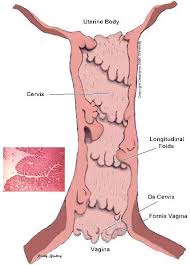
Components of a Cow cervix:
The cervix is very hard and rigid during estrus
composed of thick connective tissue
longitudinal folds
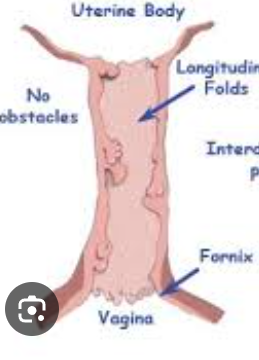
Components of a Mare cervix:
Longitudinal folds
There are no obstacles in the mare after the fornix vagina
Opposite of other species, as the cervix is soft and pliable during estrus
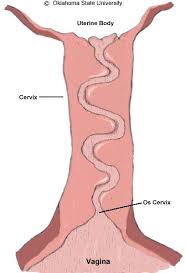
Characteristics of the Sow cervix:
“Cork screw”
Sow cervix has many interdigitating pads
Sow does NOT have fornix vagina
What is another word for uterus
Womb
Functions of the uterus
incubator for a fertilized ovum, nutrients for the ovum
aids the travel of sperm
secretory organ (hormones and mucus)
Look of the uterus
Has two horns or branches and a single body
shape differs between species
Advanced Duplex uterus species
opossum
Duplex uterus species
Rabbit, mouse
Bicornuate cervix species
Pig
Bipartite uterus species
cow, ewe, and doe
Modified bipartite uterus species
mare
Simplex uterus species
Human
6 functions of the uterus
transport sperm
muscle contractions
sperm motility
absorption and phagocytosis
partially prepares sperm for fertilization
provides an environment for the embryo
supports the development of the fetus
At birth, it expels the fetus
recovers from pregnancy
functions of the uterus: transport sperm
estrogen stimulates myometrial contractions so that sperm can move to site of fertilization
functions of the uterus: muscle contractions
towards the oviduct during estrus (heat), but following ovulation, they are toward the cervix until progesterone increases from CL
functions of the uterus: Sperm motility
Viable sperm (motile) are important so that they are not absorbed
functions of the uterus: absorption and phagocytosis
Occurs by uterine epithelium and leukocytes, which fight infection
functions of the uterus: partially prepares sperm for fertilization
Estrogen stimulates uterine secretions which capacitate sperm (zona pelucida)
functions of the uterus: provides environment for the embryo
uterine secretions stimulated by estrogen and progesterone
proper timing of embryo and uterus is important for embryo transfer
functions of the uterus: supports development of the fetus
Quiescent myometrium- progesterone
immunological protection from rejection by the maternal immune system
functions of the uterus: at birth expels fetus
strong rhythmic myometrial contractions (progesterone low)
functions of the uterus: recovers from pregnancy
Uterine involution- myometrial contractions and enzymatic activity shrink the uterus back to normal size
If the female is not pregnant, what happens to the CL
Uterine endometrium releases Prostaglandin (PGF2) to cause the CL to regress
If the female is pregnant, what happens to the CL?
Embryo provides a chemical signal (interferon tau) that allows the CL to be maintained
Oviduct
Tube that connects the ovary to the uterus
What are the 3 distinct regions of the oviduct?
Infundibulum
Ampulla
Isthmus
Infundibulum
Surrounds the ovary
Ampulla
Transport oocyte
Isthmus
Transport sperm
Significance of the Ampulla-Isthmus junction
It is the site of fertilization
What are the two main regions of the ovary?
Cortex and medulla
Cortex
outer on all except mare
produce the female gamete (ovum or oocyte)
released from the follicle
includes ovarian structures
Produce hormones
Medulla
inner on all- except mare
support tissue including blood vessels and immune cells
How many ovaries do farm animals have?
2
What surrounds the ovary?
Surrounded by connective tissue called the tunica albuginea
What does the ovary produce?
Produces female gamete (the ovum)- largest single cell in the body
Produces female sex hormones (estrogen and progesterone)
Follicle structure
Blister-like structure on ovary that contains ovum and hormone rich fluid
3 types of follicles
Graafian- mature follicle
Atrophic- deteriorated follicle
Cystic- continuous Corpus Luteum or Graafian or Atretic structure (uncontrolled growth, failed ovulation)
Corpus Luteum
solid tissue which is composed of luteal cells that originate from granulosa and theca cells of the Graafian follicle
Corpus Luteum functions
Produce progesterone to:
inhibit estrus and parturition
block myometrial contractions
stimulate endometrial secretion of nutrients
stimulate the production of luteolytic agent to kill the CL if no embryo is present
Prostaglandin (PGF2a)
Mare ovary
Single ovulation from the interior cortex is funneled to the oviduct via a specialized structure called the ovulation fossa
Sow Ovary
Multiple ovulations from the cortex located on the exterior or surface of the ovary
“popcorn”
Follicle development summary
Follicles develop on the ovary and undergo stages of maturation until one becomes a Graafian follicle
What happens to follicles not selected for ovulation?
Follicles not selected for ovulation become atritic and regress
Where will the follicles transition through following ovulation?
Following ovulation (when the oocyte is released from the follicle), the follicles will transition through the CH, CL, and CA structures

