Key Etherum Concepts
 Call Kai
 Learn
Learn Practice Test
 Spaced Repetition
 Match
Match Flashcards
 Knowt Play
1/119

There's no tags or description
Looks like no tags are added yet.
Name | Mastery | Learn | Test | Matching | Spaced | Call with Kai | Chat |
|---|
No analytics yet
Send a link to your students to track their progress
120 Terms
What are the two types of Ethereum accounts?
Externally Owned Accounts (EOAs)
Contract Accounts (Smart Contracts)
What is an EOA?
An EOA is a user-controlled account (your wallet). It’s controlled by a private key.
What can an EOA do?
An EOA can:
Send and receive ETH
Start transactions
Interact with smart contracts (call their functions)
How do people usually access an EOA?
Through wallet apps like MetaMask or Ledger.
What is a Contract Account?
A Contract Account is a smart contract controlled by code, not a private key.
What can a Contract Account NOT do?
It cannot initiate transactions by itself.
So how does a smart contract run?
It only runs when an EOA calls it (when you send a transaction to it).
What does a Contract Account “store”?
It stores:
Logic (rules like “if paid, then deliver”)
State (data it remembers on-chain, like balances, ownership, booking status)
What is the EVM?
The Ethereum Virtual Machine (EVM) is the global execution engine where all smart contracts run.
What does the EVM do in simple terms
t processes transactions and executes smart contract code the same way on every node.
Why does “every node runs the EVM” matter?
Because it ensures everyone gets the same result, which helps the network reach consensus (agreement on what happened).
What language are smart contracts commonly written in?
Solidity (and others), but Solidity is the main one mentioned.
What does it mean that the EVM is “isolated”?
The EVM runs in a sandbox, meaning it:
Cannot access the internet
Cannot read your computer files
Only interacts with on-chain data
Why is EVM isolation important?
It improves security — smart contracts can’t spy on you or pull random external data directly.
What is Ether (ETH)?
Ether (ETH) is Ethereum’s native cryptocurrency. It powers transactions and smart contracts on the Ethereum network.
What does “native token” mean?
It means ETH is the built-in currency of Ethereum. The network runs using ETH.
What is the smallest unit of Ether?
The smallest unit is Wei.
How many Wei are in 1 ETH?
1 ETH = 10¹⁸ Wei
In what unit does Ethereum execute internal transactions?
All internal calculations are done in Wei, not ETH.
What is the first key use of ETH?
Paying transaction fees (gas fees).
What are gas fees?
Gas fees are payments made in ETH to execute transactions or smart contract operations.
Why are gas fees necessary?
They:
Compensate validators
Prevent spam
Ensure network security
No gas = no transaction.
What is the second key use of ETH?
Running smart contracts and decentralised applications (dApps)
Why is ETH needed for smart contracts?
Because every operation in a smart contract costs computational power, which must be paid for in ETH.
What is the third key use of ETH?
Staking in Proof of Stake (PoS
What does staking mean?
Validators lock up ETH to help secure the network and validate transactions.
Why do validators stake ETH?
To:
Secure the network
Propose and verify blocks
Earn rewards
What does “Ether powers all applications” mean?
Every app on Ethereum — from simple payments to complex DeFi platforms — requires ETH to function.
Why is ETH still often used as money?
Because of its high utility and demand within the Ethereum ecosystem.
Why is ETH considered valuable?
Because:
It is required for all transactions
It secures the network
It powers all smart contracts
It has high demand due to network usage
What consensus system does Ethereum use now?
Ethereum uses Proof of Stake (PoS).
It replaced Proof of Work (PoW) in 2022 during The Merge.
What changed from PoW to PoS?
PoW → miners + computers
PoS → validators + staked ETH
Mining was removed and replaced with staking.
Who secures the network in PoS?
Validators secure the network.
They lock up ETH as a guarantee of honest behaviour.
How much ETH is needed to become a validator?
32 ETH (minimum stake) is required.
This allows participation in block validation.
Why do validators have to stake ETH?
Because it gives them financial risk.
If they cheat → they lose money.
If they are honest → they earn rewards.
This creates security.
How are new blocks created in PoS?
Through random selection.
A validator is randomly chosen to propose the next block.
What happens after a block is proposed?
Other validators check and verify the block.
If they agree → the block is added.
This is consensus.
How is consensus reached in PoS?
One validator proposes a block
Others verify it
Majority agreement confirms it
So the network agrees on one history.
How do validators get rewarded?
Honest validators earn ETH rewards.
They are paid for:
Proposing blocks
Verifying blocks
Staying online
When does slashing happen?
If a validator:
Cheats
Tries to attack the network
Signs invalid blocks
Is seriously negligent
They lose ETH.
Why is PoS more energy-efficient than PoW?
Because it does NOT require mining machines.
No heavy computation.
No massive electricity use.
Just staking + validation.
Why is PoS sometimes called “plutocratic”?
Because “plutocracy” means “rule by the rich”.
In PoS:
More ETH → more validating power.
So wealth gives power.
What is a validator in Ethereum?
A validator is a node that helps secure the network by proposing and verifying blocks after staking ETH.
How does someone become a validator?
By staking ETH and joining the validator set.
You must:
Lock up ETH
Run a validator node
Stay online and honest
Why do validators have to stake ETH?
Staking creates financial responsibility.
If they behave honestly → earn rewards
If they cheat or fail → lose ETH
This keeps the network secure.
Why are validators randomly assigned?
To prevent manipulation and attacks.
Random selection makes it hard to control the network.
How do validators earn rewards?
They earn ETH by:
Proposing valid blocks
Attesting to blocks
Staying active
Honest participation = income.
What is slashing?
Slashing is a punishment where a validator loses part of their staked ETH.
What happens to inactive validators?
They lose small amounts of ETH over time.
Being offline = penalty.
What is an epoch in Ethereum?
An epoch is a time period in Proof of Stake that contains 32 slots (blocks).
Think of it as a “working round” for validators.
What is a slot?
A slot is a short time window where one block can be proposed.
32 slots = 1 epoch.
What is a checkpoint?
A checkpoint is a special block at the end of an epoch that validators vote on.
It helps confirm the blockchain’s history.
What does “finality” mean?
Finality means a block is permanently confirmed and cannot be reversed.
Once final → it stays forever.
How is finality achieved?
When 66% (two-thirds) of the total stake confirms a checkpoint.
This is a supermajority.
What is a validator committee?
A committee is a group of validators selected for each epoch to vote on blocks.
They:
Check blocks
Vote on validity
Help reach consensus
How are blocks finalised in Ethereum PoS?
Through a voting process by validators.
At least 66% of the total staked ETH must agree for a block to become final.
Why are checkpoints important?
Because they help “lock in” previous blocks.
When a checkpoint is approved, earlier transactions become irreversible.
How are block proposers and committees chosen?
They are selected randomly for each epoch.
Why is random selection important?
It prevents manipulation.
If selection were predictable:
Attackers could plan attacks
Powerful validators could cheat
Randomness keeps the system fair.
What is RANDAO?
RANDAO is an algorithm that helps generate random numbers for validator selection.
Why does Ethereum need RANDAO?
To make selection semi-random and unpredictable.
Validators do not know in advance when they will be chosen.
What makes Ethereum PoS secure?
66% finality rule
Checkpoint voting
Random validator selection
Slashing penalties
RANDAO randomness
Together, these discourage attacks.
How much energy does PoS save compared to PoW?
PoS reduces Ethereum’s energy use by about 99.9%.
Why does PoS use so much less energy?
Because it does not use mining.
No:
Complex calculations
Mining farms
High electricity use
Validators only stake and verify.
Why was PoW hard to enter?
Because you needed:
Expensive GPUs/ASICs
Large electricity supply
Cooling systems
This favoured big companies.
Why is PoS easier to join?
You only need:
ETH to stake
A normal computer
Internet connection
No mining hardware.
How does PoS improve scalability?
PoS creates the foundation for:
Layer 2 rollups
Sharding
These increase transaction capacity.
Why couldn’t PoW scale well?
Mining was slow and resource-heavy.
It limited how fast blocks could be processed.
How do Layer 2 and sharding help?
Layer 2 → moves work off the main chain
Sharding → splits data across chains
Both reduce congestion and fee
How is PoS more secure than PoW?
Because attacks require controlling large amounts of ETH.
This is very expensive.
What is a “51% attack” in PoS?
When an attacker controls more than 51% of staked ETH.
They could try to manipulate the blockchain.
Why is this unlikely in PoS?
Because buying 51% of all staked ETH would cost billions.
It is financially unrealistic.
What happens if attackers try anyway?
They risk:
Slashing
Losing huge amounts of ETH
Destroying their own investment
So attacks are discouraged.
How does PoW hardware reduce censorship resistance?
Mining farms are visible and centralised.
Governments can pressure or close them.
PoS runs on normal computers worldwide.
What are gas fees in Ethereum?
Gas fees are payments made in ETH to run transactions and smart contracts on the Ethereum network.
They pay for computational work.
Why do gas fees exist?
as fees exist to:
1⃣ Pay validators for processing transactions
2⃣ Prevent spam and network abuse
3⃣ Maintain network security
Without fees, the network could be flooded.
: How do gas fees prevent spam?
Every action costs money.
So attackers can’t send millions of fake transactions for free.
Why do gas fees improve security?
Because validators are rewarded for honest work.
This encourages them to maintain the network.
In what unit are gas fees measured?
Gas fees are measured in Gwei.
What is Gwei?
Gwei is a small unit of ETH.
1 Gwei = 0.000000001 ETH = 10⁻⁹ ETH
What is the gas limit?
The gas limit is the maximum amount of computational work you are willing to pay for.
It sets a spending cap.
Who sets the gas limit?
The user sets the gas limit when sending a transaction.
Wallets often suggest a value.
: What happens if the gas limit is too low?
The transaction fails, but:
❗ You still pay the gas used.
No refund.
Why do you still pay if it fails?
Because validators still did the work.
They must be paid for computation.
How does network demand affect fees?
More users = more competition = higher fees.
When many people use Ethereum at once, gas becomes expensive.
Why do smart contracts cost more than transfers?
Because they require more computation.
Simple ETH transfer = low gas
Complex contract = high gas
What is the base fee?
The base fee is the minimum fee required by the network.
It changes automatically based on demand.
What is the priority tip?
The tip is extra ETH paid to validators to process your transaction faster.
: What does the graph show?
It shows that Ethereum’s daily average gas limit has steadily increased from 2015 to 2026.
This means blocks can now handle significantly more computation than before.
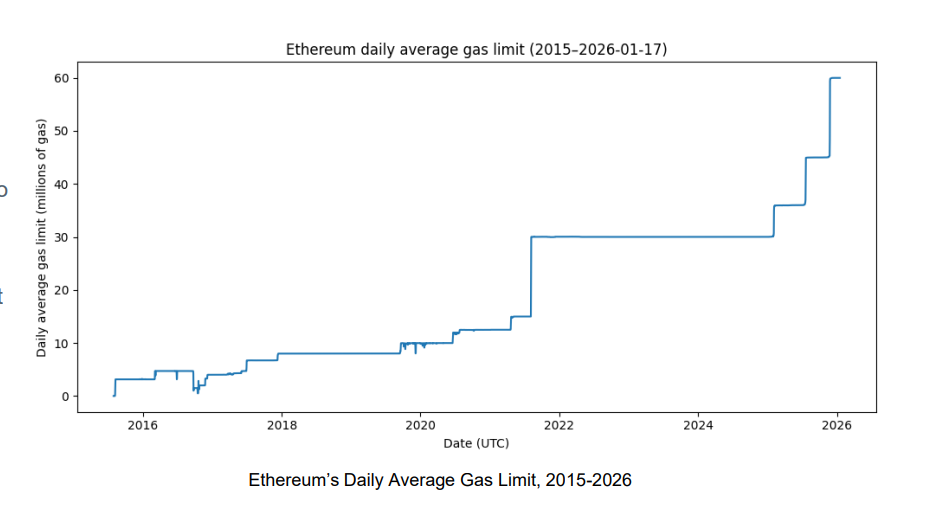
Why has the gas limit increased over time?
Because Ethereum has:
Improved its infrastructure
Increased network capacity
Upgraded protocol efficiency
Validators can vote to increase the block gas limit gradually.
What is the relationship between gas limit and fees?
Higher gas limit → More space per block → Less congestion
Lower gas limit → Limited space → Higher competition → Higher fees
So increasing gas limit helps reduce pressure
Why did fees soar during the DeFi boom?
Because demand exploded.
More users + limited block space = bidding war for inclusion.
DeFi activity pushed gas prices up.
Does gas limit directly equal transaction count?
No.
Because:
Different transactions use different gas amounts.
Simple ETH transfer → ~21,000 gas
Complex DeFi contract → hundreds of thousands
What is a token on Ethereum?
A token is a blockchain-based digital asset created using a smart contract on Ethereum.
It can represent:
Currency
Ownership
Voting rights
Access rights
Digital items
How is a token different from ETH?
ETH:
Native currency of Ethereum
Used for gas and staking
Tokens:
Created using smart contracts
Follow specific technical standards
Run on top of Ethereum
So tokens depend on Ethereum to function.
What does “fungible” mean?
Fungible means identical and interchangeable.
1 unit = another unit.
Example:
1 DAI = 1 DAI
1 USDC = 1 USDC
What are ERC-20 tokens used for?
Stablecoins (USDC, DAI)
Governance tokens
Utility tokens
DeFi protocols
They behave like digital money.
Why are ERC-20 tokens important?
They enabled:
DeFi
Tokenised finance
Decentralised exchanges
ERC-20 standardised programmable money.
What does “non-fungible” mean?
Non-fungible means unique and not interchangeable.
Each token is different.
What are ERC-721 tokens used for?
Digital art
Collectibles
Unique assets
NFTs
Each token has a unique ID.