7. audition/hearing (for exam 2)
 Call Kai
 Learn
Learn Practice Test
 Spaced Repetition
 Match
Match Flashcards
 Knowt Play
1/35

There's no tags or description
Looks like no tags are added yet.
Name | Mastery | Learn | Test | Matching | Spaced | Call with Kai |
|---|
No analytics yet
Send a link to your students to track their progress
36 Terms
auditory receptors are…
mechanoreceptors — a physical force makes them fire
amplitude/intensity (what it measures)
loudness in decibels (dB)
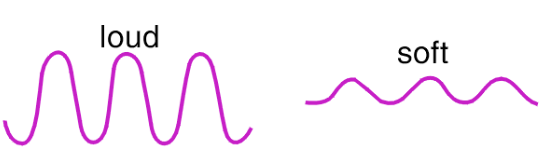
frequency (what it measures)
pitch in Hz = cycles/second (range of 20Hz - 20,000Hz)

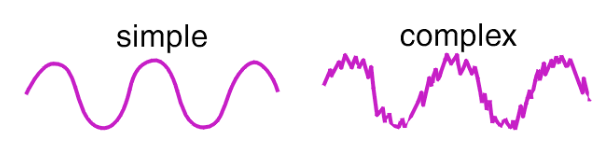
complexity (what it measures)
timbre
health of … is important for hearing
pinna
compressed vs rarefied parts of sounds waves
compressed parts are where sound is most concentrated
rarefied parts have negative pressure
what happens if there’s no cochlear fluid?
without cochlear fluid, no reverberation within cochlea → no mechanical force of liquid → can’t be converted into electrical/chemical msgs sent to the brain → hearing loss
why does potassium cause EPSPs in the cochlea if it normally produces IPSPs in the brain?
bc cochlear fluid is rich w calcium and potassium
olivary nuclei
both sets of olives get info from BOTH ears, but most of it goes contralateral (80-20 rule, 80% goes contralateral and 20% stays ipsilateral)
parts of the outer ear, middle ear, and inner ear
outer ear: channel to tympanic membrane
middle ear: ossicles
inner ear: cochlea
ossicles
baseplate of the stapes makes more forceful impact against the oval window than the tympanic membrane against the malleus
ossicles acts as an amplifier
cochlear mechanics
stapes presses against oval window to create force in cochlea
cochlea is filled w liquid, which transmits energy
liquid moves in a closed system via the membrane-covered round window
organ of corti + 3 parts
inside the cochlea, aka the “land snail”
basilar membrane (forms the base) w hair cells
tectorial membrane (forms the roof)
hair cells in btwn membranes
what do hair cells within the organ of Corti do?
transduce sound waves into nerve impulses
2 types of hair cells located within the human organ of Corti + arrangement
inner hair cells - form a single line of cells along the basilar membrane (they don’t touch tectorial membrane, but move w mvmt of liquid)
outer hair cells - arranged in 3 rows along the basilar membrane, connect the basilar and tectorial membranes
what does destruction of inner hair cells eliminate?
hearing
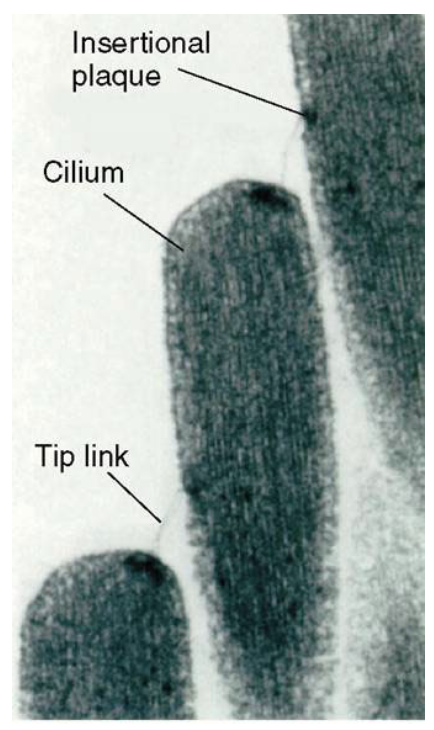
cilia project from where?
project from the top of each hair cell
tip links
attack adjacent cilia at a point known as an “insertional plaque”
what happens to the cilia when sound waves hit it?
when sound waves move fluid within cochlea, the cilia bend in one direction or the other
cilia mvmt (tallest cilia bend the most, tiplinks get taut) produces tension of the link which opens an ion channel in the adjacent tip
calcium and potassium ions flow into the cilia and produce a depolarization
shear of cilia generate what?
generate a receptor potential at insertional plaque to release NT
what % of cilia are activated at rest?
10%
4 afferent pathways through cochlear nuclei
to superior olivary nuclei (medulla)
to inferior colliculus (dorsal midbrain, near cerebellum)
to medial geniculate (thalamus)
to auditory cortex (superior temporal lobe)
3 cortical auditory divisions + what they contain
core region - contains the primary auditory cortex
belt region - the secondary association area (receives info from the PAC and the medial geniculate nucleus)
parabelt region - tertiary regions (receives info from the belt region and medial geniculate nucleus)
what stimulation of cortical auditory divisions cause
core region stimulation → ppl hear sounds from contralateral region (whirrs, buzzes)
belt region → the sounds which ppl hear become more complex and is from contralateral region (sounds like distant, muffled sounds)
parabelt region → ppl hear word-like utterances from contralateral region
different frequencies produce maximal distortion at different points of the basilar membrane. where do high frequencies vs. moderate frequencies vibrate the most?
high frequency: near base of basilar membrane (20k Hz)
moderate frequency: near apex of basilar membrane (200 Hz)
do different regions of the basilar membrane project to different areas of the auditory cortex?
yes
throughout the auditory system, there is tonotropic representation. what does this mean?
adjacent neurons receive signals from adjacent areas of the basilar membrane
basal end of basilar membrane (high pitches) is represented most … in the auditory cortex. apical end is most …
medially, lateral
2 auditory streams + roles
dorsal stream - determines sound location
ventral stream - helps determine meaning
3 evidence in support for place theory
con Bekesy observed traveling waves and found that different frequencies produce maximal displacement at different points along the basilar membrane
some antibiotics induce hair cell loss first at base of basilar membrane, which produces a loss of hearing for high frequency sounds
cochlear implants restore speech perception by stimulating different regions of the basilar membrane
loudness is determined by the rate of…
rate of hair cell firing
more intense vibrations produce more intense shearing force on cilia → cells release more NT → more firing
doctrine of specific nerve energies and rate law!
timbre + where the pattern of activity is detected and sent, the areas of the brain that help us know what sound is
complex sounds of a fundamental frequency w overtones of other frequencies
pattern of activity is detected in the cochlear nerve and sent to primary auditory cortex
experience helps us know what sound is (secondary association areas; hippocampus)
medial superior olives (what detectors they have, what kinds of sounds reach it)
have coincidence detectors (determine timing difference btwn ears)
if sound is to the right or left, it will reach one sooner and get to the medulla sooner
lateral superior olives (what detectors it has, what part of sound it processes)
have intensity detectors
the ear closer to the sound will experience a higher intensity of sound → increased APs
are we good at detecting the location of sounds along the medial line?
no
what encodes the pitch and intensity (dB) at 200-20kHz? at 20-200Hz?
200-20kHz
place coding encodes pitch
rate law encodes intensity
20-200Hz
rate of firing at apex
# of hair cells activated at apex

