PHMP Helminths
 Studied by 9 people
 Call Kai
 Learn
Learn Practice Test
 Spaced Repetition
 Match
Match Flashcards
 Knowt Play
1/105

There's no tags or description
Looks like no tags are added yet.
Name | Mastery | Learn | Test | Matching | Spaced | Call with Kai |
|---|
No analytics yet
Send a link to your students to track their progress
106 Terms
helminthic parasites
are multicellular (metazoa) bilalerally symmetrical animals having 3 germ layers (triplobastic metazoa) and belong to the kingdom Metazoa.
'helminth' (Greek helmins-’worm’)
originally referred to intestinal worms, but now comprises many other worms, including tissue parasites as well as many free-living specie
Phylum Platyhelminthes
The platyhelminths are tape-like, dorsoventrally attened worms.
Phylum Platyhelminthes
They either lack alimentary canal (as in cestodes) or their alimentary canal is incomplete, lacking an anus (as in trematodes). Body cavity is absent, viscera is suspended in gelatinous matrix.
They are mostly hermaphrodites (monoecious)
Class – Cestoda (tapeworms)
Class – Trematoda ( ukes or digeneans)
Phylum Platyhelminthes includes 2 classes:
Class Cestoda
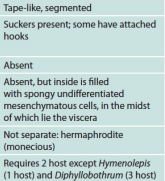
have tape-like, dorsoventrally attened, segmented bodies.
They do not possess an alimentary system.
The head carries suckers and some also have hooks
Class Cestoda
They possess scolex, neck, and proglottids.
They are monoecious and body cavity is absent.
They are oviparous
Class Trematoda
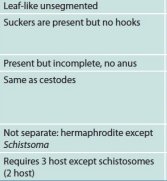
have flat or fleshy, leaf-like unsegmented bodies.
The alimentary canal is present but is incomplete i.e., without an anus
Class Trematoda
They possess suckers but no hooks.
The sexes are separate in the schistosomes, while the other flukes are hermaphroditic.
They are oviparous
Phylum Nemathelminthes (Nematoda)
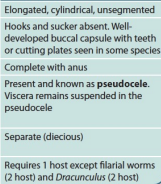
are elongated, cylindrical worms with an unsegmented body. They possess a relatively well-developed complete alimentary canal, with an anus.
Body cavity is present.
Phylum Nemathelminthes (Nematoda)
The head does not have suckers or hooks, but may have a buccal capsule with teeth or cutting plates.
The sexes are separate (diecious).
They are either oviparous or larviparous
Cestodes
Trematodes
Nematodes
Cestodes (Greek kestos—girdle or ribbon)
re multisegmented, dorsoventrally flattened tape-like worms whose sizes vary from a few millimeters to several meters. The adult worms are found in the small intestine of humans
Head (scolex)
Neck
Trunk (strobila)
The adult worm consists of 3 parts:
Head (scolex)
It is the organ of attachment to the intestinal mucosa of the definitive host, human or animal
4 suckers (or acetabula)
In parasites of the order cyclophyllidea, the scolex possesses
rostellum
In some cyclophyllidea like Taenia solium, scolex has an apical protrusion called as the ____,may or may not be armed with hooks.
v
Neck
It is the part, immediately behind the head and is the region of growth from where the segments of the body (proglottids) are being generated continuously
Trunk (strobila)
also called as strobila is composed of a chain of proglottids or segments The proglottids near the neck, are the young immature segments, behind them are the mature segments, and at the hind end, are the gravid segments.
are hermaphrodites (monoecious) and every mature segment contains both male and female sex organs. In the immature segments, the reproductive organs are not well-developed. They are well-developed in the mature segments. The gravid segments are completely occupied by the uterus filled with eggs
Tapewrorms
do not have a body cavity or alimentary canal
Rudimentary excretory and nervous systems are present
Tapeworm
do not have a body cavity or alimentary canal
Rudimentary excretory and nervous systems are present
Metazoans
They are multicellular eukaryotic organism
As animals, they have organ systems
Metazoans
However, the parasitic species often have limited digestive tracts, nervous systems, and locomotor abilities.
May have complex reproductive cycles with several different life stages and more than one type of host.
monoecious
having both male and female reproductive organs in a single individua
dioecious
each having either male or female reproductive organs.
intestinal species
those primarily involved with the intestinal tract,
intestinal tissue species
those that migrate into the tissue following initial contact with the intestinal tract
Nematodes
Unsegmented
Have full digestive system
Dioecious – Female usually larger than male in size
Some species migrates and or take up residence outside the intestine
definitive host
The adult stage of a parasitic helminth is found in the
intermediate host
Each larval stage of a parasitic helminth requires an
Rhabditiform larva
early developmental stage or juvenile stage
Filariform
short and pointed, penetrates the skin
Enterobius, Ascaris, Trichuris
Ingestion of eggs:
Skin penetration:
Strongyloides, Necator, Ancylostoma
Trichinella spiralis (usually by undercooked meat e.g. pork containing the larvae) (penetrates through the muscle)
Ingestion of larvae:
Wuchereria, Loa, Mansonella, Onchocerca, Drancunculus
Larvae transmission via insect bite:
Enterobius vermicularis
Pinworm, seatworm, Oxyuriasis
Yellowish white in color, pointed, resembles pinhead
Trichuris trichiura
Whipworm
Pinkish gray, resembles whip itself, males possess prominent curled tail
Ascaris lumbricoides
Roundworm of man
Creamy white, pink tint, female has lead thickness, male has prominent incurved tail
Strongyloides stercoloaris
Threadworm
Colorless, transparent body, finely striated cuticle, short buccal cavity
Necator americanus
New world hookworm
Contains pair of cutting plates, Male has prominent copulatory bursa
Ancylostoma duodenale
Old world hookworm
Contains actual teeth, Male has prominent copulatory bursa
Trichinella spiralilis
Trichina worm
Thin anterior end females are blunt and round posterior end, males are curved
Dracunculus medinensis
Guinea worm
Female has prominent rounded anterior end, male coils its anterior end at least once
Enterobius vermicularis
Colorless, double-layered thick shell
Trichuris trichiura
Yellow brown color, barrel or football shape, hyaline polar plug each end
Ascaris lumbricoides
Rounded (fertilized) or oval (non-fertilized), corticated
Strongyloides, Necator, Ancylostoma
Smooth and colorless shell, 2,4-8 embryonic cleavage
Filarial Nematodes
Thread-like parasitic nematodes that are transmitted by arthropod vectors
Adults are threadlike and creamy in appearance
They are formed in different lymphatics or body cavities
Filarial Nematodes
Classified as “Sheathed or unsheathed”
They are vector-borne parasitic nematodes ( Female mosquito)
mosquitoes (Anopheles minimus flavirostris-rural; Aedes poecilusurban; Culex pians quinquefasciatus
Filarial Nematodes
W. bancroft
mosquitoes (Mansonia spp., Anopheles spp.)
Filarial Nematodes
Brugia malayi
Chrysops spp.( deer flies)
Filarial Nematodes
L. loa
Simulium damnosum (black flies)
Filarial Nematodes
O. volvulus
Wuchereria bancrofti (Peripheral blood)
Brugia malayi (Peripheral blood)
Loa loa (Peripheral blood)
Sheathed species
Onchocerca volvulus (Lymph spaces of skin, subcutaneous nodules)
Mansonella species (Peripheral blood)
Unsheathed species
Wuchereria bancrofti
Bancroft’s filaria
Tip of tail free of nuclei
Brugia malayi
Malayan filaria
Presence of two distinct nuclei in the tip of the tail
Loa loa
Eye worm
Distinct continuous row of nuclei extent to tip of tail
Onchocerca volvulus
Blinding filaria
Nuclei do not extend to tip of tail
Mansonella ozzardi
New world filaria
Numerous nuclei, do not extend to tip of tail
Mansonella perstans
Perstans filaria
Numerous nuclei, do not extend to tip of tail
Cestodes
As compared to other parasitic worms, ____are characterized by a long, flat body (ribbon-like) that can grow to over 20 meters in length depending on the species.
Cestodes
They are also characterized by a segmented body that plays an important role in their life cycle
Cestodes
The immature segment lies proximal to the neck and is composed of immature reproduction organs, this is followed by the middle or mature segments which contain the well- developed reproductive organs; the distal most portion is the gravid segment which characterized by its uteri filled with eggs
Cestodes
Hermaphrodites (Monoecious)
No digestive tract – nutrition mainly derived from absorption
Required at least 1 intermediate host for transmission (Except D. latum where 2 intermediate host are required and H. nana where no intermediate host is needed.)
Cestodes
The egg consist of a hexacanth embryo (Oncosphere) – defined as the motile
First larval stage characterized by the presence of six small hooks called hooklets – for attachment
Scolex
Part of adult tapeworm
anterior end
Proglottids
Part of adult tapeworm
individual segments in their mature form
Strobila
Part of adult tapeworm
reproductive organs
Suckers
Part of adult tapeworm
attachment
Rostellum
Part of adult tapeworm
extension of scolex
Tegument
Part of adult tapeworm
excreted waste products
Taenia solium
Pork tapeworm
Four suckers, rostellum and hooks are present (Double crown hooks) 7-15 branches per segment
Taenia saginata
Beef tapeworm
Four suckers, rostellum and hooks not present 15-30 branches per segment
Hymenolepis diminuta
Rat tapeworm
Four suckers, rostellum is present but no hooks Sac-like uterus filled with eggs
Hymenolepis nana
Dwarf tapeworm
Four suckers, rostellum is short hooks are present in one row Saclike uterus filled with eggs
Dipylidium caninum
Dog/Cat tapeworm Pumpkin seedtapeworm
Four suckers, Club-shape rostellum with 1-7 spines, hooks not present Pumpkin seed-shape proglottid
Diphyllobothrium latum
Broadfish tapeworm
Two sucking grooves with almond shape, hooks and rostellum not present Centrally located rosette shape uterus
Echinococcus granulosus
Dog tapeworm
Hyadatid tapeworm Scolex contains 4 suckers and approx. 36 hooks, small neck and three proglottids
Trematodes
they are a group of animals that belong to the phylum Platyhelminthes, specifically to the class Trematoda. They are flattened worms, with a typically leaf-shaped flattened bod
Trematodes
The are broadly oval or leaf like in shape with an oral sucker, a prepharyngeal tube, a pharynx and esophagus and a bifurcated intestinal ceca which ends blindly except in the blood flukes
Trematodes
They are hermaphrodites except for the human blood flukes (Schistosoma spp)
Sexually mature trematodes found in the definitive host
Trematodes
Requires two intermediate host, mollusks (Snail) and shellfish/fish except Schistosoma spp (one intermediate host needed)
Manner of transmission is through ingestion of infective stage except Schistosoma spp (through skin penetration)
Trematodes
Early stage developed inside the mollusks
Infective stage is metacercaria
Fork-tailed appearance
Cercaria in Schistosoma spp –
Fasciola hepatica
Fasciolopsis buski
Presence of distinct operculum
Clornochis sinensis
Presence of distinct shoulders and presence of small knob opposite operculum
Heterophyes heterophyes
Metagonimus yokogawai
Operculum present, shoulder is also present but not discrete, small knob may be present
Paragonimus westermani
Prominent operculum with shoulders; obvious terminal shell thickening opposite operculum
Schistosoma mansoni
Appearance of large lateral spine
Schistosoma japonicum
Appearance of small lateral spine
Schistosoma haematobium
Appearance of large terminal spine
Fasciola hepatica
Liver fluke
Equipped with so called shoulders
Fasciolopsis buski
Large intestinal fluke
Oblong, fleshy, No shoulders
Clonorchis sinensis
Chinese liver fluke
Each end is narrower than the midportion of the body
 Note
Note  Flashcards (32)