SSTIs
 Studied by 0 people
 Call Kai
 Learn
Learn Practice Test
 Spaced Repetition
 Match
Match Flashcards
 Knowt Play
1/115

There's no tags or description
Looks like no tags are added yet.
Name | Mastery | Learn | Test | Matching | Spaced | Call with Kai |
|---|
No analytics yet
Send a link to your students to track their progress
116 Terms
skin and soft tissue infections (SSTIs)
infections of the skin that may involve any or all layers of the skin, SQ tissue, muscle, or fascia
Erysipelas
Impetigo
Lymphangitis
Cellulitis
Necrotizing fascitis
Primary SSTIs
Diabetic foot infections
Pressure sores
Animal and human bite wounds
Burn wounds
Secondary SSTIs
GP organisms: MSSA, MRSA, S. pyogenes
SSTIs are primarily caused by what organisms?
1. Age (anybody)
2. Obesity
3. Poor hygiene
4. Diabetes
5. Dialysis
6. Immunocompromised
7. Prior injury: trauma, radiotherapy, surgery
8. Vascular insufficiency: lymphatic or venous
9. IV drug abuse
10. Trauma
Risk factors for SSTIs
CA-MRSA
SSTIs that occur in patients with no known risk factors for MRSA
true
- Clindamycin
- TMP-SMX
- Doxycycline or Minocycline
T/F: CA-MRSA is more likely to be sensitive to oral antimicrobials
1. individuals in close proximity to each other
2. IV drug users
3. Tattooing and piercings
4. Homelessness
5. HIV infection
6. MSM
CA-MRSA risk factors
Panton-Valentine Leukocidin (PVL)
Cytotoxin produced by CA-MRSA
true
T/F: HA-MRSA is less likely to produce Panton-Valentine Leukocidin (PVL) toxin
1. Indwelling catheter
2. Hemodialysis
3. Prolonged hospitalization
4. Prolonged antimicrobial use
5. ICU admission
HA-MRSA risk factors
Impetigo
- characterized as bullous or nonbullous
Contagious, superficial, purulent bacterial infection of the skin, which leaves a dry crust after eruption
S. pyogenes
S. aureus
Which organisms are responsible for causing impetigo?
Pruritis
Weakness
Fever
Diarrhea
Clinical presentation of impetigo
children
Impetigo is most common in ____ and usually affects the face followed by the extremities
summer (hot and humid weather conditions)
Impetigo is most prevalent in which season?
nonbullous
Most common form of impetigo
S. pyogenes
S. aureus
Which organisms cause nonbullous impetigo?
Nonbullous impetigo
Which kind of impetigo is characterized by small, fluid-filled vesicles that discharge to form dry, honey-crusted lesions?
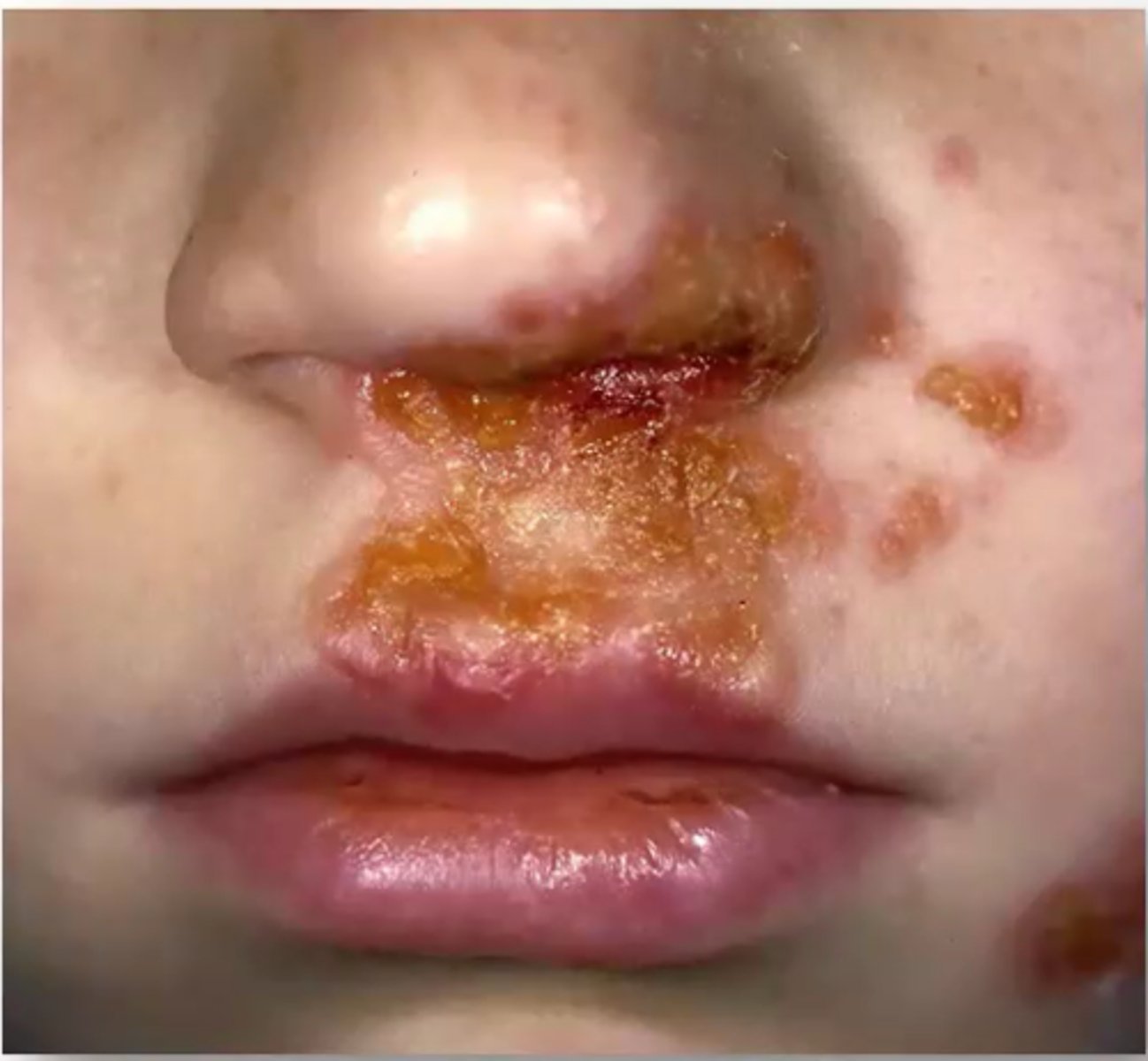
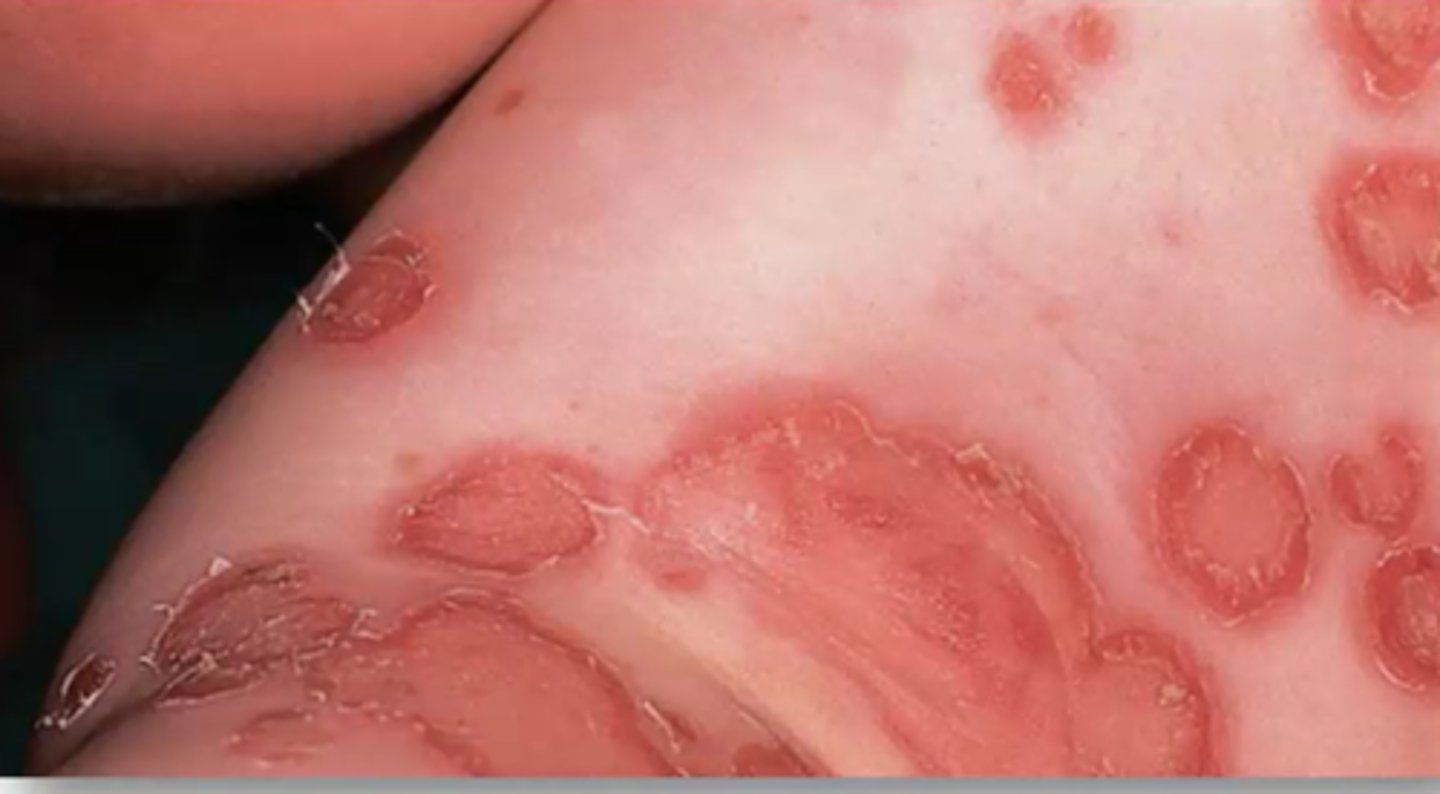
Bullous impetigo
Which kind of impetigo is characterized by vesicles containing clear yellow fluid that discharge to form a thin, light brown crust?
neonates
Bullous impetigo mostly occurs in what patient population (what age)?
S. aureus
What is the causative organism of bullous impetigo?
When there are not several lesions and it does not involve the face.
When is topical therapy indicated for impetigo?
Mupirocin (first line) or Retapamulin applied topically BID x 5 days
Topical treatment for impetigo.
oral
Which type of therapy (oral or topical) for impetigo is recommended for patients presenting with multiple lesions and/or involving the face?
Cephalexin (first-line)
- Peds: 25 to 50 mg/kg/day divided every 6 to 8 hours
- Adult: 250 mg PO QID x 7 days
Dicloxacillin
- Peds: 6.25 to 12.5 mg/kg/dose every 6 hours
- Adult: 250 to 500 mg QID x 7 days
Recommended treatment for impetigo caused by S. aureus and GAS.
TMP-SMX (first-line alternative)
- Peds: 8 to 12 mg TMP/kg/day in divided doses every 12 hours for 7 days
- Adults: 1 to 2 double-strength tablets twice daily for 7 days
Clindamycin
- Peds: 20 mg/kg/day in divided doses every 8 hours for 7 days
- Adults: 300 mg 4 times daily or 450 mg 3 times daily for 7 days
Doxycycline (do not use in patients <8)
- Peds: ≤45 kg: Oral: 2 mg/kg/dose every 12 hours for 5 to 10 days; >45 kg: Oral: 100 mg twice daily for 5 to 10 days.
- Adults: 100 mg PO twice daily for 7 days
Recommended treatment for impetigo caused by CA-MRSA and/or for patients with a PCN allergy
Lymphangitis
Inflammation of the lymphatic channels
S. pyogenes
Causative organism of Lymphangitis
Red linear streaks, enlarged and tender lymph nodes, peripheral edema, pain, fever, chills, malaise, headache
Clinical presentation of lymphangitis
DOC: PCN G 1-2 million units IV Q4-6 hours x 48-72 hours then switch to PCN VK 500 mg PO Q6 hours
- Total days of therapy: 10 days
*If PCN allergy: Clindamycin 600 mg IV Q8 hours x 10 days
- start with IV; if patient improves, switch to PO
Recommendation of therapy for lymphangitis
Immobilization and elevation of the affected extremity with warm, moist compresses every 2-4 hours
Nonpharmacological treatment of lymphangitis
Abscess
Furuncle
Carbuncle
List some purulent SSTIs
Patients with purulent infection and NO systemic signs of infection
- localized signs of infection
Purulent SSTI mild infection
Patients with purulent infection with systemic signs of infection
- at least 1 SIRS criteria
Purulent SSTI moderate infection
Patients who have failed incision and drainage plus antibiotics OR those meeting SIRS criteria (≥2) OR those who are immunocompromised
Purulent SSTI severe infection
Temperature > 38°C or < 36°C (>100.4°F or <96.8°F)
HR > 90
RR > 24
WBC > 12,000 or < 4,000
SIRS criteria
true; gold-standard
- may see recurrent infection if I&D is not done
T/F: I&D and C&S should be for mild, moderate, and severe purulent SSTIs (abscess, furuncle, carbuncle)
SMX-TMP (first-line): 1 to 2 double-strength tablets twice daily for ≥5 days.
Doxycycline 100 mg PO BID x 5 days.
Empiric treatment for moderate, purulent SSTIs.
Vancomycin 15 mg/kg Q12 hours.
Daptomycin 4-6 mg/kg IV once daily.
Linezolid 600 mg IV Q12 hours.
Telavancin 10 mg/kg IV once daily.
Ceftaroline 600 mg IV Q12 hours.
Empiric treatment for severe, purulent SSTIs
SMX-TMP 1 to 2 double-strength tablets twice daily for ≥5 days.
- if a patient has an allergy to sulfa, then use Doxycycline
Definitive treatment for moderate, purulent SSTIs caused by MRSA
Cephalexin (first-line): 500 mg PO QID
Dicloxacillin 500 mg PO QID
Definitive treatment for moderate, purulent SSTIs caused by MSSA
Same as empiric therapy
Vancomycin 15 mg/kg Q12 hours x 5-7 days.
Daptomycin 4-6 mg/kg IV once daily x 5-7 days.
Linezolid 600 mg IV Q12 hours x 5-7 days.
Telavancin 10 mg/kg IV once daily x 5-7 days.
Ceftaroline 600 mg IV Q12 hours x 5-7 days.
Definitive treatment for severe, purulent SSTIs caused by MRSA
Nafcillin 1.5-2 g IV Q4 hours
Cefazolin 1-2 g IV Q8 hours
Clindamycin 600 mg IV every 8 hours
- only if PCN allergy
Definitive treatment for severe, purulent SSTIs caused by MSSA
Folliculitis
Inflammation of the hair follicle due to physical injury, chemical irritation, or infection
Stye
Infection occurring at the base of the eyelid
- type of folliculitis
S. aureus
P. aeruginosa
Most common causative organisms of folliculitis
Small, pruritic, erythematous papules
- systemic signs are uncommon; use topical treatment
Clinical presentation of folliculitis
Mupirocin topically TID x 5-7 days
Clindamycin topically BID x 7-10 days
Benzoyl peroxide topically once daily
Topical therapy for folliculitis
Furuncles
Painful, firm, fluctuant abscess or boil originating from an infected hair follicle
- (+/-) necrotic centers characteristic of spider bite
S. aureus
Causative organism of furuncles
Small, red, tender nodule that becomes painful and pustular
- commonly develops on the face, neck, axilla, and buttocks
Clinical presentation of furuncles
Carbuncles
Coalescent furuncles extending to the subcutaneous tissue that are large and painful
- can be associated with fever, chills, malaise, and bacteremia
diabetic patients and form on the back of the neck
Carbuncles commonly occur in _____ patients and form where?
Patients with nonpurulent infection and no systemic signs of infection
- localized infection
Nonpurulent SSTI mild infection
Patients with nonpurulent infection with systemic signs of infection
- at least one SIRS criterion
Nonpurulent SSTI moderate infection
Patients who have failed oral abx OR those with systemic signs (≥2 SIRS criteria) of infection OR immunocompromised OR with deeper tissue involvement (bullae, skin sloughing, hypotension, organ dysfunction)
Nonpurulent SSTI severe infection
Cellulitis
Erysipelas
Necrotizing infection
Types of nonpurulent SSTIs
Oral
- PenVK 500 mg Q6 hours
- Cephalexin 500 mg QID
- Cefadroxil 1 g QD or 500 mg BID
- Dicloxacillin 500 mg QID
- Clindamycin 300 mg QID or 450 mg TID
Empiric treatment for mild nonpurulent SSTIs
IV
- PCN G 2-4 million units Q4-6 hours
- Cefazolin 1-2 g Q8 hours
- Ceftriaxone 1-2 g QD
- Clindamycin 600-900 mg Q8 hours
Empiric treatment for moderate nonpurulent SSTIs
- Urgent surgical consult/debridement
- Empiric: Vancomycin 15 mg/kg Q12 hours + Pip/Tazo 4.5 g Q8 hours
Empiric treatment for severe nonpurulent SSTIs
Penicillin 4 million units IV Q4 hours
PLUS
Clindamycin 600-900 mg IV Q8 hours
Definitive treatment for necrotizing infection (severe) caused by S. pyogenes
Penicillin 4 million units IV Q4 hours
PLUS
Clindamycin 600-900 mg IV Q8 hours
Definitive treatment for necrotizing infection (severe) caused by Clostridial spp.
Doxycycline 100 mg IV BID
PLUS
3rd gen Cephalosporin (IV):
- Ceftriaxone 1-2 g QD
- Cefotaxime 2 g Q6 hours
- Ceftazidime 2 g Q8 hours
Definitive treatment for necrotizing infection (severe) caused by Vibrio vulnificus
Doxycycline 100 mg IV BID
PLUS
Ciprofloxacin 400 mg IV Q12 hours or Ceftriaxone 1-2 g QD
Definitive treatment for necrotizing infection (severe) caused by Aeromonas hydrophila
Vancomycin 15 mg/kg Q12 hours
PLUS
Pip/Tazo 4.5 g Q8 hours
Polymicrobial definitive treatment for necrotizing infection (severe)
Cellulitis
Acute, inflammatory infection of superficial and deep skin (dermis, superficial fascia)
S. pyogenes
S. aureus
Causative organisms for cellulitis
Erythema and edema of the skin that is not elevated with poorly demarcated borders, tenderness/pain, warm to the touch, w/o purulent drainage
Clinical presentation of cellulitis
Erysipelas
Infection of the superficial layers of the skin and lymphatics
- aka "St. Anthony's Fire"
S. pyogenes (S. aureus less common)
Causative organisms of erysipelas
Burning, painful lesion, bright red, edematous, indurated appearance, defined margins, warm to the touch
- legs and feet most affected
- low-grade fever, flu-like illness, leukocytosis
Clinical presentation of erysipelas
Penicillin VK 500 mg Q6 hours or Cephalexin 500 mg QID for 5-7 days
Empiric treatment for a mild infection of cellulitis or erysipelas
Dicloxacillin 500 mg QIDx 5-7 days
- PCN allergy: Clindamycin 300 mg QID or 450 mg TID
Definitive treatment of a mild infection of cellulitis or erysipelas caused by MSSA
SMX-TMP 1-2 DS tabs PO BID,
Doxycycline 100 mg PO BID,
Minocycline 200 mg PO LD, then 100 mg Q12h, or
Clindamycin 300 mg QID or 450 mg TID
Definitive treatment of a mild infection of cellulitis or erysipelas caused by MRSA
PCN G 2-4 million units IV Q4-6 hours x5-7 days
Empiric treatment of a moderate infection of cellulitis or erysipelas
Cefazolin 1-2 g Q8 hours or Ceftriaxone 1-2 g QD x5-7 days
- PCN allergy: Clindamycin 600-900 mg Q8 hours x 5-7 days
Definitive treatment of a moderate infection of cellulitis or erysipelas caused by MSSA
Choose one:
Vancomycin 15 mg/kg IV Q12 hours
Daptomycin 4 to 6 mg/kg IV once daily
Linezolid 600 mg IV Q12 hours
Telavancin 10 mg/kg IV once daily
Ceftaroline 600 mg IV Q12 hours
Definitive treatment of a moderate infection of cellulitis or erysipelas caused by MRSA
Vancomycin 15 mg/kg IV Q12 hours PLUS Pip/Tazo 4.5 g Q8 hours x 5-7 days
- Alt: Vancomycin + Primaxin 500 mg Q6 hours or Meropenem 1 g Q8 hours x 5-7 days
Empiric treatment for severe infections of cellulitis or erysipelas
Necrotizing fasciitis
Highly aggressive, very fast-spreading, serious, life-threatening infection of the subcutaneous tissue
S. pyogenes (most common)
S. aureus (MSSA or MRSA)
Vibrio vulnificus
A. hydrophila
Peptostreptococcus
Polymicrobial
Causative organisms for necrotizing fasciitis
Infection site reveals edema, inflammation, discoloration, possible gangrene, crepitus (gas in the tissues), skin necrosis, bullous lesions, and wooden hard induration of the subcutaneous tissue
- mostly involves limbs and lower extremities, but can occur anywhere
- pain, AMS, fever, chills, leukocytosis, lethargy
Clinical presentation of necrotizing fasciitis
Type I
Which type of necrotizing fasciitis is described below?
- Generally occurs after trauma or surgery
- Organisms: anaerobes (Bacteriodes, Peptostreptococcus), facultative aerobes (streptococci, enterbacteriaceae)
- Less skin destruction, slower progression: 3-5 days
Type II "flesh-eating disease"
Which type of necrotizing fasciitis is described below?
- Organisms: S. pyogenes; referred to as streptococcal gangrene
- Rapid skin/subcutaneous tissue desctruction (24-72 hours), local pain, systemic toxicity, early onset of shock/organ failure
Type III: Clostridial myonecrosis "gas gangrene"
Which type of necrotizing fasciitis is described below?
- Organisms: Clostridium perfringens
- Infection of skeletal muscle causing gas production and muscle necrosis
- Progression 1-6 hours
Choose one:
- Vancomycin 15 mg/kg IV Q12 hours
- Daptomycin 4 to 6 mg/kg IV once daily
- Linezolid 600 mg IV Q12 hours
PLUS (choose one):
- Pip/Tazo4.5 g Q8H
- Ertapenem 1 g QD, Primaxin 1 g Q6-8H, or Meropenem 1 g Q8H
- Ceftriaxone 1-2 g QD PLUS Metronidazole 500 mg Q6H
- Ciprofloxacin 400 mg Q12H or Levofloxacin 750 mg QD PLUS Metronidazole 500 mg Q6H
Empiric treatment of necrotizing fasciitis
Penicillin 4 million units Q4 hours PLUS Clindamycin 600 to 900 mg Q8 hours
Definitive treatment for necrotizing fasciitis caused by S. pyogenes
Penicillin 4 million units Q4 hours PLUS Clindamycin 600 to 900 mg Q8 hours
Definitive treatment for necrotizing fasciitis caused by Clostridial spp.
Doxycycline 100 mg IV BID
PLUS
3rd generation cephalosporin (choose one):
- Ceftriaxone 1-2 g QD
- Cefotaxime 2 g Q6H
- Ceftazidime 2 g Q8H
Definitive treatment for necrotizing fasciitis caused by V. vulnificus
Doxycycline 100 mg IV BID PLUS Ciprofloxacin 400 mg Q12H OR Ceftriaxone 1-2 g QD
Definitive treatment for necrotizing fasciitis caused by A. hydrophila
20%
Diabetic foot infections (DFI) account for ___% of all hospitalizations in diabetics.
- Can progress to: amputation and osteomyelitis
Deep abscesses
Cellulitis of the dorsum
Mal perforans ulcers
Types of DFIs
Edema, erythema, tenderness, pain, induration, and purulent secretions
- Foul-smelling odor, discolored granulation tissue, and mildly elevated or normal temp
Clinical presentation of DFI
No systemic or local symptoms or signs of infection
PEDIS Grade 1 for classifying DFIs
- IDSA: uninfected
At least 2 of the following present and no other cause of inflammatory response of the skin (e.g., trauma, gout, thrombosis, fracture, venous stasis):
- local swelling or induration
- erythema around the ulder must be > 0.5 cm to < 2 cm
- local tenderness or pain
- local increased warmth
- purulent discharge
PEDIS Grade 2 for classifying DFIs
- IDSA: mild infection
Infection with no systemic manifestations and involving:
- erythema ≥2 cm from the wound margin and/or
- tissue deeper than skin and SQ tissue (tendon, muscle, joint, and bone)
PEDIS Grade 3 for classifying DFIs
- IDSA: moderate infection
Any foot infection with ≥ 2 of the following SIRS criteria:
- Temperature > 38°C or < 36°C (>100.4°F or <96.8°F)
- HR > 90
- RR > 24
- WBC > 12,000 or < 4,000 or ≥10% bands
PEDIS Grade 4 for classifying DFIs
- IDSA: severe infection
Bed rest, leg elevation, proper glycemic control, wound drainage, wound dressing changes 2-3 times daily, avoidance of weight-bearing activities
Nonpharmacological treatment of DFIs
Suspected MSSA, Streptococcus spp.:
- Augmentin 875 mg BID
- Cephalexin 250 to 500 mg QID
- Clindamycin 300 to 450 mg Q6-8H
- Dicloxacillin 250 to 500 mg QID
- Levofloxacin 500 mg QD
Suspected MRSA:
- Doxycycline 100 mg BID
- SMX/TMP 1-2 DS tabs PO BID
Treatment of Mild DFIs
- topical or oral therapy for 1-2 weeks
- Unasyn 3 g IV Q6H
- Cefoxitin 1-2 g IV Q6-8H
- Ceftriaxone 1-2 g QD
- Ciprofloxacin 400 mg IV Q12H + Clindamycin 300-450 mg Q6-8H
- Ertapenem 1 g QD
- Primaxin 500 mg Q6H
- Levofloxacin 750 mg IV Q24 hours + Clindamycin 300-450 mg Q6-8H
- Moxifloxacin 400 mg IV/PO QD
- Tigecycline 100 mg IV LD, then 50 mg IV Q12H
Treatment of moderate DFIs when there's suspected MSSA, Streptococcus, Enterobacteriaceae, and/or obligate anaerobes
- PO therapy or initial parenteral followed by oral therapy for 1-3 weeks
 Note
Note  Flashcards (20)