Algebra 3
 Call Kai
 Learn
Learn Practice Test
 Spaced Repetition
 Match
Match Flashcards
 Knowt Play
1/106

There's no tags or description
Looks like no tags are added yet.
Name | Mastery | Learn | Test | Matching | Spaced | Call with Kai |
|---|
No analytics yet
Send a link to your students to track their progress
107 Terms
Coset
Let G be a group and H a subgroup. Let g be an element of G.
The set gH = {gh : h ∈ H} is a left _ of H in G
The set Hg = {hg : h ∈ H} a right _ of H in G
When is g1H = g2H?
if and only if g1-1g2∈
Index
Let G be a group and H be a subgroup.
The left __of H in G, denoted by [G : H], is the number of left cosets of H in G.
The right __of H in G is the number of right cosets of H in G.
When does #gH = #H
Let G be a group and H a finite subgroup. If g ∈ G then gH and Hg
Construct a bijection between H and gH
Partition
Let A be a set and B1, B2, . . . , Bn be subsets of A.
A = B1 ∪ B2 ∪ · · · ∪ Bn
if i ≠ j then Bi ∩ Bj = ∅ (i.e. the Bi are pairwise disjoint)
Bi ≠ ∅ for i = 1, . . . , n
Lagrange’s Theorem
Let G be a finite group and H a subgroup.
#G = [G : H] · #H
Conjugate
Let H be a subgroup of G.
A __of H has the form gHg-1 for some g ∈ G.
Normal subgroup
A subgroup H of G is __if and only if gHg-1 = H for all g ∈ G
That is H is equal to all its conjugates. We write H ⊴ G.
Quotient
Let G be a group and H a subgroup.
Write G/H for the set of left cosets of H in G: G/H = {gH : g ∈ G}.
Multiplication of G/N
(gN)(g′N) = gg′N
Quotient Group of G over N
Let G be a group and N a normal subgroup. Then G/N with its operation is a group with identity element N = 1GN and inverses given by (gN)−1 = g−1N
If G is finite then #(G/N) = [G : N] = #G #N .
Linear Map
Let F be a field. Let V and W be F-vector spaces.
A map ϕ : V → W satisfying the two conditions
ϕ(v1 + v2) = ϕ(v1) + ϕ(v2) for all v1, v2 ∈ V
ϕ(λv) = λϕ(v) for all λ ∈ F and v ∈ V
Kernel and Image
Ker(ϕ) = {v ∈ V : ϕ(v) = 0} - subspace of V
Im(ϕ) = {ϕ(v) : v ∈ V } - subspace of W
Homomorphism
Let G, H be groups and let ϕ : G → H be a map.
ϕ is a __ of groups if ϕ(gh) = ϕ(g)ϕ(h) for all g, h ∈ G.
Isomorphism
Let G and H be groups.
A map ϕ:G → H is an __ if it is a bijective homomorphism (G ∼= H)
What is Ker(ϕ) and Im(ϕ)?
Ker(ϕ) is a normal subgroup of G
Im(ϕ) is a subgroup of H.
The First Isomorphism Theorem
Let ϕ : G → H be a homomorphism of groups.
Let ϕˆ : G/ Ker(ϕ) → Im(ϕ),
ϕˆ(g Ker(ϕ)) = ϕ(g)
Then ϕˆ is a well-defined group isomorphism.
Even/ Odd permutation
can be written as a product of an even number of transpositions
can be written as a product of an odd number of transpositions
Sign
σ ∈ Sn by sign(σ) = ( 1 if σ is even −1 if σ is odd)
sign(σ) = (-1)m for σ = ε1,ε2,…,εm where εi are transpositions
It is a homomorphism
What is An in relation to Sn /what is its size?
Let n ≥ 2. Then An is a normal subgroup of Sn.
[Sn : An] = 2
#An = #Sn/2 = n!/2
Isomorphic
Let G and H be cyclic groups of order n. Then G and H are _________.
Let G be a cyclic group of order n, then G≅Cn (cyclic group of order n)
Prime
Let p be a ___. Any group of order p is isomorphic to Cp.
Direct Product
Let G and H be groups. The ____ of G and H is: G × H = {(g, h) : g ∈ G, h ∈ H}
i.e. G × H is the set of ordered pairs (g, h) where g ∈ G and h ∈ H
The binary operation on G × H is (g1, h1) · (g2, h2) = (g1g2, h1h2)
Groups of order 4
C4
C2xC2
Fundamental Theorem of Finite Abelian Groups
Let G be a non-trivial finite abelian group. Then there are integers b1 | b2 | · · · | bn, all > 1, such that G ≅ Cb1 × Cb2 × · · · × Cbn .
#G = b1b2 · · · bn.
Dihedral group
Let n ≥ 3. The regular n-gon has 2n symmetries which consist of n rotations and n reflections which form a group D2n.
Centered at the origin, with one vertex lying on the x-axis, which is labelled as 1.
The numbering goes anticlockwise.
The symmetry r is anticlockwise rotation around the centre through angle 2π/n.
The symmetry s is reflection in the x-axis
D2n and #D2n
Let n ≥ 3. Then D2n = {id, r, r2 , . . . , rn−1 } ∪ {s, sr, sr2 , . . . , srn−1 }.
#D2n = 2n and R is a normal subgroup of index 2.
a = id and b=c
Let a ∈ D2n. Suppose a fixes vertices 1 and 2.
Let b, c ∈ D2n. Suppose b(1) = c(1) and b(2) = c(2).
rn, s2, srs = ???
With r, s as above, rn = id, s2 = id, srs = r-1
Word
Let G be a group. Let g1, . . . , gn be elements of G. A ___ in g1, g2, . . . , gn is a finite product of g1, g−11 , g2, g−12 , . . . , gn, g−1n .
For example, if g, h ∈ G, then the following are words in g, h: h3, g−1h, h−2g−1h−1g3h, 1G.
The subset of words is a _____
Let G be a group. Let g1, . . . , gn be elements of G. Write ⟨g1, . . . , gn⟩ for the subset of words in g1, . . . , gn. Then ⟨g1, . . . , gn⟩ is a subgroup of G
Group Presentation
To specify a group by specifying generators and relations.
The notation has the form G = ⟨S|R⟩ where S is a set of symbols, and R is a set of relations between the symbols.
Fundamental Theorem of Group Presentations
Let G = ⟨S | R⟩ be a group presentation where S = {s1, s2, . . . , sn} is a finite set of generators and R is a set of relations. Let H be a group and let h1, h2, . . . , hn be elements of H.
There exists a homomorphism ϕ : G → H satisfying ϕ(si) = hi if and only if every relation r ∈ R holds with the si replaced by the hi.
Moreover, in this case the homomorphism ϕ is unique.
Quaternion group
Q8 = ⟨a, b | a4 = id, a2 = b2 , bab−1 = a−1⟩.
Elements of Q8
Every element of Q8 can uniquely be written as ai bj with 0 ≤ i ≤ 3 and 0 ≤ j ≤ 1. Thus #Q8 = 8
Exponent
Let n be a positive integer. We say that a group G has ____ n if n is the smallest positive integer such that gn = id for all g ∈ G
Abelian
Let G be a group with exponent 2.
Then G is ____.
Then, for some positive integer n, G≅Cn2 . In particular, #G = 2n.
Isomorphism of groups order 6
Let G be a group of order 6. Then G≅C6 or G≅D6.
Isomorphism of groups order 8
Let G be a group of order 8. Then G is isomorphic to one of
C2×C2×C2
C2×C4
C8
D8
Q8
Left Action
Let G be a group and X a set. A ____ of G on X is a map G × X → X, (g, x)→g ∗ x which satisfies the following two properties:
(A1) 1G∗x = x for all x ∈ X
(A2) (gh)∗x = g∗(h∗x) for all g, h ∈ G and x ∈ X
∼ an equivalence relation
Let G act on X. For x, y ∈ X write x ∼ y if and only if there some g ∈ G such that g ∗ x = y. Then ∼ is an _____.
Orbit
We define the ___ of x ∈ X under the action of G by OrbG(x) = {g∗x : g ∈ G}.
They form a partition of X.
Acts transitively
G acts ___ on X if, for any x, y ∈ X, there is some g ∈ G such that g ∗ x = y. ↔ OrbG(x) = X
Fixed
We say that x ∈ X is _____ by G if g ∗ x = x for all g ∈ G.
We write Fix(G) for the set of x ∈ X that are ___ by G.
Observe that x ∈ Fix(G) ⇐⇒ x is fixed by G ⇐⇒ OrbG(x) = {x}.
Stabilizer
Suppose G acts on X. The ___ of x ∈ X is StabG(x) = {g ∈ G : g ∗ x = x} the set of elements of G that fix x. It is a subgroup of G.
Orbit-Stabilizer Theorem
Let G be a finite group acting on a finite set X, and let x ∈ X.
Then #G = # OrbG(x) × # StabG(x), or equivalently [G : StabG(x)] = # OrbG(x).
p be a prime and let X be a finite set. Suppose Cp acts on X.
(i) Every orbit has size 1 or p.
(ii) # Fix(Cp) ≡ #X (mod p).
(#G)p-1
Let G be a finite group and p a prime. Then
____ ≡ (#{g ∈ G : g p = id}) (mod p).
Cauchy’s Theorem
Let G be a finite group and let p be a prime. Suppose p | #G. Then G has an element of order p
Conjugate
Let G be a group. Two elements h1, h2 ∈ G are ____ if there is some g ∈ G such that gh1g−1 = h2.
conjugation
The group G acts on itself by _____ G × G → G, g ∗ h = ghg−1 .
Conjugacy class
of h ∈ G is simply the orbit of h under the conjugation action of G:
ClG(h) = {ghg−1 : g ∈ G}
Centralizer
of h ∈ G is simply the stabilizer of h: CG(h) = {g ∈ G : ghg−1 = h} = {g ∈ G gh = hg}.
Cycle type
Let σ ∈ Sn be a permutation. We say that σ has ___ 1r1 2r2 3r3 4r4 · · · if its disjoint cycle decomposition has exactly r1 cycles of length 1, r2 cycles of length 2, r3 cycles of length 3, and so on.
aba−1
Let a = (x1, x2, . . . , xr) be an r-cycle in Sn. Let b ∈ Sn. Then aba−1 = (b (x1), b(x2), . . . , b(xr))
Two permutations are conjugate
in Sn are ___ if and only if they have the same cycle type.
Unit
Let R be a ring. An element u is called a ____ if there is some element v in R such that uv = vu = 1.
Field
a commutative ring in which every non-zero element has a multiplicative inverse. (every non-zero element is a unit)
Unit group
of R to be the set R∗ = {a ∈ R : a is a unit in R}.
Norm map
N: Z[i] → Z by N(a + bi) = a2 + b2 , a, b ∈ Z.
Multiplicative
Let α, β ∈ Z[i]. Then N(αβ) = N(α)N(β).
Unit group of Z[i]
{1, −1, i, −i}
Ring homomorphism
Let R, S be rings. A ____ ϕ : R → S is a function that satisfies
ϕ(a + b) = ϕ(a) + ϕ(b) for all a, b ∈ R
(b) ϕ(ab) = ϕ(a)ϕ(b) for all a, b ∈ R
(c) ϕ(1R) = 1S
Kernel
Let ψ : R → S be a homomorphism of rings.
Ker(ψ) = {r ∈ R : ψ(r) = 0}.
Image
Im(ψ) = {ψ(r) : r ∈ R}.
First Isomorphism Theorem
Let ψ : R → S be a homomorphism of rings.
Ker(ψ) is an ideal of R
Im(ψ) is a subring of S
The induced map ψˆ : R/ Ker(ψ) → Im(ψ), ψˆ(r + Ker(ψ)) = ψ(r) is an isomorphism.
Zero divisor
Let R be a commutative ring. An element x ≠ 0 is called a ____ if there is y ≠ 0 in R such that xy = 0.
Integral domian
An ___ is a non-zero commutative ring that has no zero divisors. Thus if xy = 0 then x = 0 or y = 0.
Field and subring of a field
Any ___ is an integral domain. A ___ is an integral domain.
Cancellation law for integral domain
Let R be an integral domain. Let a, b, c ∈ R with a ≠ 0. If ab = ac then b = c.
Finite
Every ___ integral domain is a field.
Divides
Let R be an integral domain. Let a, b ∈ R. We say that a ___ b and write a|b if b = ac for some c ∈ R.
Associates
We say that a, b are ____ (and write a ∼ b) if a | b and b | a.
Proper divisor
We say that a is a ___ of b if a | b and b ∤ a; this is equivalent to a | b and a ̸∼ b.
When does a~b
Let R be an integral domain and let a, b ∈ R.
____ if and only if there is a unit u ∈ R∗ such that a = ub.
Irreducible
Let R be an integral domain. An element a ∈ R is called _____if it satisfies the following:
a ≠ 0
a is not a unit of R
if a = bc with b, c ∈ R, then either b is a unit or c is a unit
Prime
An element π ∈ R is called ____ if it satisfies the following
π ≠ 0
π is not a unit of R
if π | bc with b, c ∈ R, then π | b or π | c.
Every prime
Let R be an integral domain. Then __ of R is irreducible.
Unique Factorisation Domain
Let R be an integral domain. We say that R is a UF if
(existence of factorisation) every non-zero element a can be written in the form a = up1p2 · · · pr where the pi are irreducible and u is a unit
(uniqueness of factorisation) whenever up1p2 · · · pr = vq1q2 · · · qs with pi , qj irreducible, and u, v are units, then r = s and we can reorder the qj so that pi ∼ qi for i = 1, 2, . . . , r.
Division with remainder for integers
Let m, n ∈ Z with n ≠ 0. Then there are unique q, r ∈ Z such that m = qn + r, 0 ≤ r < |n|.
We call q the quotient and r the remainder obtained upon dividing m by n.
Division with remainder for polynomials
Let F be a field. Let g, f ∈ F[X] with f ≠ 0. Then there are unique q, r ∈ F[X] with g = qf + r, r = 0 or deg(r) < deg(f).
We call q the quotient and r the remainder obtained upon dividing g by f.
Euclidian function
Let R be an integral domain. A ___ on R is a map ∂ : R \ {0} → N satisfying the following two conditions:
if a, b ∈ R \ {0} and a | b then ∂(a) ≤ ∂(b)
if a, b ∈ R, and b ≠ 0, then there exists q, r ∈ R such that a = bq + r with either r = 0 or ∂(r) < ∂(b).
Euclidian ring/ domain
A pair (R, ∂) where R is an integral domain, and ∂ is a Euclidean function on R.
F[X] and deg
Let F be a field. Then __ is a Euclidean domain with Euclidean function _.
R is a Euclidian domain.
Let R be a ____. Then R is a unique factorization domain.
a~b
Let R be a Euclidean domain. Let a, b be non-zero elements of R with a|b and ∂(a) = ∂(b). Then ____.
In particular, if a is a proper divisor of b, then ∂(a) < ∂(b).
Product of irreducibles
Let R be a Euclidean domain. Every element that is neither 0 nor a unit is a ___
Coprime
Let R be an integral domain, and let a, b ∈ R. We say that a, b are ___, if the only elements of R that divide both a and b are units.
a is irreducible
Let R be an integral domain. Let a, b ∈ R and suppose ____. Then either a | b or a and b are coprime.
Bezout’s theorem
Let R be a Euclidean domain. Let a, b ∈ R be coprime. Then there are x, y ∈ R such that xa+yb = 1.
the same
Let R be a Euclidean domain. Then in R the primes and irreducibles are ___.
Allowable
Let R be a Euclidean ring and let A ∈ Mm,n(R). Write Ri for the i-th row and Ci for the i-th column. We call the following elementary row and column operations ____:
Ri ↔ Rj : swap the i-th and j-th rows (i ≠ j).
Ci ↔ Cj : swap the i-th and j-th columns (i≠ j)
Ri → Ri+qRj : add q times the j-th row to the i-th row (i ≠ j, q ∈ R)
Ci → Ci+qCj : add q times the j-th column to the i-th column (i ≠ j, q ∈ R)
Ri → uRi : multiply the i-th row by unit u ∈ R∗
Ci → uCi : multiply the i-th column by unit u ∈ R∗
Smith Normal Form
Let R be a Euclidean domain. Let A ∈ Mm,n(R). Then there is a finite sequence of allowable elementary operations such that A becomes of the form (X.26)
where the bi are non-zero elements of R and b1 | b2 | · · · | br
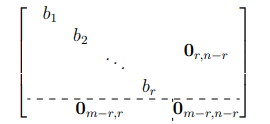
UAV
Let R be a Euclidean ring. Let A ∈ Mn(R). Then there are matrices U, V ∈ GLn(R) such that ___ is in Smith Normal Form.
R-module
an additive abelian group (M, +, 0) equipped with an operation
R × M → M, (r, m) → rm (scalar multiplication)
that satisfies the following properties:
1 · m = m for all m ∈ M
(r · s) · m = r · (s · m) for all r, s ∈ R and m ∈ M
(r + s) · m = r · m + s · m for all r, s ∈ R and m ∈ M
r · (m + n) = r · m + r · n for all r ∈ R and m, n ∈ M.
R-submodule
of M is a subgroup (N, +, 0) of (M, +, 0) that satisfies r · n ∈ N for all r ∈ R and n ∈ N.
Quotient module
M/N to be the set of cosets m + N with m ∈ M. Addition and scalar multiplication are given in the natural way
(m1 + N) + (m2 + N) = (m1 + m2) + N
r · (m + N) = rm + N
Homomorphism of R-modules
Let M, N be R-modules. A map ϕ : M → N is a _____ if
ϕ(m1 + m2) = ϕ(m1) + ϕ(m2)
ϕ(rm) = rϕ(m).
First Isomorphism Theorem (R-modules)
Let ϕ : M → N be a homomorphism of R-modules.
Ker(ϕ) is an R-submodule of M
Im(ϕ) is an R-submodule of N
The induced map ϕˆ : M/ Ker(ϕ) → Im(ϕ), ϕˆ(m + Ker(ϕ)) = ϕ(m) is an isomorphism of R-modules.
R-span
Let M be an R-module. Let X = {x1, . . . , xn} be a finite subset of M. We define the __ of X to be SpanR(X) = {r1x1 + · · · + rnxn : ri ∈ R} .
This the set of all linear combinations of elements of X with coefficients in R.

