Mgmt Exam 2
 Call Kai
 Learn
Learn Practice Test
 Spaced Repetition
 Match
Match Flashcards
 Knowt Play
1/127

There's no tags or description
Looks like no tags are added yet.
Name | Mastery | Learn | Test | Matching | Spaced | Call with Kai |
|---|
No analytics yet
Send a link to your students to track their progress
128 Terms
Information from the __________ and the _________ is how financial SUCCESS/LOSS is measured
income statement, balance sheet
Income Statement
______________: reports the net income for a specific time period, a tally of revenues and expense over a period of time
profit and loss statement (P&L)
Most ______ follows the same format as an Income Statement
budgets
****INCOME STATEMENT EQUATION
Net income = Revenues - Expenses
COST OF GOODS SOLD (COGS) formula
BI = beginning inventory
EI = ending inventory
P = purchases
COGS = BI + P - EI
Example calculating COGS
BI = $1,200,000
EI = $1,300,000
Purchases = $4,100,000
$4,000,000
GROSS MARGIN “Gross Profit” formula
GM = Sales - COGS
Gross Margin Percent (GM%) formula
GM% = GM / Sales
____________: reduction in the value of an asset over time
depreciation
________________ (Vertical Analysis): Revenues & expenses are converted to % of sales by dividing each revenue or expense by total sales
common size statement
BALANCE SHEET (3)
list Assets
list of liabilities
residual balance “owners equity”
“ACCOUNT EQUATION” formula
Assets = Liabilities + OE
Networth =
assets - liabilities
_________: measure of how fast assets can be converted to cash
liquidity
Which is more liquid? current or noncurrent assets
current
Which can depreciate? current or noncurrent assets
noncurrent
___________: debts due within 1 Year
current liabilities
____________:debts due after the current operating cycle (1 yr)
noncurrent liabilities
CURRENT ASSETS
_________ → currency, checking, certificate of deposits (CDs)
_________ → moneys owed to business
_________ → third party and credit, PBM, medicaid, in store credit, credit card
_________ → merchandise, drugs, OTC
_________
short term investments → _____, _______, etc
prepaid expenses → ______
cash
accounts receivable
sales
inventory
supplies
CDs, mutual funds
rent
NONCURRENT ASSETS
Items _________ by business → delivery truck, leasehold improvements, equipment
Intangible assets “goodwill” → 3
purchased for use
non-phys assets, patents, mgmt
CURRENT LIABILITIES
Accounts payable “________” → wholesaler bill, utility bills, etc
____________ notes payable
signed _________
portion of long term ________
accrued expenses →
bills you owe
current/short term
promissory notes
debt due in a year
employee wages
NONCURRENT LIABILITIES
Notes payable LONG TERM →
mortgages, auto loans, etc
Which of the following would you NOT need to calculate Net Income
A. Current Assets
B. Sales Revenue
C. Cost of Goods Sold
D. Employee Wages
A
(net income = revenues - expenses)
________: number of Rxs Dispensed per Day
Rx activity
TESTS OF PROFITABILITY
-
-
GM/GM%
NI/NI%
NET INCOME %
Formula =
Affected by gross margin and ______
Higher NI% →
Lower NI% →
TARGET FOR PHARMACIES: NI% ____
NI% = (NI x 100%) / sales
sales
higher GM%
higher expenses
>2%
Test of overall performance →
Target:
ROE = (NI/OE) x 100
>10%
Tests of liquidity (measures firms ability to pay current debts) →
Target: _____ but may be less for larger firms
If ___ then significant problem if small firm
current ratio = current assets/current liabilities
2-5
<1
Tests of Efficiency →
→
Targets
ARCP = (accounts receivable x 365)/annual credit sales
ITO = COGS / avg inventory at cost
ARCP <30 days, ITO 8-12+
To calculate ARCP, will need _________________ reported which is not standard reporting for some income statements
annual credit sales
INVENTORY TURNOVER
Generally, as ITO increases, GM% ______
Ideally you want to stock products that have …
dec
high ITO + high GM%
FACTORS INFLUENCING ITO → 4
+sales = +ITO
inventory on shelves
purchase -expensive inventory
selecting product mix
Used to evaluate location & building type of pharmacy, particularly useful for front end sales →
sales/sq foot
Misc tests of efficiency →
unit of input/output
Which of the following factors does NOT influence gross margin percent?
A. Pricing strategy
B. Cost of goods sold
C. Level of current liabilities
D. Shoplifting
C
(GM% = GM / Sales)
If sales are $3.0 million, cost of goods sold are $2.2 million dollars, and all other expenses are $0.7 million, what is the Net Income of this retail pharmacy?
A. $0.1 million
B. $0.8 million
C. $2.3 million
D. $3.0 million
E. $3.7 million
F. $5.9 million
A
If sales are $3.0 million, cost of goods sold are $2.2 million dollars, and all other expenses are $0.7 million, what is the Gross Margin of this retail pharmacy?
A. $0.1 million
B. $0.8 million
C. $2.3 million
D. $3.0 million
E. $3.7 million
F. $5.9 million
B
(GM = Sales - COGS)
Which is NOT a “Current Asset”?
A. merchandise
B. supplies
C. patents
D. moneys owed to the the Business (Accounts Receivable)
E. prepaid expenses
F. cash
C
CASH VS ACCRUAL ACCOUNTING
________ → recognizes revenues + expenses when cash is involved
________ → recognizes revenues + expenses when cash OR services are involved
Most common method is _______
cash
accrual
accrual
PRODUCT COST TERMINOLOGY
____________ → price that pharmacy pays wholesaler
actual acquisition cost (AAC)
PRODUCT COST TERMINOLOGY
____________ → list price for what drug wholesalers charge pharmacies
average wholesaler price (AWP)
PRODUCT COST TERMINOLOGY
_____________ → max cost third party will pay for drug
maximum allowable cost (MAC)
PRODUCT COST TERMINOLOGY
____________ → list price for what manufacturers charge drug wholesalers
wholesaler acquisition cost (WAC)
___________: the “fair share” of pharmacy costs over and above the cost of the drug
cost of dispensing
TYPES OF COSTS
__________: independent of Rx volume → example?
__________: only change with “large” changes in Rx volume → example?
__________: change as Rx volume changes → example?
__________: completely attributable to Rx department → example?
__________: shared btwn Rx department and rest of store → example?
fixed → pharmacy license
semi-fixed → pharmacist labor
variable → Rx vials
direct → Rx vials
indirect → rent
ALLOCATING INDIRECT COSTS
__________ → proportion of time/effort spent on Rx department → examples (4)
__________ → portion of pharmacy sq footage allocated to Rx department → examples (7)
__________ → proportion of sales coming from Rx sales (not including OTC) → examples (7)
effort ratio → pharmacist, tech, clerk, owner
area ratio → rent, utilities, real estate taxes, facility insurance, maint/cleaning, depreciation, mortgage interest
sales ratio → marketing, services, computer system, office supplies, other insurance, franchise fees, transaction/merchant
For each of the following expenses, determine:
-variable, semi-fixed, fixed
-direct or indirect
-IF INDIRECT, allocate to effort, area, or sales
clerk wages
account services
electricity
safe for controls
label printer
labels
cash register
bone density POCT machine
telephone
variable, indirect, effort
fixed, indirect, sales
fixed, indirect, area
fixed, direct
fixed, direct
variable, direct
fixed, indirect, sales
fixed, indirect, sales
fixed, indirect, area
CALCULATING AVERAGE COD PER RX
Step 1: Identify costs associated with Rx department →
Step 2: Sum all Rx department costs →
Step 3: cost of dispensing =
labor, direct, indirect
total expenses
Rx expenses / # of Rx dispensed
A list price for what pharmaceutical manufacturers charge drug wholesalers is known as:
A. Average acquisition cost (AvAC)
B. Average manufacturer price (AMP)
C. Average wholesaler price (AWP)
D. Estimated acquisition cost (EAC)
E. Wholesaler acquisition cost (WAC)
F. Actual acquisition cost (AAC)
E
Pharmacy labor is an example of a:
A. fixed cost
B. semi-fixed cost
C. variable cost
D. none of the above
B
In a typical pharmacy the highest cost considered in cost of dispensing is:
A. cost of goods sold
B. rent
C. utilities
D. wages and benefits
D
FORMULARY GUIDING PRINCIPLES → 5
safe
rational
evidence-based
clinically appropriate
cost-effective
GROUP PURCHASING ORGANIZATION (GPOs)
Hospitals join together to leverage _________ collectively
GPO allows for __________, lowers cost per unit
sole source vs generic purchasing →
buying power
+purchasing volume
GPO labeled product
PRIME VENDOR WHOLESALER
Advantages
More _____ delivery of orders
Less time creating _______ - standing/framework
Wholesaler _____
Simplified __________ process
Disadvantages
What if your prime vendor wholesale is __________?
Difficult to get a ________ wholesaler contract
timely
purchase orders
reports
credit & return
out of a medication
secondary
ORDERING MEDICATIONS
Pareto ABC Model
Aggregate value & volume into 3 groupings, ABC
Group A → (tight control)
Group B →
Group C →
*Focus on controlling ___________ inventory
10% items, 70% invent cost
20% items, 15% invent cost
70% items, 10% invent cost
most expensive
ORDERING MEDICATIONS
EOQ Model → Economic Order Quantity
An ___________ that optimizes your order quantity for demand & cost
Data used in this model include →
accounting formula
variable + fixed cost
ORDERING MEDICATIONS
PERPETUAL INVENTORY MODEL
*most popular
A fully _________ system where each dispensing action is subtracted from a perpetual inventory
Interfaced to pharmacy _______ system
Requires ___________ of the medication dispensed
computerized
ordering
accurate accounting
ORDERING MEDICATIONS
MANUAL/DEDICATED PERSONNEL MODEL
“_____________”
_________ process - bar coded shelves, bar code scanning devices, iphone/ipad applications
“Walking the shelves”
semi-automated
ORDERING MEDICATIONS
“REQUEST BOOK” MODEL
*least reliable
_________
requires participation by the ________
typical for non-formulary/______ requests
request list
entire staff
special
OTHER INVENTORY ISSUES/TERMS
_________ → controlled & monitored temp, space, special requirements for vaccines/drugs
_________ process
_________ meds
_________ products
_________ of pharmaceuticals
_________ compliance
_________
_________ levels = decreased inventory
_________ → ______ is better
drug ______
drug ______
storage
receiving
expired
SALAD
borrowing
340B
Drug supply chain security act
dec PAR (periodic automatic replenishment)
inventory turns → higher
recalls
shortages
OTHER INVENTORY ISSUES - NARCOTIC ORDER
Paper ordering - 222 form (_____ turn around)
can now order electronically - CSOS (_____ turn around, digital signature)
need secure _______
checks and balances for ______ prevention
72h
24h
storage
diversion
Pharmacy Budget Components → 3
revenue
expenses
capital expense requests & position requests
BUDGET PROCESS
Negotiation, review, and _____ of budget by finance budget committee
Presentation of ___________
_________ of budget and budget variance throughout the year
variance ____________ (good stewardship)
______ from variance and budget more accurately next year
approval
capital expense analysis
monitoring
analysis & reporting
learn
PHARMACY TECHNOLOGY: AUTOMATION
improved ________ efficiencies
enhanced ___________
cost ________
improving customer _______
compensate for staff __________
eliminate personnel ________ due to inefficiency
operating
pt safety
reductions
services
shortages
frustrations
______________: computer software designed to permit physicians and other practitioners to electronically transmit requests for patient care
computerized provider order entry (CPOE)
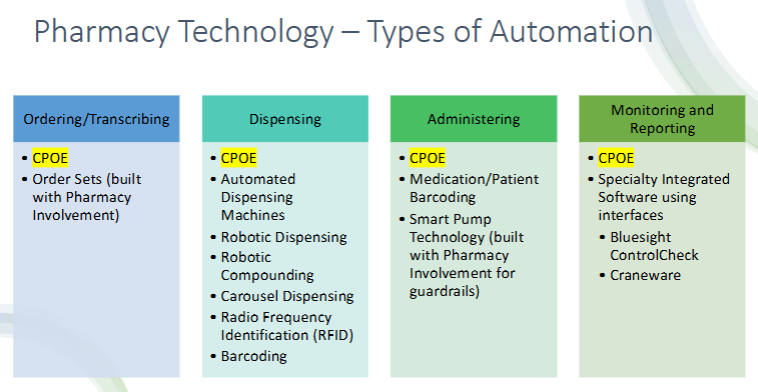
CPOE COMPONENTS
Patient-specific information is ________
________ tool which includes order sets, decision support systems, and follow-up care for better “transitions of care”
______ documentation → MAR, flow sheets
______ documentation areas → MedREc, provider visit data
Patient _________ and ______
consolidated
order entry
nursing
ancillary
charge capture, billing
2 types of CPOE systems
Integrated systems - combines components of order entry, pharmacy system, and pharmacy billing
Interfaced systems - communication btwn order entry software program and other software systems
Which is more used today? (new standard)
integrated
AUTOMATED DISPENSING MACHINES
Advantages
Puts medication at ________
Decrease or eliminate ______
Improved _________
Helps with nursing _______
Decreased ________ time
Perpetual inventory & _______ tracking
Disadvantages
_________
open access to certain medications (________)
medication in ____ pocket/lack of verification
increased ______
increased time checking for ________ supply
point of need
cart fills
narcotics control
availability
turnaround
expiration
expensive
matrix drawers
wrong
inventory
outdated
__________ dispensing can help increase inventory turns
carousel
RADIO FREQUENCY IDENTIFICATION (RFID)
Advantages
_______ process for product detection and accuracy checking
Can store ______, ______, and other information in RFID tag
Enables more accurate ______
Disadvantages
Tagging each dose by hand is _________
Tags can be _______
Passive RFID tags must be read with a ________
Active RFID tags are ______
automates
lot number, exp date
reporting
time consuming
expensive
sensor device
bulky
__________________ → inventory control system that automates dispensing and administration processes
“biggest bang for the buck” for safety
bar code medication administration (BCMA)
Which of the following are disadvantages of CPOE Integrated systems?
A. Minor changes can impact various aspects of the systems
B. Various computer languages are used
C. Drug Databases need to be maintained and updated consistently
D. A & B
E. A & C
F. All of the above
E
Which of the following is an advantage of Automated Dispensing Machines?
A. Increased inventory
B. Open access to medications
C. Decreased turnaround time
D. Inexpensive
C
Which of the following is NOT a medication ordering model?
A. Pareto ABC Model
B. Economic Order Quantity Model
C. Perpetual Inventory Model
D. None of the above
D
____________: “improving implementation of evidence-based practices (EBPs)”
implementation science
__________________: targeted spread of information
dissemination
____________: an effort specifically designed to get best practice findings and related products into routine and sustained use via appropriate uptake interventions
implementation
COMMON MEASURES IN IMPLEMENTATION RESEARCH:
____________ “counts and amounts” → raw count of delivery, rates of delivery
____________ “how well performed” → checklist, expert rating, etc
____________ “stick with it or dropped it?” → adoption & fidelity measures over time
If we are doing pilot/early work, then also look at … (3) → intervention and strategies
adoption
fidelity
sustainability
feasibility, acceptability, satisfaction
ERIC TAXONOMY OF IMPLEMENTATION STRATS
Train and educate _________
Provide __________
Support __________
Change __________
Utilize _______________
Engage __________
Develop _____________
_____________ to context
Use ________ and _______ strategies
stakeholders
interactive assistance
clinicians
infrastructure
financial strategies
consumers
stakeholder relationships
adapt & tailor
evaluative, iterative
PRACTICE TRANSFORMATION
Community-based pharmacies aspire to ________ their practices to care for people over time to meet health care system needs and their communities. Practice transformation is broadly defined as the implementation of _____________ in how a clinical practice operates to better achieve the quadruple aim.
transform, substantive changes
Outer context of implementation science in pharmacy → 3
laws/scope
politics
economics
Inner context of implementation science in pharmacy → 4
rel priority
local workflows
roles of staff
organizational structure
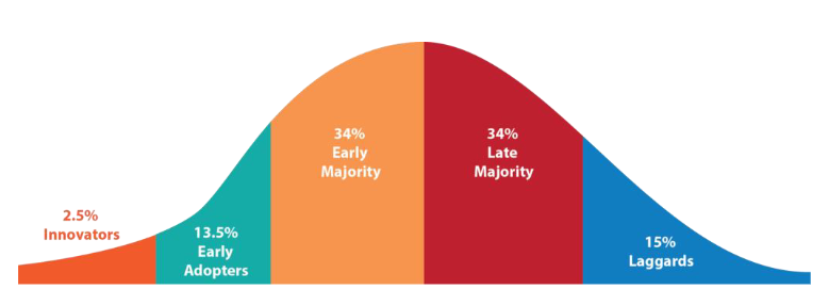
Change Management Model from the diffusion of innovations theory
The theory categorizes individuals/groups within a system based on their willilingness to adopt the change, following a normal distribution
Innovators →
Early adopters →
Early majority →
Late majority →
Laggards →
macro frame
1st to adopt
opinion leaders who help spread to the wider group
ppl who adopt before the avg
ppl who adopt only after majority does
last to adopt/resistant
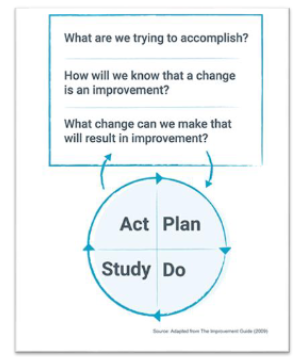
Change management model from the institute for healthcare improvement model for improvement
local frame
CONSIDERING INNOVATIONS LOCALLY
Pros →
Cons →
compatibility, simplicity, effectiveness
trialability, resources, cost
EXAMPLES OF PHARMACY TRANSFORMATIONS → 7
Flip the pharmacy
POCT
pharmacist prescribing & med billing
med sync
MTM workflow models
MTM implementation strategies
primary care collaboration
What is the largest pharmacy asset?
inventory
_____________: a financial statement that reports a company’s assets, liabilities, and shareholder’s equity (where inventory resides)
balance sheet
INVENTORY COSTS
acquisition →
procurement →
carrying →
stock-out/shortage →
paid for product
money spent to get the product to us
money spent to keep & maintain product
cost LOST
3 TYPES OF INVENTORY MANAGEMENT
Type → pros → cons
individually physically examine and compare what is on hand vs demand
similar to ^ but is performed on a specific interval (eg every Monday)
computerized
visual → cheaper, better for smaller pharm → error, all staff must know quantities
periodic → cheaper, 1-2 ppl → error, most time consuming, longer lag in ordering
perpetual → most common & efficient, real-time data, better for larger pharm → most $$$, software errors
Inventory turnover ratio (ITOR) =
COGS / avg invent at cost
average inventory =
(BI + EI) / 2
What does ITOR tell you?
how many times we sell out our inventory / year
PURCHASING OBJECTIVES → 5
right _____
product
quantity
time
price
vendor
3 TYPES OF STOCKS
____________: regulatory inventory required to fulfill orders
____________: additional inventory needed incase of supply or demand fluctuation
____________: inventory kept on hand because of unexpected future demand or unexpected price increases
cycle stock
buffer/safety stock
anticipatory/speculative stock
__________: the point where it’s reasonably certain that the item will be available on demand “reorder point”
stock depth
__________: the period of time allowed for taking discounts and the date when invoices become payable
dating
TYPES OF DISCOUNTS
__________ discounts: based on amount of product ordered, cumulative or noncumulative
__________ discounts: offered by suppliers for prompt payment
__________ discounts: occurs when multiple discounts are applied simultaneously
quantity
cash
serial
What does “2/10 ROG, net 30” mean?
2% discount
10 = w/in 10d after ROG
ROG = receipt of goods
net 30 = otherwise, must pay full amount within 30d after ROG
TYPES OF DATING
____________: collected before ordering or delivery
____________: no time period prior to discount or payment due date
____________: invoice is due at a later date
prepayment
collect on delivery
delayed or future

