externalities and public goods
 Studied by 0 people
 Call Kai
 Learn
Learn Practice Test
 Spaced Repetition
 Match
Match Flashcards
 Knowt Play
1/21

There's no tags or description
Looks like no tags are added yet.
Name | Mastery | Learn | Test | Matching | Spaced | Call with Kai |
|---|
No analytics yet
Send a link to your students to track their progress
22 Terms
externalities
an action affects bystanders but those effects aren’t priced
negative externality → too much activity
positive externality → too little activity
goal: make private optimal equal social optimal
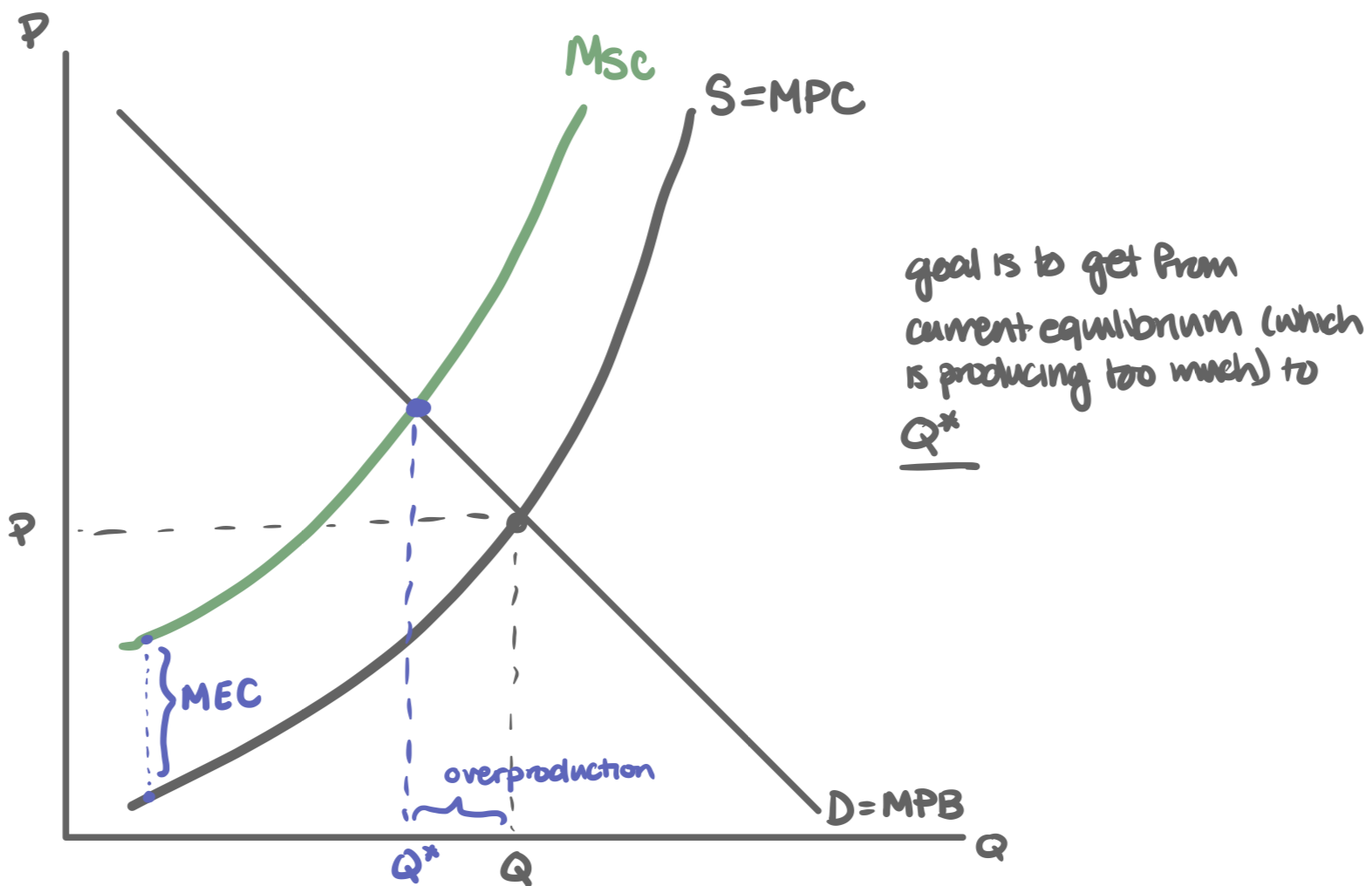
negative externality - costs
marginal private cost (MPC): my cost (supply)
marginal external cost (MEC): harm to others
marginal social cost (MSC) = MPC + MEC
marginal private benefit (MPB) = my benefit (demand)
market picks MPB = MPC → quantity too high if MEC > 0
negative externality graph
goal is to get from current equilibrium (which is producing too much) to Q*
positive externality - benefits
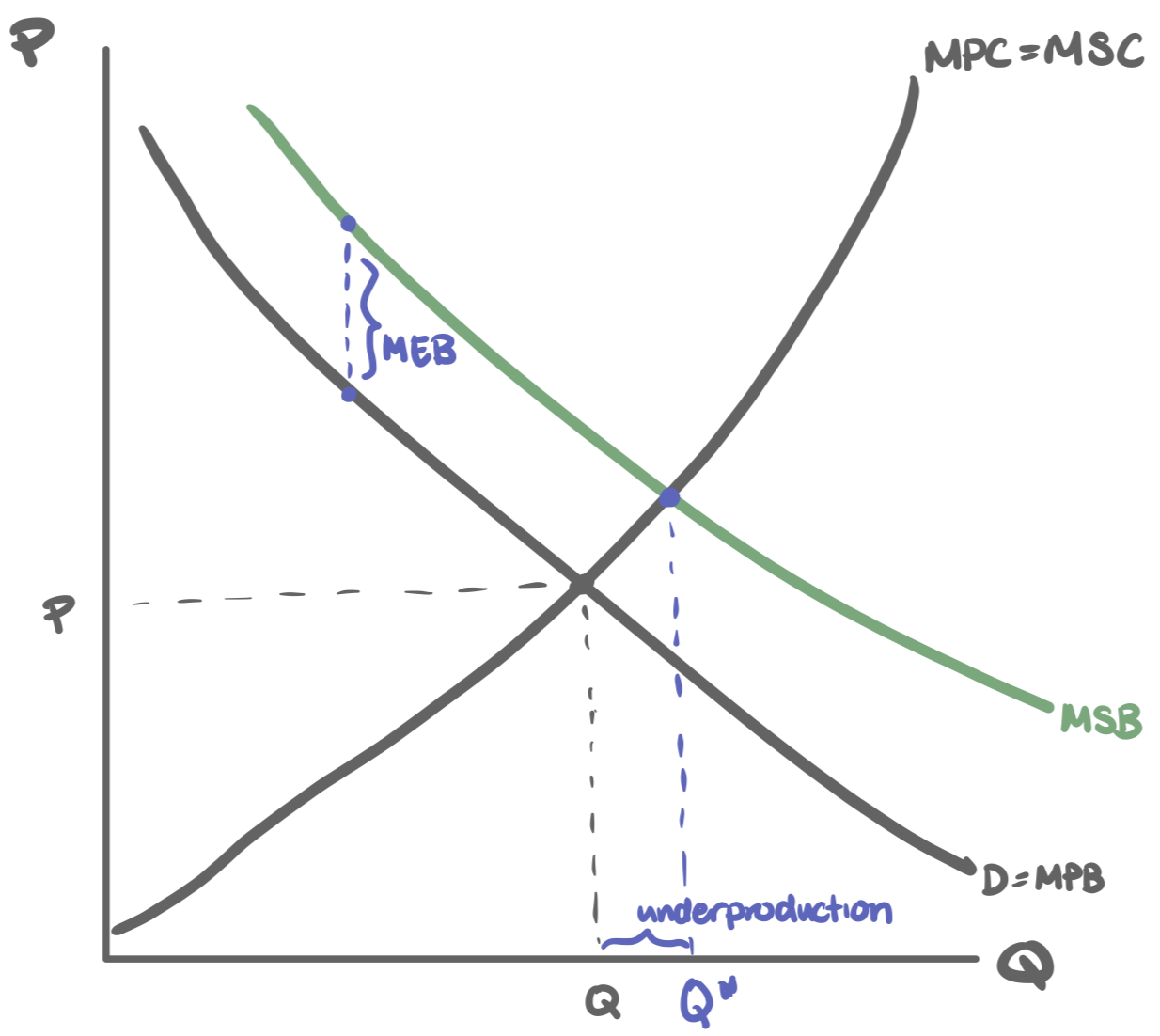
marginal private benefit (MPB): my benefit
marginal external benefit (MEB): benefit to others
marginal social benefit (MSB) = MPB + MEB
market picks MPB = MPC → quantity too low if MEB > 0
positive externality graph
goal is to get from current equilibrium (which is producing too little) to Q*
the Coase theorem
if property rights are clearly assigned and bargaining is costless, private negotiation between affected parties can lead to the socially efficient outcome, regardless of who holds the initial rights
implications:
with zero transaction costs, parties bargain to Q* → the allocation is efficient either way; the distribution (who pays/gets paid) depends on initial rights
when does bargaining work?
clear property rights, few parties, easy to find each other, low transaction & legal costs
common failures:
many parties = holdout/free-riding, high bargaining or enforcement costs, harms across borders or generations
Pigouvian taxes & subsidies
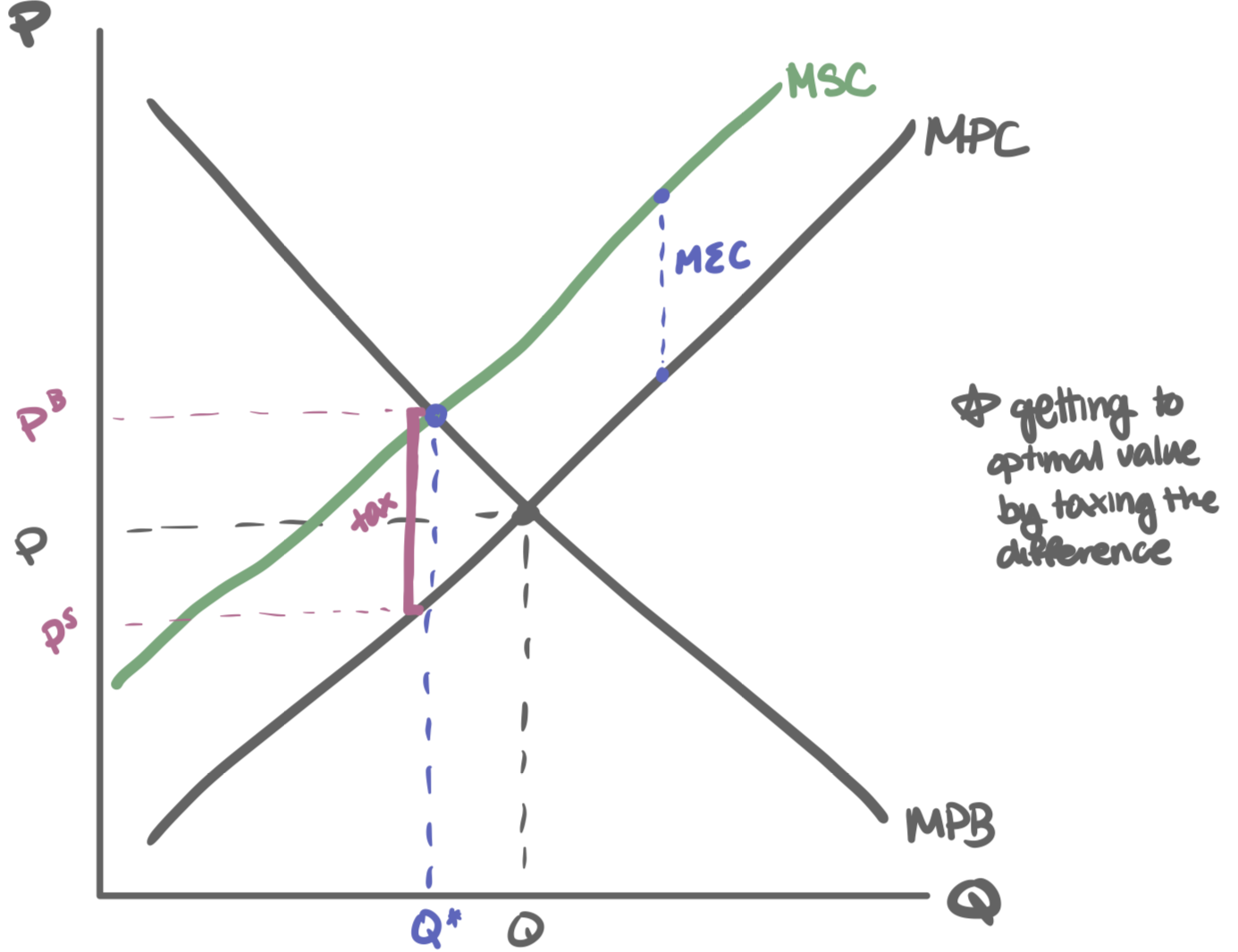
tax for negative externality to drop production
ex. carbon tax, trying to price up the item until it hits Q*
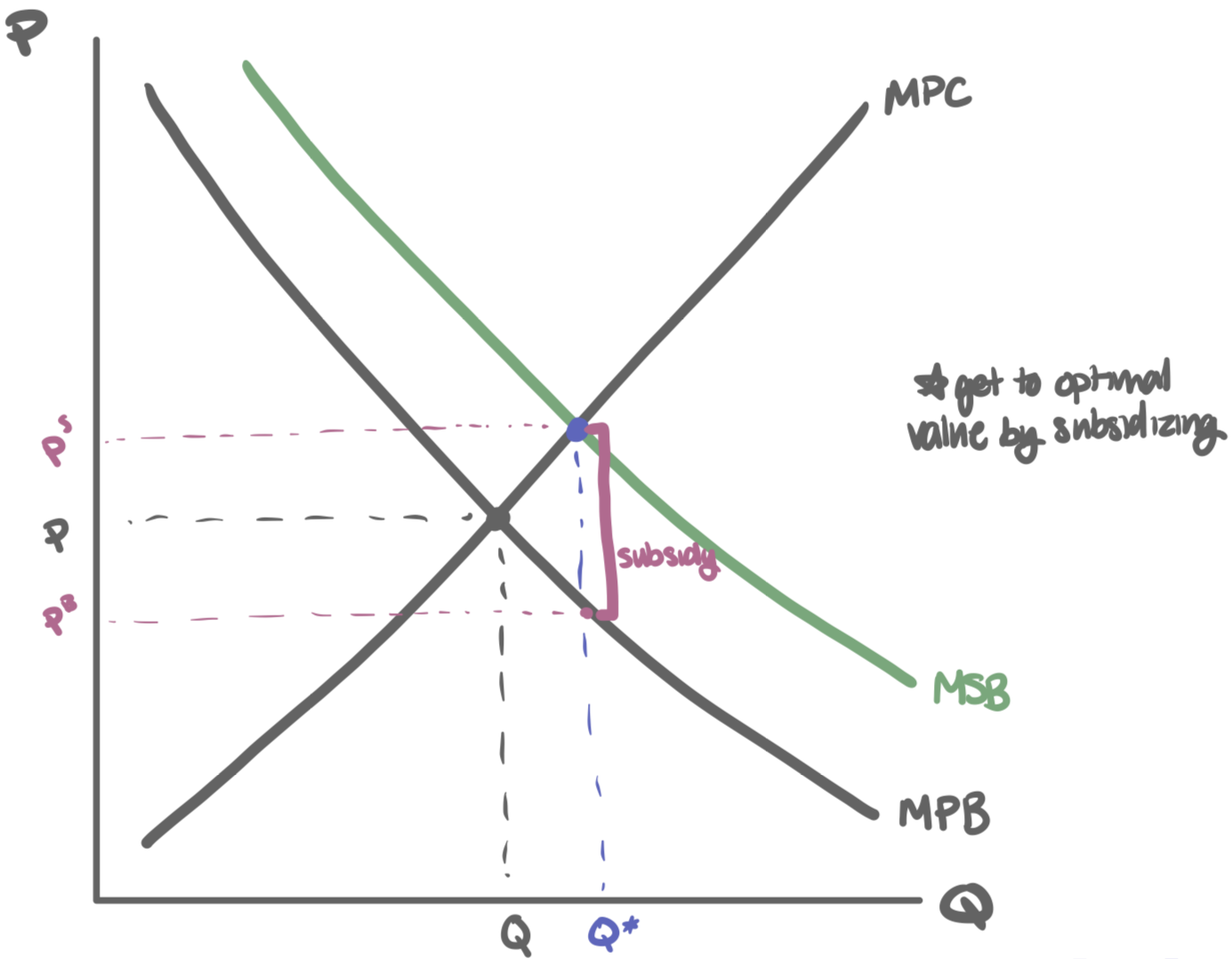
subsidy for positive externality to increase production
aligns private with social margin in order to hit Q*
negative externality tax graph
tax per unit = MEC at Q*
positive externality subsidy graph
subsidy per unit = MEB at Q*
how to pick between Coase & policy (ex. tax/sub)
Coase: few parties, clear rights, low frictions
policy (tax/sub, standards, cap): many/anonymous parties or high frictions
distribution vs efficiency: rights affect who pays; well-designed policy targets Q*
cap-and-trade definition
set total permits = Q* (the optimal quantity in the market)
firms can trade permits → establishes market + price
achieves Q* at the least cost, aka setting a quota for the good
cap = hard limit on total emissions/output → issue exactly Q* permits
each permit = legal right to emit 1 unit; firms must hold permits for emissions
trade = firms buy/sell permits; the permit price emerges in the market
cap-and-trade results
hit the target quantity Q*, with lowest-cost reducers cutting the most (cost-effective)
aka firms with low cutting costs have a financial incentive to invest in clean technologies and efficient practices to reduce emissions below their allocated cap → every extra ton of emissions they reduce can be converted into an allowance to sell for profit
cap-and-trade revenue allocation
depends on allocation of system:
auctions → government gets revenue by auctioning off permits to businesses, bid up prices
free allocation → no revenue, but permits get traded around
how to pick between tax & c&t
price certainty (tax): firms know t; quantity adjusts
good when damage per unit is stable
quantity certainty (cap): society fixes total Q; permit price adjusts
good when total quantity is critical
administration (aka $$): tax raises revenue automatically; cap can auction(revenue) or freely allocate (no revenue)
classifying goods:
excludable: feasible to prevent nonpayers from using it (e.g., paywall, turnstile)
nonexcludable: can’t feasibly keep nonpayers out (e.g., street lighting)
rival: one person’s use reduces what’s left for others (e.g., a sandwich)
nonrival: my use doesn’t diminish yours (e.g., a lecture recording)
kinds of goods
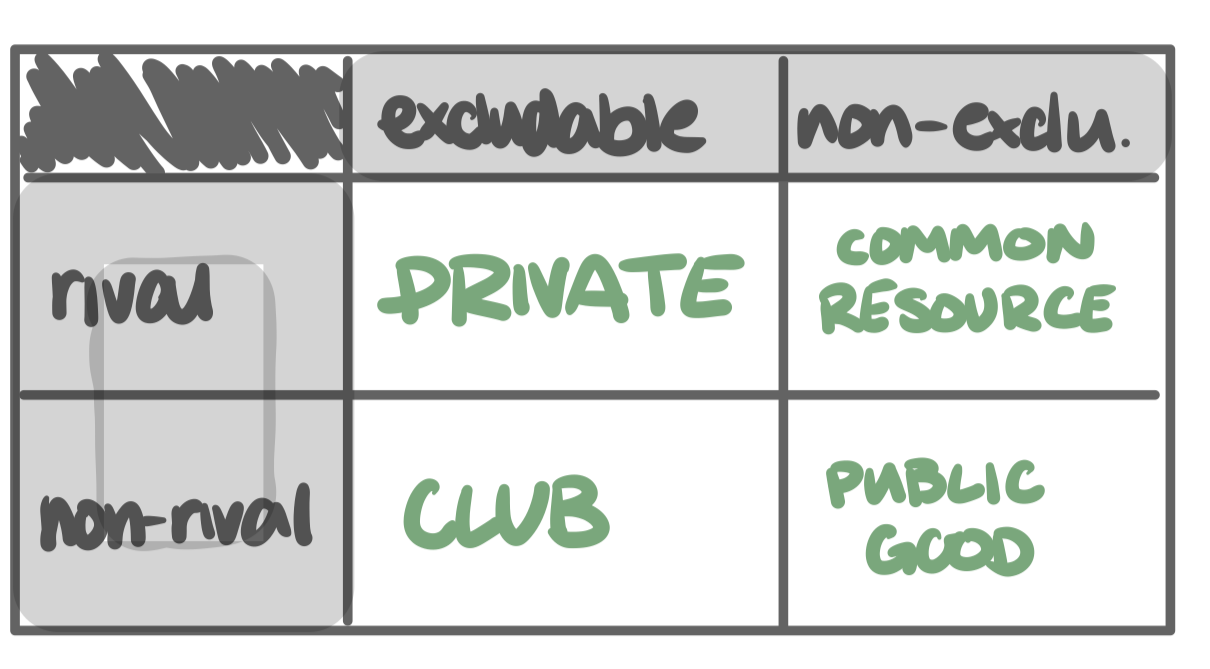
goods - private
rival, excludable
basically most goods we’ve talked about so far
goods - club
nonrival, excludable
ex. tennis membership where courts are always available
goods - common resource
rival, nonexcludable
leads to overuse! tragedy of the commons
ex. nonrenewable resources (fisheries)
fixes: quotas, access fees, tradable rights, property rights
basically, assign rights to fix this issue → incentivize people to conserve for future profits, make someone the residual claimant for the stock, etc.
ex. congestion/toll pricing, private owned fisheries, etc.
tragedy of the commons
overuse and depletion of resources without rules as common resources are private gains with shared costs
goods - public goods
nonrival, nonexcludable
leads to underproviding! due to free-riding
ex. national defense
fixes to underproviding issue: two part-tariffs, donations with matching, norms
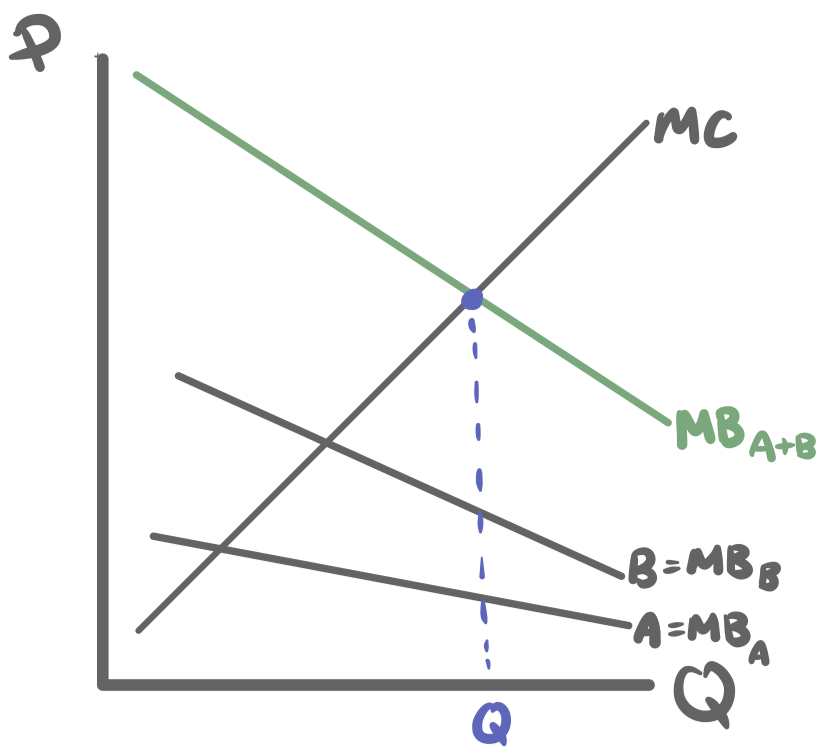
calculating marginal benefit (MB) of public goods
calculate the vertical sum of benefits across all users
works since person A using does not affect person B using
= marginal benefit of society as a whole
 Note
Note  Flashcards (46)