Topic C - Wave Behaviour
 Call Kai
 Learn
Learn Practice Test
 Spaced Repetition
 Match
Match Flashcards
 Knowt Play
1/78

There's no tags or description
Looks like no tags are added yet.
Name | Mastery | Learn | Test | Matching | Spaced | Call with Kai |
|---|
No analytics yet
Send a link to your students to track their progress
79 Terms
Define SMH
An oscillation in which the acceleration and resultant force is proportional to and in the opposite direction of the displacement.
Conditions for SHM
Must have a restoring force (force that acts towards the equilibrium position)
What is the defining equation of SHM
a = –ω2 x
Time period in terms of frequency of oscillation and angular frequency
T = 1/ƒ = 2π/ω
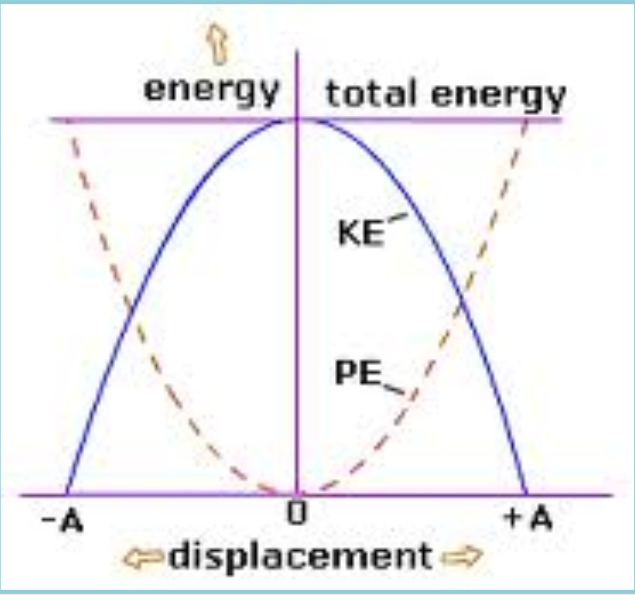
Describe the total energy displacement graph
Derive an equation for a using x and v
Differences between a standing and a travelling wave
A standing wave doesn’t transfer energy or matter whereas a travelling transfers energy but not matter and the positions of maximum and minimum amplitude travel through the medium.
Transverse wave
A travelling wave in which particles oscillate perpendicular to the direction of energy transfer.
Longitudinal wave
A travelling wave in which particles oscillate parallel to the direction of energy transfer.
Displacement
Distance of a particle from the equilibrium/rest position measured in metres.
Amplitude(x0 or A)
Maximum distance from equilibrium, measured in metres.
Wavelength
The shortest distance between two points that are in phase (points moving together).
Time Period
The time it takes for one complete oscillation, measured in seconds.
For a travelling wave this will be the time for a whole wave to pass a point.
For a standing wave its the time for one particle to complete a full cycle of movement.
Frequency
The number of oscillations in one second, measured in Hz
Mechanical waves properties and examples
A mechanical wave involves the movement of particles through a medium. A transverse mechanical would be water ripples, a longitudinal mechanical wave would be a sound wave.
Electromagnetic waves properties and examples
EM waves can travel through a vacuum or through a medium. Their is a pair of electric and magnetic fields oscillating as they propagate through space.
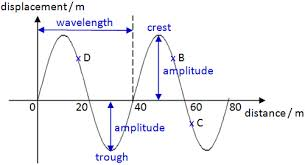
Displacement distance graphs characteristics
Represents the displacement of all particles in the wave at a given moment in time.
Can be used to determine the amplitude and wavelength
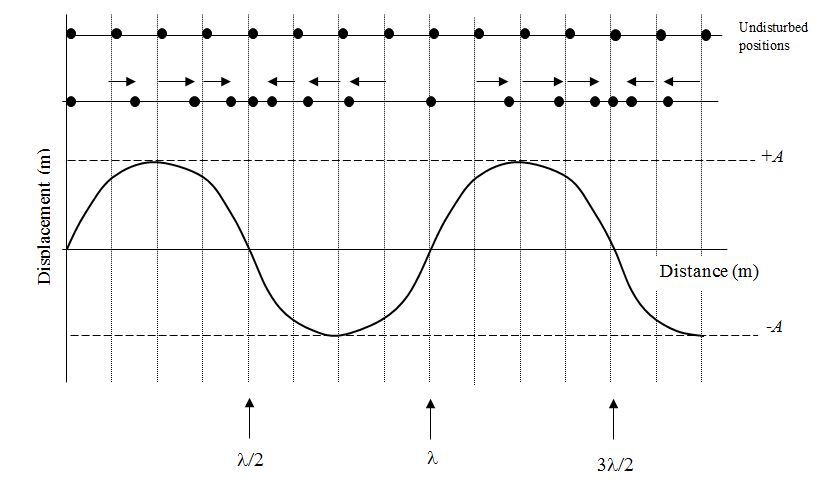
Displacement distance graphs of a longitudinal wave characteristics
Displacement to the right is positive and displacement to the left is negative.
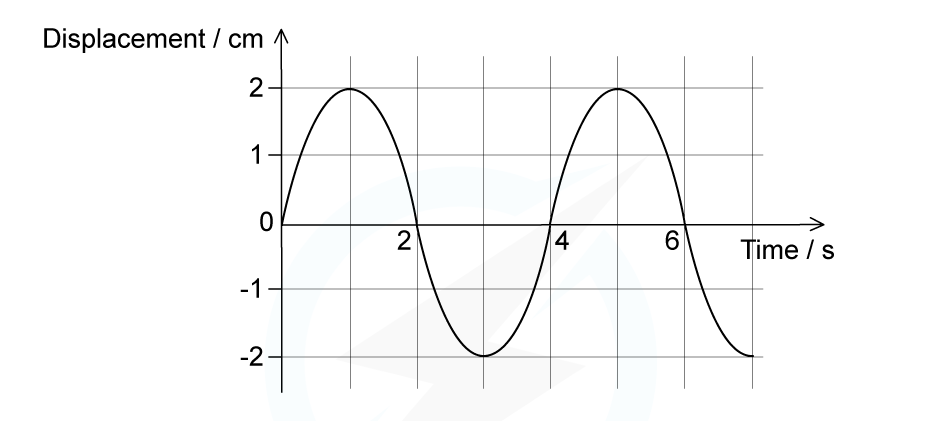
Displacement time graphs characteristics
Looks at one particle of the wave over a period of time.
We can measure amplitude and period (therefore frequency)
What is one full wave cycle in degrees and radians?
360 degrees and 2π radians.
What is the phase difference for waves that are in phase (in π) ?
The phase difference is any even multiple of π - 2π,4π,6π.
What is the phase difference for waves that are out of phase (in π) ?
The phase difference is any odd multiple of π - π, 3π, 5π.
What do EM waves consist of?
They consist of two fields oscillating perpendicularly to each other and the direction of energy transfer.
List the properties that all EM waves have.
Transverse waves
Can travel in a vacuum
Travel at 3×10⁸ in a vacuum
Transfer energy from a source to absorber
List the difference in EM waves.
Frequency and energy increase from Radio waves to Gamma radiation.
The regions between each wave is very broad so there is an overlap of wavelengths.
They can arise from accelerated electrons or when charged particles change energy levels.
The sources of different radiation e.g. x- rays coming from outside the nucleus and gamma rays coming from inside the nucleus.
What effect does damping have on resonance?
Damping reduces:
The frequency of which resonance occurs
The amplitude of the oscillation at resonance
The sharpness of the graph
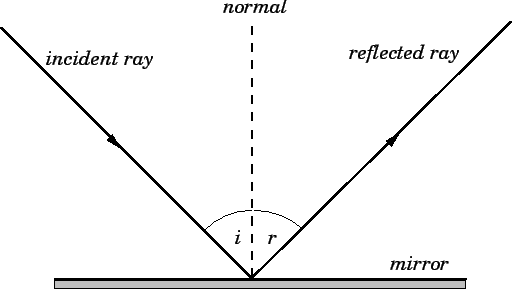
State the Law of Reflection
When a wave is reflected the incident angle is equal to the angle of reflection.
What do wave fronts show?
They show the parts of waves that are in phase with each other.
How wavelengths change across mediums.
Change in direction.(Rays also show this)
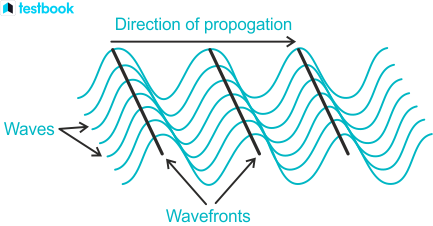
What are perpendicular to wave fronts and what do they show.
Rays are perpendicular to wave fronts and show direction of energy transfer.
What is a point source?
A source that emits waves in all directions.
When does wave speed change?
When:
The mass per unit length of a rope changes
The optical density of a transparent substance changes
The depth of water changes
What happens when a wave enters a medium with a lower wave speed?
The ray bends towards the normal.
What happens when a wave enters a medium with a higher wave speed?
The ray bends away from the normal.
Define refraction.
The change in wavelength, speed and direction of a wave as it passes through a new medium.
Define the index of refraction. What is the formula?
The Index of Refraction is the ratio of the speed of light in a vacuum to the speed of light in a medium.
n1 = c/v1
Define Snell’s Law. What is the formula ?
The relationship between the incident angle, refracted angle and speed of wave.
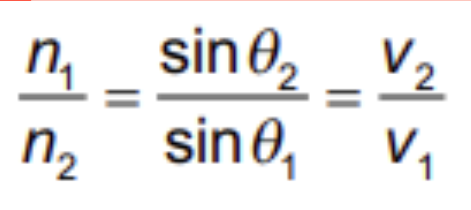
What happens when light enters a less optically dense medium?
The refracted angle is greater than the incident angle.
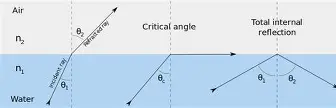
What is the critical angle and what happens when the angle is beyond this?
The angle at which the light is refracted along the boundary (i.e. r = 90). Any angle beyond this will result in total internal reflection.
What is the principle of superposition?
When two or more waves cross, the resultant displacement equals the vector sum of the waves.
Interference
The result of superposition of two or more values.
Constructive Interference
When two waves meet to make a larger displacement. If a crest and a crest meet or two waves are in phase then constructive interference occurs.
Destructive Interference
When two waves meet to make a smaller displacement. If a crest and a trough meet or two waves are out of phase then destructive interference occurs.
When are two waves said to be coherent?
If they have a constant phase difference between them. They also need to have the same wave speed, frequency and wavelength.
What is diffraction?
It is the spreading out of waves when they pass through a gap —> aperture/slit or around an obstacle .
Diffraction is greatest when the wavelength is comparable to the width of the slit.
What is Young’s Double Slit Experiment?
Two slits act as two coherent sources.
Curved wave fronts now overlap and interference occurs.
An interference pattern is produced on the screen with equally spaced bright and dark fringes.
When is a bright fringe produced?
When the rays arrive in phase - constructive interference.
When is a dark fringe produced?
When the rays arrive out of phase - destructive interference.
Two source inteference formula

What is Huygens Principle?
Huygens Described a wave front as a sum of multiple tiny wavelets created by each point in a medium.
The wave front of a travelling wave consists of circular wavelets created by every point on the previous wave front.
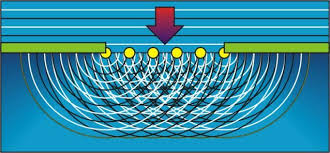
Single Slit Diffraction
A wave will diffract through a single slit
The greatest diffraction will happen when the wavelength is equal to the slit.
From Huygens Principle, each point on the wave can act as its own point source of wave.
Each point of the wave can interfere and superpose with another point on the same wave.
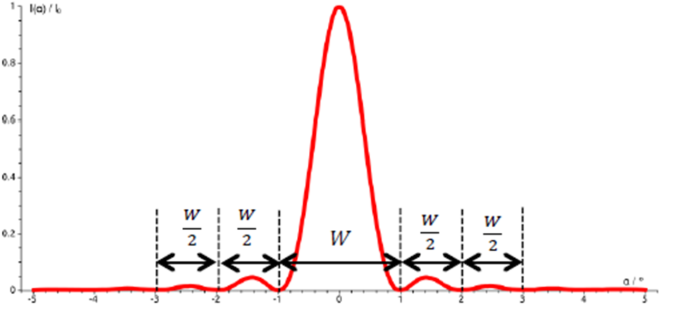
Compare the central maximum and the secondary maxima in the intensity angle graph.
Central maximum is double the width of the secondary maxima on either side.
And secondary maxima greatly reduce in intensity.
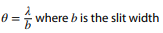
What is the single slit equation?
Multiple slit diffraction
The slit must be small therefore the single slit envelope gets very wide.
The slit spacing must be small therefore the primary maxima are spread out.
Many slits means many infinitesimally small secondary fringes
Primary fringes narrow and brighten
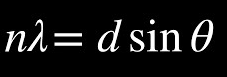
Multiple slit diffraction equation
Why is there no maximum in a double slit?
Double slit has a maximum that constructively interferes.
The single slit will have a minimum that destructively interferes.
The double slit pattern is modulated by the single slit.

How do you work out the number of secondary maxima and what happens when the number of slits increases?
N - 2 where N is the number of slits
Intensity of primary maxima increases
Primary maxima become sharper (narrower)
The secondary maxima become less bright
What do diffraction gratings do?
A diffraction grating contains many parallel slits,(typically hundreds of slits per mm.)
The grating produces bright maxima at discrete points on the screen.
How is a standing wave formed?
When two coherent waves with the same amplitude, travelling in opposite directions, interfere with each other and superposition occurs, forming a standing wave.
What happens to a wave when it is reflects off a fixed/closed end?
The wave become inverted and out of phase by π.
What happens to a wave when it is reflects off a free/open end?
The wave has the same orientation and is in phase with the incident wave.
Does an open end form an antinode or node?
They will always form antinodes.
Does a closed end form an antinode or node?
They will always form nodes.
Nodes
A point on a wave that doesn’t move.
Antinodes
A point on a wave that has the maximum displacement.
What does the harmonic number refer to in closed closed end?
The number of anti-nodes.
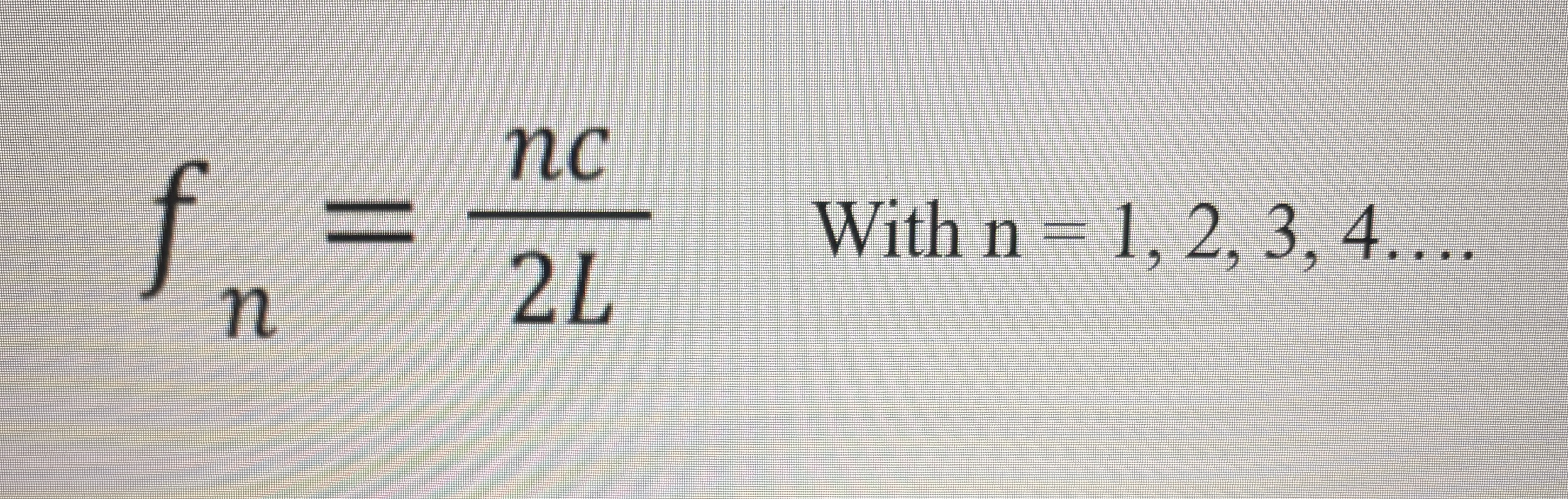
For two closed or open ends what is the frequency formula?
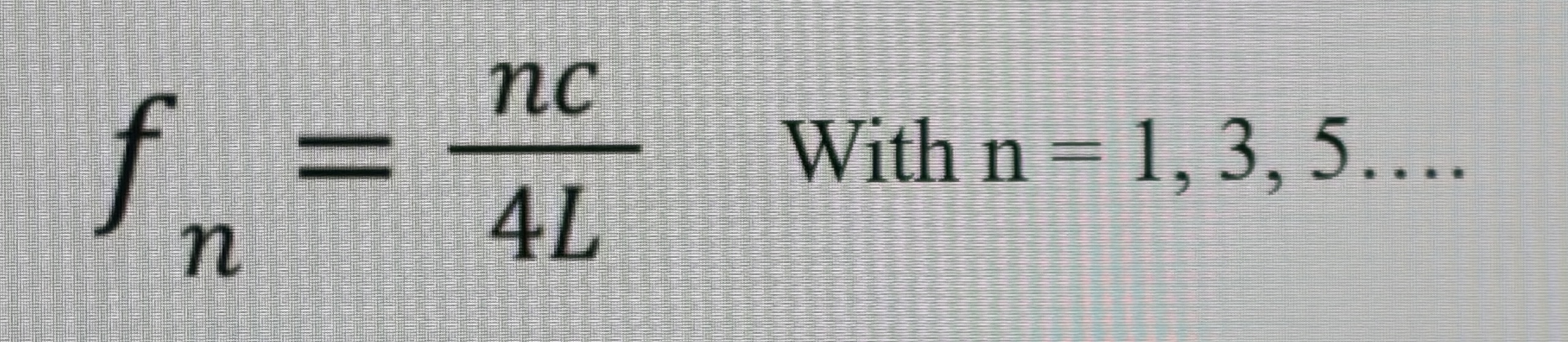
For one closed and one open end what is the frequency formula?
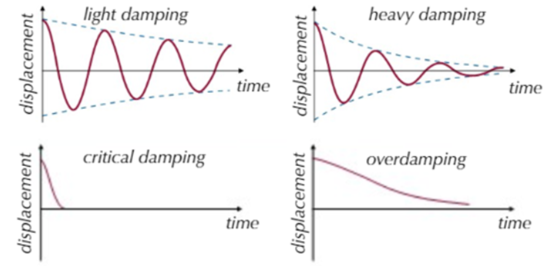
What does light, heavy, over and critical damping do?
Light damping gradually reduces the amplitude of the oscillation without changing the time period
Heavy damping reduces the amplitude to a greater degree than light damping.
Over damping causes the displaced object to return very slowly to its equilibrium position
Critical damping causes the displaced object to return to its equilibrium position in the shortest time possible.
Natural frequency
The frequency an object vibrates at freely after an initial disturbance
How can you force an object to vibrate?
By a periodic driving force
Frequency of this force is called the driving force.
This can happen when pushing someone on a swing
Resonance
When the driving frequency matches the natural frerquency of the system then a maximum amplitude is achieved.
What effect does damping have on resonance?
Damping reduces:
The frequency of which resonance occurs
The amplitude of the oscillation at resonance
The sharpness of the graph
What is the Doppler Effect?
The apparent change in frequency of a wave due to relative motion between the source and the observer.
Draw the wavefronts for the Doppler Effect when the source is moving towards the observer
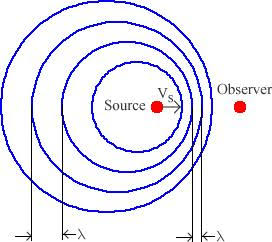
Draw the wavefronts for the Doppler Effect when the observer is moving towards the source
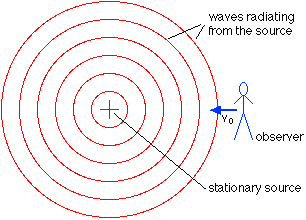
What happens to the wavelength and frequency when the source is moving?
The wavelength and frequency changes (moving towards the observer increases frequency etc.).
What happens to the wavelength and frequency when the observer is moving?
The wavelength doesn’t change but the observed frequency and apparent wave speed changes (moving closer to the source increases frequency etc.).
What is the formula for the observed frequency for a source moving towards you and a source moving away from you?
f′ = f(v/v-us) for a source moving towards you
f′ = f(v/v+us) for a source moving away from you
What is the formula for the observed frequency for an observer moving towards a source and the observer moving away from the source?
f′ = f(v+uo/v) for an observer moving towards the source.
f′ = f(v-uo/v) for an observer moving away from the source.
Explore top notes

Explore top flashcards
