3.2.2 All Cells Arise From Other Cells
 Call Kai
 Learn
Learn Practice Test
 Spaced Repetition
 Match
Match Flashcards
 Knowt Play
1/12

There's no tags or description
Looks like no tags are added yet.
Name | Mastery | Learn | Test | Matching | Spaced | Call with Kai |
|---|
No analytics yet
Send a link to your students to track their progress
13 Terms
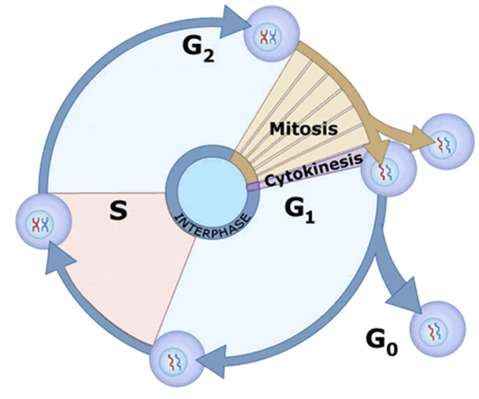
cell cycle
1) mitotic phase - mitosis and cytokinesis
2) G1 phase - cellular contents (excluding the chromosomes) are duplicated
3) S phase - each of the 46 chromosomes are duplicated
4) G2 phase - the cell ‘double checks’ duplicated chromosomes for error, making any needed repairs
mitosis stages -interphase
DNA replication, cell growth, organelles duplicate
-prophase
chromosomes condense and become visible, centrioles migrate to poles, spindle fibres develop, nuclear envelope breaks down and nucleolus disappears, chromosomes appear as 2 chromatids joined at centromere
metaphase
chromosomes attach to spindle fibres at centromere, chromosomes line up along the equator because the spindle fibres shorten
anaphase
centromeres divide, sister chromatids are pulled to opposite poles by spindle fibres - will be V-shaped as being pulled apart at centromeres
telophase
chromosomes unwind/decondense, nuclear envelope reforms, spindle fibres disintegrate
cytokinesis
cytoplasm splits to create 2 separate cells, cell membrane is pulled inwards creating a furrow which deepens and fuses to form 2 individual cells
cell cycle graph
-mass of DNA doubles during interphase
-then when mitosis occurs, mass of DNA halves
-then cell cycle repeats
how is cytokinesis different in plants?
vesicles form membrane structures down the centre of the cell then fuse together to form 2 individual cells
mitotic index formula
number of cells in mitosis / total number of cells in field of view (x 100)
cancer + treatment of it
uncontrollable division of abnormal cells lead to tumours (benign and malignant)
treatment - block part of cell cycle, 1) prevent DNA replication, 2) inhibit metaphase by interfering with spindle formation
binary fission
-in prokaryotic cells
1) circular DNA and plasmids replicate
2) cytoplasm divides to produce 2 daughter cells
3) each daughter cell has a single identical copy of circular DNA and a variable number of copies of plasmids
viral replication
-cannot undergo cell division and replicate using host cells
1) attachment proteins attach to receptors
2) virus injects nucleotides
3) host cell replicates the nucleic acid
4) host cell produces viral components
5) virus is assembled and replicated

