AP Micro Monopolistic Competition & Oligopoly
 Call Kai
 Learn
Learn Practice Test
 Spaced Repetition
 Match
Match Flashcards
 Knowt Play
1/42

There's no tags or description
Looks like no tags are added yet.
Name | Mastery | Learn | Test | Matching | Spaced | Call with Kai |
|---|
No analytics yet
Send a link to your students to track their progress
43 Terms
many
in monopolistic competition, there are ______ sellers
free, low
in monopolistic competition, there is ________ entry and barriers are _______
downward sloping demand curve
in monopolistic competition each seller may set its own price for its own production, so it has a
unsustainable
in monopolistic competition, economic profits are ___________ in the long-run
allocative, productive
Neither __________ or ____________ efficiency will be achieved in the long-run in monopolistic competition
closer
monopolistic competition is ____________ to perfect competition than monopoly
oligopoly
few sellers, not always aggressive competition, 2nd most common market structure in the US
product differentiation
physical aspects (unbreakable bottle, nonstick surface, non-shrink, extra spicy), etc.
Location (gas station on a heavily travelled corner)
Intangible aspects (satisfaction guaranteed, reputation, services like free delivery)
between, elastic
for monopolistically competitive goods, a firm perceives a demand for its goods that is ________ monopoly and perfect competition, and since there are substitutes, the demand curve facing a monopolistically competitive firm is more _________ than that of a monopoly
perfectly competitive firm, monopoly
if a monopolistic competitor raises its prices, it will not lose as many customers as would a _______________, but it will lose more customers than a ___________ would
monopolistic competition demand curve
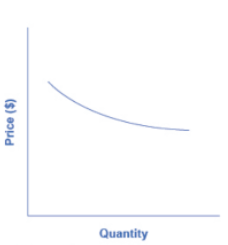
monopolistic competition in the short run
the firm should be able to earn profits in the short run
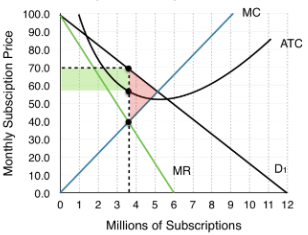
MR=MC
How are prices and profits determined in monopolistic competition in the short run?
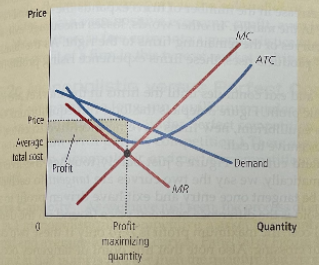
firm makes a profit
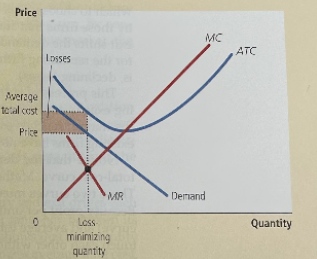
firm makes a loss
long run, zero economic profit
monopolistic competitors can make an economic profit or loss in the short run, but in the ________, entry and exit will drive these firms towards a _______________ outcome
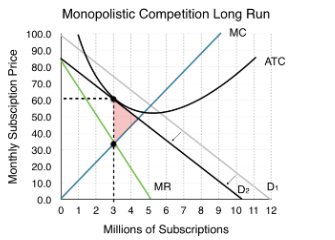
monopolistic competition long run
profits will be eliminated when new firms enter the market, demand for the original firm will decrease, the firm will produce decreased Q at a lower price, ATC = P (zero economic profits), at the profit-maximizing quantity, there are zero economic profits, demand is always tangent to ATC in the long run
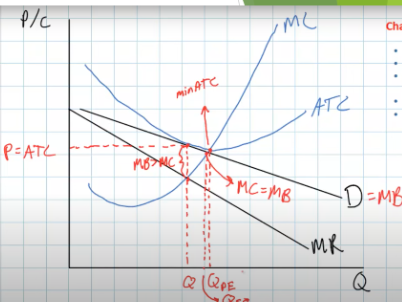
not productively efficient
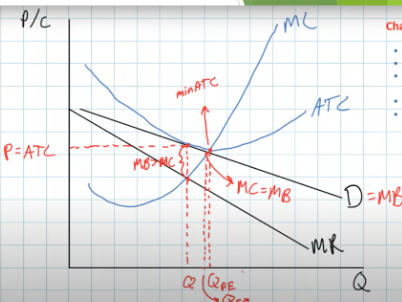
not allocatively efficient
economies of scale
in the long run, monopolistic competition produces in a region where ____________________ exist (declining portion of long-run ATC)
excess
both monopolies and monopolistic competition have ________ capacity in the long run, ATC is not minimized, so it has this
less
the allocative efficiency of a monopolistically competitive firm will be _____ than with a monopoly (price (or MB or demand) = MC)
lower, higher
the monopolistically competitive firm will produce a ________ quantity of a good and charge a ________ price than in perfect competition
does not
a monopolistically competitive firm _______ have productive or allocative efficiency in the short run (making economic profits & losses) OR in the long run (zero profits)
advertising
stresses how one firm’s products differ from others in the same market
inelastic
advertising causes a firm’s perceived demand curve to become more ________
increase (shift to the right)
advertising causes demand to __________
collusion
firms act together like a monopoly which holds down industry output, charges a higher price, divides profit among themselves
cartel
a group of firms that have a formal agreement to collude to produce the monopoly output and sell at the monopoly price
cheat
cartels are difficult to maintain because members have incentive to
game theory
a branch of mathematics that analyzes situations in which players must make decisions and then receive payoffs based on what other players decide to do
the prisoner’s dilemma
shows the gains from cooperation are larger than the rewards from pursuing self-interest
nash equilbirium
a stable state of a system that involves several interacting participants in which no participant can gain by a change of strategy as long as all the other participants remain unchanged
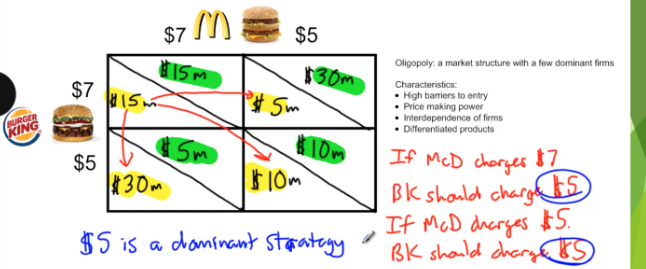
dominant strategy
a strategy that is the best choice no matter what the other player does, it gives a higher payoff in every possible scenario, and a player can choose it without worrying about predicting the other player
interdependence
oligopolies recognize their mutual
joint profit
because oligopolies pursue their own self-interest, they do not end up reaching the monopoly outcome and maximize their
raise production, larger
each oligopolist is tempted to _________ and capture a _________ market share, but as each of them does this, total production rises and price falls
less, greater
oligopoly price is ____ than the monopoly price but _______ than the price in perfect competition (which equals MC)
if the only two firms in an industry successfully collude, the price of the product will be above the MC of production (on demand curve)
price war
a competitive exchange among rival companies who lower the price points on their products in a strategic attempt to undercut one another and capture greater market share - may be used to increase revenue in the short term, or it may be employed as a longer-term strategy
rival firms
will match price decreases but not match price increases
price leadership
occurs when a leading firm exerts enough influence in the market that it can effectively determine the price of goods or services, common in oligopolies, rivals often have to follow the price leader if they want to hold on to their market share
monopolistic competition
television is generally
Explore top notes

